
Practical Guide to AI Agent Implementation for Enterprises
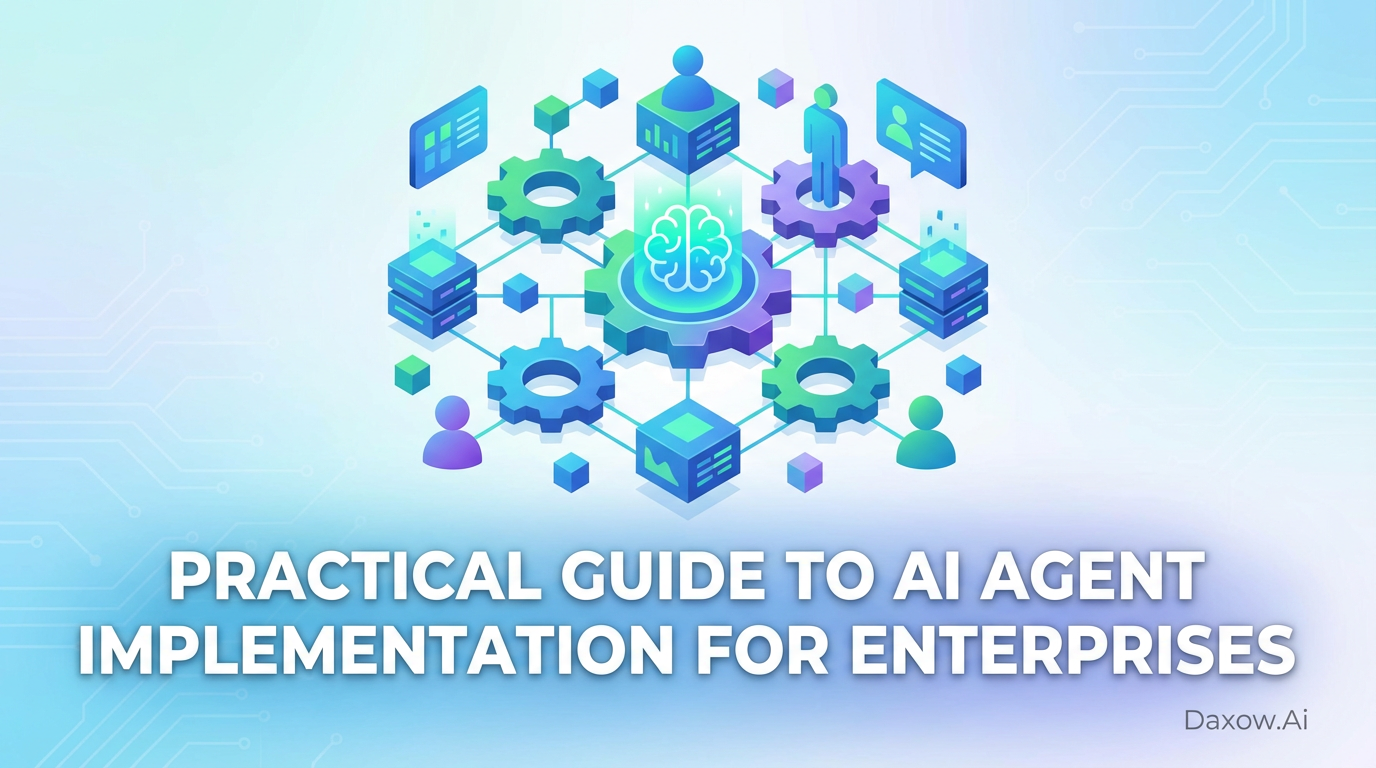
Plan, design, and scale AI agents to automate enterprise workflows, reduce manual work, and prove ROI with practical steps, use cases, and Daxow.ai services.
AI agent implementation for enterprise automation — A practical guide to workflow automation and productivity gains
Estimated reading time: 15 minutes
Key Takeaways
- AI agents automate end-to-end business workflows, improving productivity and reducing manual work.
- Successful implementation follows a phased approach: discovery, prototyping, deployment, and continuous improvement.
- Use cases span multiple industries including technology, e-commerce, finance, healthcare, real estate, and HR.
- Measuring ROI involves cost savings, revenue impact, operational risk reduction, and scalability benefits.
- Daxow.ai offers expert services for custom AI agent development, integration, and ongoing optimization.
Table of Contents
- AI agent implementation for enterprise automation: Why it matters
- How AI agents enable workflow automation and business automation
- Use cases across industries — practical examples
- Designing an AI agent program — end-to-end approach
- Implementation roadmap — practical steps for decision-makers
- Measuring ROI and demonstrating business value
- Common pitfalls and best practices
- How Daxow.ai helps with AI agent implementation for enterprise automation
- Getting started — recommended next steps
- Frequently Asked Questions
AI agent implementation for enterprise automation: Why it matters
AI agents combine decision-making, integration, and task execution capabilities to automate end-to-end business processes. Unlike point solutions, AI agents can orchestrate multiple systems, handle exceptions, and learn from interactions — creating scalable workflow automation that delivers continuous value.
Key drivers:
- Reduce manual tasks across back-office and customer-facing functions.
- Increase productivity by delegating repetitive work to autonomous agents.
- Improve customer support automation with consistent, 24/7 responses.
- Accelerate sales automation through intelligent lead qualification and follow-up.
- Lower operational costs while improving compliance and accuracy.
Market context and expected impact
- Enterprises report faster response times, lower error rates, and improved employee satisfaction after deploying AI agents.
- Common targets for automation include invoice processing, customer triage, lead routing, HR onboarding, and claims processing.
- Leading organizations treat AI agents as programmable staff — measurable by throughput, cycle time, and customer satisfaction.
How AI agents enable workflow automation and business automation
AI agents are built from modular capabilities: language understanding, decision logic, connectors to systems (CRMs, ERPs), and task execution tools (email, ticketing, RPA). When combined, these create unified automation workflows.
Core components:
- Intelligence layer: LLMs and domain models for intent detection, summarization, and recommendations.
- Orchestration: Rules and planners that sequence tasks, trigger actions, and escalate exceptions.
- Integration layer: API connectors, database access, and event listeners for CRMs, support platforms, and productivity tools.
- Execution layer: Action modules (send email, update record, generate document) and RPA bots for legacy systems.
- Monitoring & feedback: Telemetry, human-in-the-loop interfaces, and retraining pipelines.
Example workflow (lead qualification + handoff)
- Lead arrives via web form or email.
- AI agent extracts details, enriches contact data, and scores lead automatically.
- If score high, agent schedules a demo and notifies salesperson; if low, agent enrolls lead in nurture sequence.
- All actions are logged in CRM; agent reports daily pipeline updates.
Use cases across industries — practical examples
Technology & SaaS
Use case: Automated trial onboarding and expansion.
How it works: AI agents analyze user behavior, send contextual guidance, and trigger in-app messages; high-value prospects are routed to account executives.
Value: Faster time-to-value, higher conversion from trial to paid, reduced manual outreach.
E-commerce & Retail
Use case: Post-purchase customer support automation.
How it works: AI agents process returns, generate labels, update inventory, and provide shipping updates.
Value: Lower support costs, improved NPS, faster incident resolution.
Finance & Insurance
Use case: Claims intake and triage.
How it works: AI agents extract data from documents, validate claims against policy rules, and route complex cases to adjusters.
Value: Reduced claim cycle times, lower false positives, improved fraud detection.
Healthcare
Use case: Patient intake and scheduling.
How it works: AI agents collect intake forms, verify insurance eligibility, and schedule appointments with reminders.
Value: Reduced administrative burden for clinicians, fewer no-shows, improved patient experience.
Real Estate
Use case: Listing intake and lead nurturing.
How it works: AI agents scrape listing data, create property briefs, and qualify buyer leads based on preferences.
Value: Faster listings live, better lead-to-showing conversion, streamlined agent workflows.
HR & Admin
Use case: Employee onboarding and document automation.
How it works: AI agents collect required documents, pre-fill forms, and coordinate access provisioning.
Value: Faster onboarding, fewer errors, improved compliance.
Designing an AI agent program — end-to-end approach
Phase 1 — Process discovery and value mapping
- Map current workflows and identify high-volume, repetitive tasks.
- Quantify pain points: time spent, error rates, cycle times, and costs.
- Prioritize use cases by impact and feasibility.
- Deliverable: Value roadmap with prioritized automation opportunities.
Phase 2 — Solution architecture and prototype
- Define agent responsibilities and success metrics.
- Design integrations with CRM, ticketing, ERP, and databases.
- Build a prototype (MVP) handling core tasks with human-in-the-loop controls.
- Deliverable: Working prototype and integration plan.
Phase 3 — Iteration and production deployment
- Scale connectors and harden security, compliance, and auditability.
- Establish monitoring and retraining processes for AI components.
- Roll out in waves to manage change and measure impact.
- Deliverable: Production-grade AI agents with dashboards and SLAs.
Phase 4 — Continuous improvement
- Collect performance data and user feedback.
- Optimize models and business rules.
- Expand scope to adjacent processes and cross-functional orchestration.
- Deliverable: Roadmap for incremental automation and ROI growth.
Implementation roadmap — practical steps for decision-makers
Implementing AI agent initiatives requires coordination across IT, operations, and business stakeholders.
Step-by-step:
- Set clear objectives: e.g., reduce manual tasks by X hours/month, reduce resolution time by Y%.
- Establish governance: data privacy, access control, audit trails, and escalation policies.
- Select pilot processes: high volume, rule-based, and measurable.
- Prepare data: unify, clean, and annotate where necessary.
- Integrate systems: ensure APIs, webhooks, and connectors are in place.
- Deploy MVP: include human oversight for the first N weeks.
- Measure & iterate: use KPIs to refine agent behavior.
Key KPIs to track
- Productivity: tasks automated per month, hours saved.
- Efficiency: cycle time reduction, throughput increase.
- Quality: error rates, rework, compliance incidents.
- Business outcomes: conversion lift, cost per transaction, customer satisfaction.
Measuring ROI and demonstrating business value
To secure budget and executive support, translate technical achievements into business metrics.
Quantify value:
- Cost savings: multiply hours saved by fully burdened labor rates.
- Revenue impact: improved lead conversion, reduced churn, faster sales cycles.
- Operational risk reduction: fewer compliance fines, lower human error rates.
- Scalability value: marginal cost of processing an additional transaction.
Example ROI calculation:
Automated invoice processing: 1,000 invoices/month, 30 minutes manual processing each, $40/hr fully loaded cost.
Monthly labor hours saved = 500 hours. Monthly savings = 500 * $40 = $20,000.
Annualized savings = $240,000 minus implementation and maintenance costs.
Add intangible benefits (faster vendor payments, supplier satisfaction) for full picture.
Common pitfalls and best practices
Pitfalls:
- Over-automating without human oversight.
- Ignoring data quality and integration complexity.
- Neglecting change management and employee buy-in.
- Failing to measure or optimize post-deployment.
Best practices:
- Start small and measurable.
- Keep humans in the loop for exceptions and critical decisions.
- Design for explainability and auditability.
- Invest in integrations to avoid brittle point solutions.
- Prioritize security and privacy from day one.
How Daxow.ai helps with AI agent implementation for enterprise automation
Daxow.ai specializes in building custom AI agents and end-to-end workflow automation that deliver measurable business value.
Our services:
- Process discovery and automation strategy: We map workflows, quantify value, and prioritize opportunities.
- Custom AI agent development: Build agents that execute real tasks — from lead qualification to document automation and complex orchestration.
- Workflow automation & system integration: Connect CRMs, ERPs, ticketing systems, and legacy platforms to create seamless automation.
- Customer support automation: Implement chatbots and triage agents that resolve common issues and escalate appropriately.
- Data extraction & document automation: Automate unstructured data capture from invoices, contracts, and claims.
- Sales automation: Design autonomous lead scoring, nurturing, and scheduling agents to boost conversion.
- Ongoing monitoring & optimization: Continuous improvement with retraining, metrics, and SLA reporting.
Why partner with Daxow.ai:
- Practical focus: We deliver production-ready solutions, not just POCs.
- End-to-end delivery: From discovery to integration and scaling.
- Cost-efficient scaling: We optimize for rapid ROI and reduced operational costs.
- Security-first architecture: Designed for enterprise compliance and audit needs.
- Cross-industry experience: Proven use cases in technology, finance, healthcare, real estate, and retail.
Example Daxow.ai engagement
- Discovery workshop identifying 12 automation opportunities.
- Pilot: AI agent for invoice processing reduced manual effort by 70% in 8 weeks.
- Production rollout: Integrated with ERP and finance systems; automated 90% of incoming invoices.
- Outcome: Immediate monthly cost reduction and improved supplier relationships.
Getting started — recommended next steps
If your organization is exploring AI agent implementation for enterprise automation, follow a pragmatic starting path.
Immediate actions:
- Request a process analysis to map and prioritize automation candidates.
- Run a small pilot focused on a single, measurable outcome.
- Define KPIs and expected ROI before development begins.
- Plan integrations and data access early to avoid delays.
- Engage stakeholders from IT, operations, and business units to ensure adoption.
AI agent implementation for enterprise automation is a strategic investment that reduces manual tasks, increases productivity, and unlocks scalable business automation. With a disciplined approach — starting from discovery, building prototypes, and scaling production-ready agents — organizations can realize rapid ROI and continuous improvement.
Book a free consultation with Daxow.ai to request a process analysis for your company and begin designing custom AI systems that automate workflows, reduce operational costs, and improve customer experience. Contact us to build a custom AI system and start your automation journey today.
Frequently Asked Questions
What industries benefit most from AI agent implementation?
AI agents provide value across multiple industries including technology, finance, healthcare, retail, real estate, and HR by automating repetitive processes and improving operational efficiency.
How does Daxow.ai ensure data security and compliance?
Daxow.ai designs security-first architectures with strict access controls, audit trails, and compliance alignment tailored to enterprise requirements, ensuring safe integration of AI agents.
What is the typical timeline for deploying AI agents in a business?
Deployment timelines vary by scope but typically follow phased approaches: discovery (2-4 weeks), prototype (4-8 weeks), production rollout (several months), and continuous improvement thereafter.
Can AI agents integrate with existing enterprise systems?
Yes, AI agents are built with connectors and APIs to integrate seamlessly with CRMs, ERPs, ticketing platforms, databases, and legacy systems to enable unified automation workflows.