
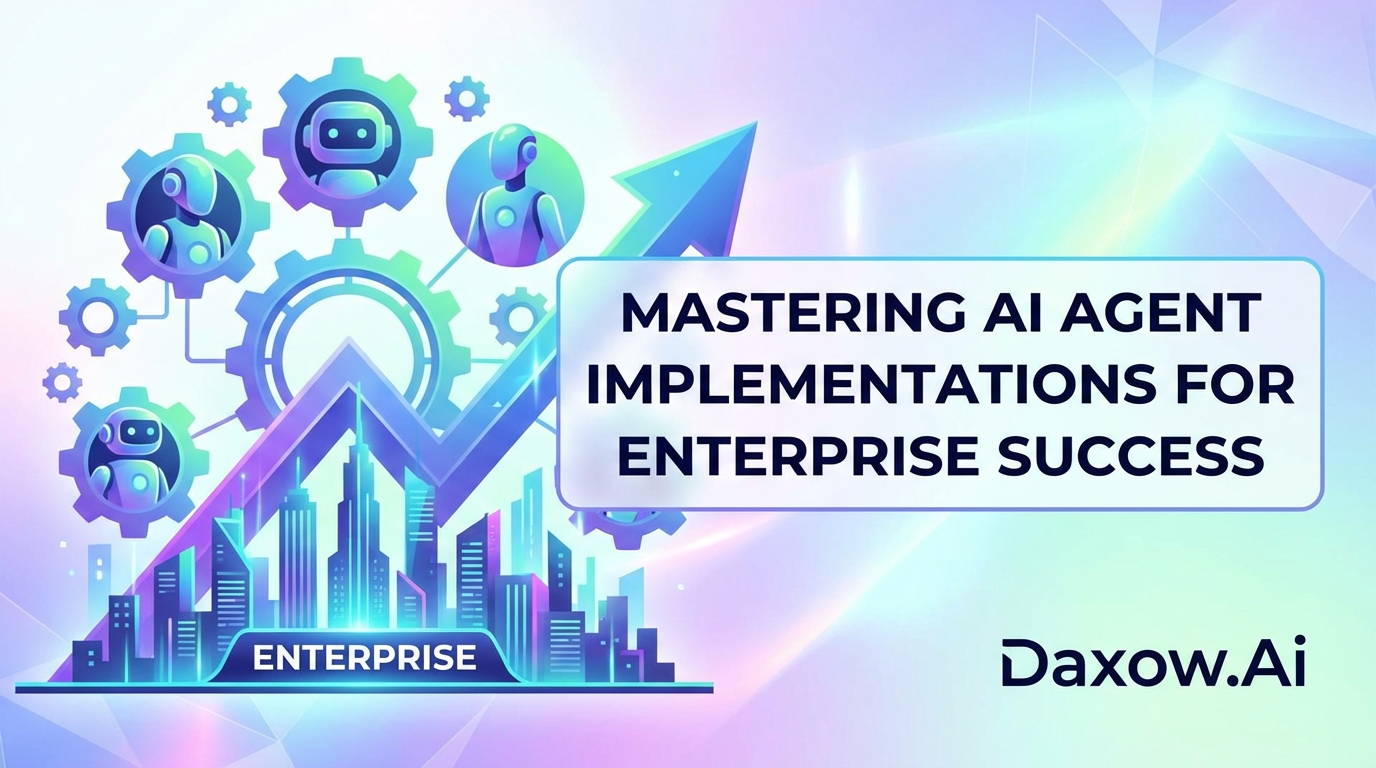
Mastering AI Agent Implementations for Enterprise Success
Guide to implement enterprise-grade AI agents in 2026: API-first architecture, governance, measurable ROI, integrations, and scalable pilots.
Mastering AI Agent Implementations: A Strategic Guide for Enterprise Success in 2026
Estimated reading time: 15 minutes
Key Takeaways
- AI agents have evolved into core operational infrastructure delivering measurable efficiency and cost savings.
- A strategic, KPI-driven approach reduces deployment risks and accelerates enterprise-scale automation.
- Industry-specific AI agent use cases demonstrate meaningful business impacts across e-commerce, healthcare, finance, real estate, HR, and cross-functional areas.
- A robust five-phase implementation framework guides organizations from assessment to continuous optimization.
- Daxow.ai offers tailored AI agent solutions that integrate with existing business tools and ensure ongoing value realization.
Table of Contents
- Mastering AI Agent Implementations: A Strategic Guide for Enterprise Success in 2026
- Practical Use Cases Across Industries
- A Five-Phase Implementation Framework
- Technology, Architecture, and Integration Considerations
- Measuring ROI and Scaling Successfully
- Common Challenges and How to Mitigate Them
- Putting It Together — A Practical Example (End-to-End)
- Frequently Asked Questions
Mastering AI Agent Implementations: A Strategic Guide for Enterprise Success in 2026
What “AI agent implementations” mean for your company
AI agent implementations are the design and deployment of autonomous software entities that can observe, decide, and act across enterprise systems. Unlike rules-based automation, modern agents combine real-time data access, API orchestration, and machine learning to resolve dynamic scenarios. They:
- Execute workflows end-to-end (e.g., order-to-cash).
- Coordinate with human operators through human-in-the-loop gates.
- Self-optimize via feedback loops and retraining.
- Integrate securely with existing systems using API-first architectures and interoperability protocols.
Business outcomes to prioritize
When planning implementations, align technology choices to measurable business outcomes:
- Reduce manual tasks: Target repetitive processes for elimination (e.g., invoice processing, lead qualification).
- Improve productivity: Free specialist teams for higher-value activities by automating administrative work.
- Enhance customer experience: Faster response times and personalised interactions through customer support automation.
- Lower operational costs: Realize 25–40% cost savings through resilient automation and error reduction.
- Shorten time-to-decision: Real-time agents shorten the cycle for risk assessments, approvals, and sales decisions.
Practical Use Cases Across Industries
E-commerce — Order-to-cash and personalization
Use case:
- Agents automate inventory forecasting, dynamic pricing, and returns handling.
- A customer support agent triages inquiries, issues refunds, and triggers logistic workflows.
Business impact: 50% faster response times, higher conversion from personalized recommendations.
How Daxow helps:
- Build customer support automation that links chatbots to order systems and CRM.
- Deploy workflow automation to connect inventory, pricing engines, and fulfillment.
Healthcare — Triage, scheduling, and compliance
Use case:
- Triage agents perform symptom intake, prioritize patients, and book appointments.
- Clinical support agents surface anomalies from device data for clinician review.
Business impact: Reduced administrative burden on staff, faster access to care, and compliant handling of sensitive data.
How Daxow helps:
- Implement HIPAA-aware data extraction, secure integrations with EHRs, and agent workflows that include human review for critical decisions.
Finance — Real-time risk, fraud detection, and compliance
Use case:
- Agents analyze transactions, flag anomalous patterns, and initiate holds or escalations.
- Compliance agents map transactions against regulatory rules and prepare audit trails.
Business impact: Up to 95% accuracy in certain fraud detection scenarios; lower compliance costs and faster audits.
How Daxow helps:
- Integrate agents with payment platforms, implement continuous monitoring, and set up model governance and retraining pipelines.
Real Estate — Lead qualification and valuation
Use case:
- Lead nurturing agents assess inbound inquiries, schedule viewings, and prioritize high-probability prospects.
- Valuation agents aggregate market data and produce instant appraisals.
Business impact: Reduced manual listing work by ~30% and a more efficient sales funnel.
How Daxow helps:
- Connect CRM systems, automate data enrichment, and deploy lead qualification workflows to increase agent productivity.
HR — Recruitment, onboarding, and retention
Use case:
- Recruitment agents screen resumes, conduct initial chat-based interviews, and rank candidates.
- Onboarding agents deliver personalized training and monitor new hire progress.
Business impact: Faster time-to-hire, improved retention through tailored onboarding paths.
How Daxow helps:
- Deploy recruitment automation integrated with applicant tracking systems and HRIS, plus analytics to predict attrition risk.
Cross-functional — Customer support automation and sales automation
Use case:
- Support chatbots resolve tier-1 issues and escalate complex cases.
- Sales automation agents qualify leads, schedule demos, and update CRM records.
Business impact: Consistent service quality, faster sales cycles, and a measurable reduction in manual CRM updates.
How Daxow helps:
- Provide end-to-end implementation: chatbots, integration with ticketing and CRM systems, and orchestration of multi-step sales workflows.
A Five-Phase Implementation Framework
Phase 1 — Strategic Assessment and Planning
Actions:
- Define top business problems and set measurable KPIs (e.g., 30% faster response time, 40% reduction in manual processing).
- Map current workflows and identify low-risk, high-impact pilot candidates.
- Evaluate data readiness: sources, quality, access controls.
How Daxow helps: Run discovery workshops, process mapping, and KPI definition sessions to prioritize the first wave of automation.
Phase 2 — Technology Architecture and Design
Actions:
- Design an API-first architecture and data pipelines for real-time access.
- Choose cloud-native infrastructure, security frameworks, and interoperability standards such as MCP.
- Define model governance, auditing, and compliance requirements.
How Daxow helps: Architect secure, scalable systems that integrate with existing CRMs and ERPs via robust connectors and APIs.
Phase 3 — Development and Integration
Actions:
- Build agents with test suites and scenario coverage; implement human-in-the-loop for critical decisions.
- Create intuitive operator interfaces and logging for traceability.
How Daxow helps: Deliver production-ready AI agents, integrate them into live systems, and implement monitoring and rollback strategies.
Phase 4 — Deployment and Change Management
Actions:
- Launch pilots in low-risk environments, measure KPIs, and gather user feedback.
- Train teams and communicate process changes with clear roles and escalation paths.
How Daxow helps: Provide rollout playbooks, onboarding training, and stakeholder alignment to reduce adoption friction.
Phase 5 — Monitoring and Continuous Optimization
Actions:
- Monitor KPIs and system health; retrain models with fresh data and refine decision logic.
- Implement governance for bias detection, compliance, and incident response.
How Daxow helps: Operate continuous improvement cycles, maintain models, and provide transparent reporting for stakeholders.
Technology, Architecture, and Integration Considerations
Design for interoperability and resilience
- API-first approach ensures agents can call services, retrieve data, and push updates reliably.
- Use Model Context Protocol (MCP) or equivalent interoperability standards to coordinate multi-agent workflows.
- Build real-time validation and QA into data pipelines to avoid failures that derail deployments.
Security, compliance, and governance
- Encrypt data at rest and in transit; enforce role-based access controls.
- Embed audit trails and explainability features for regulated environments.
- Define clear governance roles: model owners, data stewards, compliance leads.
Human-in-the-loop and escalation patterns
- For high-risk decisions, route agents’ suggestions to human approvers with contextual evidence.
- Implement confidence thresholds and safe-fail behaviors to maintain continuity.
Measuring ROI and Scaling Successfully
Metrics to track
- Operational: task completion time, error rates, throughput.
- Financial: cost per transaction, headcount reallocation savings, revenue lift from personalized automation.
- Adoption: agent-to-human handoff rates, user satisfaction, usage frequency.
Typical ROI timelines
- Pilot to ROI: well-scoped pilots commonly show payback within 6–12 months.
- Scaling: expand from vertical pilots to horizontal automation across departments using standardized connectors and governance.
How Daxow secures ROI
- We run KPI-driven pilots with clear measurement frameworks.
- Post-deployment, Daxow provides optimization sprints to increase automation coverage and extract additional value.
- Our approach ensures investments convert into measurable cost savings and productivity gains.
Common Challenges and How to Mitigate Them
Data pipeline failures
- Mitigation: real-time validation, staging environments, and automated rollback.
- Daxow role: build resilient ETL pipelines and continuous monitoring to prevent downstream failures.
Integration gaps
- Mitigation: API-first development and connector libraries, alignment on data schemas.
- Daxow role: deliver tailored integrations with CRMs, ERPs, and third-party services to ensure end-to-end workflows.
Resistance to adoption
- Mitigation: phased rollouts, role-based training, and stakeholder engagement.
- Daxow role: provide change management resources and training to accelerate adoption.
ROI uncertainty
- Mitigation: run small, measurable pilots with predefined KPIs and success criteria.
- Daxow role: design experiments that demonstrate value quickly and provide a clear expansion plan.
Putting It Together — A Practical Example (End-to-End)
Scenario: A mid-market e-commerce company wants to reduce manual order processing and improve customer support.
- Step 1: Daxow performs a process analysis to map order-to-cash and support workflows.
- Step 2: We identify a pilot: automated returns handling and a support chatbot for tier-1 queries.
- Step 3: Architecture: API-first connectors to the e-commerce platform, WMS, and CRM; secure data pipeline; and monitoring dashboards.
- Step 4: Deployment: phased rollout with human-in-the-loop for exceptions and live A/B testing.
Outcomes in 9 months: 40% reduction in manual order handling, 50% faster support response times, and measurable uplift in customer satisfaction.
This example illustrates how targeted AI automation and AI agents create immediate operational wins while establishing a platform for enterprise-scale automation.
Conclusion and Next Steps
Mastering AI Agent Implementations: A Strategic Guide for Enterprise Success in 2026 demonstrates that successful AI agent programs combine strategic planning, robust architecture, phased delivery, and continuous governance. Organizations that adopt an API-first, KPI-driven approach—starting with high-impact, low-risk pilots—realize rapid ROI and create a foundation for enterprise-wide automation.
Daxow.ai partners with companies to design and deliver custom AI systems that reduce manual tasks, increase productivity, and improve customer outcomes. From AI agents and workflow automation to customer support automation, lead qualification, and data extraction, we provide end-to-end implementation, integrations with your business tools and CRMs, and ongoing optimization to maximize ROI.
Book a free consultation with Daxow.ai to request a process analysis for your company and start building a custom AI system that scales. Contact us today to transform repetitive work into strategic value.
Frequently Asked Questions
What distinguishes AI agent implementations from traditional automation?
AI agent implementations leverage autonomous decision-making with real-time data, machine learning, and API orchestration, enabling end-to-end workflow execution and continuous self-optimization, unlike static, rules-based automation.
How can enterprises ensure the security and compliance of AI agents?
By implementing encrypted data storage and transit, role-based access controls, audit trails, explainability features, and clear governance roles, organizations can maintain secure, compliant AI agent deployments.
What industries benefit most from AI agent implementations?
While AI agents bring value across sectors, industries such as e-commerce, healthcare, finance, real estate, and HR have demonstrated particularly strong business impact through targeted applications like customer support, risk detection, and recruitment automation.
How does Daxow support enterprises in scaling AI agent implementations?
Daxow offers a comprehensive five-phase framework from strategic assessment to continuous optimization, ensuring scalable integration, governance, training, and performance measurement to maximize ROI and operational benefits.