
AI Agents and Automation: Transforming Business Operations in 2026
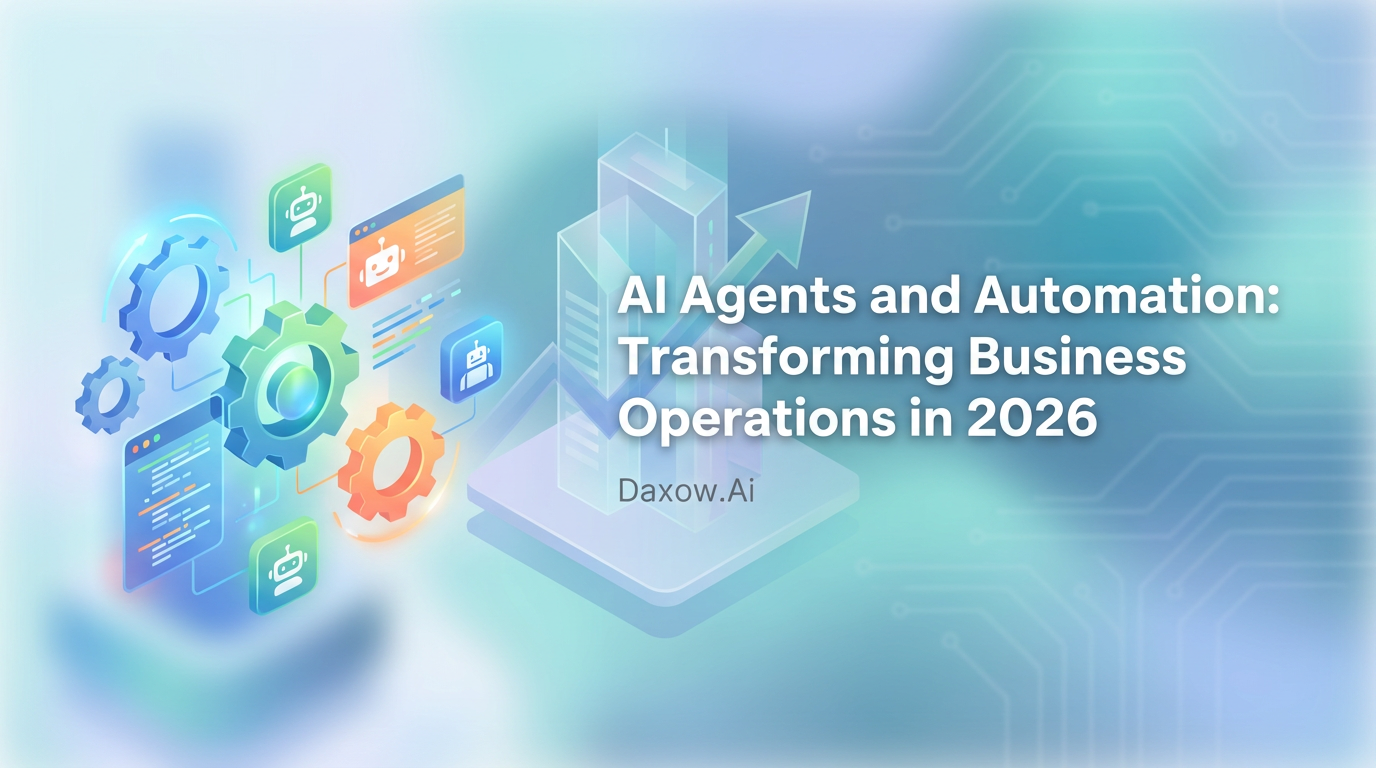
AI agents and automation in 2026 cut costs, boost productivity, and improve CX across industries. Daxow.ai use cases, ROI, and a 90-day rollout roadmap.
AI Agents and Automation: Transforming Business Operations in 2026
Estimated reading time: 15 minutes
Key Takeaways
- AI agents in 2026 combine autonomous reasoning with workflow automation to deliver significant business value.
- Practical use cases across e-commerce, healthcare, finance, real estate, and HR demonstrate measurable ROI.
- Deployment requires a strategic roadmap emphasizing governance, integration, and continuous optimization.
- Daxow.ai provides custom AI automation solutions integrated with existing enterprise systems.
- Effective AI automation improves productivity, customer experience, and scales expertise while reducing costs.
Table of Contents
- AI Agents and Automation: Transforming Business Operations in 2026
- What AI Agents and Workflow Automation Mean for Your Business
- Practical Use Cases and Industry Examples
- Implementation Roadmap — From Pilot to Enterprise-Grade Automation
- Measuring ROI and Business Value
- Common Risks and How to Mitigate Them
- Two Practical Scenarios — From Concept to Outcome
- How Daxow.ai Builds Custom AI Agents and End-to-End Automation
- Getting Started — A Practical First 90 Days
- Frequently Asked Questions
AI Agents and Automation: Transforming Business Operations in 2026
What has changed in 2026 is the maturity of agent architectures, cloud-native integrations, and standard protocols that allow autonomous systems to act across enterprise data and tooling. AI agents are now capable of perceiving context, reasoning against models, and acting within workflows — not just following fixed rules. Combined with robust workflow automation, these capabilities unlock material business value.
What AI Agents and Workflow Automation Mean for Your Business
AI agents are autonomous software entities that sense, reason, and act. They differ from traditional bots by handling variability, adapting to real-time data, and escalating only when necessary. Workflow automation scripts predictable flows; AI agents add decision-making and exception handling.
- Reduce manual tasks: Agents process high-volume, repetitive work 24/7.
- Increase productivity: Teams redirect effort from routine tasks to strategic initiatives.
- Improve customer experience: Faster responses, personalized interactions, and fewer errors.
- Lower operational costs: Automation reduces error rates and processing time, cutting operational spend.
- Scale expertise: Expert knowledge embedded in agents becomes broadly available.
Core capabilities to expect in 2026
- Real-time data pipelines for instantaneous decisions.
- API-first architectures and standards enabling multi-agent coordination.
- Error-resilient autonomy that self-corrects and escalates selectively.
- Cloud-native scalability that adapts cost to demand.
Practical Use Cases and Industry Examples
E-commerce
Use case:
- Automated order processing that validates orders, checks inventory, triggers fulfillment, and handles exceptions autonomously.
- Inventory forecasting using real-time sales and supplier data to optimize stock levels.
- Personalized recommendations delivered via conversational agents.
Business impact:
- Reduces fulfillment errors by ~30% and increases conversion by 15–20% through dynamic pricing and personalization.
- Faster time-to-ship and fewer returns reduce operational cost and improve customer satisfaction.
How Daxow.ai helps:
- Builds AI agents that integrate with your commerce platform and ERP.
- Implements workflow automation to connect order lifecycle systems.
- Delivers monitoring dashboards to track conversion and error KPIs.
Healthcare
Use case:
- Patient triage agents that intake symptoms, prioritize appointments, and route urgent cases to clinicians.
- Automated extraction of structured data from medical records for triage and billing purposes.
Business impact:
- Cuts wait times by ~25%, improves triage accuracy, and reduces administrative overhead.
- Enables staff to focus on clinical care while agents manage scheduling and follow-ups.
How Daxow.ai helps:
- Designs privacy-first integrations with EHR systems.
- Trains domain-specific models to respect clinical terminology and compliance requirements.
Finance
Use case:
- Fraud detection agents that analyze transaction patterns in real time, flag anomalies, and trigger automated containment workflows.
- Automated compliance checks and loan underwriting that surface exceptions to human reviewers.
Business impact:
- Lowers fraud losses by up to 40%, and accelerates approvals while maintaining regulatory controls.
How Daxow.ai helps:
- Creates multi-model detection pipelines and integrates with fraud response systems.
- Implements governance to ensure transparency and auditability of automated decisions.
Real Estate
Use case:
- Automated lead qualification agents that interact with prospects, qualify by intent and budget, and schedule viewings.
- Market data scraping for automated property valuation and personalized listing recommendations.
Business impact:
- Speeds listings by 50% and doubles qualified leads without increasing staff workload.
How Daxow.ai helps:
- Connects MLS data, CRM platforms, and chat systems to create a unified lead qualification pipeline.
- Builds agents that host virtual tours and handle prospect questions autonomously.
HR and Operations
Use case:
- Resume screening and candidate shortlisting with automated interview scheduling and onboarding workflows.
- Employee sentiment analysis from surveys and support tickets to surface retention risks.
Business impact:
- Shortens hiring cycles by ~35% and improves retention through proactive interventions.
How Daxow.ai helps:
- Automates candidate workflows and integrates HRIS systems.
- Applies ethical model governance to reduce bias in screening.
Implementation Roadmap — From Pilot to Enterprise-Grade Automation
1. Strategic assessment and planning
- Audit current processes to identify high-impact opportunities.
- Define measurable KPIs (e.g., reduce processing time by 30%, achieve under 5% error rate).
- Prioritize low-risk, high-volume workflows to build capability quickly.
2. Architecture and design
- Decide agent types: autonomous agents for dynamic tasks, scripted automations for predictable sequences.
- Design cloud-native, API-first architectures that ensure security and interoperability.
- Establish data quality and governance rules at the outset.
3. Development and integration
- Build modular agents and automation flows that integrate with CRM, ERP, ticketing, and data lakes.
- Implement human-in-the-loop checkpoints for critical decisions.
- Test across edge cases and real-world scenarios.
4. Deployment and change management
- Launch focused pilots, then expand.
- Train teams and document new operating procedures.
- Maintain transparent communication to secure organizational buy-in.
5. Monitoring and continuous optimization
- Track KPIs and model drift; retrain models with fresh data.
- Implement governance for ethics, bias mitigation, and compliance.
- Optimize based on ROI metrics and user feedback.
How Daxow.ai supports each step:
- We run process audits to identify automation candidates.
- We design agent architectures with secure integrations and governance baked in.
- We develop, test, and deploy end-to-end automation, and provide training and monitoring services.
Measuring ROI and Business Value
Short-term metrics (0–12 months)
- Process time reduction: expect 25–40% faster for targeted workflows.
- Error rate improvements: aim for under 5% in automated processes.
- Cost savings: initial operational cost reductions typically in the 20–40% range.
Mid-to-long-term metrics (12–36 months)
- Revenue uplift: personalization and improved response can generate 10–25% additional revenue.
- Scalability: automations enable growth without proportional headcount increases.
- Strategic returns: expect 3–5x ROI within 18 months for phased rollouts of high-impact processes.
How to baseline and track
- Collect pre-implementation KPIs: processing time, error rates, headcount effort, customer satisfaction (CSAT).
- Establish dashboards for real-time visibility.
- Use A/B testing where feasible to quantify lift from AI agents versus existing processes.
Common Risks and How to Mitigate Them
AI automation carries operational and governance risks. Address these proactively.
Key risks:
- Data quality and integration failures
- Model drift and bias
- Poor change management and user adoption
- Over-automation of sensitive decisions
Mitigation strategies:
- Prioritize data governance early, with validation and lineage tracking.
- Start small with non-critical workflows to build trust and capability.
- Incorporate human-in-the-loop controls for sensitive decisions.
- Maintain monitoring and retraining schedules to limit drift and keep bias under control.
Daxow.ai delivers governance frameworks, integration expertise, and training to help clients avoid these pitfalls and scale responsibly.
Two Practical Scenarios — From Concept to Outcome
Scenario 1: Mid-size e-commerce retailer
- Challenge: Manual order exceptions and inventory mismatches causing fulfillment delays.
- Solution: Daxow.ai implemented a hybrid system — AI agents for exception triage plus workflow automation connecting storefront, inventory, and fulfillment partners.
- Outcome: Order exception handling time reduced by 60%, fulfillment errors down 30%, and conversion increased via improved stock accuracy.
Scenario 2: Financial services firm
- Challenge: Rising fraud attempts and slow manual reviews.
- Solution: Multi-model detection agents that score transactions, trigger containment workflows, and escalate uncertain cases to a human analyst.
- Outcome: Fraud-related losses decreased by 40%, review times halved, and compliance reporting automated for audits.
How Daxow.ai Builds Custom AI Agents and End-to-End Automation
Daxow.ai specializes in turning processes into automated systems that deliver measurable outcomes. Our approach combines strategy, engineering, and operational ownership.
What we provide:
- Process discovery and ROI modeling to prioritize opportunities.
- Custom agent design and model selection, including domain fine-tuning.
- Seamless integrations with CRMs, ERPs, ticketing platforms, and databases.
- Deployment, monitoring, and lifecycle management — ensuring models remain accurate and compliant.
- Change management and staff training for smooth adoption.
Why clients choose Daxow.ai:
- We focus on business outcomes over technology for technology’s sake.
- We deliver end-to-end automation — from data connectors to live agents that execute tasks.
- We emphasize interoperability and governance, aligning with enterprise security and compliance needs.
Getting Started — A Practical First 90 Days
Days 0–30: Discovery and prioritization
- Conduct process audits and KPI baselining.
- Select 1–3 pilot processes.
Days 30–60: Build and integrate
- Develop agents and automation flows.
- Connect systems and run closed testing.
Days 60–90: Pilot and measure
- Deploy pilot with human oversight.
- Measure impact, refine models, and prepare scaling plan.
Daxow.ai offers a packaged pilot engagement that follows this timeline and is tailored to your systems and goals.
Frequently Asked Questions
What distinguishes AI agents from traditional bots?
AI agents differ by adapting to real-time data, handling variability, and making autonomous decisions rather than simply executing fixed scripts.
How can businesses ensure ethical AI automation?
Through governance frameworks, human-in-the-loop controls, bias mitigation strategies, and continuous monitoring, businesses can maintain ethical AI automation.
What industries benefit most from AI agents and automation?
Industries with high-volume, repeatable processes and variability, such as e-commerce, healthcare, finance, real estate, and HR, benefit significantly from AI agents and automation.
How does Daxow.ai support integration with existing enterprise systems?
Daxow.ai specializes in seamless integrations with CRMs, ERPs, ticketing platforms, and databases, ensuring AI agents work within your current infrastructure.