
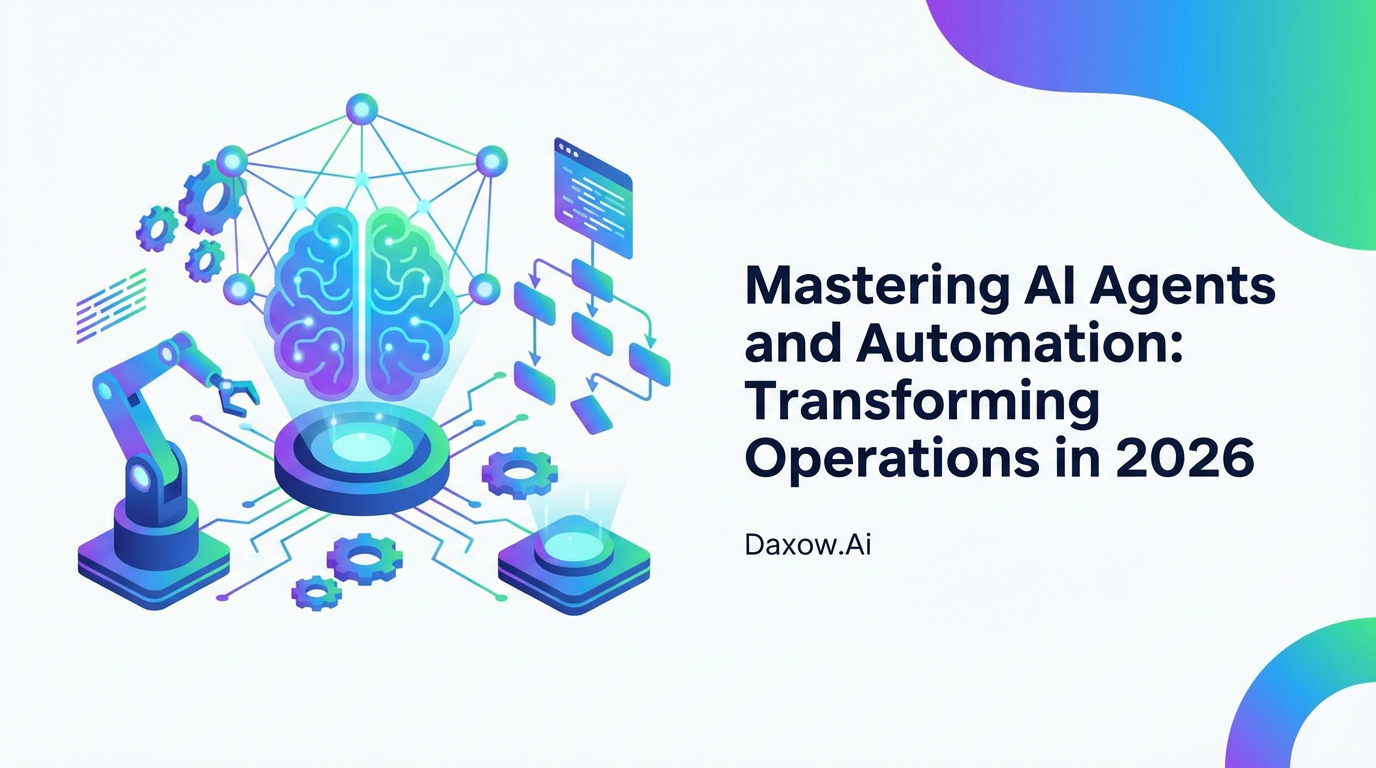
Mastering AI Agents and Automation: Transforming Operations in 2026
Practical guide to AI agents and workflow automation in 2026: use cases, implementation roadmap, governance, ROI, and how Daxow.ai delivers enterprise deployments.
Mastering AI Agents and Automation: Transforming Business Operations in 2026
Estimated reading time: 15 minutes
Key Takeaways
- AI agents combined with workflow automation enable hyperautomation, cutting cycle times and errors while boosting customer experience.
- 2026 brings mature AI models and integration platforms that make automation practical and scalable across industries.
- Cross-industry use cases demonstrate tangible benefits in e-commerce, healthcare, finance, real estate, HR, and customer support.
- A structured five-step implementation roadmap ensures successful and scalable AI automation adoption.
- Effective governance, security, and bias mitigation are critical to sustainable AI operations.
- Measurable ROI includes cost reduction, productivity gains, error reduction, and improved customer satisfaction.
- Daxow.ai offers end-to-end design, integration, and governance for custom AI automation solutions.
Table of Contents
- Mastering AI Agents and Automation: Transforming Business Operations in 2026
- Why 2026 is different
- Practical Use Cases: How AI Agents and Automation Deliver Value
- Implementation Roadmap: From Process Audit to Scalable AI Automation
- Risk Management, Governance, and Best Practices
- Measuring ROI and Business Value of AI Agents
- How Daxow.ai Designs and Delivers Custom AI Automation
- Frequently Asked Questions
Mastering AI Agents and Automation: Transforming Business Operations in 2026
AI agents are autonomous software entities that perceive inputs, reason, and take actions across systems. When paired with workflow automation, they enable hyperautomation—end-to-end automation of business processes that formerly required human handoffs. The combined effect is faster cycle times, fewer errors, and improved customer experiences. For leaders, the priority is to align these technologies with measurable business goals and to institutionalize governance so benefits scale across the enterprise.
- What AI agents do: process documents, answer natural-language queries, orchestrate multi-step workflows, monitor for anomalies, and execute transactions across integrated systems.
- What workflow automation does: connects systems and defines rules for process flow, approvals, notifications, and exception handling.
- Business outcomes: reduced manual tasks, higher productivity, improved NPS and customer support automation, and faster time-to-value for new initiatives.
Why 2026 is different
Technological maturity and broader enterprise adoption have changed feasibility and ROI:
- Mature model capabilities allow agents to handle context-rich conversations and complex decision logic.
- Improved integration platforms make connecting legacy systems, CRMs, and databases simpler.
- Operational best practices—from data pipelines to governance—reduce deployment risk.
Together, these changes make AI automation a practical growth lever rather than an experimental cost center.
Practical Use Cases: How AI Agents and Automation Deliver Value
E-commerce — Order-to-cash and personalization
Problem: Long order processing times, inventory stockouts, and low conversion due to generic experiences.
AI automation solution:
- AI agents automate invoice generation, reconciliation, and exception resolution.
- Predictive agents forecast inventory needs and trigger procurement workflows.
- Customer support automation handles inquiries, processes returns, and personalizes recommendations.
Expected outcomes:
- Reduced manual tasks in finance and supply chain, faster order fulfillment, and fewer stockouts.
- Productivity uplift through automation of routine support conversations and content generation for marketing.
Healthcare — Document processing and triage
Problem: High volumes of forms and patient documents create administrative bottlenecks and slow triage.
AI automation solution:
- Document automation extracts structured data from referrals, EHR attachments, and insurance forms.
- Chatbot agents triage patient queries, schedule appointments, and escalate urgent cases.
- Analytics agents identify demand patterns to optimize staffing.
Expected outcomes:
- Faster response times, reduced administrative error rates, and improved patient satisfaction.
- Compliance-aware automation that preserves data privacy and auditability.
Finance — Fraud detection and compliance
Problem: Manual transaction monitoring and compliance checks are slow and error-prone.
AI automation solution:
- Agents analyze transaction patterns in real time to flag anomalies.
- Document automation completes KYC and AML checks, populating compliance systems.
- Workflow automation routes flagged items for investigation and documents the audit trail.
Expected outcomes:
- Lower fraud losses, reduced manual review time, and faster regulatory reporting.
Real Estate — Lead qualification and listings automation
Problem: Slow lead response and manual property data entry reduce conversion rates.
AI automation solution:
- AI agents qualify inbound leads, schedule viewings, and push qualified prospects into the CRM.
- Document extraction turns PDFs and images into structured listing data.
- Market-analysis agents monitor local trends and suggest pricing changes.
Expected outcomes:
- Shorter sales cycles, higher lead-to-tour conversion, and more accurate listings.
Human Resources — Recruiting and onboarding
Problem: High administrative load in recruiting and onboarding, inconsistent candidate experiences.
AI automation solution:
- Resume-parsing agents extract candidate attributes and score against role profiles.
- Onboarding workflows automate paperwork, access provisioning, and training assignment.
- Employee query bots answer HR policy and benefits questions, reducing helpdesk volume.
Expected outcomes:
- Reduced time-to-hire, lower administrative costs, and improved candidate and employee satisfaction.
Customer Support and Sales — Faster resolution and smarter pipelines
Problem: Support teams overwhelmed by repetitive queries; sales teams wasting time on unqualified leads.
AI automation solution:
- Customer support automation handles tier-1 issues, generates tickets for exceptions, and provides context-rich summaries to agents.
- Sales automation qualifies leads, schedules follow-ups, and personalizes outreach sequences.
Expected outcomes:
- Improved NPS, fewer escalations, and higher sales efficiency.
Implementation Roadmap: From Process Audit to Scalable AI Automation
1. Define objectives and prioritize processes
- Set specific goals (e.g., reduce invoice processing cost by 20%, improve first-response time to under 1 hour).
- Conduct process mining and stakeholder interviews to identify high-volume, repetitive tasks.
- Score opportunities by potential ROI, technical feasibility, compliance risk, and strategic impact.
Daxow role: We run structured process audits and create an AI-first scorecard to prioritize quick wins.
2. Assess and prepare data
- Inventory data sources and assess quality, completeness, and consistency.
- Standardize formats and build secure data pipelines to feed agents and workflows.
- Address compliance requirements: encryption, access controls, and audit logging.
Daxow role: We design secure data architectures and handle ETL to ensure agents receive clean, compliant inputs.
3. Select platform and form teams
- Choose low-code/no-code or developer-friendly platforms that support integrations with CRMs and ERPs.
- Assemble cross-functional teams: business owners, IT, data engineers, and security.
- Train staff on new workflows and establish change management plans.
Daxow role: We recommend platform stacks that balance speed and security and embed upskilling programs for operational teams.
4. Prototype, integrate, and pilot
- Build a focused prototype for a single high-impact process (e.g., invoice automation or lead qualification).
- Validate integrations with legacy systems and run a controlled pilot with real users.
- Collect KPIs and user feedback to refine logic and exceptions handling.
Daxow role: We implement end-to-end pilots, integrate with CRMs and internal systems, and manage phased rollouts to production.
5. Monitor, measure, and iterate
- Define metrics: cycle time, error rate, cost per transaction, NPS, and ROI.
- Implement monitoring for performance drift, bias in models, and security events.
- Retrain models and update workflows based on operational feedback.
Daxow role: We deliver continuous monitoring, model retraining, and periodic process optimization to sustain gains.
Risk Management, Governance, and Best Practices
Governance and policy
- Establish clear ownership for agents and workflows.
- Create approval gates for agent capabilities and data access.
- Define escalation paths for automated exceptions.
Security and compliance
- Apply enterprise-grade security controls: role-based access, encryption, and tamper-evident logs.
- Ensure data residency and regulatory compliance for sensitive industries like finance and healthcare.
Bias, transparency, and auditability
- Test models for biased outcomes and document decision logic.
- Maintain interpretable logs to explain agent decisions for audits.
- Use human-in-the-loop checkpoints where appropriate.
Avoiding shadow AI
- Provide sanctioned tools and clear training to reduce unauthorized tool use.
- Align incentives to encourage adoption of approved automation.
Daxow approach: We build governance frameworks tailored to organizational risk appetite and industry requirements. Our deployments include audit trails, access controls, and role-based views for transparency.
Measuring ROI and Business Value of AI Agents
When implemented correctly, AI agents and workflow automation deliver measurable improvements across cost, speed, accuracy, and customer satisfaction.
Key metrics to track:
- Cost Reduction: Automating accounts payable, claims processing, or other high-volume tasks typically reduces operating cost in the 20–40% range.
- Productivity: Automation can lift productivity by 30–50% by eliminating repetitive tasks and accelerating handoffs.
- Error Reduction: Automated, data-driven processing reduces manual error rates substantially, improving compliance and lowering rework.
- Customer Satisfaction: Faster response times through customer support automation improve NPS and retention.
- Time to Value: Well-scoped pilots often show payback under 12 months.
How to quantify impact:
- Start with a baseline process map and cost-per-transaction calculation.
- Model the impact of automating steps, accounting for implementation and ongoing operational costs.
- Use pilot results to refine estimates and build a business case for scaling.
Daxow advantage: We combine domain expertise, benchmark metrics, and real pilot data to produce conservative, evidence-based ROI projections and help ensure projects hit payback targets.
How Daxow.ai Designs and Delivers Custom AI Automation
- Process discovery and prioritization: We map processes, measure manual effort, and identify the highest-value automation candidates.
- Custom AI agents: We design agents that execute real tasks — from document extraction to multi-step transaction orchestration — and integrate them with your CRM, ERP, ticketing, and data warehouses.
- Workflow automation and integrations: We build robust connectors and orchestrations so agents operate reliably across existing systems.
- Security and governance: We implement enterprise-grade controls, monitoring, and auditability to meet compliance requirements.
- Continuous improvement: We monitor performance, retrain models, and iterate on workflows to preserve and grow ROI.
Daxow’s focus is practical outcomes: reducing manual tasks, improving productivity, and delivering measurable business automation that directly supports customer support automation, sales automation, and operational efficiency.
Frequently Asked Questions
What are AI agents and how do they differ from traditional automation?
AI agents are autonomous software entities capable of perceiving inputs, reasoning, and taking actions across systems, whereas traditional automation typically follows fixed rules without adaptive intelligence.
How can my organization start implementing AI automation?
Begin by defining clear objectives and prioritizing high-volume, repetitive processes using process audits and stakeholder input. Partnering with experts like Daxow.ai can accelerate this journey with tailored implementation roadmaps.
What industries benefit most from AI agents and automation?
Industries such as e-commerce, healthcare, finance, real estate, human resources, customer support, and sales gain significant value through improved efficiency, accuracy, and customer experience.
How does governance help reduce risk in deploying AI automation?
Governance establishes ownership, approval processes, security controls, and accountability to prevent risks like unauthorized AI use, data breaches, and biased outcomes, ensuring sustainable and compliant deployments.