
AI Agents and Automation in 2026: Unlock Growth & Cut Costs
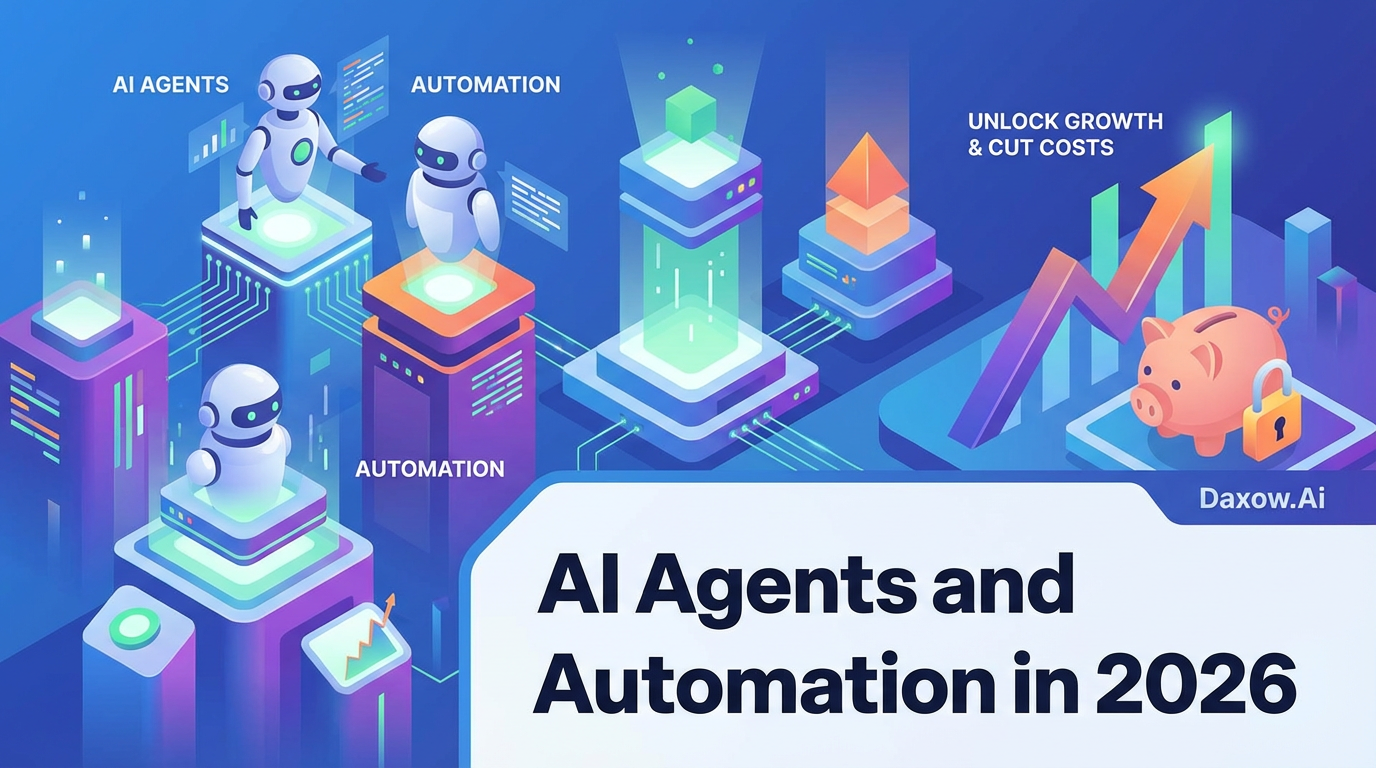
Discover how AI agents and workflow automation can cut costs, speed outcomes, and boost customer experience in 2026 — use cases, KPIs, and an implementation roadmap.
AI Agents and Automation in 2026: How to Unlock Rapid Growth, Cut Costs, and Improve Customer Experience
Estimated reading time: 18 minutes
Key Takeaways
- AI agents combined with workflow automation can reduce operational costs by 40–60% and accelerate goal achievement by 3–5x.
- Industry-specific use cases showcase how AI improves order processing, patient intake, invoice handling, lead qualification, and recruitment.
- A layered architecture including data, AI, orchestration, and integration is essential for successful deployments.
- A phased implementation roadmap paired with best practices reduces risk and ensures measurable ROI within 6–18 months.
- Daxow.ai specializes in designing and deploying custom AI automation solutions that drive productivity and business value.
Table of Contents
- Why AI Agents and Automation in 2026 Matter for Your Business
- Practical Use Cases: How AI Agents and Automation Drive Value Across Industries
- How AI Agents and Workflow Automation Work Together
- Implementation Roadmap and Best Practices
- Measuring ROI and Business Value
- How Daxow.ai Delivers End-to-End Business Automation
- A Checklist for Decision-Makers Ready to Act
- Frequently Asked Questions
Why AI Agents and Automation in 2026 Matter for Your Business
The evolution from simple rule-based automation to autonomous AI agents has changed the payoff equation. Modern AI agents combine machine learning, natural language processing, and generative models to orchestrate multi-step workflows, make decisions, and handle exceptions. When paired with workflow automation, they free employees to focus on strategic work, reduce human error, and enable 24/7 operations.
Key business impacts:
- Operational cost reduction: Targeted automation can cut operating costs by 40–60% in specific processes.
- Speed and scalability: Teams reach objectives 3–5x faster while systems scale to handle growth.
- Customer experience: Faster resolution times and personalized interactions increase conversion and retention.
- Risk and compliance: Automated audit trails and validation reduce compliance overhead and errors.
Daxow.ai helps organizations translate these high-level benefits into real outcomes by assessing workflows, designing AI agents that execute real tasks, integrating with existing CRMs and ERPs, and delivering end-to-end automation.
Practical Use Cases: How AI Agents and Automation Drive Value Across Industries
E-commerce — Order Processing, Personalization, and Returns
Problem: Manual order validation, slow returns handling, and poor real-time personalization increase cart abandonment and labor costs.
Solution:
- AI agents automate order validation, flag anomalies using anomaly detection, and trigger fulfillment workflows.
- Personalization engine uses customer behavior to deliver dynamic recommendations and pricing.
- Automated returns handling routes cases, issues refunds, or schedules collections.
Expected KPIs:
- Reduction in order processing time by 60–80%.
- Lower cart abandonment through real-time personalization, driving 10–25% revenue uplift.
- Faster returns resolution and reduced manual effort.
Daxow.ai approach:
- Integrate AI agents with your e-commerce platform and ERP.
- Build real-time event pipelines and orchestration rules.
- Deploy chatbots for post-purchase support and a returns automation flow that closes cases autonomously.
Healthcare — Patient Intake, Triage, and Administrative Automation
Problem: High administrative overhead, appointment no-shows, and slow triage for non-urgent queries.
Solution:
- AI agents manage scheduling, automated reminders, and initial symptom triage.
- Document automation extracts and classifies patient records, improving data quality and reducing manual entry.
- Escalation logic forwards complex cases to clinicians with structured context.
Expected KPIs:
- Administrative time reduction by up to 50%.
- Improved appointment utilization and decreased no-shows via automated reminders.
- Faster case routing and reduced clinician admin burden.
Daxow.ai approach:
- Build HIPAA-compliant data pipelines and secure integrations with EMR systems.
- Implement triage agents trained on clinical decision trees and continuous feedback loops.
- Automate repetitive admin tasks while keeping clinicians in the loop for exceptions.
Finance — Invoice Processing, Fraud Detection, and Compliance
Problem: Paper invoices, manual reconciliations, and time-consuming compliance reporting create risk and delays.
Solution:
- Document automation extracts invoice data and populates accounting systems.
- AI agents perform anomaly detection for fraud signals and flag suspicious transactions for review.
- Automated compliance reports aggregate data across systems for faster audits.
Expected KPIs:
- Invoice processing time cut by 70–90%.
- Reduced fraud loss exposure through early detection.
- Faster compliance reporting and reduced audit costs.
Daxow.ai approach:
- Use robust OCR and data validation pipelines integrated into ERP and accounting systems.
- Train models on your transaction patterns for accurate anomaly detection.
- Deploy automated reporting workflows and secure audit trails.
Real Estate — Lead Qualification, Listings, and Contract Review
Problem: Slow lead qualification, manual matching of buyers to properties, and time-consuming contract processing.
Solution:
- AI agents qualify leads via conversational interfaces and predictive scoring.
- Matching algorithms recommend properties based on buyer profiles and historical outcomes.
- Contract automation extracts clauses, flags risks, and prepares standard documents.
Expected KPIs:
- Lead-to-appointment conversion increases.
- Faster time-to-close through automated document workflows.
- Improved regulatory compliance and reduced legal bottlenecks.
Daxow.ai approach:
- Integrate lead sources with CRM and listing platforms.
- Build AI agents that run qualification scripts and schedule showings automatically.
- Automate contract management with extraction and approval workflows.
HR — Recruitment, Onboarding, and Employee Support
Problem: Slow hiring cycles, inconsistent onboarding, and high administrative queries.
Solution:
- AI agents screen resumes and rank candidates against role profiles.
- Automated onboarding sequences deliver tasks, collect forms, and schedule training.
- Employee support bots handle payroll and policy queries, escalating HR issues as needed.
Expected KPIs:
- Time-to-hire reduction and improved quality of hire.
- Faster onboarding and higher early retention rates.
- Reduced volume of repetitive HR queries.
Daxow.ai approach:
- Connect ATS, payroll, and learning platforms.
- Deploy privacy-aware AI screening and structured interview flows.
- Automate documentation and routine HR processes to reduce manual work.
How AI Agents and Workflow Automation Work Together
AI agents add intelligence and decision-making to automated flows. Workflow automation handles deterministic, rule-based steps; AI agents handle ambiguity, exceptions, and natural language. Together they create resilient end-to-end processes.
Core components:
- Data layer: Clean, governed data pipelines that feed models and workflows.
- AI layer: Models for NLP, classification, anomaly detection, recommendation, and generative tasks.
- Orchestration layer: Workflow engines route tasks, trigger agents, and manage state.
- Integration layer: Connectors to CRM, ERP, ticketing systems, and custom APIs.
Daxow.ai builds these layers and ensures they operate as a cohesive system:
- Design knowledge graphs and decision trees for consistent behavior.
- Implement continuous learning loops to retrain models on new data.
- Monitor for bias, drift, and performance, with governance controls.
Implementation Roadmap and Best Practices
A structured, phased approach reduces risk and accelerates value. Typical timelines range from 4 to 8 months for a pilot-to-initial-rollout, and 6–18 months for material ROI on high-impact use cases.
Phased roadmap:
-
Assessment & Goal Setting (4–8 weeks)
- Audit processes, map workflows, and set measurable targets (e.g., reduce processing costs by 30%).
- Evaluate data readiness and compliance needs.
-
Technology & Team Selection (6–12 weeks)
- Choose tools for scalability and integration.
- Form cross-functional teams: IT, business owners, and change leads.
-
Preparation (4–8 weeks)
- Clean data, build knowledge bases, and document decision logic.
-
Pilot & Rollout (4–20 weeks)
- Deploy to a single channel or process, gather feedback, refine, then scale.
-
Monitor & Iterate (ongoing)
- Track KPIs, retrain models, and continuously improve.
Best practices:
- Start small with high-impact, low-complexity processes to deliver quick wins.
- Ensure compliance with data protection regulations (GDPR, HIPAA) from day one.
- Involve stakeholders early to secure adoption and avoid resistance to change.
- Define measurable success criteria that prevent scope creep.
- Plan phased integrations to avoid disruptions to operations.
Common pitfalls and mitigation:
- Poor data quality → Perform a thorough data audit and remediation before model training.
- Scope creep → Lock measurable, time-bound objectives.
- Resistance to change → Appoint change champions and provide targeted training.
- Vendor mismatch → Define scalability, support SLAs, and compliance requirements upfront.
Daxow.ai practice:
- We run assessments that prioritize automation candidates for fast ROI.
- We establish governance and compliance frameworks tailored to your industry.
- We train your teams and provide change management to ensure adoption.
Measuring ROI and Business Value
Expect payback in 6–18 months for high-impact automation projects. Typical outcome ranges:
- 20–50% operational cost reduction across automated functions.
- 10–30% revenue uplift through personalization and faster response.
- 3x or more improvements in speed for key workflows.
KPIs to track:
- Cost per transaction / Cost per interaction
- Resolution time and first-contact resolution rate
- Customer satisfaction (CSAT) and Net Promoter Score (NPS)
- Lead-to-conversion rates and average handling time
- Model accuracy, drift, and incident rates for exceptions
Example: If a contact center with 100,000 annual interactions automates 60% of routine queries, and cost-per-interaction falls from $2.50 to $0.75, annual savings exceed $60,000 — excluding upsell and retention benefits from improved CX.
Daxow.ai aligns KPIs with your business goals and builds dashboards to monitor impact in real time.
How Daxow.ai Delivers End-to-End Business Automation
Daxow.ai offers a pragmatic path from discovery to scale:
- Discovery & Process Analysis: We map workflows, prioritize automation candidates, and define measurable objectives.
- Custom AI Agent Design: We design agents tailored to your use cases — from lead qualification bots to document-processing agents.
- Workflow Automation & Integrations: We connect systems (CRM, ERP, ticketing) and automate end-to-end flows.
- Secure Deployments & Compliance: We build secure data pipelines and compliance-aware systems for your industry.
- Pilot, Scale, Monitor: We run pilots, iterate with real-world feedback, and scale across teams and languages.
- Ongoing Support & Optimization: We retrain models, refine rules, and continuously optimize ROI.
Throughout, our focus is on reducing manual tasks, increasing productivity, and delivering measurable business automation outcomes. Visit our solutions page to learn about industry-specific AI automation.
A Checklist for Decision-Makers Ready to Act
Use this checklist to evaluate readiness and prioritize your first projects:
- Have you identified repetitive, high-volume processes with clear KPIs?
- Is your core data accessible, clean, and compliant?
- Do you have executive sponsorship and stakeholder involvement?
- Have you defined measurable goals for cost, speed, or revenue impact?
- Can you assemble a cross-functional team for implementation and change management?
If you answered yes to these, you are ready to begin.
Explore our services to start your AI automation journey with Daxow.ai’s expert guidance.
Frequently Asked Questions
What are AI agents in the context of automation?
AI agents are intelligent systems that use machine learning, natural language processing, and decision logic to autonomously perform complex multi-step tasks within automated workflows.
How does automation improve customer experience?
Automation enables faster response times, personalized interactions, and 24/7 availability, all of which contribute to higher customer satisfaction and increased retention.
What industries benefit most from AI-driven automation?
AI-driven automation delivers value across industries like e-commerce, healthcare, finance, real estate, and human resources by streamlining processes and improving operational efficiency.
How long does it take to see ROI from automation projects?
High-impact automation projects typically deliver measurable ROI within 6 to 18 months, depending on scope, complexity, and organizational readiness.