
AI Agents and Automation: Transforming Business Operations in 2026
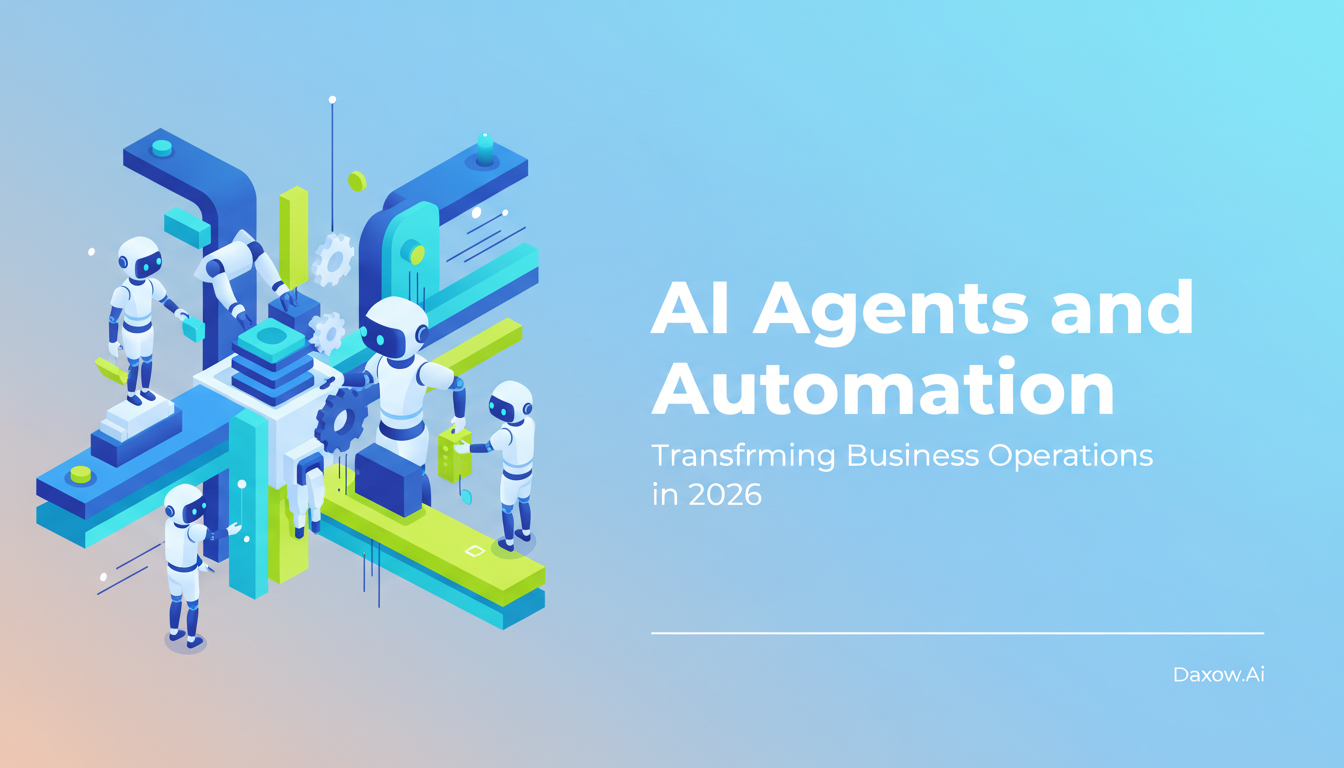
AI agents and workflow automation that cut costs, boost productivity, and deliver fast ROI across industries, plus a practical roadmap and Daxow.ai services.
AI Agents and Automation: Transforming Business Operations in 2026
Estimated reading time: 15 minutes
Key Takeaways
- AI agents combined with workflow automation enable businesses to scale operations, reduce costs, and improve accuracy.
- Strategic implementation across industries like e-commerce, healthcare, finance, and more drives measurable ROI within months.
- Daxow.ai delivers custom AI automation solutions that integrate with enterprise systems to increase productivity and lower manual effort.
- A phased roadmap and best practices ensure successful adoption and continuous improvement of AI-driven workflows.
- Continuous governance, explainability, and human oversight maintain compliance, security, and quality in AI operations.
Table of Contents
- AI Agents and Automation: Transforming Business Operations in 2026
- What AI Agents and Workflow Automation Actually Do
- Strategic Advantages: Business Value and Measurable Gains
- Practical Use Cases Across Industries
- Implementation Roadmap and Best Practices
- Technical and Organizational Considerations
- Measuring ROI and Building a Business Case
- How Daxow.ai Helps You Implement AI Agents and Automation
- Practical Next Steps for Decision-Makers
- Frequently Asked Questions
AI Agents and Automation: Transforming Business Operations in 2026
AI agents — autonomous software systems powered by advanced models — now execute multi-step tasks, make context-aware decisions, and integrate directly with enterprise systems. Combined with robust workflow automation, they move businesses from manual processes to intelligent orchestration. In 2026, mature integration standards and model context protocols enable these agents to operate across APIs and data sources, delivering faster outcomes and scaling without proportional headcount increases.
Why this matters for your organization
- Scale without proportional hires: AI agents handle repetitive and data-intensive work, allowing human teams to focus on strategy and relationships.
- Faster, more accurate execution: Automation reduces manual errors and speeds up workflows, improving time-to-resolution and customer satisfaction.
- Measurable ROI: Pilot programs typically break even within 3–6 months; full deployments deliver 3–5x faster objective realization and ongoing productivity gains.
What AI Agents and Workflow Automation Actually Do
AI agents differ from basic bots by combining reasoning, action, and continuous learning. They ingest data from multiple sources, validate inputs, call APIs, update records, and escalate when necessary. Workflow automation provides the orchestration layer that sequences tasks, enforces SLAs, and logs outcomes for governance and analytics.
Core capabilities:
- Natural language understanding for customer and employee interactions.
- Predictive analytics for forecasting, fraud detection, and demand planning.
- API-first integrations to CRM, ERP, EHR, and other tools.
- Continuous monitoring and model tuning to maintain accuracy and compliance.
Strategic Advantages: Business Value and Measurable Gains
Efficiency and cost
- Reduce manual tasks by 70–80% in high-volume processes.
- Operational cost reductions of 30–50% in targeted functions (support, back-office, claims).
- Pilot ROI: break-even in 3–6 months; sustained productivity gains of 20–40%.
Revenue and customer outcomes
- Revenue uplift (15–25%) through personalization and smarter sales automation.
- Faster customer resolutions and higher CSAT via customer support automation and AI-driven routing.
- Compliance and risk reduction through continuous monitoring and automated audit trails.
Workforce impact
- Reallocate talent to high-value tasks: strategy, complex problem solving, and customer relationships.
- Lower turnover through reduced burnout and clearer role evolution.
Practical Use Cases Across Industries
E-commerce — inventory forecasting, personalization, and dynamic pricing
Use case:
- AI agents monitor sales, supplier APIs, and web traffic to forecast demand.
- Workflow automation updates inventory systems, adjusts promotions, and triggers replenishment orders.
Impact:
- 20–30% higher conversion rates from personalized recommendations.
- Reduced overstock losses and improved cash flow.
Implementation tips:
- Start with product categories that generate 60–70% of revenue for rapid ROI.
- Integrate with existing e-commerce platforms and logistics APIs.
Healthcare — triage, scheduling, and EHR automation
Use case:
- Conversational agents capture symptoms, triage urgency, and schedule appointments.
- Agents write preliminary notes to EHRs and flag compliance checkpoints.
Impact:
- Reduced administrative wait times by up to 50%.
- Higher clinician productivity and improved patient experience.
Implementation tips:
- Enforce strict data governance and HIPAA-equivalent controls.
- Pilot with non-critical scheduling flows before expanding to clinical decision support.
Finance — fraud detection and compliance monitoring
Use case:
- AI agents analyze streaming transactions to detect anomalies using unsupervised models.
- Automated workflows freeze accounts, notify compliance teams, and generate audit reports.
Impact:
- Faster anomaly detection and reduced investigation time.
- Improved audit readiness and lower compliance risk.
Implementation tips:
- Combine rule-based triggers with ML scoring to balance precision and recall.
- Maintain explainability in models for regulatory compliance.
Real estate — property matching, virtual tours, contract automation
Use case:
- Agents parse buyer preferences, perform NLP-based matching with listings, schedule viewings, and prepare contract drafts.
Impact:
- Accelerated deal cycles and up to 40% faster closings.
- Improved lead nurturing and conversion through automated follow-ups.
Implementation tips:
- Connect agents to MLS/CRM systems and document-signature providers.
- Automate contract checks with rule-based verification and escalation for anomalies.
HR — recruitment, onboarding, and employee support
Use case:
- AI agents screen resumes, conduct initial chat interviews, and schedule hiring manager meetings.
- Onboarding workflows automate document collection, system provisioning, and benefits enrollment.
Impact:
- Shorter hiring cycles and reduced administrative overhead.
- Improved new-hire experience and retention.
Implementation tips:
- Build transparent candidate experience flows and human oversight for final decisions.
- Integrate with ATS and HRIS platforms.
Customer support — multichannel automation and escalation
Use case:
- Conversational agents handle common inquiries across chat, email, and voice.
- Agents escalate complex cases to human specialists with full context and suggested next steps.
Impact:
- Significant reductions in response times and first-contact resolution improvements.
- Lower support costs while maintaining or improving CSAT.
Implementation tips:
- Implement a phased rollout: FAQ and billing queries first, then technical and account-specific flows.
- Keep humans in the loop for nuanced or high-risk interactions.
Implementation Roadmap and Best Practices
Phase 1 — Strategic assessment and planning (4–8 weeks)
Activities:
- Define clear objectives and KPIs (e.g., 30% efficiency gain; reduction in average handling time).
- Map current workflows and identify high-impact, low-complexity processes.
- Assess data readiness, compliance needs, and stakeholder appetite.
Pitfalls to avoid:
- Vague goals or scope creep.
- Ignoring governance and data quality from the outset.
Phase 2 — Technology selection and preparation (6–12 weeks)
Activities:
- Choose components: conversational NLU, ML frameworks, orchestration engine, and integration middleware.
- Build clean data pipelines and knowledge bases.
- Design API-first integrations using standardized protocols for interoperability.
Pitfalls to avoid:
- Poor integrations and reliance on fragile point-to-point connections.
- Underestimating the effort for data cleaning.
Phase 3 — Pilot deployment (4 weeks)
Activities:
- Launch a controlled pilot in a single channel or team.
- Monitor KPIs, collect user feedback, and iterate on models and flows.
Pitfalls to avoid:
- No feedback loops; deploying without clear monitoring.
- Over-automation without human-in-the-loop controls.
Phase 4 — Gradual rollout and change management (ongoing)
Activities:
- Expand to additional use cases and teams.
- Provide training, communicate changes, and maintain escalation paths.
- Update policies and compliance documentation.
Pitfalls to avoid:
- Skipping change management and leaving teams underprepared.
- Not defining clear ownership for automated workflows.
Phase 5 — Monitoring and continuous optimization (continuous)
Activities:
- Track KPIs continuously, retrain models, and refine knowledge bases.
- Implement governance: roles, policies, audit logs, and risk plans.
Pitfalls to avoid:
- Treating deployment as a one-time project rather than an ongoing program.
Technical and Organizational Considerations
- Data quality first: High-quality, labeled data is the foundation for accurate agents.
- API-first architecture: Use standardized interfaces and Model Context Protocols where possible for scalable integrations.
- Explainability and governance: Maintain logs and human-review paths; ensure models are auditable.
- Human oversight: Keep humans in the loop for high-risk decisions and continuous training.
- Security and compliance: Apply role-based access, encryption, and data minimization in regulated industries.
Measuring ROI and Building a Business Case
Quantify value from day one by linking automation to business KPIs:
- Track time savings (hours reduced per task), cost per transaction, and resolution times.
- Monitor revenue indicators: conversion lift, upsell rates, and churn reduction.
- Use KPI dashboards to visualize progress and justify expansion.
Typical outcomes seen in enterprise programs:
- 40–60% time savings in automated workflows.
- 30–50% operational cost reduction in targeted areas.
- 15–25% revenue uplift through personalization and sales automation.
How Daxow.ai Helps You Implement AI Agents and Automation
Daxow.ai designs and delivers custom AI automation that aligns with business strategy and existing systems. Our end-to-end approach includes:
- Strategic assessment and KPI definition: We begin with a process analysis to identify high-impact use cases and measurable objectives.
- Custom design and technology selection: We architect API-first solutions, select NLP and ML models, and design resilient workflow automation.
- Building intelligent AI agents: We develop agents that execute real tasks — from CRM updates to multi-step customer journeys — with human escalation when needed.
- Integrations and data connectivity: We connect agents to CRMs, ERPs, EHRs, and third-party APIs to create real-time, reliable automation.
- Pilot, rollout, and change management: We run pilots, train teams, and manage stakeholder adoption to ensure smooth scaling.
- Monitoring, governance, and optimization: We deliver KPI dashboards, continuous model tuning, and governance frameworks so value compounds over time.
How we ensure impact
- Outcome-driven implementations: Each project starts with a clear ROI hypothesis and KPIs tied to productivity and cost reduction.
- Rapid pilots: We validate assumptions quickly, enabling break-even within months.
- Enterprise-grade controls: Security, compliance, and auditability are built into every solution.
Learn more about our approach on the Daxow.ai Services and Solutions pages.
Practical Next Steps for Decision-Makers
- Conduct a high-level process assessment to identify 2–3 pilot candidates where automation can reduce manual tasks and deliver quick ROI.
- Allocate a cross-functional team (business, IT, compliance) to sponsor the initiative.
- Prioritize data cleanup and integration readiness before model development.
- Plan for a phased rollout with clear KPIs and monitoring.
Frequently Asked Questions
What distinguishes AI agents from traditional automation bots?
AI agents combine advanced reasoning, context awareness, and continuous learning capabilities, allowing them to perform multi-step tasks, make decisions, and adapt over time, unlike traditional rule-based bots which follow fixed scripts.
How quickly can businesses expect ROI from AI automation?
Pilot programs generally break even within 3 to 6 months. Full deployments typically realize 3 to 5 times faster achievement of business objectives and sustained productivity gains over time.
How does Daxow.ai ensure compliance and security in AI implementations?
We implement role-based access controls, encryption, audit logs, and maintain human oversight for high-risk decisions. Our solutions align with regulatory standards and include governance frameworks to ensure ongoing compliance.
Can AI agents integrate with existing enterprise systems?
Yes, Daxow.ai specializes in API-first integrations with CRMs, ERPs, EHRs, and other enterprise platforms to enable seamless, real-time automation and data connectivity.