
AI Agents and Automation: Unlock Business Growth
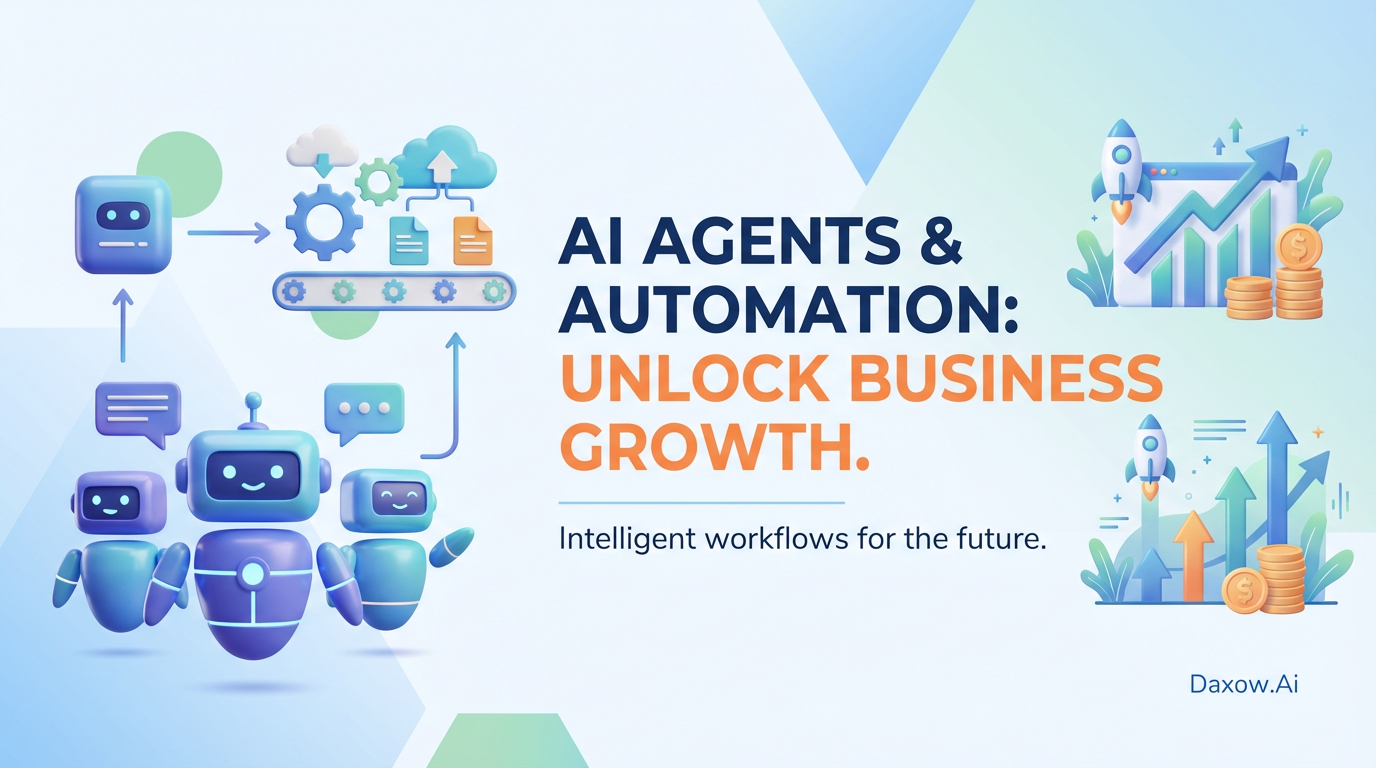
How AI agents and workflow automation drive cost savings, time reductions, and measurable ROI - a practical framework and 90-day pilot plan from Daxow.ai.
Unlocking Business Growth: The Transformative Power of AI Agents and Automation
Estimated reading time: 14 minutes
Key Takeaways
- AI agents and automation can free 40–50% of employee time and reduce repetitive task processing by up to 80%.
- A structured framework for AI implementation ensures measurable business value and rapid ROI.
- AI agents drive immediate impact across industries including e-commerce, healthcare, finance, real estate, and HR.
- Effective governance, high-quality data, and stakeholder buy-in are critical for success and scaling.
- Daxow.ai offers end-to-end AI automation solutions, from strategy to deployment and ongoing optimization.
Table of Contents
- Unlocking Business Growth: The Transformative Power of AI Agents and Automation — Why it matters
- Structured framework for implementing AI automation
- Practical use cases and industry examples
- How AI agents and automation drive measurable results
- Common pitfalls and how to avoid them
- Measuring ROI and building the business case
- How Daxow.ai helps — from strategy to execution
- Practical roadmap: a 90-day pilot plan
- Conclusion and call to action
- Frequently Asked Questions
Unlocking Business Growth: The Transformative Power of AI Agents and Automation — Why it matters
AI agents and workflow automation create a compound advantage: they free human capacity, reduce error rates, and surface predictive insights that support faster decisions. In targeted processes, automation can free up to 40–50% of employee time, while reducing processing times for repetitive tasks by up to 80%. Organizations achieve this through a combination of:
- Task automation: Replacing manual data entry and routine approvals with automated workflows.
- AI augmentation: Using AI agents to triage inquiries, synthesize documents, and execute multi-step processes.
- Predictive analytics: Applying models to detect fraud, forecast demand, and optimize inventory.
These capabilities translate directly into financial and operational value: cost reductions of 20–50% on automated processes, faster response times, and improved customer satisfaction. For many targeted initiatives, payback periods are under 12 months.
Structured framework for implementing AI automation
1 — Define clear goals and select high-impact processes
- Identify processes that are repetitive, rule-based, high-volume, and measurable (e.g., invoice reconciliation, lead qualification).
- Set quantifiable KPIs: throughput, cycle time reduction, error rate, cost per transaction, NPS uplift.
- Target pilot projects with clear ownership and realistic scope to demonstrate value rapidly.
2 — Assess and prepare your data estate
- Audit data quality and accessibility. Standardize formats and remove common sources of noise.
- Ensure compliance and privacy controls are in place for sensitive data.
- Build pipelines that provide AI agents read/write access to the systems of record needed to execute end-to-end workflows.
3 — Select tools, design teams, and governance
- Choose platforms that support integrations with CRMs, ERPs, ticketing systems, and cloud storage.
- Assemble cross-functional teams: business SMEs, data engineers, ML engineers, and change managers.
- Establish governance for ethical use, retraining cadence, and risk mitigation.
4 — Prototype, test, and roll out
- Build lightweight prototypes to validate business logic and integrations.
- Use A/B testing where applicable (e.g., customer support routing).
- Monitor model drift and set up alerts for performance degradation.
5 — Measure, iterate, and scale
- Maintain dashboards for productivity, costs, and customer experience.
- Iterate on workflows and retrain AI agents as data and requirements evolve.
- Expand automation in waves, using lessons from each pilot.
Practical use cases and industry examples
E-commerce — Speed, personalization, and order reliability
- Use case: Automate order-to-cash processes with AI agents that validate orders, update inventory, and trigger fulfillment.
Benefit: Reduce order-processing time and minimize stockouts. - Use case: Customer support automation — chatbots and agents handle returns, status checks, and refunds.
Benefit: Customer satisfaction increases by 15–25%, while support costs decline. - Use case: Predictive inventory and demand forecasting driven by AI.
Benefit: Lower carrying costs and fewer lost sales.
How Daxow.ai helps: We design AI agents that integrate with your e-commerce platform and ERP, automate exception handling, and create personalized content workflows for marketing teams.
Healthcare — Triage, records, and compliance
- Use case: AI agents triage patient inquiries and schedule appointments based on urgency and clinician availability.
Benefit: Faster access to care and reduced administrative load on clinical staff. - Use case: Document automation to summarize clinical notes and prepare compliance reports.
Benefit: Reduced time spent on administrative tasks and enhanced audit readiness. - Use case: Anomaly detection to flag patient data discrepancies or early indicators of deterioration.
Benefit: Better patient outcomes and lower risk.
How Daxow.ai helps: We build secure, compliant AI agents that connect to EHR systems, extract structured insights from unstructured records, and automate reporting workflows while preserving data privacy.
Finance — Fraud detection, reconciliation, and forecasting
- Use case: AI agents monitor transactions and flag suspicious patterns in real time.
Benefit: Fraud detection accuracy exceeding 95% in mature deployments. - Use case: Invoice and payment reconciliation with automated matching and exception processing.
Benefit: Reduced manual reconciliation and faster closing. - Use case: Market and cash-flow forecasting using signal aggregation across internal and external datasets.
Benefit: Better capital allocation and risk management.
How Daxow.ai helps: We implement end-to-end automation that integrates with payment systems, banking feeds, and internal ledgers, delivering secure, auditable workflows.
Real estate — Lead qualification, valuation, and market forecasting
- Use case: Chat-based lead qualification that captures buyer intent, budgets, and timelines.
Benefit: Higher lead-to-client conversion rates and faster agent response times. - Use case: Automated valuation reports using market data, comparables, and sentiment signals.
Benefit: Faster appraisal cycles and more consistent pricing. - Use case: Predictive demand modeling to guide portfolio and development decisions.
Benefit: Smarter investment decisions and optimized marketing spend.
How Daxow.ai helps: We deploy AI agents that connect MLS feeds, CRM systems, and valuation models to automate lead handoffs and generate ready-to-use reports for sales teams.
HR and operations — Screening, onboarding, and employee support
- Use case: Resume screening and candidate ranking with AI to reduce screening time.
Benefit: Faster hiring cycles and improved shortlist quality. - Use case: Automated onboarding workflows with integrated forms, training assignments, and compliance checks.
Benefit: Consistent new-hire experience and lower administrative burden. - Use case: Internal HR chatbots that answer policy questions and route complex cases to HR staff.
Benefit: Reduced ticket volumes and faster resolution times.
How Daxow.ai helps: We create AI assistants that plug into HRIS, ATS, and knowledge bases to automate routine HR processes and improve the employee experience.
How AI agents and automation drive measurable results
AI agents do more than accelerate tasks — they enable new capabilities:
- Multistep workflow execution: Agents can coordinate across systems to complete end-to-end processes without human handoffs.
- Learning and adaptation: Agents improve over time through supervised retraining and active feedback loops.
- Scalability under peak loads: Automated systems scale horizontally, handling spikes without proportional headcount increases.
Expected outcomes from well-scoped deployments:
- Processing time reductions up to 80% for repetitive tasks.
- Cost savings of 20–50% in automated processes.
- Faster time-to-resolution and improved customer satisfaction metrics.
These gains compound as automation covers more processes and models mature.
Common pitfalls and how to avoid them
Avoid these common failure modes by applying governance and pragmatic planning:
- Poorly defined goals: Start with measurable outcomes and avoid vague “AI for AI’s sake” projects.
- Low-quality data: Invest early in data hygiene and integration.
- Tool mismatch or lack of buy-in: Match platform capabilities to enterprise needs and secure stakeholder sponsorship.
- Skipping governance: Establish ethical and operational guardrails to manage risk.
- Neglecting change management: Train users, communicate benefits, and prevent shadow AI with clear policies.
Daxow.ai integrates governance, training, and stakeholder alignment into every project to reduce these risks.
Measuring ROI and building the business case
- Build a baseline of current costs and cycle times for target processes.
- Model expected improvements (time saved, error reductions) and translate into labor and cost impact.
- Include secondary benefits: faster sales cycles, improved NPS, reduced compliance fines, and reduced employee churn.
- Track KPIs post-deployment: throughput, accuracy, cost per transaction, and customer satisfaction.
In many targeted implementations, organizations report payback in under 12 months and ongoing annualized savings of 20–50% on automated processes.
How Daxow.ai helps — from strategy to execution
Daxow.ai delivers end-to-end AI automation services tailored to your business:
- Discovery and process analysis: We map workflows, quantify the opportunity to reduce manual tasks, and prioritize high-impact pilots.
- Custom AI agent design: We build AI agents that execute real tasks — from chat-based lead qualification to multistep reconciliation.
- Integration and connectivity: We connect AI to CRMs, ERPs, ticketing systems, databases, and cloud services for end-to-end automation.
- Workflow automation: We implement workflow orchestration that coordinates humans and AI, handling exceptions and audit trails.
- Governance and training: We define retraining schedules, ethical guardrails, and user training to ensure adoption and sustained results.
- Ongoing optimization and support: We measure outcomes, refine models, and scale automation across the organization.
By combining technical expertise with business domain knowledge, Daxow.ai focuses on rapid value delivery and measurable ROI. Learn more about our solutions and services.
Practical roadmap: a 90-day pilot plan
A pragmatic 90-day pilot accelerates value and minimizes risk:
- Days 0–15: Discovery, stakeholder alignment, and KPI definition.
- Days 15–30: Data assessment, access provisioning, and prototype architecture.
- Days 30–60: Build and integrate the AI agent with core systems; run internal tests.
- Days 60–75: Live pilot with selected users/customers; collect metrics and feedback.
- Days 75–90: Iterate, finalize handoff plan, and prepare for scale.
This timeline generates early wins while establishing governance for broader rollout.
Conclusion and call to action
AI agents and workflow automation are proven levers for unlocking business growth. They reduce manual tasks, increase productivity, and enable new predictive capabilities that support scalable, resilient operations. The pathway to success is disciplined: define clear goals, prepare data, choose the right tools, pilot deliberately, and measure outcomes.
Daxow.ai specializes in helping organizations turn ambition into results. We design custom AI systems, build AI agents that execute real tasks, integrate systems for end-to-end process automation, and focus on reducing operational costs while improving ROI.
Request a process analysis for your company or book a free consultation with Daxow.ai today to explore how AI automation and AI agents can transform your operations and drive measurable business growth.
Frequently Asked Questions
What are AI agents and how do they differ from traditional automation?
AI agents are intelligent software capable of performing tasks autonomously, learning from data, and adapting over time. Unlike traditional automation, which follows fixed rules, AI agents can handle complex, multi-step workflows and adapt to changing conditions.
How quickly can my organization expect to see ROI from AI automation?
Many organizations see payback within 12 months of targeted AI automation deployment, with ongoing annual savings between 20–50% on automated processes, depending on scope and scale.
What industries benefit most from AI agents and automation?
While virtually all industries can benefit, key examples include e-commerce, healthcare, finance, real estate, and HR. Each uses AI differently, such as fraud detection in finance or appointment triage in healthcare.
How does Daxow.ai support data privacy and compliance?
Daxow.ai designs AI agents with built-in compliance and privacy controls. We ensure secure integration with existing systems, apply strict data governance, and implement audit-ready workflows to meet industry standards.