

AI Agents & Automation: Roadmap to Business Growth
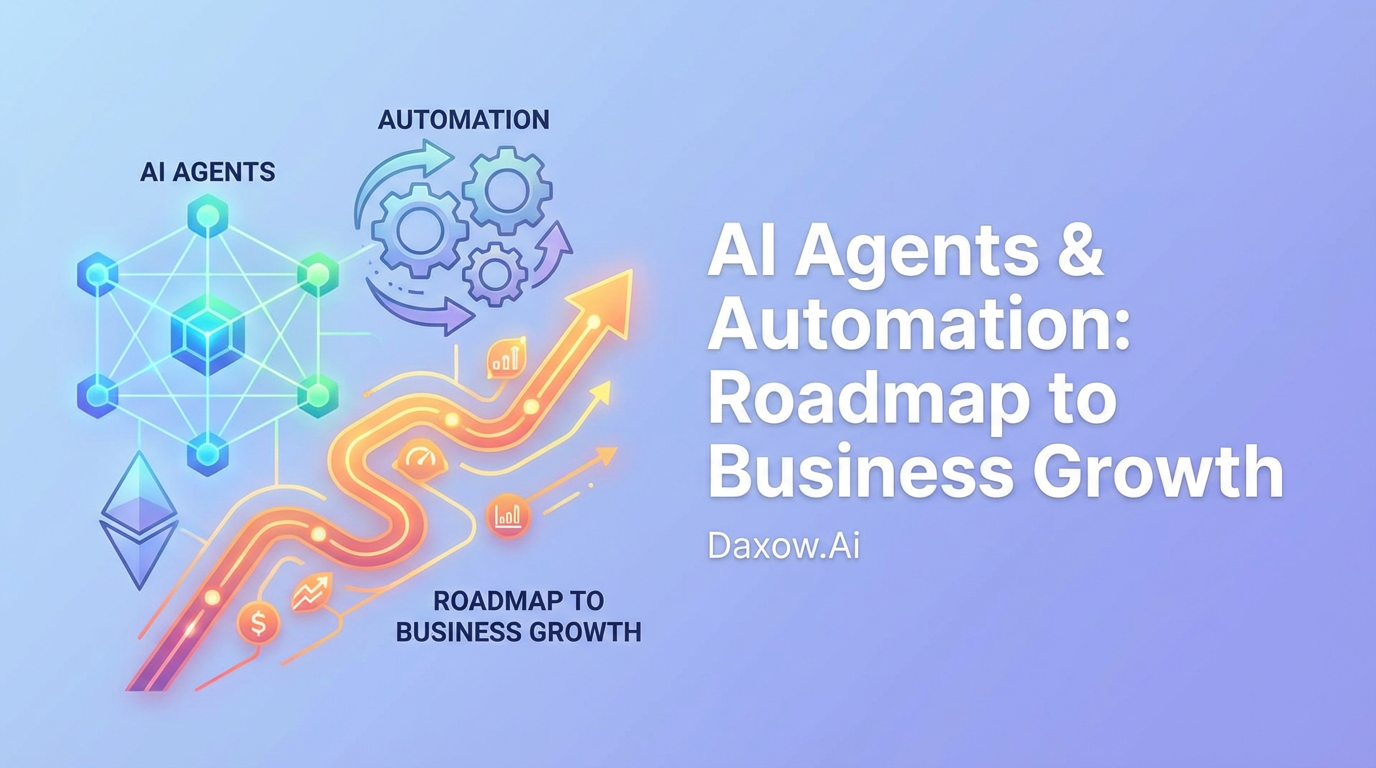
Learn how AI agents and workflow automation cut costs, boost productivity, and improve CX with industry use cases and a practical implementation roadmap.
Unlocking Business Growth: The Strategic Imperative of AI Agents and Automation
Estimated reading time: 15 minutes
Key Takeaways
- AI agents and automation enable scalable, efficient business processes by reducing manual tasks and improving productivity.
- Industries such as e-commerce, healthcare, finance, real estate, and HR benefit significantly from targeted AI automation use cases.
- Implementing AI-driven automation requires a structured roadmap including assessment, vendor selection, team building, piloting, and optimization.
- Measuring ROI focuses on cost savings, productivity, customer outcomes, and compliance improvements.
- Daxow.ai offers custom AI agent design and end-to-end automation services tailored to drive measurable business value.
Table of Contents
- Unlocking Business Growth: The Strategic Imperative of AI Agents and Automation
- What AI Agents and Automation Mean for Businesses
- Practical Use Cases Across Industries
- How AI Agents Drive Business Transformation
- Implementation Roadmap and Best Practices
- Measuring ROI and Business Value
- How Daxow.ai Designs and Delivers Custom AI Automation
- Practical Checklist for Decision-Makers
- Next Steps — Get Started with Daxow.ai
- Frequently Asked Questions
Unlocking Business Growth: The Strategic Imperative of AI Agents and Automation
Unlocking Business Growth: The Strategic Imperative of AI Agents and Automation is no longer a theoretical advantage — it is a competitive requirement. Decision-makers face pressure to reduce manual work, increase speed, and improve customer experience while managing costs. AI automation and intelligent AI agents convert repetitive, rule-based tasks into scalable processes, deliver real-time insights, and free human teams for higher-value activities. This article outlines what that means in practice, provides industry-specific use cases, and gives a clear implementation roadmap you can apply today.
Why this matters now
- Market leaders are using workflow automation and AI agents to scale without proportional headcount growth.
- Targeted automation can yield 30–50% cost reductions in automated functions and 2–3x productivity gains.
- Organizations that adopt AI-driven business automation gain agility, faster cycle times, and improved customer experience — measurable advantages for revenue and retention.
What AI Agents and Automation Mean for Businesses
Definitions and core capabilities
- AI agents: Autonomous systems that execute tasks, make decisions, and interact with data and humans using machine learning and natural language processing.
- Workflow automation: Orchestrated sequences that move work across systems and people without manual handoffs.
- Together, they create systems that are proactive, integrated, and continuously improving.
Business outcomes to expect
- Reduce manual tasks by automating high-volume, rule-based processes.
- Improve productivity by reallocating staff from repetitive work to strategic roles.
- Enhance customer experience through 24/7 support, faster response times, and personalized interactions.
- Drive measurable ROI via reduced cycle times, lower error rates, and predictable operational costs.
Practical Use Cases Across Industries
AI agents and business automation produce the greatest value where volume, rules, and repetitive steps prevail. Below are concrete, actionable use cases with expected benefits.
E-commerce
- Use case: Order processing, returns automation, inventory forecasting, and personalized upsell flows.
- How it works: AI agents pull order data from the commerce platform, check inventory levels in real time, trigger fulfillment workflows in the warehouse management system, and update customers via automated messaging.
- Impact: Reduced cart abandonment, faster fulfillment, and lower return handling time. Expected outcome: customer support ticket volumes drop, allowing teams to focus on high-value retention activities.
Healthcare
- Use case: Patient scheduling, remote triage, and automated record updates with compliance controls.
- How it works: Conversational AI collects symptom data, triages urgency, schedules appointments with clinical staff, and logs interactions into patient records with HIPAA-aligned controls.
- Impact: Less administrative burden for clinicians, faster patient access to care, and reduced no-show rates through automated reminders.
Finance
- Use case: Invoice processing, fraud detection, and compliance monitoring.
- How it works: AI extracts data from incoming invoices, validates entries against purchase orders, flags anomalies for review, and updates accounting systems automatically.
- Impact: Processing times drop from days to minutes, fraud indicators are surfaced faster, and audit readiness improves.
Real Estate
- Use case: Lead qualification, virtual tour scheduling, and automated property valuations.
- How it works: AI agents qualify inbound leads using predefined criteria, schedule viewings, and generate market-based valuation estimates that feed CRM records for follow-up.
- Impact: Faster conversions, higher agent efficiency, and personalized client outreach.
Human Resources
- Use case: Resume screening, onboarding workflows, and employee self-service.
- How it works: AI parses resumes, ranks candidates by fit, automates offer and documentation workflows, and powers chatbots for common HR queries.
- Impact: Shorter time-to-hire, improved candidate experience, and reduced HR administrative load.
How AI Agents Drive Business Transformation
From automation to autonomy
- Traditional automation executes pre-defined steps. AI agents go further by reasoning across systems, escalating exceptions, and learning from outcomes.
- They connect CRMs, ERPs, knowledge bases, and third-party APIs to execute end-to-end processes without manual intervention.
Operational advantages
- Scalability: Handle high volumes without proportional increases in headcount.
- Speed: Achieve outcomes 3–5x faster for many processes compared to manual methods.
- Accuracy: Reduce human error in data entry and rule-based decisioning.
- Continuous improvement: Agents refine performance through feedback loops and retraining based on monitored metrics.
Implementation Roadmap and Best Practices
A structured, phased approach minimizes risk and maximizes adoption. The following roadmap synthesizes best practices for enterprise and mid-market deployments.
Phase 1 — Assessment and Planning (4–8 weeks)
- Identify business outcomes (e.g., cost reduction, resolution time improvements).
- Map current processes and quantify volume and effort for repetitive tasks.
- Prioritize use cases with high volume, clear rules, and measurable ROI.
- Deliverable: A prioritized automation roadmap with success metrics.
Phase 2 — Technology and Vendor Selection (6–12 weeks)
- Evaluate platforms for integration capability, scalability, security, and compliance.
- Favor solutions that support no-code or low-code prototyping for rapid validation.
- Ensure vendors can integrate with key systems (CRM, ERP, support desks).
- Deliverable: Technology stack and vendor shortlist with proof-of-concept plans.
Phase 3 — Team Assembly and Data Preparation (4–8 weeks)
- Build a cross-functional team: product owner, SMEs, data engineers, and change leads.
- Clean and standardize data sources and build knowledge bases.
- Define escalation paths for exceptions and compliance checks.
- Deliverable: Clean datasets, documented workflows, and governance model.
Phase 4 — Pilot and Deployment (4–20 weeks)
- Launch pilots on a single use case or business unit.
- Measure outcomes against defined KPIs: time saved, error rates, cost per transaction, NPS.
- Iterate quickly using feedback, then scale incrementally.
- Deliverable: Operational pilot with defined scaling plan.
Phase 5 — Ongoing Optimization
- Establish monitoring, retraining cycles, and a continuous improvement cadence.
- Revisit performance metrics and expand automation to adjacent processes.
- Maintain governance for security, compliance, and ethical AI usage.
Best practices summary
- Start small for quick wins; scale with proven value.
- Prioritize data quality and systems integration from day one.
- Invest in change management and reskilling programs.
- Maintain clear risk and communication plans to minimize disruption.
Measuring ROI and Business Value
Which metrics matter
- Cost savings: reductions in FTE effort, processing costs, and error remediation.
- Productivity: transactions per employee, cycle time reductions, and throughput gains.
- Customer outcomes: support ticket volumes, resolution time, NPS, and churn rates.
- Compliance and risk: audit time reductions and fewer compliance incidents.
Typical financial outcomes
- Short-term pilots often produce ROI within months for customer support and finance processes.
- Targeted automation can deliver 30–50% cost reductions in automated areas and 2–3x productivity gains.
- Strategic programs yield cumulative benefits: faster revenue cycles, improved margins, and predictable operating models.
How Daxow.ai Designs and Delivers Custom AI Automation
Our approach
- We begin with a structured process analysis to identify high-impact automation opportunities aligned to your strategic goals.
- We design custom AI agents that execute real tasks — from lead qualification and sales automation to customer support automation and document extraction.
- We build end-to-end workflow automation, integrating with CRMs, ERPs, ticketing systems, and bespoke databases.
What Daxow.ai delivers
- Custom AI agents that reason across systems and execute multi-step workflows autonomously.
- Workflow automation tailored to business logic with robust exception handling and auditing.
- Chatbots and support automation that reduce response times and increase self-service rates.
- Sales automation and lead qualification that accelerate pipeline conversion and reduce manual outreach load.
- Data extraction and document automation to eliminate manual data entry and speed processing.
- Systems integrations and data connectivity to ensure real-time accuracy across platforms.
Why Daxow.ai
- End-to-end service: from process discovery to delivery and continuous optimization.
- Focus on business value: we prioritize measurable outcomes and build to ROI targets.
- Compliance-first design: we implement data controls, audit trails, and governance to meet industry standards.
- Flexible delivery: modular implementations that fit teams of all sizes and scale with growth.
Practical Checklist for Decision-Makers
Use this checklist to evaluate readiness and plan a successful AI automation program:
- Have you documented high-volume processes and quantified manual effort?
- Do you have clear, measurable goals (cost reduction, speed, CSAT)?
- Are your core systems (CRM, ERP, ticketing) integration-ready?
- Is data quality sufficient for confident automation?
- Have you assigned an executive sponsor and cross-functional team?
- Is there a pilot plan with defined KPIs and timelines?
Next Steps — Get Started with Daxow.ai
AI automation and AI agents are available today to transform operations, reduce manual tasks, and unlock lasting business growth. Daxow.ai helps companies assess processes, build custom agents, automate workflows, and integrate systems end-to-end — delivering measurable ROI and improved customer and employee experiences.
Book a free consultation with Daxow.ai to request a process analysis for your company. Contact us to build a custom AI system that reduces operational costs, increases productivity, and scales with your business.
Frequently Asked Questions
What are AI agents and how do they differ from traditional automation?
AI agents are autonomous systems capable of reasoning, decision-making, and learning across multiple systems, whereas traditional automation executes predefined, fixed sequences without adaptation.
Which industries benefit most from AI agents and automation?
Industries with high-volume, rule-based processes such as e-commerce, healthcare, finance, real estate, and human resources see significant value from AI automation.
How does Daxow.ai ensure compliance in AI automation?
Daxow.ai incorporates data controls, audit trails, and governance frameworks that align with industry standards and regulations to ensure compliance and ethical AI usage.
What should companies prioritize when starting AI automation initiatives?
Companies should focus on identifying measurable business outcomes, ensuring strong data quality, selecting integration-ready systems, and assembling a cross-functional team for successful AI automation adoption.