
Implementing AI Agents and Automation for Business Growth
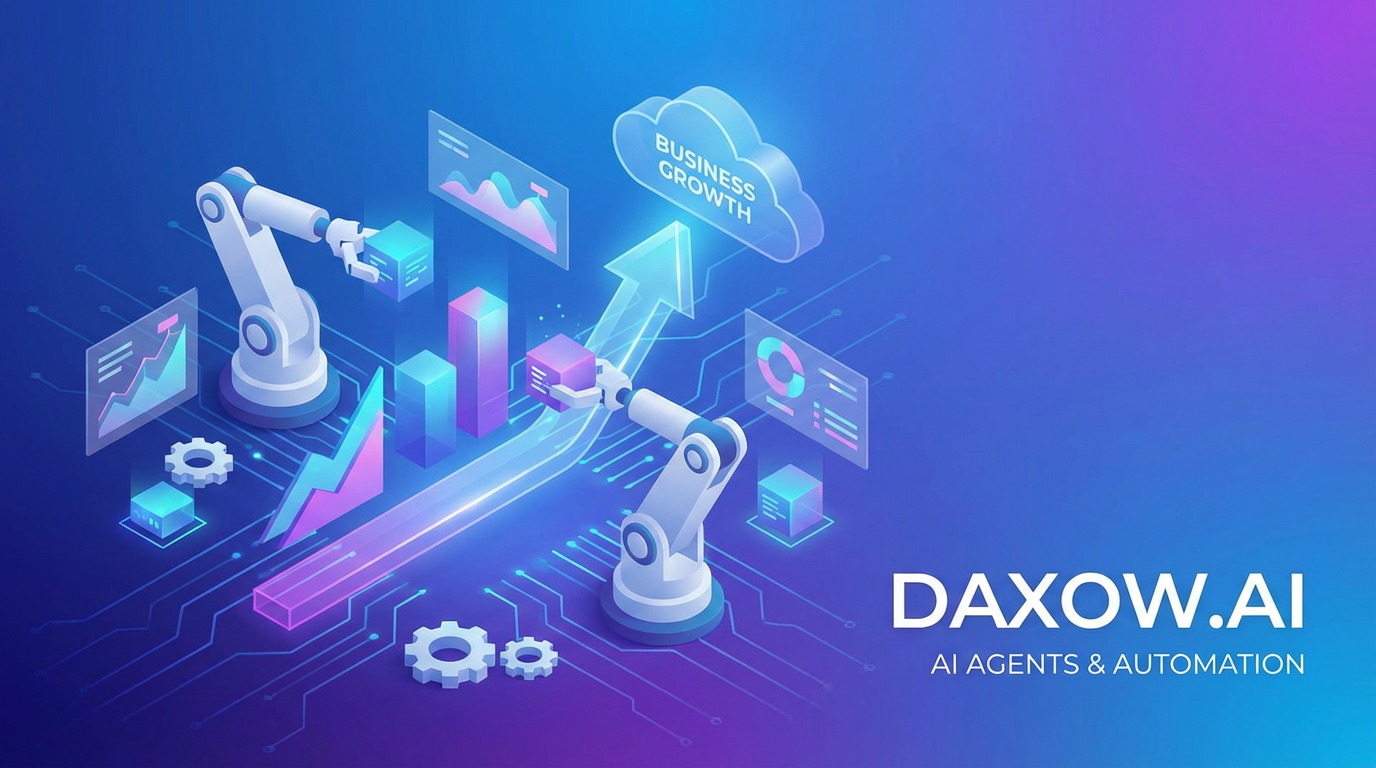
Practical roadmap to deploy AI agents and workflow automation: use cases, KPIs, implementation steps, and ROI expectations. Daxow.ai offers pilot services.
Unlocking Business Growth: Implementing AI Agents and Automation for Intelligent Process Optimization
Estimated reading time: 12 minutes
Key Takeaways
- Combining AI agents with workflow automation drives productivity improvements of 20–50% and cost reductions of 40–60%.
- AI automation enables scalable operations, enhanced customer experience, and risk mitigation across industries.
- A structured implementation roadmap is essential for successful adoption, including goal-setting, tool selection, piloting, and continuous optimization.
- Daxow.ai delivers end-to-end AI automation services, integrating systems and building custom AI agents tailored to business needs.
- Measuring ROI requires baseline cost analysis, estimating automation impact, and accounting for both tangible and intangible benefits.
Table of Contents
- Unlocking Business Growth: Implementing AI Agents and Automation for Intelligent Process Optimization
- Business value and measurable outcomes
- Practical use cases across industries
- Implementation roadmap — step-by-step, practical, and iterative
- Common pitfalls and how to avoid them
- Architecture and integration considerations
- Measuring ROI and setting realistic expectations
- How Daxow.ai helps — end-to-end AI automation services
- Actionable checklist to get started this quarter
- Final considerations and next steps
- Frequently Asked Questions
Unlocking Business Growth: Implementing AI Agents and Automation for Intelligent Process Optimization
Unlocking Business Growth: Implementing AI Agents and Automation for Intelligent Process Optimization is no longer theoretical — it is a pragmatic roadmap for organizations that want to reduce manual work, boost productivity, and scale operations without linear headcount increases. For business owners, operations leaders, and CTOs, this topic answers a core question: how do you convert repetitive, error-prone tasks into reliable, measurable business outcomes using AI automation and workflow automation?
This article lays out a structured, actionable approach to adoption. It summarizes proven research-backed benefits, industry use cases, implementation steps, pitfalls to avoid, and measurable ROI expectations. Throughout, you’ll see how Daxow.ai — founded in Estonia in 2024 — helps design and deploy custom AI systems, build AI agents that execute real tasks, and integrate automation across enterprise systems.
Why the combination of AI agents and automation matters
- AI agents are autonomous software entities that take actions, reason over data, and interact with systems and people.
- Workflow automation standardizes and executes repeatable processes reliably and at scale.
- Together they create intelligent process automation or hyperautomation: systems that not only run workflows but also adapt, make predictions, and handle unstructured inputs like documents and conversations.
Research and enterprise experience show this combination can lift targeted process productivity by 20–50%, reduce manual processing costs by 40–60%, and produce significant gains in customer satisfaction and speed-to-decision. In finance and fraud detection scenarios, accuracy improvements above 95% are achievable when models are applied correctly.
Business value and measurable outcomes
Core value drivers
- Reduce manual tasks: Minimize repetitive data entry, routing, and reconciliation.
- Improve productivity: Reallocate team capacity to strategic activities that create higher business value.
- Enhance customer experience: Faster response times and consistent outcomes via customer support automation and AI-enabled chatbots.
- Mitigate risk: Predictive models and monitoring reduce operational surprises and fraud exposure.
- Scale efficiently: Add throughput without proportional increases in operational headcount.
KPIs to track from day one
- Processing time per transaction (pre- and post-automation)
- Error rate and exception volume
- Cost per case or customer
- Lead-to-conversion rate for sales automation
- NPS or CSAT for customer support automation
- Model performance metrics (accuracy, F1 score, precision/recall)
- Time to onboard a new process into automation
Practical use cases across industries
Below are concrete examples showing how AI agents and automation translate into business impact. Each includes a short description of Daxow.ai’s role in designing end-to-end solutions.
E-commerce — sales automation and inventory forecasting
- Use case: An AI agent scans customer inquiries, classifies intent, qualifies leads, and routes high-value prospects to sales reps. Concurrently, workflow automation updates inventory levels and triggers replenishment orders.
- Business impact: Faster lead qualification increases conversion rates; predictive supply chain models reduce stockouts and holding costs.
- Daxow.ai role: Build lead qualification agents, integrate CRM, automate order workflows, and connect ERP data for demand forecasting.
Healthcare — document automation and patient triage
- Use case: Automate extraction of structured data from patient records and insurance forms; triage inbound patient messages with a conversational AI that hands complex cases to nurses.
- Business impact: Reduced administrative overhead, faster patient response times, improved regulatory compliance.
- Daxow.ai role: Implement document extraction pipelines, ensure privacy-preserving integrations, and deploy compliant chatbots that escalate appropriately.
Finance — fraud detection and reconciliation
- Use case: Real-time transaction monitoring with ML models flags anomalous activity; automated reconciliation resolves common discrepancies and routes exceptions to investigators.
- Business impact: Higher fraud detection rates, faster closing cycles, reduced audit costs.
- Daxow.ai role: Design detection models, connect to ledger systems, and automate exception workflows to reduce manual review volume.
Real estate — market analysis and lead nurturing
- Use case: Agents analyze market datasets to detect pricing trends, auto-generate listing descriptions, and qualify buyer intent from multi-channel leads.
- Business impact: Faster deal cycles, improved pricing decisions, and higher lead conversion.
- Daxow.ai role: Integrate MLS data, build analytics agents, and automate CRM updates and follow-ups.
HR — resume screening and onboarding automation
- Use case: NLP-based resume parsing and candidate scoring; automated onboarding workflows that provision accounts, schedule training, and collect documentation.
- Business impact: Faster hiring cycles, lower recruiter admin time, improved new-hire experience.
- Daxow.ai role: Deploy resume parsers, integrate HRIS and ATS, and orchestrate onboarding workflows.
Logistics & Manufacturing — predictive maintenance and dispatch
- Use case: Agents analyze telemetry and schedule maintenance proactively; workflow automation manages parts ordering and technician dispatch.
- Business impact: Reduced downtime, optimized maintenance spend, and improved delivery reliability.
- Daxow.ai role: Connect IoT and ERP systems, create alerting agents, and automate dispatch workflows.
Implementation roadmap — step-by-step, practical, and iterative
1. Define clear goals and prioritize high-impact processes
- Identify processes with high volume, error rates, or manual costs: invoice reconciliation, lead qualification, customer refunds.
- Set measurable KPIs (e.g., reduce processing time by 30%, decrease exceptions by 40%).
2. Assess data quality and readiness
- Audit data sources for completeness and formats.
- Establish data pipelines to standardize inputs for AI agents and workflow automation.
- Address privacy and compliance requirements early.
3. Select the right tools and architecture
- Choose platforms that support integration with your CRM, ERP, helpdesk, and collaboration tools.
- Use NLP for unstructured text, OCR and document automation for forms, and ML models for prediction tasks.
- Architect for observability: logging, monitoring, and explainability for models.
4. Build a cross-functional team
- Combine data engineers, ML specialists, product owners, process SMEs, and operations leads.
- Use a single product owner to maintain business alignment and avoid scope drift.
5. Pilot, test, and iterate
- Start with a focused pilot on a single process with clear KPIs.
- Validate model performance using holdout datasets; measure business outcomes, not just model metrics.
- Incorporate human-in-the-loop controls for exceptions during rollout.
6. Deploy, monitor, and optimize continuously
- Implement dashboards for operational KPIs and model performance.
- Schedule retraining where data drift occurs.
- Automate alerts for exceptions to prevent “set and forget” failures.
7. Invest in change management
- Train teams on new workflows and establish escalation paths.
- Communicate expected gains and reallocated responsibilities.
- Monitor adoption and address shadow automation by documenting processes.
Common pitfalls and how to avoid them
- Vague objectives: Start with measurable business outcomes, not technology for technology’s sake.
- Poor data hygiene: Invest early in data cleaning and pipelines to avoid unreliable AI outputs.
- Over-automation: Preserve checks and human oversight where decisions have legal or safety implications.
- Tool complexity: Prioritize platforms with strong integration capabilities and vendor support.
- Lack of governance: Establish model governance for bias mitigation, compliance, and audit trails.
- Ignoring change management: Employee resistance and shadow systems can negate potential gains.
Architecture and integration considerations
- Data connectivity: Secure ETL/ELT pipelines from source systems (CRM, ERP, HCM, ticketing).
- Microservices & event-driven workflows: Use modular services so AI agents can trigger and be triggered by business events.
- Security & compliance: Encrypt data at rest and in transit; implement role-based access and logging for audits.
- Observability: Build monitoring for latency, throughput, model drift, and business KPIs.
- API-first design: Ensure AI agents and automation workflows expose APIs for reuse across teams.
Daxow.ai specializes in designing these architectures and connecting your existing systems to intelligent automation layers, ensuring data consistency and reliable execution.
Measuring ROI and setting realistic expectations
- Short-term wins: Expect reduced handling times and lower headcount on manual tasks within 3–6 months for focused pilots.
- Mid-term outcomes: Process productivity improvements of 20–50% and manual processing cost reductions of 40–60% are common in targeted workflows.
- Long-term value: Organizations can realize 3–5x returns within 12–18 months by combining operational savings with revenue uplifts from sales automation and better customer retention.
How to compute ROI:
- Baseline current costs: FTE hours, error rework, and cycle times.
- Estimate automation impact: reduction in FTE hours, error rate improvements, and increased throughput.
- Add revenue uplifts: faster lead follow-up and personalization can improve conversions.
- Subtract implementation and running costs: platform fees, engineering, monitoring.
- Account for intangible benefits: employee engagement, faster decisions, and risk reduction.
How Daxow.ai helps — end-to-end AI automation services
Daxow.ai offers a full lifecycle approach tailored for decision-makers and operations teams:
- Discovery & Process Analysis: We map your workflows, quantify manual tasks, and identify high-ROI automation candidates.
- Custom AI Agents: We design agents that interpret documents, converse with customers, and take actions across systems.
- Workflow Automation: We automate end-to-end processes, orchestrating systems from CRM to ERP and ticketing platforms.
- Chatbots & Customer Support Automation: We build conversational agents that handle tier-1 support and escalate complex issues.
- Lead Qualification & Sales Automation: We deploy agents that score leads and automate nurture sequences to increase conversion.
- Data Extraction & Document Automation: We extract structured data from unstructured documents and integrate it into your systems.
- Integrations & Systems Connectivity: We connect data sources, ensure secure pipelines, and implement API-first solutions.
- Monitoring & Continuous Improvement: We deliver dashboards, retraining pipelines, and operations support to sustain gains.
Daxow.ai works with your team to ensure solutions are production-ready, compliant, and aligned to measurable business goals. Our approach minimizes risk and accelerates time-to-value.
Actionable checklist to get started this quarter
- Identify 1–3 high-volume, high-cost processes to pilot.
- Establish baseline KPIs and success criteria.
- Assemble a small cross-functional team and appoint a product owner.
- Secure access to relevant data and prioritize data hygiene tasks.
- Choose a vendor partner or design an architecture that supports integrations.
- Plan a 6–12 week pilot with measurable outcomes and a defined rollback strategy.
- Prepare change management communication and training materials.
Final considerations and next steps
Implementing AI agents and workflow automation is transformational but requires a disciplined, measurable approach. Start small, focus on high-impact processes, and build governance and monitoring from day one. When executed properly, these technologies deliver both cost savings and strategic advantages: faster decision-making, better customer experiences, and scalable operations.
Daxow.ai combines domain expertise, engineering capability, and a business-first approach to help organizations unlock these benefits. We design AI agents that execute real tasks, integrate systems end-to-end, and optimize processes to deliver quantifiable ROI.
Contact Daxow.ai to request a process analysis and start your journey toward intelligent process optimization. Book a free consultation today to explore how AI automation, workflow automation, and AI agents can reduce manual tasks, increase productivity, and transform your business.
Frequently Asked Questions
What are AI agents and how do they differ from traditional automation?
AI agents are autonomous software entities capable of reasoning, decision-making, and interacting with data and users, unlike traditional automation which strictly follows predefined rules.
How do I measure the success of AI automation projects?
Success is measured through KPIs such as reduced processing times, lower error rates, cost savings, improved customer satisfaction, and increased throughput, all tracked before and after implementation.
What industries benefit most from AI and workflow automation?
AI and workflow automation benefit diverse industries including e-commerce, healthcare, finance, real estate, HR, logistics, and manufacturing by optimizing core processes and reducing manual workload.
How does Daxow.ai support integration with existing systems?
Daxow.ai specializes in API-first integration, connecting CRM, ERP, HCM, and ticketing systems securely and seamlessly to automation layers and AI agents for end-to-end workflow orchestration.