
AI Agents and Automation for Business Growth
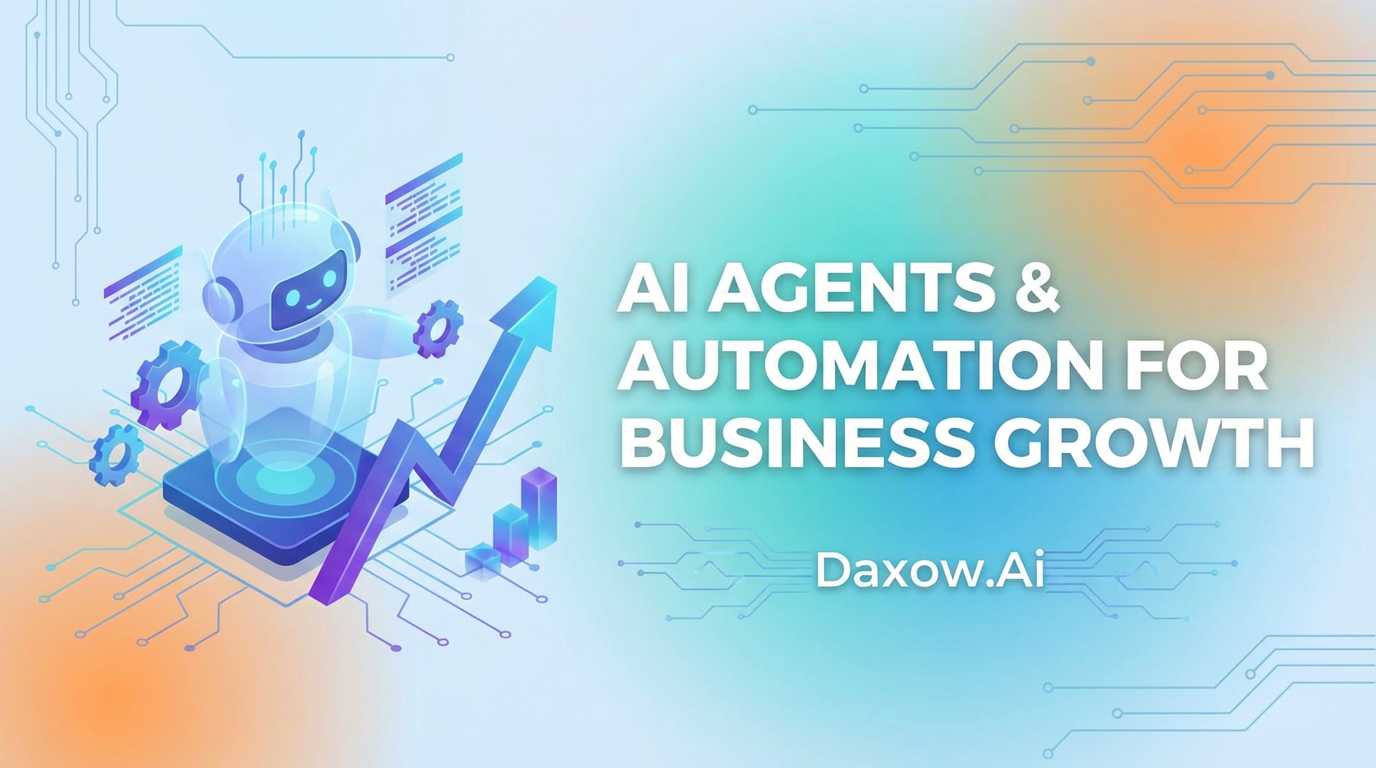
Learn how AI agents and workflow automation reduce manual work, boost productivity, and deliver ROI — use cases, roadmap, and Daxow.ai implementation services.
Unlocking Business Growth: The Power of AI Agents and Automation
Estimated reading time: 12 minutes
Key Takeaways
- AI agents and automation reduce manual tasks while boosting productivity and accuracy.
- Business operations scale effectively without proportional increases in headcount.
- Cross-industry use cases demonstrate measurable ROI often within 12 months.
- Successful implementations follow a phased roadmap with continuous optimization.
- Daxow.ai offers custom AI solutions aligned to workflows and compliance requirements.
Table of Contents
- Introduction
- What AI Agents and Automation Mean for Your Business
- How AI Agents and Automation Drive Efficiency
- Use Cases and Practical Examples Across Industries
- Implementation Roadmap: Phased and Practical
- Best Practices and Pitfalls to Avoid
- Measuring ROI and Delivering Business Value
- How Daxow.ai Helps You Unlock Growth with AI Agents and Automation
- Checklist for Decision-Makers: Preparing for Implementation
- Conclusion and Call to Action
- Frequently Asked Questions
Introduction
Unlocking Business Growth: The Power of AI Agents and Automation is no longer a theoretical advantage—it is a competitive requirement. For business owners, CTOs, operations managers and leaders across industries, intelligently applied AI automation and AI agents convert manual, error-prone work into fast, reliable, scalable digital processes. This article synthesizes current research and proven practice into an actionable guide: what these technologies deliver, where to start, how to measure value, and how Daxow.ai helps design and implement custom systems that reduce manual tasks, boost productivity, and drive measurable ROI.
What AI Agents and Automation Mean for Your Business
AI agents are autonomous or semi-autonomous software entities that execute tasks, make context-aware decisions, and interact with systems and people. Workflow automation complements agents by codifying rule-based tasks into repeatable, monitored processes. Together they form the backbone of business automation.
Key business outcomes:
- Reduce manual tasks and repetitive work, freeing staff for strategic initiatives.
- Increase productivity by enabling 24/7 operations and faster resolution times.
- Improve accuracy and compliance, especially in regulated industries.
- Scale operations without proportional headcount increases, supporting growth for 3–5 years without major infrastructure changes.
- Deliver measurable cost savings—research shows targeted reductions of 20–50% in automated areas and ROI timelines often under 12 months.
How AI Agents and Automation Drive Efficiency
AI agents connect to CRMs, ERPs, knowledge bases, and back-end systems to complete end-to-end workflows. Rather than merely automating a single step, an agent can orchestrate a multi-step process: extract data from documents, validate it against rules, update a CRM, notify stakeholders, and escalate exceptions.
What this delivers in practice:
- Fewer manual handoffs, reducing delays and error propagation.
- Faster task completion—many implementations yield 50% faster throughput on automated tasks.
- Continuous improvement through feedback loops: agents learn from outcomes and refine decision criteria.
- Better customer experience via personalized, consistent interactions across channels.
Use Cases and Practical Examples Across Industries
E-commerce — faster fulfillment and higher conversion rates
- Automate order processing, returns handling, and inventory updates.
- Deploy customer support automation (chatbots and agents) that answer order status, process refunds, and provide personalized recommendations.
- Use predictive agents to forecast stock needs and trigger procurement workflows.
Business value: reduced fulfillment errors, improved conversion rates, and lower support costs.
Healthcare — streamlined admin and safer triage
- Automate patient scheduling, reminders, and initial symptom triage.
- Use document automation to extract clinical data and update patient records while enforcing HIPAA-compliant processes.
- Implement escalation agents that flag urgent cases to clinicians.
Business value: reduced administrative burden, shorter wait times, and better resource utilization.
Finance — faster processing and stronger compliance
- Automate invoice capture, reconciliation, and exception handling using document intelligence.
- Deploy real-time monitoring agents for fraud detection and compliance checks.
- Use rule-based loan pre-qualification and document verification agents.
Business value: accelerated audits, lower risk exposure, and faster financial processing cycles.
Real estate — qualified leads and shorter sales cycles
- Automated lead qualification and scheduling agents that match buyer preferences to listings.
- Agents conduct preliminary document checks and prepare contracts for human review.
Business value: higher-quality leads, faster time-to-offer, and reduced administrative overhead.
Human Resources — improved hiring and onboarding
- Automate resume screening, interview scheduling, and onboarding checklists.
- Agents run benefits enrollment flows and payroll verifications.
Business value: higher hire quality, smoother onboarding, and less HR administrative time.
Customer support and sales automation
- Customer support automation: AI agents resolve routine tickets, escalate complex issues, and maintain knowledge bases to keep responses consistent.
- Sales automation: AI agents qualify leads, prioritize outreach, schedule meetings, and prepare summary dossiers for reps.
Business value: faster response times, improved customer satisfaction scores, and more efficient sales funnels.
Implementation Roadmap: Phased and Practical
1. Assess and Plan (4–8 weeks)
- Map existing workflows and identify high-impact processes with an impact-effort matrix.
- Interview frontline teams to surface pain points and bottlenecks.
- Define success metrics (e.g., reduction in handling time, cost per transaction, CSAT).
- Select initial pilot use cases that are high-volume and low complexity.
Best practice: start small with quick wins to build momentum.
2. Select Technology and Vendor (6–12 weeks)
- Evaluate platforms for scalability, API integrations, security and compliance needs.
- Prioritize solutions that support agentic models and can be tailored to your product and internal data.
- Validate vendor experience in your industry and request references.
Best practice: involve IT and security early to streamline integrations.
3. Prepare Systems and Data (4–8 weeks)
- Cleanse and normalize data sources; build a decision-ready knowledge base.
- Document current workflows and expected exception paths.
- Define escalation and audit trails to satisfy compliance requirements.
Best practice: data quality is foundational—poor inputs lead to poor outcomes.
4. Pilot and Test
- Deploy to a subset of customers, channels, or internal teams.
- Monitor KPIs closely: resolution rates, error rates, processing time, cost per case.
- Iterate on agent rules, training prompts and knowledge bases based on feedback.
Best practice: rigorous piloting reduces risk and uncovers hidden complexities.
5. Gradual Rollout and Continuous Optimization
- Expand scope in waves, adding channels, use cases, and integrations.
- Implement monitoring dashboards and a monthly review cadence.
- Maintain a cross-functional operations team for ongoing improvements.
Best practice: plan for continuous improvement rather than a one-time deployment.
Best Practices and Pitfalls to Avoid
- Involve end-users and IT early to ensure practical integration and adoption.
- Keep scope realistic: favor automating repeatable, high-volume tasks first.
- Protect data and ensure compliance for regulated sectors (e.g., HIPAA, financial controls).
- Plan for exceptions: define how the system escalates to humans and logs decisions.
- Measure continuously and tie automation metrics to business outcomes like cost, throughput and customer satisfaction.
Avoid: overambitious scope, poor data preparation, lack of cross-functional governance.
Measuring ROI and Delivering Business Value
Decision-makers need clear metrics tied to strategic goals. Research and deployments show that AI automation projects, when executed with best practices, deliver:
- 20–40% cost reductions in automated processes.
- 30–50% reductions in targeted operational costs for well-scoped agent implementations.
- 50% faster task completion on routine workflows.
- Typical ROI timelines are under 12 months for high-impact automations, with pilots often proving value in weeks.
Key ROI metrics to track:
- Cost per transaction before and after automation.
- Cycle time reductions (e.g., time to resolve a ticket).
- First-contact resolution and CSAT for customer-facing automations.
- Volume of exceptions requiring human intervention.
- Headcount reallocation: hours freed for strategic work.
How Daxow.ai Helps You Unlock Growth with AI Agents and Automation
Daxow.ai offers an end-to-end service model designed for measurable business outcomes. We specialize in designing custom AI systems that align with your workflows, data architecture and security requirements.
Our approach:
- Discovery and process analysis: We map workflows, identify bottlenecks and quantify potential ROI.
- Custom AI agent design: We build agents that execute real tasks—from lead qualification to invoice processing—not just chat prototypes.
- Workflow automation and integration: We connect agents to CRMs, ERPs, knowledge bases, and third-party tools to automate entire processes.
- Compliance and governance: We implement secure, auditable flows tailored to industry requirements.
- Pilot-to-scale delivery: We run focused pilots, measure results, and iterate for broader rollout.
- Ongoing optimization: Post-deployment monitoring and incremental improvements ensure sustained ROI.
Practical Daxow.ai examples
- E-commerce client: Implemented order-processing agents and customer support automation, reducing fulfillment errors and cutting support costs by a significant margin within three months.
- Healthcare provider: Deployed scheduling and triage agents with secure EHR integrations, lowering no-show rates and administrative time.
- Finance firm: Built invoice automation with fraud-detection agents, accelerating reconciliations and improving audit readiness.
Checklist for Decision-Makers: Preparing for Implementation
- Identify 1–2 pilot processes that are high-volume and well-defined.
- Assemble a cross-functional team: operations, IT, compliance, and end-users.
- Establish success metrics and a tracking dashboard.
- Prepare data sources and list integration endpoints (CRM, ERP, document stores).
- Define exception and escalation workflows.
- Budget for pilot and a phased rollout with optimization cycles.
Conclusion and Call to Action
Unlocking Business Growth: The Power of AI Agents and Automation is within reach for organizations that plan pragmatically and partner with experienced implementers. AI automation and AI agents translate into fewer manual tasks, higher productivity, better customer experiences, and measurable cost savings—often with ROI inside one year.
If you are ready to evaluate opportunities in your business, Daxow.ai can help you assess processes, design custom AI agents, and deliver end-to-end workflow automation that drives measurable results.
Book a free consultation or request a process analysis for your company to begin building a custom AI system that reduces manual work, improves productivity, and accelerates business growth. Contact us today to get started.
Frequently Asked Questions
What are AI agents and how do they differ from traditional automation?
AI agents are autonomous or semi-autonomous software entities capable of making context-aware decisions and orchestrating multi-step workflows. Unlike traditional automation which typically follows fixed rule-based scripts, AI agents can adapt, learn from outcomes, and handle exceptions with increased flexibility.
How quickly can a business expect ROI from AI automation?
Many AI automation projects deliver measurable ROI within 12 months, especially when focused on high-volume, well-defined processes. Pilot programs often show value in just a few weeks.
Is AI automation suitable for all industries?
AI automation is effective across industries that have high-volume, repetitive or rule-based process components. Healthcare, finance, e-commerce, real estate, and HR are some examples, but each implementation should be tailored to specific regulatory and operational needs.
How does Daxow.ai ensure compliance with regulations?
Daxow.ai integrates compliance and governance as core components by defining audit trails, escalation paths, and secure data handling methods that align with industry standards such as HIPAA and financial regulations, ensuring that automation processes meet all necessary requirements.