
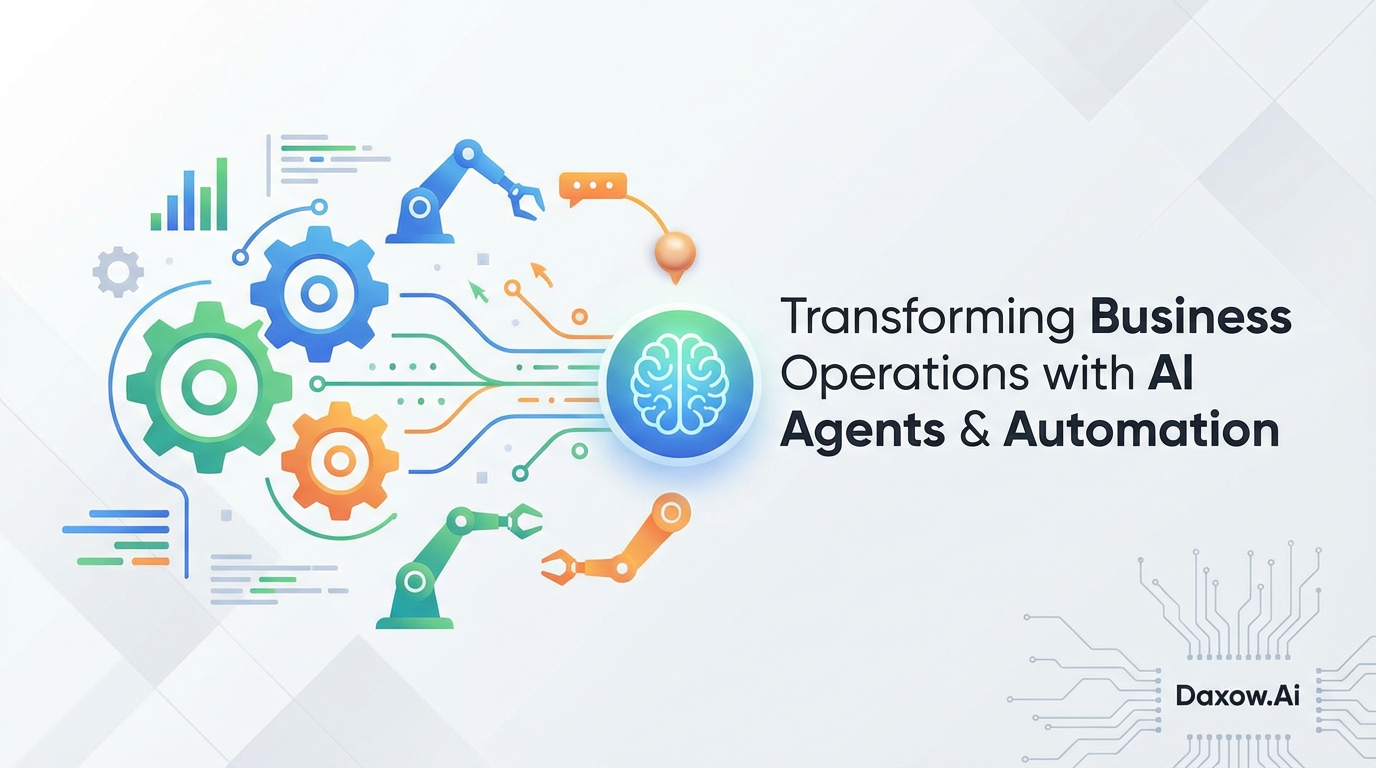
Transforming Business Operations with AI Agents & Automation
How AI agents and workflow automation streamline operations, cut costs, and boost productivity—use cases, implementation roadmap, and Daxow.ai solutions.
AI Agents and Automation: Transforming Business Operations for the Modern Enterprise
Estimated reading time: 15 minutes
Key Takeaways
- AI agents and automation reduce manual tasks while increasing speed and accuracy in workflows.
- Cross-industry use cases showcase impactful AI-driven efficiencies in e-commerce, healthcare, finance, and more.
- A phased implementation roadmap ensures scalable adoption and sustained optimization.
- Measuring KPIs like cost reductions, cycle time, and resolution rates demonstrates clear ROI.
- Daxow.ai specializes in custom AI automation solutions tailored to business goals.
Table of Contents
- Introduction
- AI Agents and Automation: What it Means for Your Business
- Practical Use Cases: AI Agents and Automation Across Industries
- Implementation Roadmap: From Assessment to Continuous Optimization
- Measuring ROI and Business Impact of AI Agents and Automation
- How Daxow.ai Delivers Custom AI Automation Solutions
- Getting Started: Practical Steps for Decision-Makers
- Conclusion and Call to Action
- Frequently Asked Questions
Introduction
AI Agents and Automation: Transforming Business Operations for the Modern Enterprise describes how intelligent, autonomous software combined with workflow automation is reshaping how organizations operate. For business owners, operations leaders, and technology decision-makers, this transformation means fewer manual tasks, faster decision cycles, and a measurable uplift in productivity. This article explains what these technologies deliver, shows practical cross-industry use cases, outlines a proven implementation roadmap, and explains how Daxow.ai builds custom AI systems to drive measurable business value.
AI Agents and Automation: What it Means for Your Business
Definition and core capabilities
- AI agents are autonomous software entities that perceive inputs, reason about context, make decisions, and execute actions across systems without constant human direction.
- Automation (workflow automation and business automation) provides the scaffolding that connects systems, enforces rules, and moves work items between people and systems.
- Together, AI agents and automation enable continuous, 24/7 operations that scale without linear headcount increases.
Why this matters now
- Reduce manual tasks that are error-prone and time-consuming, freeing teams to focus on strategy and customer relationships.
- Increase productivity through faster processing and decision-making; organizations see multi-fold acceleration in routine workflows when AI and automation are applied correctly.
- Improve customer experience by delivering predictable, faster responses and personalized interactions via customer support automation and AI-driven routing.
- Create resilient operations that adapt to changing volumes and edge cases through learning and continuous optimization.
How AI agents differ from classical bots
- Classical chatbots follow scripted rules. AI agents learn, adapt, and orchestrate across multiple systems (CRM, ERP, ticketing, databases).
- Agents can handle escalation logic, follow-ups, split complex tasks into subtasks, and provide analytics on process performance.
Practical Use Cases: AI Agents and Automation Across Industries
AI agents and workflow automation generate high impact wherever there are repetitive, rules-based tasks, high volume interactions, or complex multi-system handoffs.
E-commerce
- Use case: Automated order-to-cash orchestration.
- What it automates: Order verification, payment reconciliation, inventory updates, returns processing, and personalized shipping notifications.
- Business value: Faster fulfillment, reduced returns processing time, and higher conversion through tailored recommendations. Typical impact: lower fulfillment times by up to 50% and improved sales efficiency.
Customer Support and Service (All industries)
- Use case: 24/7 customer support automation with AI agents.
- What it automates: First-contact triage, intelligent routing to subject-matter agents, automated resolution of common requests, and follow-up workflows.
- Business value: Higher first-contact resolution, reduced average handling time, and consistent service levels across channels.
Healthcare
- Use case: Patient intake, triage, and appointment management.
- What it automates: Appointment booking, pre-visit questionnaires, triage of symptoms via compliant conversational AI, and records synchronization.
- Business value: Reduced administrative overhead, faster patient throughput, and improved clinician productivity while maintaining compliance.
Finance and Accounting
- Use case: Invoice processing, fraud detection, and compliance monitoring.
- What it automates: Data extraction from invoices, three-way matching, anomaly detection for fraud, and automated audit trails.
- Business value: Reduced processing costs (often by 30–50% on routine tasks), fewer manual errors, faster approvals, and better regulatory readiness.
Real Estate
- Use case: Lead qualification and property lifecycle automation.
- What it automates: Lead scoring, automatic property valuations using market data, scheduling viewings, and follow-up workflows.
- Business value: Shorter sales cycles, improved lead-to-close conversion rates, and better utilization of agents’ time.
Human Resources
- Use case: Screening, interviewing and onboarding automation.
- What it automates: Resume parsing, pre-screen conversational interviews, automated scheduling, offer generation, and onboarding checklists.
- Business value: Faster hiring processes, consistent candidate experience, and reduced time-to-productivity for new hires.
Manufacturing and Operations
- Use case: Predictive maintenance and procurement automation.
- What it automates: Condition-based monitoring alerts, automated parts ordering, and supplier communications.
- Business value: Reduced downtime, optimized inventory levels, and lower operational risk.
Implementation Roadmap: From Assessment to Continuous Optimization
Deploying AI agents and automation successfully requires structure, realistic milestones, and cross-functional collaboration. Below is a pragmatic phased approach.
Phase 1: Assessment and Planning (4–8 weeks)
- Define clear, measurable goals (e.g., reduce order-processing cost by 20%, improve NPS by 10 points).
- Audit processes to identify high-volume, repeatable workflows suitable for automation.
- Assess data quality and sources (CRM, ERP, ticketing systems).
- Map integration points and compliance requirements.
Phase 2: Technology Selection and Team Building (6–12 weeks)
- Evaluate platforms for scalability, extensibility, and API capability.
- Assemble a cross-functional team: IT, data engineering, business SMEs, change management.
- Select vendors or partners that provide training, support, and integration services.
Phase 3: Preparation and Design (4–8 weeks)
- Cleanse and consolidate data; create decision trees and knowledge bases.
- Design target workflows and failure modes.
- Define KPIs and monitoring strategy (throughput, accuracy, resolution rate).
Phase 4: Pilot Deployment and Rollout (4–20 weeks)
- Launch a focused pilot on a single use case and channel.
- Collect performance data and user feedback.
- Iterate quickly and expand scope in waves.
Phase 5: Ongoing Optimization (Continuous)
- Retrain models with fresh data.
- Monitor KPIs and adjust orchestration rules.
- Conduct periodic audits for compliance, security, and performance.
Best practices and pitfalls to avoid
- Start with high-impact, low-complexity workflows to demonstrate value.
- Prioritize data readiness and governance.
- Avoid scope creep; iterate with measurable milestones.
- Invest in user training and change management to ensure adoption.
Measuring ROI and Business Impact of AI Agents and Automation
Core KPIs
- Cost per transaction or interaction — track before and after automation.
- Cycle time reduction — measure average processing times and SLA adherence.
- Resolution rate and escalation rate — for customer support automation.
- Employee time reallocated — hours saved on manual tasks.
- Revenue impact — conversion uplift, cross-sell and upsell improvements.
Typical ROI expectations
- Cost reductions: Routine task automation commonly yields 30–50% savings.
- Productivity gains: Some workflows see up to 5x faster throughput.
- Payback periods: When pilots are prioritized correctly, many organizations see payback within 6–12 months.
- Long-term value: Compounded gains from continuous optimization and predictive insights support 3–5 years of scalable growth.
How to present ROI to stakeholders
- Use a conservative baseline for current costs.
- Model incremental savings and revenue uplift.
- Include implementation and ongoing maintenance costs.
- Provide scenario analysis (conservative, realistic, aggressive).
How Daxow.ai Delivers Custom AI Automation Solutions
Founded in Estonia in 2024, Daxow.ai focuses on delivering tailored AI automation that aligns with business objectives. We combine domain knowledge with engineering rigor to deploy systems that generate tangible ROI.
Our approach (end-to-end and practical)
- Discovery and process mapping: We audit your workflows, identify where to reduce manual tasks, and quantify potential savings.
- Rapid prototyping: We build pilots to validate assumptions and measure early wins.
- Custom AI agents: We design agents that execute real tasks — from multi-step customer conversations to backend orchestration across CRM, ERP, and support platforms.
- Workflow automation and integrations: We connect systems through robust integrations and automation engines to ensure data flows reliably between tools.
- Governance and compliance: We enforce data governance, security, and compliance requirements relevant to your industry.
- Continuous improvement: We monitor performance, retrain models, and refine automation to maximize long-term ROI.
What we deliver
- Reduced operational costs through automated, reliable workflows.
- Improved productivity via AI agents that execute repetitive and decision-based tasks.
- Faster time-to-value through targeted pilots and phased rollouts.
- Flexible integrations that preserve your existing technology investments.
- Real execution: Our agents don’t stop at recommendations; they act — updating records, triggering approvals, and interacting with customers on your behalf.
Example Daxow.ai engagements (illustrative)
- E-commerce customer experience overhaul: Implemented AI agents to manage returns and customer inquiries, reducing average handling time by 40% and increasing repeat purchases.
- Finance automation: Built an invoice-processing pipeline that cut approval cycles in half and reduced manual errors by 70%.
- HR automation: Deployed a conversational pre-screening agent that reduced time-to-hire by 30% while improving candidate experience.
Getting Started: Practical Steps for Decision-Makers
Quick checklist to initiate an AI automation program
- Identify 1–3 high-impact processes with clear volume and cost metrics.
- Define success metrics and a target timeline (pilot in 8–12 weeks).
- Secure an executive sponsor and a cross-functional team.
- Audit data sources and confirm integration feasibility.
- Choose a partner experienced in building and operating AI agents and workflow automation.
- Plan for change management and user training.
Pilot ideas mapped to expected outcomes
- Customer support automation pilot: target 60% automation of Tier 1 inquiries; expected reduction in response times and improved CSAT.
- Invoice automation pilot: target 50% reduction in manual approvals; expected cash-flow improvements and fewer late payments.
- Lead qualification agent: target 70% automated qualification of inbound leads; expected faster sales follow-up and higher conversion rates.
Conclusion and Call to Action
AI Agents and Automation: Transforming Business Operations for the Modern Enterprise is not a theoretical trend — it is a practical, measurable route to reduced costs, higher productivity, and superior customer experiences. Organizations that adopt a structured approach, start with high-impact pilots, and partner with experienced teams see rapid payback and sustainable benefits.
If you are ready to reduce manual work, scale operations, and unlock the productivity gains of AI automation, Daxow.ai can help. Book a free consultation to evaluate your processes, request a process analysis for your company, or contact us to build a custom AI system that automates real tasks and delivers measurable ROI.
Frequently Asked Questions
What are AI agents?
AI agents are autonomous software entities that perceive inputs, reason about context, make decisions, and execute actions across systems without constant human direction.
How do AI agents differ from classical chatbots?
Unlike scripted chatbots, AI agents learn, adapt, and orchestrate tasks across multiple systems such as CRM and ERP. They handle complex workflows, escalations, and provide analytics.
What industries benefit most from AI automation?
Industries with repetitive, rules-based tasks see high benefits, including e-commerce, healthcare, finance, real estate, customer support, HR, and manufacturing.
How does Daxow.ai approach AI automation projects?
We deliver end-to-end AI automation through workflow mapping, rapid prototyping, custom AI agent design, robust integrations, governance, and continuous improvement focused on measurable ROI.