
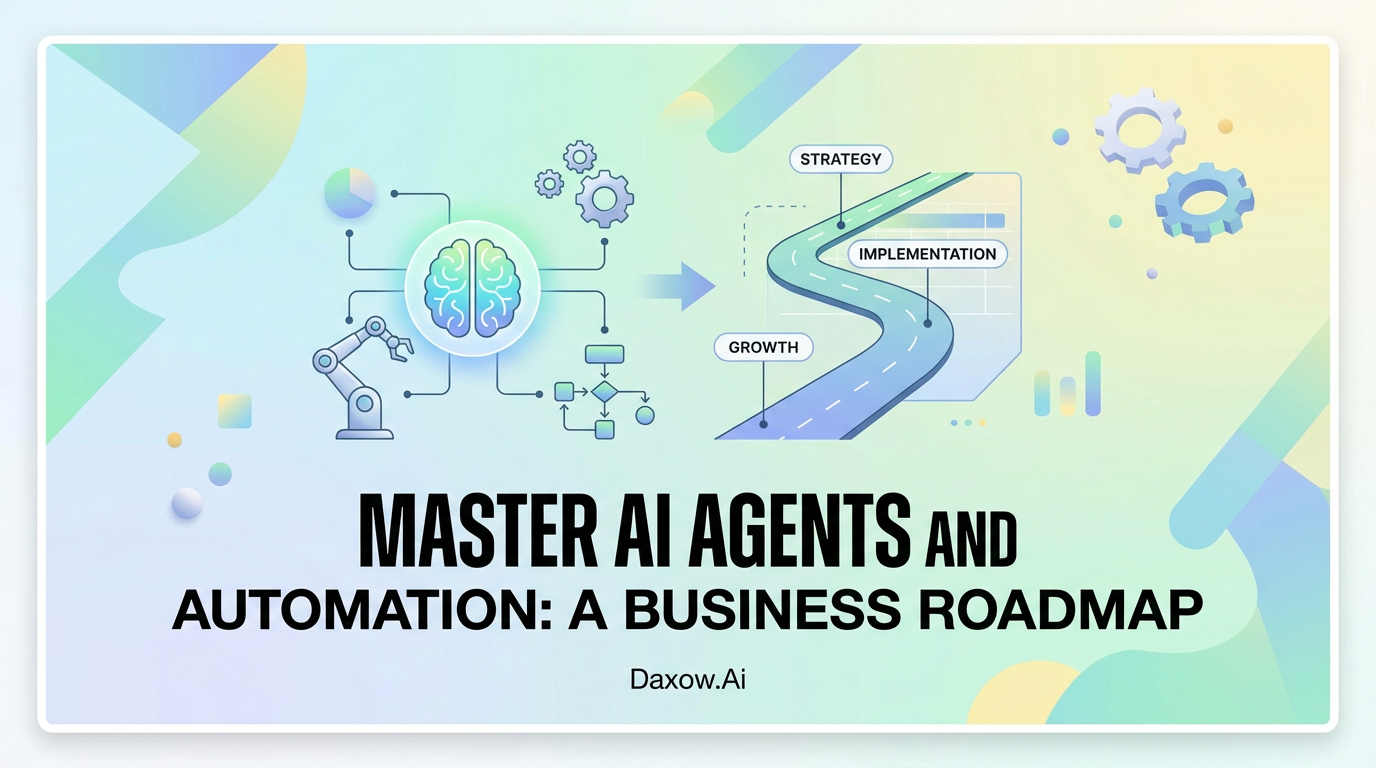
Master AI Agents and Automation: A Business Roadmap
Discover how AI agents and automation deliver faster outcomes, lower costs, and better customer experiences with use cases, ROI metrics, and a practical roadmap.
Mastering AI Agents and Automation: A Strategic Imperative for Business Transformation
Estimated reading time: 15 minutes
Key Takeaways
- AI agents and automation enable 3–5x faster outcomes and up to 50% cost reductions for business workflows.
- End-to-end orchestration by AI agents drives greater operational efficiency and improved customer experience.
- Strategic implementation through a phased roadmap ensures measurable ROI and risk mitigation.
- Daxow.ai offers tailored AI automation services integrating with existing enterprise systems for scalable impact.
- Common pitfalls include overambitious scope and poor data quality; mitigation requires clear KPIs and monitoring.
Table of Contents
- Mastering AI Agents and Automation: A Strategic Imperative for Business Transformation
- What AI Agents and Automation Mean for Your Business
- Practical Use Cases Across Industries
- How AI Agents and Automation Drive Business Outcomes
- Implementation Roadmap — From Pilot to Scale
- Measuring ROI and Business Value
- How Daxow.ai Helps You Execute and Scale AI Automation
- Common Pitfalls and How to Avoid Them
- Frequently Asked Questions
Mastering AI Agents and Automation: A Strategic Imperative for Business Transformation
Mastering AI Agents and Automation: A Strategic Imperative for Business Transformation is no longer a theoretical advantage — it is a practical necessity for organizations that want to scale, reduce manual work, and improve customer experience. For business owners and decision-makers, adopting AI automation and intelligent AI agents can deliver 3–5x faster outcomes, significant cost savings, and measurable productivity gains when executed with best practices. This article translates research into actionable steps, industry use cases, and a clear implementation roadmap so you can convert automation potential into business value.
What this strategic imperative means
AI agents and automation are autonomous systems that execute tasks, make decisions, and orchestrate workflows with minimal human intervention. When aligned with business objectives they:
- Eliminate repetitive manual tasks.
- Increase throughput and consistency.
- Improve compliance and traceability.
- Free teams to focus on strategic, high-value work.
Key outcome: organizations that adopt AI agents as orchestrators of workflows can expect faster response times, lower operational risk, and improved customer satisfaction — turning automation into a competitive advantage rather than a cost center.
What AI Agents and Automation Mean for Your Business
Core capabilities
AI agents deliver value by combining:
- Natural language understanding for customer interactions.
- Decision logic and business rules for automated processing.
- Integrations with CRMs, ERPs, and databases to execute end-to-end workflows.
- Continuous learning loops for ongoing optimization.
Quantifiable benefits
- 3–5x faster outcomes for prioritized workflows when implemented with best practices.
- 30–50% cost reduction on routine, high-volume tasks.
- Improved hiring velocity and retention where HR automation is applied.
- Measurable revenue and conversion uplift through targeted sales automation and personalization.
Practical Use Cases Across Industries
Below are targeted, actionable examples showing where to start for rapid, high-impact wins.
E-commerce — Order processing, inventory and personalization
Use case:
- Automate order validation, fraud checks, and fulfillment orchestration.
- Implement dynamic repricing and personalized product recommendations.
Business impact:
- Up to 50% faster fulfillment through automated inventory and order routing.
- Reduced cart abandonment and higher average order value via personalization.
How Daxow.ai helps:
- Build AI agents that connect storefronts, warehouses, and CRMs to automate order-to-delivery workflows.
- Deploy chatbots and customer support automation to handle returns, FAQs, and order status updates.
Healthcare — Scheduling, triage and compliance
Use case:
- Automate appointment scheduling, patient triage, and records routing.
- Use AI agents to flag anomalies in patient data for clinical review.
Business impact:
- Faster access to care, fewer scheduling errors, and better compliance controls.
How Daxow.ai helps:
- Design HIPAA-aware workflow automation and data extraction solutions.
- Integrate agent-led triage with EHRs and hotline systems to reduce administrative burden.
Finance — Invoice processing, fraud detection, compliance reporting
Use case:
- Automate invoice capture, reconciliation, and exception handling.
- Monitor transactions in real-time with fraud-detection agents.
Business impact:
- Lower processing costs, faster month-end close, and stronger regulatory adherence.
How Daxow.ai helps:
- Implement document automation and data extraction to remove manual entry.
- Build AI agents that escalate suspicious transactions and generate audit-ready reports.
Real Estate — Lead qualification and contract automation
Use case:
- Automate lead intake, scoring, scheduling, and initial contract reviews.
Business impact:
- Accelerated deal cycles and higher conversion rates.
How Daxow.ai helps:
- Combine lead qualification agents with CRM integrations and automated document generation to speed closings and reduce manual negotiation tasks.
HR — Recruitment, onboarding, and employee experience
Use case:
- Automate resume screening, interview scheduling, and onboarding checklists.
Business impact:
- Up to 40% faster hiring and improved candidate experience.
How Daxow.ai helps:
- Deploy AI agents for resume parsing, candidate scoring, and onboarding workflow automation to reduce HR admin time and improve retention.
How AI Agents and Automation Drive Business Outcomes
From point automation to end-to-end orchestration
The greatest value comes when AI agents are not isolated solutions but orchestrators of end-to-end workflows. Agents should:
- Pull and push data across systems (CRM, ERP, ticketing).
- Execute multi-step processes autonomously and escalate exceptions.
- Provide an audit trail and actionable analytics.
Operational and financial benefits
- Reduced manual tasks drives down headcount growth while increasing output.
- Fewer errors and compliance lapses through consistent, auditable processes.
- Actionable analytics enable continuous improvement and visibility for leadership.
Customer experience and revenue impact
- Faster response times from customer support automation increase satisfaction and retention.
- Sales automation and lead qualification shorten sales cycles and lift conversion rates.
- Personalization engines lead to higher average order value and repeat purchases.
Implementation Roadmap — From Pilot to Scale
A phased, data-driven approach reduces risk and ensures measurable returns.
1. Assess needs and define objectives
- Conduct a bottleneck audit to identify high-volume, rule-based tasks.
- Prioritize use cases that deliver fast ROI and align with strategic goals.
- Define measurable KPIs (e.g., processing time, error rate, cost per transaction).
2. Prepare data and systems
- Clean and standardize data sources and knowledge bases.
- Map integrations with CRMs, ERPs, and document repositories.
- Address compliance and security requirements (e.g., HIPAA, SOC2).
3. Select technology and build the team
- Evaluate platforms for scalability, security, and integration capabilities.
- Use no-code or low-code tools for rapid prototyping where appropriate.
- Designate internal owners for data, process, and change management.
4. Pilot and iterate (4–8 weeks)
- Launch a focused pilot on a single high-impact process.
- Track metrics, capture edge cases, and refine decision rules.
- Use human-in-the-loop feedback to train agents and improve accuracy.
5. Scale gradually
- Expand across teams, channels, and regions after pilot validation.
- Implement monitoring, monthly/quarterly reviews, and governance.
- Maintain rollback and contingency plans for critical workflows.
6. Optimize continuously
- Establish feedback loops, audit trails, and escalation paths.
- Periodically retrain models and refine business rules.
- Measure long-term KPIs and identify new automation opportunities.
Best practices:
- Start with strategic outcomes, not technology experiments.
- Invest in data quality and system integrations early.
- Ensure cross-functional involvement to secure adoption.
- Plan for 3–5 years of scalability and governance.
Measuring ROI and Business Value
How to calculate and report impact
Use a simple ROI formula: ROI = (Gains − Costs) / Costs. Track:
- Direct cost savings from reduced manual labor.
- Time-to-resolution or fulfillment improvements.
- Revenue lift from sales automation and personalization.
- Compliance and risk reduction (quantified where possible).
Typical timelines and expectations
- Pilot to proof-of-value: 4–8 weeks.
- Positive ROI often visible within 6–12 months after pilot expansion.
- Mature automation programs deliver sustained 20–40% efficiency gains through continuous optimization.
KPIs to monitor
- Processing time per transaction.
- Error and exception rates.
- Customer satisfaction and resolution time.
- Cost per ticket, lead-to-deal time, and hiring time.
How Daxow.ai Helps You Execute and Scale AI Automation
Daxow.ai designs and implements custom AI systems that move companies from isolated automations to fully orchestrated, high-value workflows.
End-to-end services
- Process discovery and bottleneck audits to identify target automation opportunities.
- Custom AI agent development that executes real tasks across systems.
- Workflow automation design that integrates with CRMs, ERPs, ticketing systems, and data lakes.
- Chatbots and customer support automation to reduce response times and costs.
- Document automation and data extraction to eliminate manual entry and reconciliation.
- Lead qualification and sales automation to accelerate revenue cycles.
Our approach
- Discovery: We analyze your current workflows and metrics to prioritize pilots.
- Prototype: Rapid no-code or low-code prototypes deliver fast validation.
- Pilot: A focused pilot proves value and refines agent behavior.
- Scale: We expand to additional processes and integrate monitoring and governance.
- Operate: Ongoing optimization and model updates ensure continuous ROI.
Why partner with Daxow.ai
- Practical, measurable outcomes: We focus on concrete KPIs and business value.
- Integration expertise: We connect AI agents to the systems your teams rely on.
- Compliance and security: Enterprise-grade practices for regulated industries.
- End-to-end delivery: From data prep to production and support.
Common Pitfalls and How to Avoid Them
- Overambitious scope: Start with high-impact, low-complexity processes.
- Poor data quality: Invest in data cleanup and mapping before building agents.
- Limited stakeholder buy-in: Engage cross-functional teams early.
- No monitoring: Implement dashboards, alerts, and governance from day one.
Mitigation checklist
- Define clear KPIs and success criteria before development.
- Use human-in-the-loop controls during early stages.
- Maintain an audit trail for compliance and troubleshooting.
- Plan for regular reviews and retraining cycles.
Frequently Asked Questions
What are AI agents and how do they differ from traditional automation?
AI agents are autonomous systems capable of decision-making, natural language understanding, and multi-step workflow orchestration, whereas traditional automation typically follows fixed, pre-defined scripts without adaptive intelligence.
How long does it typically take to see ROI from AI automation?
Positive ROI often becomes visible within 6–12 months after completing pilot expansions, with pilot phases usually lasting 4–8 weeks.
What industries benefit most from AI agents and automation?
Industries such as e-commerce, healthcare, finance, real estate, and HR can achieve significant benefits by automating order processing, compliance, lead qualification, recruitment, and other processes.
How does Daxow.ai ensure compliance and security in automation projects?
Daxow.ai incorporates enterprise-grade compliance and security standards such as HIPAA and SOC2, integrates audit trails, and enforces strict governance throughout design and deployment phases.