
Master AI Agents & Automation: A Business Transformation Roadmap
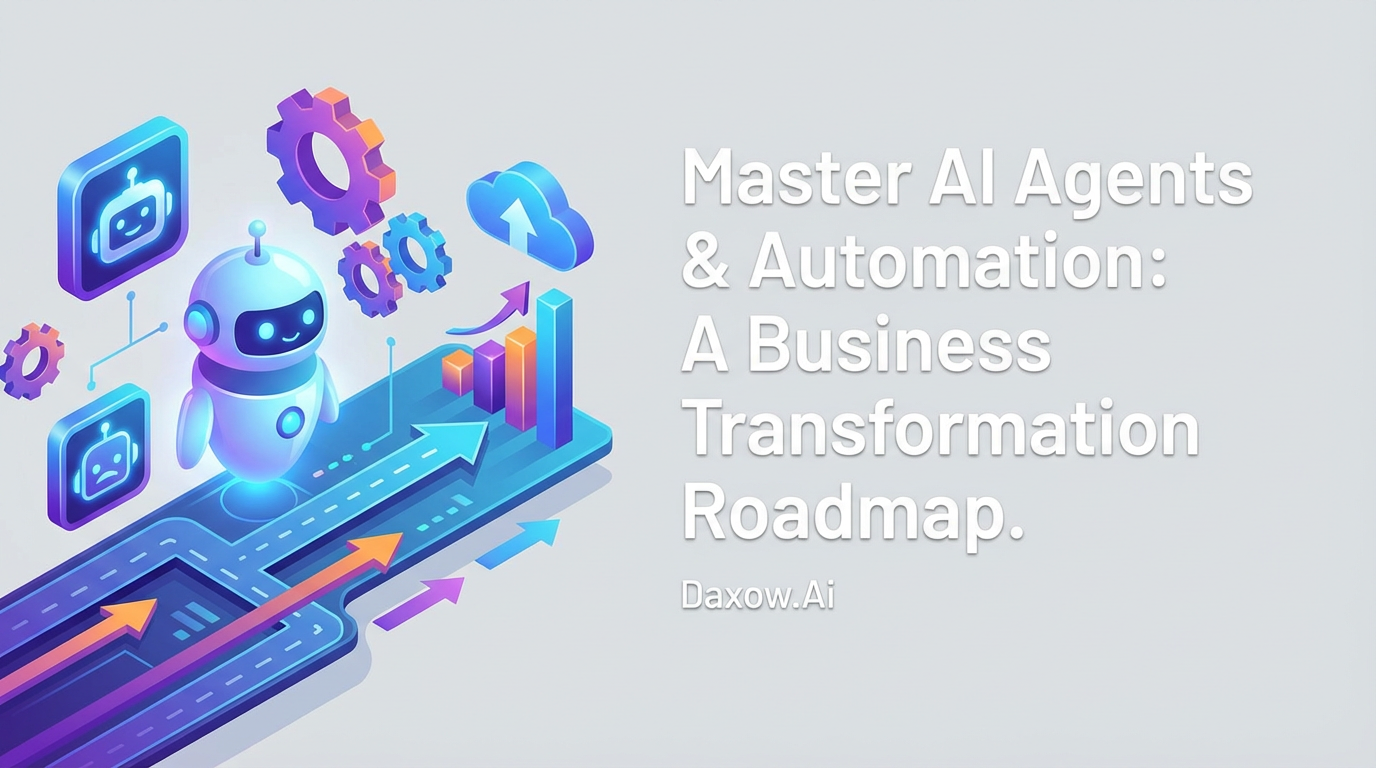
Practical roadmap to deploy AI agents and workflow automation - use cases, phased implementation, ROI metrics, and how Daxow.ai delivers end-to-end solutions.
Mastering AI Agents and Automation: A Strategic Imperative for Business Transformation
Estimated reading time: 15 minutes
Key Takeaways
- AI agents and workflow automation enable businesses to reduce manual tasks by up to 80% and accelerate decision-making.
- Implementing AI initiatives with a structured roadmap delivers ROI typically within 6–12 months and speeds results by 3–5x.
- Industry use cases span e-commerce, healthcare, finance, real estate, HR, and customer support, demonstrating measurable impact.
- A phased implementation approach minimizes risk and ensures continuous optimization aligned with business KPIs.
- Daxow.ai offers end-to-end AI and automation solutions built on API-first architecture with governance for compliance and scalability.
Table of Contents
- Mastering AI Agents and Automation: A Strategic Imperative for Business Transformation
- Practical Use Cases of AI Agents and Automation
- Implementation Roadmap: From Assessment to Continuous Optimization
- Measuring ROI and Business Value
- How Daxow.ai Delivers End-to-End Business Automation and AI Agents
- Getting Started — Practical Checklist
- Frequently Asked Questions
Mastering AI Agents and Automation: A Strategic Imperative for Business Transformation
Mastering AI Agents and Automation: A Strategic Imperative for Business Transformation is more than a trending topic — it is a practical roadmap for organizations that need to reduce manual tasks, accelerate decision-making, and unlock measurable ROI. Across industries, leaders are implementing AI automation and intelligent workflow automation to improve customer experience, raise productivity, and scale operations with lower headcount risk. This article lays out a structured, actionable approach to deploying AI agents and end-to-end business automation, with concrete use cases, implementation steps, and how Daxow.ai helps companies achieve measurable outcomes.
What do we mean by AI agents and automation? In practice, AI agents are autonomous systems powered by artificial intelligence that execute tasks, interact with users or systems, and make constrained decisions with minimal oversight. Workflow automation complements agents by codifying repeatable processes and orchestrating integrations across tools like CRMs and ERPs. Together they enable organizations to scale routine work, improve accuracy, and free knowledge workers for strategic activities.
Why this matters now
- Faster implementations and outcomes: When planned correctly, AI initiatives can deliver value up to 3–5x faster than ad-hoc automation efforts.
- High-impact reductions in manual work: Optimized systems can reduce manual intervention by 70–80% in targeted workflows.
- Tangible ROI: Typical projects produce payback within 6–12 months and ongoing gains in productivity and customer satisfaction.
How AI agents operate in business environments
- Action-oriented: Agents can perform tasks such as booking appointments, updating records, or executing transactions through APIs.
- Conversational and adaptive: Using natural language processing, agents handle customer inquiries and escalate complex cases to humans.
- Integrated and governed: Agents function best within an API-first architecture and robust data pipelines, with governance to manage compliance, bias, and audit trails.
Practical Use Cases of AI Agents and Automation
Below are industry-focused, actionable use cases showing where AI agents and business automation provide immediate value. Each example includes typical outcomes and a short implementation pattern.
E-commerce — Order, inventory, and support orchestration
Use case:
- Automate order validation, fulfillment status updates, and returns processing.
- Deploy chat agents for customer support that integrate with order management systems to provide accurate tracking and self-service returns.
Impact:
- Reduced order handling costs, fewer support tickets, and faster resolution times.
Implementation pattern:
- Integrate agents with inventory and OMS via APIs, add business rules for exceptions, and set escalation paths for fraud checks or stockouts.
Healthcare — Scheduling, triage, and records compliance
Use case:
- AI agents handle appointment booking, initial symptom triage, and reminders.
- Automate document extraction for medical records and regulatory reporting.
Impact:
- Improved response times, fewer missed appointments, and better adherence to documentation standards.
Implementation pattern:
- Build secure connectors to EHRs, implement role-based access, and maintain human-in-the-loop escalation for clinical decisions.
Finance — Invoicing, reconciliation, and fraud detection
Use case:
- Automate invoice ingestion and matching, realtime reconciliation, and transaction anomaly detection.
- AI agents generate compliance-ready reports and alert teams for suspicious activity.
Impact:
- Lower reconciliation time, fewer manual errors, and faster fraud detection.
Implementation pattern:
- Establish reliable data pipelines from accounting systems, apply ML models for anomaly scoring, and define approval workflows for exceptions.
Real Estate — Lead qualification and deal acceleration
Use case:
- Agents qualify inbound leads, book virtual or in-person tours, and populate CRM records with enriched data.
- Automate valuation checks and document preparation for contract review.
Impact:
- Increased lead conversion and a faster sales cycle.
Implementation pattern:
- Connect listing platforms and CRM, implement decision trees for qualification, and use document automation for contracts.
HR — Recruitment, onboarding, and workforce analytics
Use case:
- Screen resumes, schedule interviews, automate offer letters, and handle payroll queries with bots.
- Predict turnover risk and recommend retention interventions.
Impact:
- Faster time-to-hire and reduced administrative load on HR teams.
Implementation pattern:
- Integrate ATS and payroll systems, create knowledge bases for policy queries, and define privacy-safe data governance.
Customer support and sales automation (cross-industry)
Use case:
- Implement customer support automation via chat and agent-assisted escalation; set up sales automation for lead routing and follow-ups.
Impact:
- 40–60% cost reduction in support operations is achievable; higher conversion rates from faster lead response.
Implementation pattern:
- Start with high-volume, rule-based queries; use escalation points; monitor CSAT and handle model retraining for language and sentiment.
Implementation Roadmap: From Assessment to Continuous Optimization
A structured, phased approach reduces risk and accelerates impact. Below is a practical timeline and the core activities Daxow.ai applies in client engagements.
Phase 1 — Strategic Assessment and Planning (4–8 weeks)
- Define clear goals and KPIs (e.g., 30% cost reduction, 50% faster response).
- Map current workflows and identify high-impact, low-risk automation candidates.
- Assess data readiness, compliance needs, and integration points.
Deliverables: Prioritized roadmap, success criteria, and project charter.
Phase 2 — Technology Selection and Data Preparation (6–12 weeks)
- Choose scalable platforms and tools that support an API-first approach.
- Clean and structure data; build knowledge bases and decision trees.
- Define governance, roles, and audit mechanisms.
Deliverables: Integration design, data pipelines, and a prototype knowledge model.
Phase 3 — Pilot Deployment (2–4 weeks)
- Launch a limited pilot on a subset of users or channels.
- Collect operational metrics, user feedback, and error patterns.
- Iterate quickly: refine intent recognition, business rules, and escalation paths.
Deliverables: Pilot performance report and updated model logic.
Phase 4 — Gradual Rollout and Change Management (Ongoing)
- Scale to additional channels, teams, and languages.
- Train staff on new workflows and clearly communicate changes.
- Maintain human oversight for critical decisions.
Deliverables: Deployment playbook, training materials, and support SLAs.
Phase 5 — Continuous Monitoring and Optimization (Continuous)
- Monitor KPIs, retrain models with fresh data, and update governance.
- Implement regular audits for bias, accuracy, and compliance.
- Use analytics to identify new automation opportunities.
Deliverables: Performance dashboards, A/B tests results, and governance reports.
Best practices summary
- Start small to build confidence and capability.
- Prioritize robust data pipelines to ensure reliability.
- Align business and IT with clear communication and success metrics.
- Avoid scope creep by measuring against defined success criteria.
Measuring ROI and Business Value
To secure executive buy-in, tie AI agent projects to measurable business outcomes.
Key metrics to track
- Cost per transaction or support ticket.
- Resolution time and first-contact resolution rate.
- Conversion rates for sales and lead qualification.
- Productivity metrics (tasks automated per agent).
- Customer satisfaction (CSAT/NPS) and employee satisfaction.
Expected outcomes (based on industry findings)
- 40–60% cost reduction in support-intensive processes.
- 20–50% productivity improvement across knowledge work tasks.
- 3–5x faster realization of value when using phased, governed implementation.
- Typical payback in 6–12 months for well-scoped pilots.
Practical measurement plan
- Establish baseline KPIs during assessment phase.
- Use short pilot windows to validate assumptions and quantify gains.
- Create dashboards for real-time monitoring and executive reporting.
How Daxow.ai Delivers End-to-End Business Automation and AI Agents
Daxow.ai builds tailored AI systems that integrate with existing enterprise tools and deliver measurable value from day one. Our approach is pragmatic, governed, and results-driven.
What Daxow provides
- Process discovery and analysis: We map workflows to identify automation opportunities and quantify expected ROI.
- Custom AI agent design and engineering: We design agents that perform actions, provide knowledge, or combine both — fully integrated with your systems.
- Workflow automation and orchestration: We implement workflow automation that ties AI agents, CRMs, ERPs, and third-party tools into reliable end-to-end processes.
- Data extraction and document automation: We extract structured data from unstructured documents to reduce manual entry and accelerate downstream processes.
- Customer support automation and chatbots: We design conversational agents that resolve common issues, qualify leads, and escalate appropriately.
- Sales automation and lead qualification: We automate lead scoring, routing, and follow-up sequences to shorten sales cycles and improve conversion.
- Governance, security, and compliance: We embed role-based access, audit trails, and bias mitigation into every implementation.
Typical engagement and timelines
- Assessment and pilot: 6–12 weeks.
- Production rollout: additional 2–6 months depending on scale.
- Ongoing optimization and support: continuous, with quarterly reviews.
How Daxow ensures outcomes
- We align implementations with strategic KPIs and provide transparent performance tracking.
- We minimize vendor lock-in by using interoperable, API-first architectures.
- We provide training and change management to secure adoption and sustain productivity gains.
Getting Started — Practical Checklist
- Define 2–3 business goals tied to measurable KPIs.
- Identify 1–2 high-volume, rule-based processes for a pilot.
- Audit data sources and document integration points (CRM, ERP, ticketing).
- Appoint an internal sponsor and a cross-functional team.
- Plan for change management and a pilot evaluation window.
Mastering AI Agents and Automation: A Strategic Imperative for Business Transformation is within reach when organizations follow a disciplined, phased approach and partner with experts who can deliver end-to-end solutions. Daxow.ai combines process analysis, custom AI agents, workflow automation, and secure integrations to reduce manual tasks, increase productivity, and deliver measurable ROI.
Book a free consultation with Daxow.ai to request a process analysis for your company and explore a tailored roadmap to build a custom AI system that scales. Contact us today to start automating the right processes and achieve faster, measurable business outcomes.
Frequently Asked Questions
What are AI agents and how do they differ from workflow automation?
AI agents are autonomous systems that execute specific tasks and interact using AI capabilities, often handling complex decision-making and user interaction. Workflow automation codifies repeatable business processes, orchestrating tasks across systems without necessarily involving AI decision-making.
How long does it take to see ROI from AI automation projects?
Typically, well-planned AI automation projects achieve payback within 6–12 months, especially when following a phased approach with clear KPIs and governance.
Which industries benefit most from AI agent implementation?
AI agents provide value across many industries including e-commerce, healthcare, finance, real estate, human resources, and customer support. The technology improves efficiency in any operation involving repetitive tasks, customer interactions, or data processing.
How does Daxow.ai ensure compliance and governance in AI deployments?
Daxow.ai incorporates role-based access, audit trails, bias mitigation strategies, and rigorous governance frameworks throughout the AI system design and implementation to ensure security, compliance, and ethical operation.