
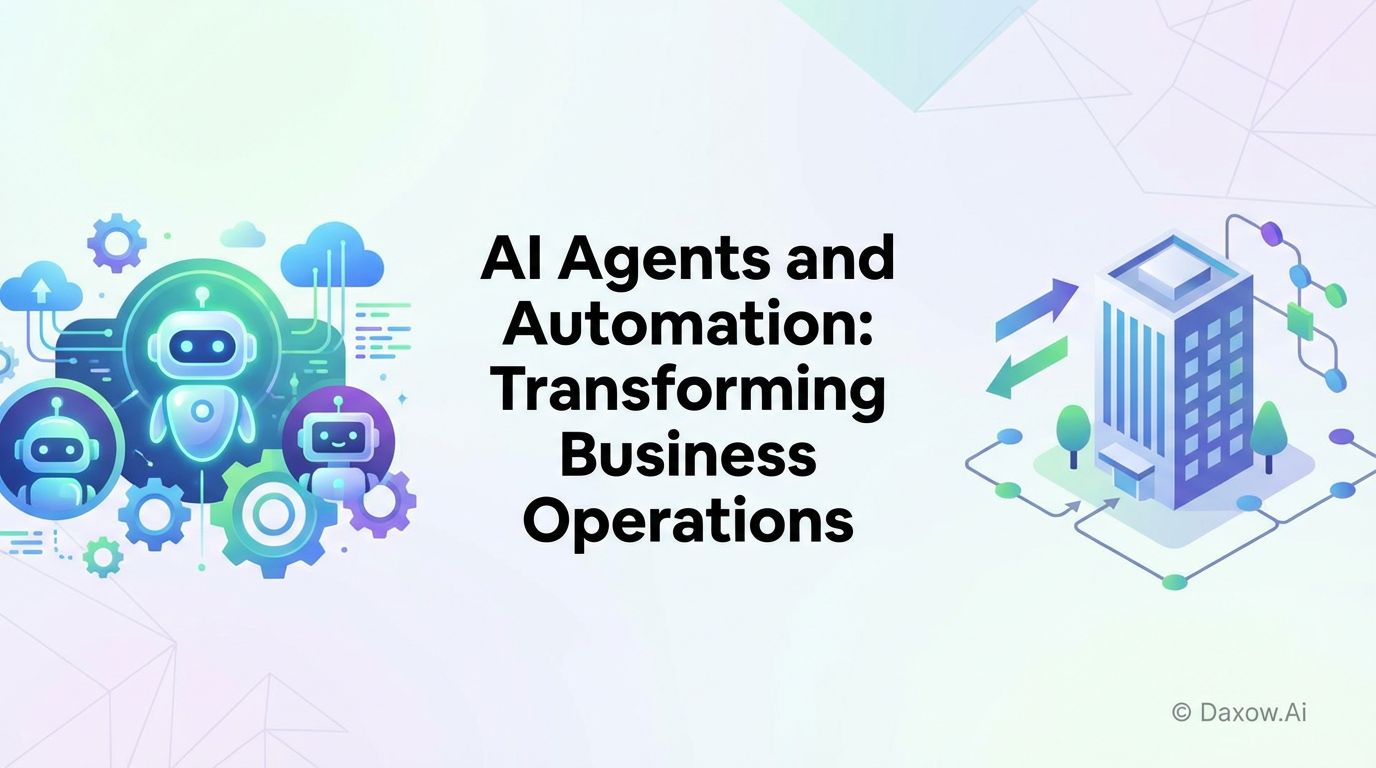
AI Agents and Automation: Transforming Business Operations
How AI agents and workflow automation drive productivity, lower costs, and measurable ROI - practical steps, industry use cases, and a 6-12 week pilot plan.
Unlocking Business Transformation: The Strategic Imperative of AI Agents and Automation
Estimated reading time: 12 minutes
Key Takeaways
- AI agents and automation transform manual, error-prone tasks into scalable, measurable business outcomes.
- Businesses gain 20–50% productivity boosts while reducing costs and improving customer experience.
- Industry-specific use cases demonstrate tangible impact across e-commerce, healthcare, finance, real estate, HR, and support.
- A structured implementation approach and best practices mitigate risks and maximize ROI.
- Daxow.ai provides end-to-end AI system design, integration, and continuous improvement for business transformation.
Table of Contents
- Unlocking Business Transformation: The Strategic Imperative of AI Agents and Automation for Your Organization
- What AI Agents and Automation Mean for Business Value
- Practical Use Cases Across Industries
- How AI Agents and Automation Deliver Measurable ROI
- Implementation Steps and Best Practices
- How Daxow.ai Helps You Unlock Transformation
- Practical Pilot Plan — From Idea to Production (6–12 Weeks)
- Common Risks and How to Mitigate Them
- Measuring Success — KPIs That Matter
Unlocking Business Transformation: The Strategic Imperative of AI Agents and Automation for Your Organization
AI agents and automation are intelligent systems that autonomously execute tasks, make decisions, and continuously optimize workflows. They combine machine learning, natural language processing, and robotic process automation to handle high-volume, repetitive, and predictive tasks. The result is a shift from fragmented manual work to integrated, data-driven operations that improve customer support automation, sales automation, and broader business automation initiatives.
Why this matters now
- Speed to value: Modern tooling and cloud infrastructure allow rapid pilots and fast iteration.
- Scale without linear headcount growth: Automations scale throughput while keeping fixed costs stable.
- Improved customer experience: Faster response times and personalized interactions increase retention.
- Risk reduction: Predictive analytics and monitoring reduce fraud, compliance failures, and supply-chain disruptions.
What AI Agents and Automation Mean for Business Value
AI agents work as proactive extensions of teams. They process documents, route cases, qualify leads, and execute multi-step workflows across systems. When built and deployed correctly, they deliver measurable outcomes:
- Reduce manual tasks: Automate data entry, invoice processing, and routine customer inquiries to free staff for strategic activities.
- Boost productivity: Organizations often realize 20–50% productivity gains in automated areas.
- Improve decision-making: Predictive models surface risks in finance or supply chains, enabling preventive action.
- Enhance customer experience: Faster resolutions and personalized experiences lift NPS and conversion rates.
Core capabilities of AI agents
- Natural language understanding for human-like interactions.
- Document extraction and classification for large unstructured datasets.
- Integration with CRMs, ERPs, and collaboration tools to orchestrate end-to-end processes.
- Monitoring and self-improvement through analytics and retraining pipelines.
Practical Use Cases Across Industries
E-commerce — Conversational sales automation and post-sale support
- Use case: AI agents answer product questions, resolve returns, and generate personalized recommendations.
- Automation pattern: Conversational AI + CRM integration + order-system access.
- Business impact: Reduced average handling time, improved conversion rates, and higher repeat purchase frequency.
- Example: An AI agent that qualifies intent, applies upsell logic, and routes complex cases to agents increases conversion on live chat by 15–30%.
Healthcare — Document automation and resource prediction
- Use case: Extract clinical details from intake forms and referral letters; flag anomalies for clinician review.
- Automation pattern: Document AI + rules-based triage + scheduling integration.
- Business impact: Faster patient triage, reduced administrative backlog, improved compliance.
- Example: Automated extraction of patient vitals and claims data reduces manual entry time by 60%, accelerating billing cycles.
Finance — Fraud detection, invoice processing, and reconciliation
- Use case: Real-time transaction monitoring for fraud patterns; automated matching and approval of invoices.
- Automation pattern: Machine learning models + RPA for legacy systems + secure logging.
- Business impact: Fewer false positives, reduced losses, and tighter audit trails.
- Example: A finance AI agent flags anomalous payments and automates reconciliation, reducing month-end close time by weeks.
Real Estate — Market analytics and client personalization
- Use case: Analyze listings and behavioral data to surface high-probability prospects; automate listing creation.
- Automation pattern: Data ingestion from portals + recommendation engine + content generation.
- Business impact: Faster deal cycles, higher lead-to-appointment conversion, and efficient content production.
- Example: Automated listing drafts and personalized outreach lift lead engagement while reducing agent admin time.
HR — Talent screening and onboarding automation
- Use case: Screen resumes, schedule interviews, and automate onboarding document generation.
- Automation pattern: NLP resume parsing + workflow automation + calendar and HRIS integration.
- Business impact: Shorter time-to-hire, improved candidate experience, and consistent compliance.
- Example: Screening and pre-qualification by AI reduces recruiter hours per hire by 40%.
Customer Support — End-to-end case handling
- Use case: AI agents handle tier-1 inquiries, escalate complex cases, and suggest knowledge base articles.
- Automation pattern: Conversational AI + knowledge retrieval + case orchestration.
- Business impact: Faster response times, lower support costs, higher CSAT.
- Example: Support automation reduces average resolution time by up to 50% and cuts operational cost per ticket.
How AI Agents and Automation Deliver Measurable ROI
Deploying AI agents is an investment. The highest-return projects focus on high-volume, repeatable processes with clear KPIs. Expected outcomes include:
- Operational cost reduction: Fewer manual hours and fewer errors.
- Revenue uplift: Improved conversion and retention from personalized experiences and faster service.
- Risk mitigation: Early detection of fraud, compliance gaps, and supply-chain issues.
- Scalability: Support volume increases without parallel staff growth.
Quantifying ROI
- Track metrics such as cost per transaction, time-to-resolution, accuracy (F1 score for ML tasks), and adoption rates.
- Early pilots should aim to demonstrate measurable improvements within 6–12 weeks.
- Typical measurable benefits: 20–50% productivity gains, faster processing times, and improved forecast accuracy.
Implementation Steps and Best Practices
1. Define goals and prioritize processes
- Map existing workflows and identify high-volume, high-cost, or high-risk processes.
- Establish clear KPIs: cost savings targets, NPS improvement, time reduction goals.
- Use an AI-readiness scorecard to prioritize pilots.
2. Conduct a data audit and tool selection
- Assess data quality: completeness, accuracy, and access controls.
- Choose tools that support scalable integrations and model retraining.
- Start with smaller, high-impact automations (e.g., invoice extraction, lead qualification).
3. Build a cross-functional team
- Assemble data scientists, engineers, process owners, and compliance experts.
- Include domain experts to validate edge cases and create acceptance criteria.
- Provide training to avoid resistance and reduce shadow AI adoption.
4. Prototype, test, and validate quickly
- Run a bounded pilot with defined metrics and validation datasets.
- Measure accuracy, false positive rates, and user feedback.
- Refine prompts and retrain models based on real-world outcomes.
5. Deploy, monitor, and iterate
- Deploy with observability: dashboards, alerts, and retraining triggers.
- Treat automations as products with backlog, roadmaps, and user support.
- Schedule periodic reviews for model drift and process changes.
Best practices summary
- Ethical and compliant AI: Document privacy, logging, and human-in-the-loop controls.
- Standardized data pipelines: Ensure consistent inputs and versioning.
- Change management: Communicate value and provide hands-on training.
- Start small, scale fast: Demonstrate wins, then expand to adjacent processes.
How Daxow.ai Helps You Unlock Transformation
Daxow.ai specializes in designing and delivering custom AI systems and workflow automation that turn strategy into production-grade capabilities. Our approach is end-to-end and business-focused.
Discovery and Process Analysis
- We begin with a detailed process analysis to identify automation candidates and map KPIs.
- Our discovery includes an AI-readiness assessment and ROI projection tailored to your business.
Solution Design and Prototyping
- Daxow builds tailored prototypes that combine AI agents, RPA, and system integrations.
- We design data pipelines, model selection, and human-in-the-loop workflows to maximize reliability.
Integration and Deployment
- We connect AI agents to CRMs, ERPs, support platforms, and custom databases to enable end-to-end automation.
- Our engineers ensure secure, auditable integrations with legacy systems where needed.
Monitoring, Governance, and Continuous Improvement
- Daxow sets up production monitoring, drift detection, and retraining schedules.
- We implement governance frameworks to maintain compliance and ethical AI practices.
Outcomes you can expect with Daxow.ai
- Reduced operational costs through targeted automation.
- Improved productivity by eliminating repetitive tasks.
- Faster customer response and higher satisfaction via AI-driven support.
- Scalable systems that integrate across business tools for centralized automation.
Practical Pilot Plan — From Idea to Production (6–12 Weeks)
A practical pilot plan reduces risk and demonstrates value quickly. A typical timeline:
- Week 1–2: Discovery and KPI definition
Process mapping, data audit, and readiness scoring. - Week 3–5: Prototype and test
Build an MVP AI agent or automation flow. Run tests with historical data and a small set of live cases. - Week 6–8: Pilot deployment
Deploy to a controlled environment. Collect metrics and user feedback. - Week 9–12: Scale and productionize
Harden integrations, implement monitoring, and plan roll-out. Define ongoing governance and retraining cadence.
Common Risks and How to Mitigate Them
Understanding pitfalls up front prevents costly rework.
- Poor data quality: Conduct comprehensive data profiling and cleansing before training.
- Scope creep: Lock scope for pilots and focus on measurable KPIs.
- Lack of adoption: Invest in change management and co-design with users.
- Model drift: Implement scheduled retraining and continuous monitoring.
- Compliance gaps: Build privacy and audit capabilities into system design.
Measuring Success — KPIs That Matter
Select KPIs aligned to business goals:
- Time saved per process (minutes/hours)
- Cost per transaction and total operational cost reduction
- Accuracy and error rates (precision, recall, F1 as applicable)
- Customer satisfaction (CSAT, NPS)
- Lead-to-conversion rates and revenue impact
- Model uptime and latency for real-time agents
Conclusion and Call to Action
Unlocking Business Transformation: The Strategic Imperative of AI Agents and Automation is achievable with a disciplined, business-centric approach. AI agents and workflow automation deliver measurable productivity gains, cost reduction, and improved customer experiences across industries. At Daxow.ai, we partner with organizations to design, build, and scale custom AI systems that integrate with existing tools, reduce manual tasks, and maximize ROI.
Book a free consultation with Daxow.ai to request a process analysis for your company and begin a pilot that demonstrates clear, measurable business value. Contact us to build a custom AI system tailored to your workflows and goals.
Frequently Asked Questions
What are AI agents and how do they differ from traditional automation?
AI agents are intelligent systems that autonomously execute complex tasks using machine learning, natural language processing, and robotic process automation, whereas traditional automation typically follows fixed rule-based scripts without adaptive decision-making capabilities.
How long does it take to see ROI from AI agent implementation?
Early pilots usually demonstrate measurable improvements within 6 to 12 weeks, delivering productivity gains, cost reductions, and improved customer experience as KPIs are tracked and optimized.
How does Daxow.ai ensure compliance and ethical AI usage?
Daxow.ai implements governance frameworks that include privacy safeguards, audit trails, human-in-the-loop controls, and monitoring mechanisms to maintain compliance and ethical usage throughout the AI system lifecycle.
Can AI agents integrate with existing business systems?
Yes, Daxow.ai specializes in connecting AI agents to CRMs, ERPs, support platforms, and custom databases, ensuring secure, auditable integrations that extend existing system capabilities with intelligent automation.