
Unlock Business Transformation with AI Agents & Automation
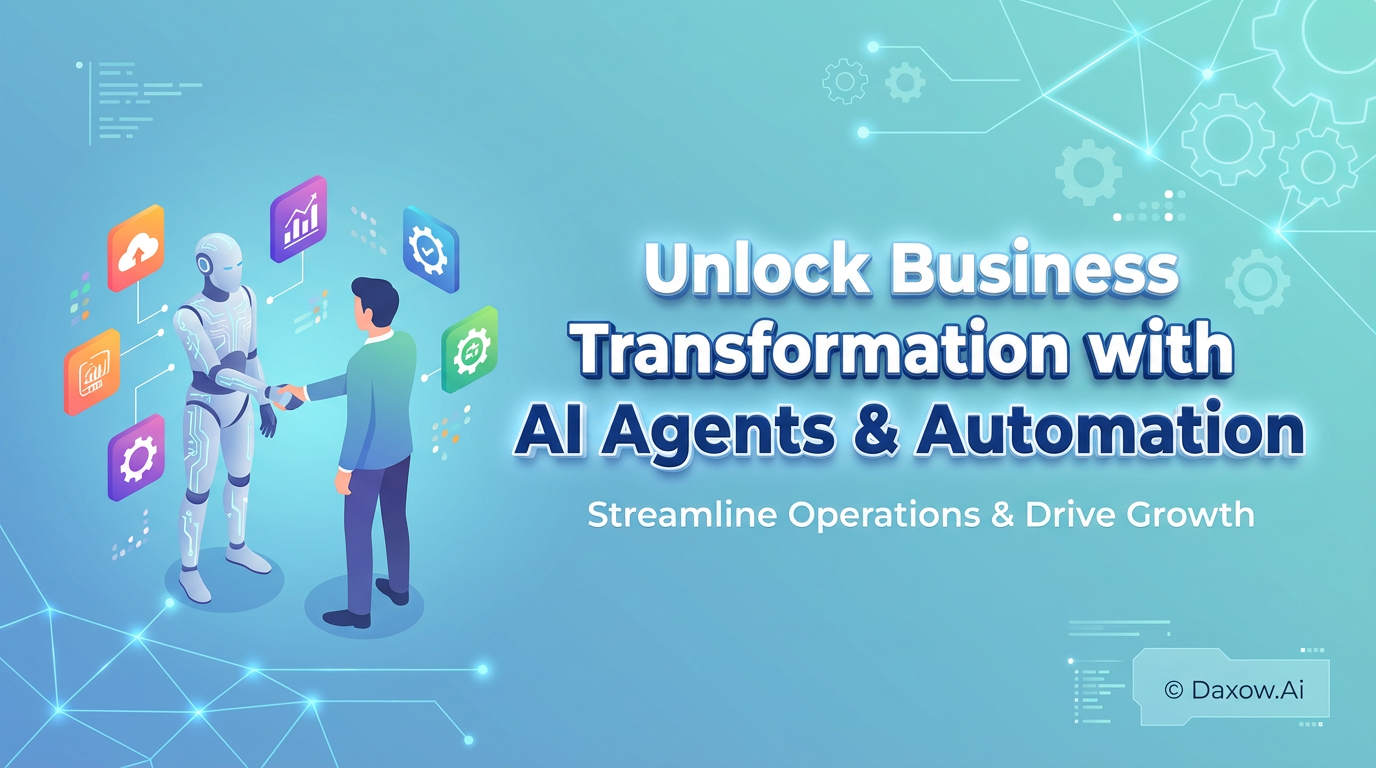
Practical guide to AI agents and workflow automation: industry use cases, ROI modeling, implementation steps, and how Daxow.ai builds secure, scalable automations.
Unlocking Business Transformation: AI Agents and Automation for Intelligent Process Optimization
Estimated reading time: 15 minutes
Key Takeaways
- AI agents combined with workflow automation enhance productivity by 40–50% and reduce labor costs by up to 50%.
- Industry-specific AI solutions from Daxow.ai optimize e-commerce, healthcare, finance, real estate, and HR processes effectively.
- Structured implementation steps ensure scalable, secure, and compliant AI deployments with measurable ROI.
- Effective integration, ethical AI practices, and continuous monitoring are key to sustainable automation success.
- Daxow.ai offers end-to-end AI automation services, from discovery and prototyping to scaling and managed support.
Table of Contents
- Unlocking Business Transformation: AI Agents and Automation for Intelligent Process Optimization
- Practical Use Cases Across Industries
- Implementation Steps and Best Practices for AI Agents and Automation
- Measuring ROI and Tangible Business Value
- Security, Compliance, and Operational Resilience
- Getting Started with Daxow.ai: From Discovery to Continuous Optimization
- Frequently Asked Questions
Unlocking Business Transformation: AI Agents and Automation for Intelligent Process Optimization
AI agents combine artificial intelligence with automation frameworks to autonomously execute tasks, make data-driven decisions, and orchestrate complex multi-step processes. When paired with workflow automation, these agents become proactive operators inside your business processes — handling repetitive work, surfacing exceptions, and continuously improving through retraining.
Key business impacts:
- Higher productivity: Organizations report up to 40–50% productivity gains when applying hyperautomation principles.
- Lower operating costs: Expect 25–50% labor savings on targeted processes and a common 3–5x ROI within 12–18 months.
- Improved accuracy and compliance: Automated document processing and AI-led monitoring reduce human error and strengthen regulatory adherence.
- Faster decision-making: Predictive models and orchestration accelerate response times across customer support, supply chain, and financial operations.
How AI Agents and Workflow Automation Work Together
AI agents are not standalone chatbots. They are integrated services that:
- Use NLP and ML for understanding, summarizing, and classifying unstructured data.
- Leverage RPA-style connectors for system interactions (CRMs, ERPs, databases).
- Orchestrate multi-step workflows, escalate exceptions, and trigger downstream actions.
- Continuously learn from new data and feedback to reduce drift and maintain performance.
Daxow.ai couples these capabilities with robust integration expertise to ensure agents access the right data, execute tasks reliably, and provide transparent audit trails for compliance.
Practical Use Cases Across Industries
E-commerce — Demand Forecasting, Personalized CX, Inventory Automation
Use cases:
- Predictive inventory allocation using sales history and external signals to reduce stockouts.
- AI-powered conversational agents resolving complex customer queries and routing escalations.
- Automated product content generation and personalized recommendations to improve conversion.
Business impact:
- 20–30% sales uplift from personalized recommendations and improved availability.
- Reduced inventory carrying costs and fewer lost sales due to stockouts.
Daxow.ai approach:
- Integrate e-commerce platforms and ERPs to centralize data.
- Train demand forecasting models and embed agents into customer support channels.
- Automate periodic retraining and A/B test recommendation strategies to optimize revenue.
Healthcare — Record Processing, Triage, Research Summaries
Use cases:
- Extracting clinical data from unstructured records for billing and analytics.
- Virtual triage agents that prioritize patient inquiries and schedule follow-ups.
- Summarizing medical literature for clinical teams to accelerate decision-making.
Business impact:
- Reduced administrative time by ~40%, faster patient throughput, and improved clinician satisfaction.
Daxow.ai approach:
- Build HIPAA-compliant pipelines, enforce role-based access, and apply specialized NLP models tuned to clinical language.
- Integrate with EHR systems and scheduling software for seamless automation.
Finance — Fraud Detection, Compliance, Forecasting
Use cases:
- Real-time transaction monitoring for anomaly detection and fraud prevention.
- Automated compliance reporting and KYC document processing.
- Scenario-based forecasting using macro and internal datasets for risk mitigation.
Business impact:
- Lower risk exposure, reduced fraud losses, and time savings in compliance workflows.
Daxow.ai approach:
- Combine supervised and unsupervised models for anomaly detection.
- Orchestrate alerts to investigators and automate evidence collection from multiple systems.
- Implement model explainability and audit logging to satisfy regulators.
Real Estate — Listing Automation, Lead Qualification
Use cases:
- Automate extraction of property details from contracts and PDFs to populate listings.
- Conversational AI agents qualify leads, schedule viewings, and hand off to agents.
- Market trend analysis to support pricing strategies.
Business impact:
- Faster deal cycles, reduced manual entry, and better-qualified leads.
Daxow.ai approach:
- Use document extraction pipelines and CRM integrations to eliminate manual entry.
- Deploy lead qualification agents that score and route prospects based on custom criteria.
HR — Resume Screening, Onboarding, Retention Insights
Use cases:
- Automated resume parsing, skill matching, and initial candidate outreach.
- Onboarding checklists automated across IT, payroll, and training systems.
- Sentiment analysis on employee feedback to identify retention risks.
Business impact:
- Improved hiring efficiency and time-to-productivity for new hires.
Daxow.ai approach:
- Implement AI-driven candidate screening that learns from past hiring decisions.
- Automate cross-system onboarding workflows to ensure consistent new-hire experiences.
Implementation Steps and Best Practices for AI Agents and Automation
1. Define Clear Goals and Identify High-Impact Processes
Start with specific, measurable outcomes: reduce invoice processing time by X%, increase qualified leads by Y%, or cut customer response time to under Z minutes. Prioritize processes that are repetitive, high-volume, and rule-based, but where exceptions exist for ML augmentation.
Daxow.ai helps map current workflows and quantify baseline metrics to set realistic targets.
2. Assess Your Data and Select Tools
Evaluate data quality, completeness, and accessibility. Determine where sensitive data resides and apply privacy safeguards. Choose platforms that support modular AI models, connectors to your tech stack, and monitoring capabilities.
Daxow.ai designs data architectures that secure PII, centralize training datasets, and enable smooth model updates.
3. Build a Cross-Functional Team
Bring together domain experts, data scientists, engineers, and operational owners. Include compliance and ethics oversight to mitigate bias and ensure transparency.
Daxow.ai embeds client stakeholders into sprint cycles and provides training to reduce shadow AI adoption.
4. Test, Deploy, and Monitor
Use pilot projects to validate assumptions. Implement validation datasets and KPIs (precision/recall, time saved, error rates). Deploy with dashboards, alerting, and retraining pipelines to address model drift.
Daxow.ai sets up monitoring frameworks and SLA-driven support to ensure production reliability.
5. Scale and Iterate
After validating pilots, scale horizontally to other processes and vertically to more complex workflows. Treat automations as products with lifecycle management, periodic reviews, and ROI re-assessments.
Daxow.ai supports staged rollouts and continuous improvement programs to maximize long-term value.
Best Practices and Common Pitfalls
- Prioritize integration with legacy systems to avoid siloed automations.
- Enforce ethical AI practices with bias testing and transparent decision logs.
- Start small and measure continuously to avoid costly wide-scale missteps.
- Design for human-in-the-loop for exceptions and progressive autonomy.
Daxow.ai applies these practices to ensure deployments are sustainable and auditable.
Measuring ROI and Tangible Business Value
Decision-makers need clear ways to quantify gains from AI automation. Use a mix of direct and indirect metrics:
Direct measures:
- Labor hours saved (FTE reduction or reallocation).
- Reduction in error rates and rework.
- Processing time improvements (e.g., average handle time, invoice cycle time).
Indirect measures:
- Revenue uplift from improved conversion or faster time-to-market.
- Customer satisfaction and Net Promoter Score improvements.
- Risk reduction (fraud prevented, compliance fines avoided).
Practical ROI approach:
- Calculate baseline cost for the target process (labor, overhead).
- Estimate time savings from automation (percentage or absolute hours).
- Factor in error reductions and downstream cost avoidance.
- Subtract implementation and recurring maintenance costs.
- Project break-even and expected 12–18 month ROI (many clients see 3–5x).
Example:
An accounts payable process costing $500k/year can save 40% through automation, delivering $200k annual savings. With an implementation cost of $150k and ongoing $30k/year, payback occurs within 9–12 months and ROI exceeds 3x in year two.
Daxow.ai provides ROI modeling during discovery to prioritize initiatives with the fastest and largest impacts.
Security, Compliance, and Operational Resilience
AI agents must adhere to privacy regulations and corporate governance. Ensure:
- Data minimization and encryption in transit and at rest.
- Role-based access controls and detailed audit logs.
- Model explainability for regulated decisions.
- Disaster recovery and fallback workflows for critical processes.
Daxow.ai builds secure, compliant systems with industry-standard controls and provides documentation required for audits and regulators.
Getting Started with Daxow.ai: From Discovery to Continuous Optimization
- Discovery & Process Analysis
- Map workflows, quantify pain points, and prioritize quick wins.
- Produce a roadmap with estimated ROI and timelines.
- Prototype & Pilot
- Build minimum viable AI agents and automation for a narrow scope.
- Validate against KPIs and collect stakeholder feedback.
- Implementation & Integration
- Deploy production-grade systems with connectors to CRMs, ERPs, and cloud services.
- Implement monitoring, retraining, and governance.
- Scale & Optimize
- Expand automation across processes and business units.
- Continuously refine models and orchestrations based on performance.
- Support & Managed Services
- Ongoing model maintenance, performance monitoring, and compliance reviews.
- Training and change management support for teams.
Across each phase, Daxow.ai emphasizes measurable outcomes, tight integration with existing tools, and transparent communication to maximize adoption and ROI.
Frequently Asked Questions
What distinguishes AI agents from traditional automation tools?
AI agents combine artificial intelligence techniques such as NLP and machine learning with automation frameworks to not only execute repetitive tasks but also make data-driven decisions and adapt workflows dynamically, unlike traditional rule-based automations.
How soon can we expect ROI from implementing AI agents?
Many implementations realize a return on investment within 12 to 18 months, often achieving 3 to 5 times ROI through labor savings, improved accuracy, and revenue uplifts as demonstrated by Daxow.ai’s client projects.
Is integrating AI agents with existing systems complicated?
Integration can be complex; however, Daxow.ai specializes in seamless connection of AI agents with CRMs, ERPs, and databases using RPA-style connectors to ensure reliable data flow and execution with minimal disruption.
How does Daxow.ai ensure compliance and data security?
Daxow.ai implements encryption, role-based access, audit trails, and adheres to privacy regulations like HIPAA, providing secure, compliant AI automation solutions tailored to industry-specific requirements.