
AI Agents and Automation for Business Transformation
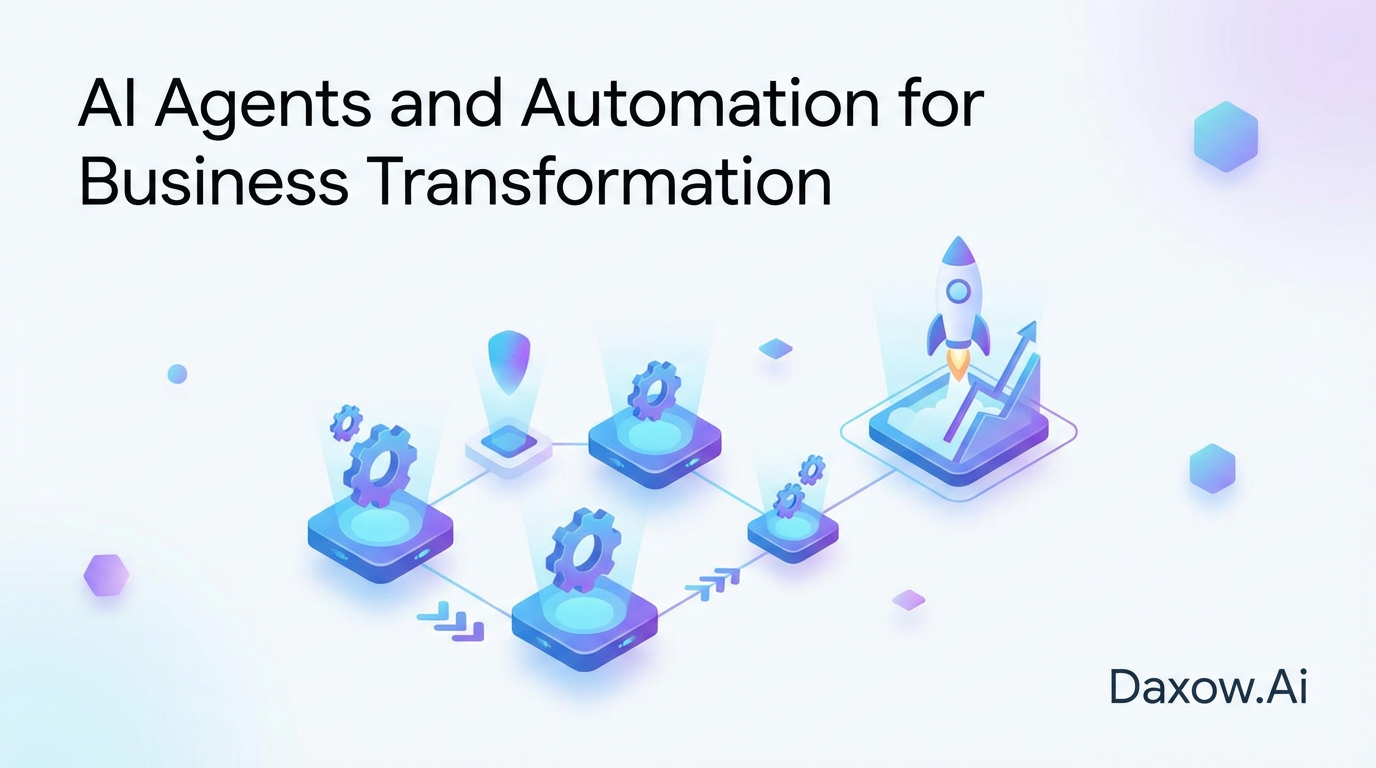
Learn how AI agents and automation cut costs, speed processes, and improve accuracy with industry use cases, ROI expectations, and a practical implementation roadmap.
Unlocking Business Transformation: AI Agents and Automation for Intelligent Process Optimization
Estimated reading time: 15 minutes
Key Takeaways
- AI agents and automation reduce operational costs by 30–50% while improving accuracy and compliance.
- Industry-specific use cases demonstrate measurable business outcomes in e-commerce, healthcare, finance, real estate, and HR.
- Successful adoption requires a clear roadmap covering strategy, data readiness, cross-functional teams, prototyping, and governance.
- Daxow.ai offers end-to-end AI automation solutions with proven client success stories and ongoing support.
- Measuring KPIs and avoiding common pitfalls like poor data quality and inadequate change management are critical for ROI.
Table of Contents
- What Unlocking Business Transformation Means for Your Company
- Practical Use Cases
- How AI Agents and Automation Drive Business Outcomes and ROI
- Implementation Roadmap — From Strategy to Scale
- Design and Integration Considerations
- Daxow.ai — How We Help You Unlock Business Transformation
- Measuring Success — KPIs That Matter
- Common Pitfalls and How to Avoid Them
- Real-World Mini Use Cases — Actionable Templates
- Conclusion and Call to Action
- Frequently Asked Questions
What Unlocking Business Transformation Means for Your Company
AI agents and workflow automation combine artificial intelligence, orchestration, and robotic process automation to execute complex, data-intensive workflows with minimal human intervention. Instead of simply replacing manual tasks, these systems transform how work gets done by:
- Automating repetitive, rule-based work such as invoice reconciliation, lead qualification, and document extraction.
- Accelerating processing times from hours to minutes for document-heavy tasks.
- Improving accuracy and compliance via audit trails, standardized decisions, and bias detection.
- Freeing teams to focus on high-value initiatives, increasing overall productivity and innovation.
When implemented correctly, businesses achieve 30–50% reductions in operational costs, faster SLA compliance, and accuracy improvements in areas like fraud detection that can exceed 90%. The technical and organizational challenge is not the promise but the execution: integration with legacy systems, data quality, and change management are common obstacles that must be addressed.
Unlocking Business Transformation: AI Agents and Automation for Intelligent Process Optimization — Practical Use Cases
E‑commerce — Sales and Inventory Automation
What to automate:
- Lead qualification and routing.
- Customer support automation (order status, returns).
- Review sentiment analysis and automated responses.
- Inventory forecasting using sales patterns.
Typical stack:
- Conversational AI + CRM integration for lead qualification.
- Document and data extraction for returns and refunds.
- Predictive models connected to inventory systems.
Business outcomes:
- Faster lead response, increasing conversion rates.
- Reduced stockouts and overstock through automated forecasting.
- Customer support resolution times cut substantially, improving NPS.
Healthcare — Patient-Centric Automation
What to automate:
- Patient intake forms and insurance verification.
- Triage and scheduling via chatbots.
- Document automation for clinical notes and billing.
Typical stack:
- Secure data pipelines and privacy-first AI models.
- Natural language understanding for triage and summarization.
- Workflow automation for claims and billing reconciliation.
Business outcomes:
- Administrative overhead reduced, letting clinicians spend more time with patients.
- Faster claim processing and fewer billing errors.
- Improved compliance via audit trails and standardized handling.
Finance — Risk, Compliance, and Reconciliation
What to automate:
- Transaction monitoring and fraud detection.
- Invoice reconciliation and exception handling.
- Compliance report generation and audit trails.
Typical stack:
- Real-time data ingestion and anomaly detection models.
- Rule-based orchestration and human-in-the-loop workflows for edge cases.
- Secure logging and versioned model governance.
Business outcomes:
- Fraud detection accuracy improvements and faster investigations.
- Reduced manual reconciliation time with traceable audit records.
- Lower operational risk and improved regulatory readiness.
Real Estate — Lead Management and Document Processing
What to automate:
- Pre-qualification of buyer and tenant leads.
- Extraction of key terms from contracts and leases.
- Market trend analysis for pricing and sourcing.
Typical stack:
- Document AI for lease and title processing.
- Integrations with property management and CRM systems.
- Predictive analytics for pricing and demand.
Business outcomes:
- Faster deal cycles and more accurate valuations.
- Reduced time spent on paperwork and manual reviews.
- Better prioritization of leads leading to higher close rates.
HR and Operations — Recruitment and Onboarding
What to automate:
- Resume parsing and candidate scoring.
- Automating background checks and offer letter generation.
- Employee onboarding workflows and FAQ chatbots.
Typical stack:
- NLP models for resume screening.
- Workflow automation for multi-step onboarding processes.
- Integrations with HRIS and payroll systems.
Business outcomes:
- Shorter time-to-hire and consistent candidate evaluation.
- Fewer manual errors in onboarding paperwork.
- Improved employee experience and retention.
How AI Agents and Automation Drive Business Outcomes and ROI
AI agents do more than perform individual tasks — they orchestrate multi-step processes across tools and teams. Key mechanisms include:
- Autonomous orchestration: Agents coordinate across CRMs, ticketing systems, and ERPs to complete end-to-end workflows.
- Human-in-the-loop: When exceptions arise, agents escalate to humans with context, preserving speed and control.
- Continuous learning: Models are retrained with new data to maintain accuracy and adapt to changing conditions.
- Compliance by design: Audit logs, role-based access, and bias detection are embedded into workflows.
Expected ROI:
- Operational cost reduction of 30–50% on targeted processes.
- Processing times reduced from hours to minutes for document handling.
- Higher conversion and customer satisfaction via faster, personalized responses.
- Long-term scalability with modular, reusable workflow components.
Implementation Roadmap — From Strategy to Scale
1. Define clear goals and identify high-impact processes
- Map current workflows and identify tasks that are repetitive, rule-based, or data-heavy.
- Prioritize by ROI potential: cost, volume, error rate, and customer impact.
- Set measurable targets (e.g., reduce invoice processing time by 50%, improve lead response SLA to under 5 minutes).
2. Assess data readiness and choose tools
- Audit data quality, availability, and privacy requirements.
- Select tools that offer strong APIs and integration capabilities.
- Favor modular platforms that support model governance and explainability.
3. Build a cross-functional team
- Include business owners, data engineers, compliance experts, and change managers.
- Establish KPIs and executive sponsorship to maintain momentum.
- Provide training and quick wins to reduce resistance.
4. Prototype, test, and iterate
- Start with a Minimum Viable Automation (MVA) on a single process.
- Use measurable pilots and collect feedback from users.
- Monitor performance and retrain models where needed.
5. Scale and govern
- Modularize workflows for reuse across departments.
- Implement monitoring dashboards, automated alerts, and audit trails.
- Maintain centralized governance to prevent shadow AI and ensure compliance.
Design and Integration Considerations
- Legacy system integration: Select connectors and APIs that support secure data exchange and test interoperability early.
- Infrastructure: Plan for storage, compute, and model serving to handle scale and latency requirements.
- Data quality: Standardize formats and build validation pipelines to prevent garbage-in/garbage-out.
- Change management: Communicate benefits, provide training, and highlight early wins to secure adoption.
- Compliance and security: Embed privacy checks, role-based access, and logging to meet regulatory needs.
Daxow.ai — How We Help You Unlock Business Transformation
Daxow.ai designs and implements custom AI automation solutions that deliver measurable business outcomes. Our approach covers the full lifecycle:
- Discovery and process analysis: We map your workflows and identify high-impact automation opportunities that reduce manual tasks and increase productivity.
- Custom AI agent design: We build AI agents tailored to your operations — from chatbots for customer support automation to autonomous lead qualification systems for sales automation.
- End-to-end workflow automation: We orchestrate integrations across CRMs, ERPs, ticketing systems, and business tools to deliver seamless, audit-ready processes.
- Data engineering and governance: We ensure data pipelines are robust, compliant, and optimized for continuous learning.
- Deployment and monitoring: We deliver production-ready agents with dashboards, alerts, and retraining pipelines to sustain accuracy and ROI.
- Change management and training: We provide stakeholder alignment and training materials to embed automation within your teams.
Example engagement outcomes:
- A retail client saw 30% fewer stockouts and improved conversion rates after we implemented inventory and sales automation.
- A finance firm reduced manual reconciliation time by over 50%, while fraud alerts improved detection accuracy above 90% with AI-assisted monitoring.
- A healthcare provider automated intake and triage workflows, cutting administrative time and improving patient throughput.
Discover more about our services on the Daxow.ai Solutions page or learn about our Process Analysis approach.
Measuring Success — KPIs That Matter
Measure both operational and business outcomes to validate impact:
Operational KPIs:
- Average processing time per workflow (hours to minutes).
- Number of manual interventions per process.
- Accuracy/error rate of automated decisions.
Business KPIs:
- Cost savings and ROI percentage.
- Customer satisfaction scores (NPS, CSAT).
- Conversion rate uplift (sales automation).
- Time-to-hire reductions (HR automation).
Common Pitfalls and How to Avoid Them
- Pitfall: Starting too broad
Mitigation: Focus on one or two high-impact processes and expand from success. - Pitfall: Poor data quality
Mitigation: Invest in data pipelines and validation early. - Pitfall: Ignoring integration challenges
Mitigation: Test APIs and connectors during the discovery phase. - Pitfall: Neglecting governance and compliance
Mitigation: Build audit trails and privacy controls into every workflow. - Pitfall: Underestimating change management
Mitigation: Secure executive sponsorship and demonstrate quick wins.
Real-World Mini Use Cases — Actionable Templates
Use Case: Automated Invoice Reconciliation (Finance)
- Trigger: New invoice arrives via email.
- Steps: Document extraction → line-item matching → exception routing → posting to ERP.
- Outcome: Processing time reduced from 4 hours to under 15 minutes; human review only for exceptions.
Use Case: Conversational Lead Qualification (Sales Automation)
- Trigger: Website lead submits form.
- Steps: AI agent engages via chat or email → scores lead based on intent and fit → schedules meeting or routes to sales rep.
- Outcome: Faster response time, higher qualified lead throughput, improved close rates.
Use Case: Patient Intake and Triage (Customer Support Automation in Healthcare)
- Trigger: Patient initiates chatbot interaction.
- Steps: Symptom capture → triage scoring → appointment scheduling or escalation to clinician.
- Outcome: Reduced administrative burden and faster triage decisions.
Conclusion and Call to Action
Unlocking Business Transformation: AI Agents and Automation for Intelligent Process Optimization is not theoretical — it is a pragmatic pathway to lower costs, higher productivity, and improved customer outcomes. The technical building blocks are proven; what separates winners is a disciplined approach to process selection, integration, governance, and change management.
If you are ready to reduce manual tasks, scale productivity, and realize measurable ROI, Daxow.ai can help. Book a free consultation or request a process analysis for your company today. Contact us to build a custom AI system that automates your most critical workflows and delivers tangible business value.
Frequently Asked Questions
What distinguishes AI agents from traditional automation?
AI agents combine artificial intelligence with orchestration and robotic process automation to handle complex workflows dynamically, adapting to new data and escalating exceptions—beyond simple rule-based task automation.
How do I measure ROI from AI automation?
ROI is measured using operational KPIs like processing time and error rates, alongside business KPIs such as cost savings, customer satisfaction scores, and conversion rate improvements. Setting clear targets during planning is critical.
What industries benefit most from AI agents and automation?
While virtually all industries benefit, e-commerce, healthcare, finance, real estate, and HR have demonstrated strong value with specific use cases for sales, patient care, risk, contract processing, and recruitment automation.
How does Daxow.ai assist with change management?
We provide stakeholder alignment, training materials, quick wins demonstrations, and executive sponsorship support to encourage adoption and reduce resistance during AI and automation implementation.