
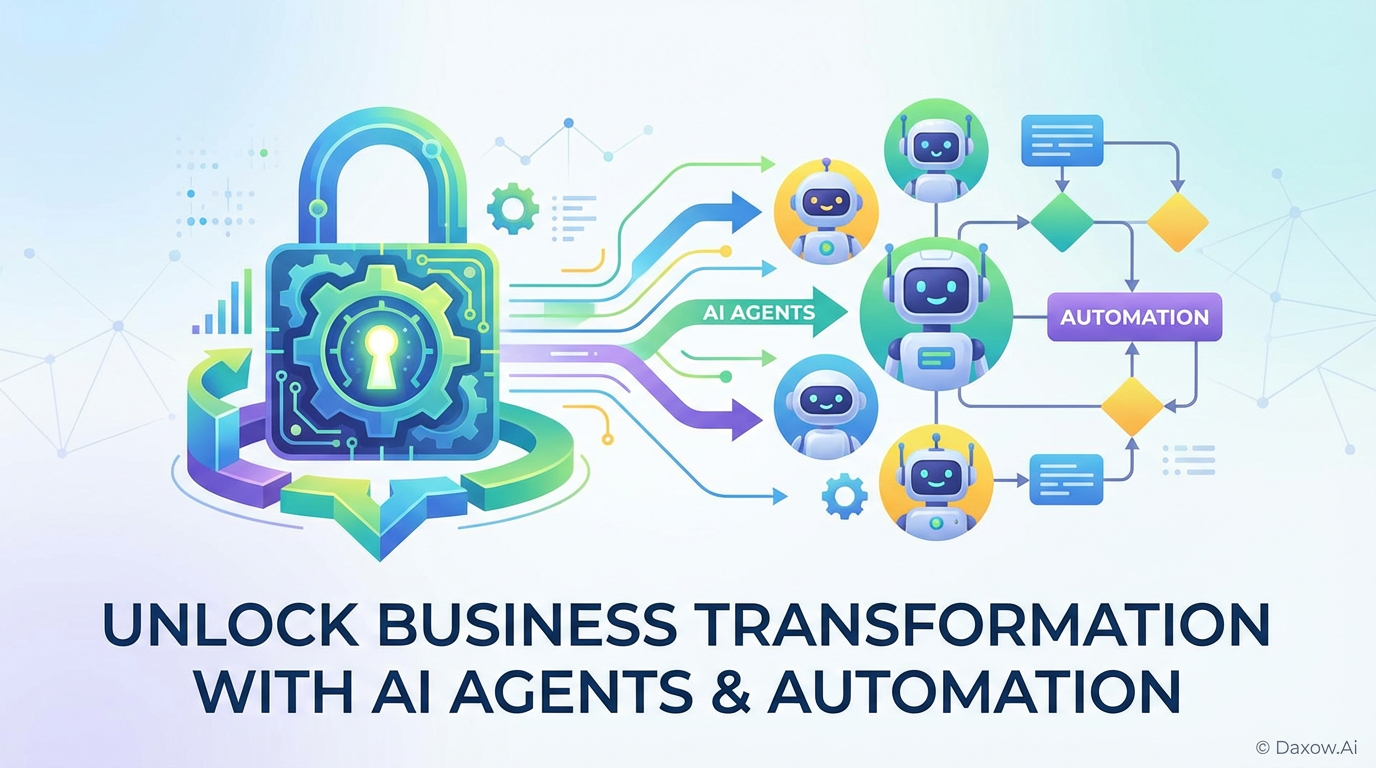
Unlock Business Transformation with AI Agents & Automation
Discover how AI agents and automation deliver measurable ROI — industry use cases, implementation framework, and Daxow.ai's approach to cut costs and boost productivity.
Unlocking Business Transformation with AI Agents and Automation
Estimated reading time: 15 minutes
Key Takeaways
- AI agents and automation enable businesses to scale efficiently, reduce costs, and improve customer experiences.
- Real-world use cases span e-commerce, healthcare, finance, real estate, and HR with measurable ROI.
- A structured implementation framework is essential to minimize risk and maximize business value.
- Technical excellence combines API-first integration, hybrid automation, and human-in-the-loop governance.
- Daxow.ai partners with organizations to build custom AI systems delivering rapid ROI and operational improvements.
Table of Contents
- Unlocking Business Transformation with AI Agents and Automation — Why it matters
- Practical Use Cases: How AI automation and AI agents deliver measurable value
- Implementation framework for AI automation that reduces risk and maximizes ROI
- Technical approach — building AI agents that execute real tasks
- ROI, KPIs, and tangible business value
- Three real-world implementation scenarios (mini case studies)
- Frequently Asked Questions
Unlocking Business Transformation with AI Agents and Automation — Why it matters
Unlocking Business Transformation with AI Agents and Automation is no longer an experimental initiative — it is a strategic imperative for companies that want to scale efficiently, reduce operational costs, and improve customer outcomes. Modern organizations face rising customer expectations, complex compliance requirements, and an urgent need to do more with smaller teams. Deploying AI agents and workflow automation shifts operations from reactive to proactive, enabling companies to:
- Free employees from repetitive work so they can focus on high-value activities.
- Improve accuracy and consistency across data-heavy processes like invoicing, compliance, and forecasting.
- Deliver personalized customer experiences at scale through real-time decisioning and conversational AI.
- Scale operations without linear increases in headcount, improving margins and speed to market.
Evidence from enterprise deployments shows organizations reach objectives 3–5x faster when they adopt structured AI implementations that pair task automation with clear escalation paths to human teams. In targeted processes, automation can reduce manual intervention by up to 80%, while delivering 30–50% reductions in operational costs and payback within 6–12 months when projects are scoped for ROI from the start.
Practical Use Cases: How AI automation and AI agents deliver measurable value
E-commerce — inventory, pricing, and conversational commerce
Use case:
- AI agents forecast demand using historical sales, seasonality, and supplier lead times to reduce out-of-stock occurrences.
- Dynamic pricing agents adjust prices based on competitor data, inventory levels, and margin targets.
- Customer support automation replies to FAQs, processes returns, and escalates complex issues to humans.
Business outcomes:
- Reduced stockouts and overstocks, improving fulfillment rates.
- Higher conversion and lower cart abandonment from faster, personalized responses.
- Typical impact: 10–25% uplift in conversion and notable reductions in working capital tied up in inventory.
How Daxow helps:
- Build custom forecasting agents integrated with your ERP and sales data.
- Implement chatbots connected to order, returns, and CRM systems.
- Deploy A/B testing frameworks to validate pricing strategies.
Healthcare — scheduling, triage, and compliance automation
Use case:
- Virtual agents handle appointment triage, prioritize urgent cases, and pre-populate forms for clinicians.
- Automation pipelines consolidate data for compliance reporting and billing reconciliation.
Business outcomes:
- Shorter patient wait times, fewer missed appointments.
- Reduced administrative burden on clinical staff, enabling more patient-facing time.
- Typical impact: 30–50% reduction in scheduling effort, faster compliance reporting cycles.
How Daxow helps:
- Design secure, HIPAA-aligned connectors to EHR systems and scheduling platforms.
- Develop triage agents using natural language processing tuned to medical intents.
- Automate audit-ready reporting and logging.
Finance — fraud detection, invoice processing, and KYC
Use case:
- AI agents analyze transactions to flag anomalies and suspicious patterns in real time.
- Document automation extracts invoice line items and approvals from unstructured PDFs.
- Conversational agents guide customers through KYC steps and verify documents.
Business outcomes:
- Lower false positives and faster fraud detection.
- Faster invoice cycle times and fewer payment delays.
- Typical impact: 40–60% reduction in manual review time, improved compliance posture.
How Daxow helps:
- Deploy anomaly-detection models integrated with transaction systems.
- Build OCR and NLP pipelines for high-accuracy data extraction.
- Implement role-based escalation and audit trails for regulatory compliance.
Real Estate — valuations, lead qualification, and contract automation
Use case:
- Agents compute property valuations by combining market feeds, comparables, and local trends.
- Conversational AI qualifies leads, captures requirements, and schedules viewings.
- Contract agents pre-fill and validate contract terms and flag exceptions for legal review.
Business outcomes:
- Faster lead-to-contract cycles and better lead nurturing.
- Reduced time for manual valuation and contract preparation.
- Typical impact: Accelerated deal velocity, higher conversion rates.
How Daxow helps:
- Integrate MLS and market data feeds, build valuation models, and automate lead scoring within CRMs.
- Configure conversational workflows that feed directly into sales automation.
HR — candidate screening, onboarding, and retention analytics
Use case:
- Resume screening agents perform semantic matching and surface the best candidates.
- Onboarding workflows automate documentation, training assignments, and IT provisioning.
- Sentiment and attrition models identify employees at risk of leaving.
Business outcomes:
- Faster time-to-hire and reduced recruiter workload.
- Streamlined onboarding, leading to faster productivity ramp-up.
- Typical impact: Lower hiring costs and improved retention metrics.
How Daxow helps:
- Build semantic search and scoring models for applicant pools.
- Automate multi-system onboarding sequences and compliance checks.
- Integrate HRIS and learning platforms to measure onboarding effectiveness.
Implementation framework for AI automation that reduces risk and maximizes ROI
1. Strategic assessment and planning (4–8 weeks)
- Activities: process mapping, data readiness audit, KPI definition (e.g., resolution time, cost per transaction).
- Deliverables: prioritized automation roadmap, pilot selection, success criteria.
- Daxow role: lead workshops with stakeholders, map systems, and quantify expected savings.
2. Technology selection and preparation
- Activities: choose platforms with API-first architectures, set up data pipelines, clean and label data.
- Deliverables: integration plan, knowledge base, vendor recommendations.
- Daxow role: architect scalable solutions, implement connectors, and construct secure data stores.
3. Pilot deployment
- Activities: implement low-risk, high-impact use case; monitor metrics; gather user feedback.
- Deliverables: working pilot, performance dashboard, user training materials.
- Daxow role: deliver the pilot agent, monitor performance, and optimize models in production.
4. Gradual rollout and change management
- Activities: extend automation across departments, conduct training, establish governance and escalation paths.
- Deliverables: implementation playbooks, governance documentation, audit trails.
- Daxow role: manage phased rollout, train internal teams, and help set policies.
5. Continuous monitoring and optimization
- Activities: model retraining, drift detection, KPI monitoring, feature expansion.
- Deliverables: ongoing improvement backlog, periodic business reviews.
- Daxow role: provide managed services or handover with runbooks; implement observability tools.
Best practices to follow:
- Start with high-frequency, low-complexity processes to prove value quickly.
- Ensure data readiness and real-time pipelines to avoid production failures.
- Align business and IT through transparent governance and shared KPIs.
- Design human-AI collaboration with clear escalation and override mechanisms.
Technical approach — building AI agents that execute real tasks
AI agents are more than chatbots. They are executable workflows that combine intelligence, integration, and orchestration.
Core technical pillars:
- API-first integration: Agents must query and act on enterprise systems (CRM, ERP, ticketing) via secure APIs.
- Robust data pipelines: Real-time ingestion, normalization, and feature stores enable reliable decisioning.
- Hybrid automation: Combine rule-based automation for deterministic tasks and ML agents for unstructured inputs.
- Observability and governance: Audit logs, model explainability, and performance dashboards are required for trust and compliance.
- Human-in-the-loop: Escalation paths for exceptions, approval steps, and ongoing feedback loops ensure safety and continuous learning.
How Daxow implements this:
- We map your system landscape and build secure connectors to key tools.
- We create knowledge bases and model contexts to ensure agents act with correct domain information.
- We orchestrate end-to-end workflows so an agent can read an email, extract intent, update a CRM record, and schedule a human review if needed.
- We provide governance frameworks and retraining schedules to prevent drift and bias.
ROI, KPIs, and tangible business value
Decision-makers need clear metrics. Typical outcomes from focused AI automation programs include:
- 30–50% reduction in operational costs in targeted functions.
- Up to 80% reduction in manual interventions for well-scoped processes.
- Payback within 6–12 months for ROI-focused pilots.
- Improved customer satisfaction scores and faster resolution times for support channels.
- Accelerated revenue impacts via better lead qualification and faster sales cycles.
Example KPI dashboard items:
- Average handling time (AHT) before vs. after automation.
- Percentage of tasks fully automated end-to-end.
- Cost per transaction and monthly cost savings.
- Model precision/recall and escalation rates.
- Customer satisfaction (CSAT) or Net Promoter Score (NPS) improvements.
Quick ROI illustration:
If a process currently costs $50,000/month in labor and automation reduces manual work by 40%, monthly savings are $20,000. If the pilot costs $60,000 to implement, payback occurs in three months. This simplistic example illustrates why ROI-focused pilots are powerful.
Three real-world implementation scenarios (mini case studies)
Scenario 1 — Global e-commerce brand
Challenge: High order volumes produced frequent out-of-stock notices and high support ticket loads.
Solution: Daxow built an AI agent that forecasts demand, adjusts pricing, and automated first-line support.
Results: 15% increase in conversion, 35% reduction in support tickets, ROI realized in 5 months.
Scenario 2 — Mid-sized financial services firm
Challenge: Manual KYC and invoice processing slowed onboarding and increased compliance risk.
Solution: Document automation and anomaly detection agents integrated with core banking systems.
Results: 60% reduction in manual review time, faster onboarding, and measurable compliance improvements within 6 months.
Scenario 3 — Healthcare network
Challenge: Administrative overhead for scheduling and triage limited clinician availability.
Solution: A secure conversational agent handled scheduling, pre-visit triage, and automated reporting.
Results: 40% fewer no-shows, 30% reduction in scheduling workload, and improved patient satisfaction.
Each deployment followed the same disciplined Daxow approach: assess, pilot, integrate, scale, and continuously optimize.
Frequently Asked Questions
What are AI agents and how do they differ from traditional automation?
AI agents combine artificial intelligence with workflow automation to perform complex tasks involving unstructured data, decision-making, and real-time integration, going beyond simple rule-based automation.
How quickly can companies expect ROI from AI automation projects?
When scoped with clear ROI targets and using a structured implementation framework, companies often realize payback within 6–12 months after pilot deployment.
What industries benefit most from AI agents and automation?
AI agents and automation deliver value across many sectors including e-commerce, healthcare, finance, real estate, and HR by tackling diverse use cases from demand forecasting to compliance reporting.
How does Daxow.ai ensure compliance and governance in AI implementations?
Daxow implements audit logs, escalation paths, approval workflows, and model explainability tools to maintain trust, regulatory compliance, and operational safety.