
Master AI Agents and Automation for Business Transformation
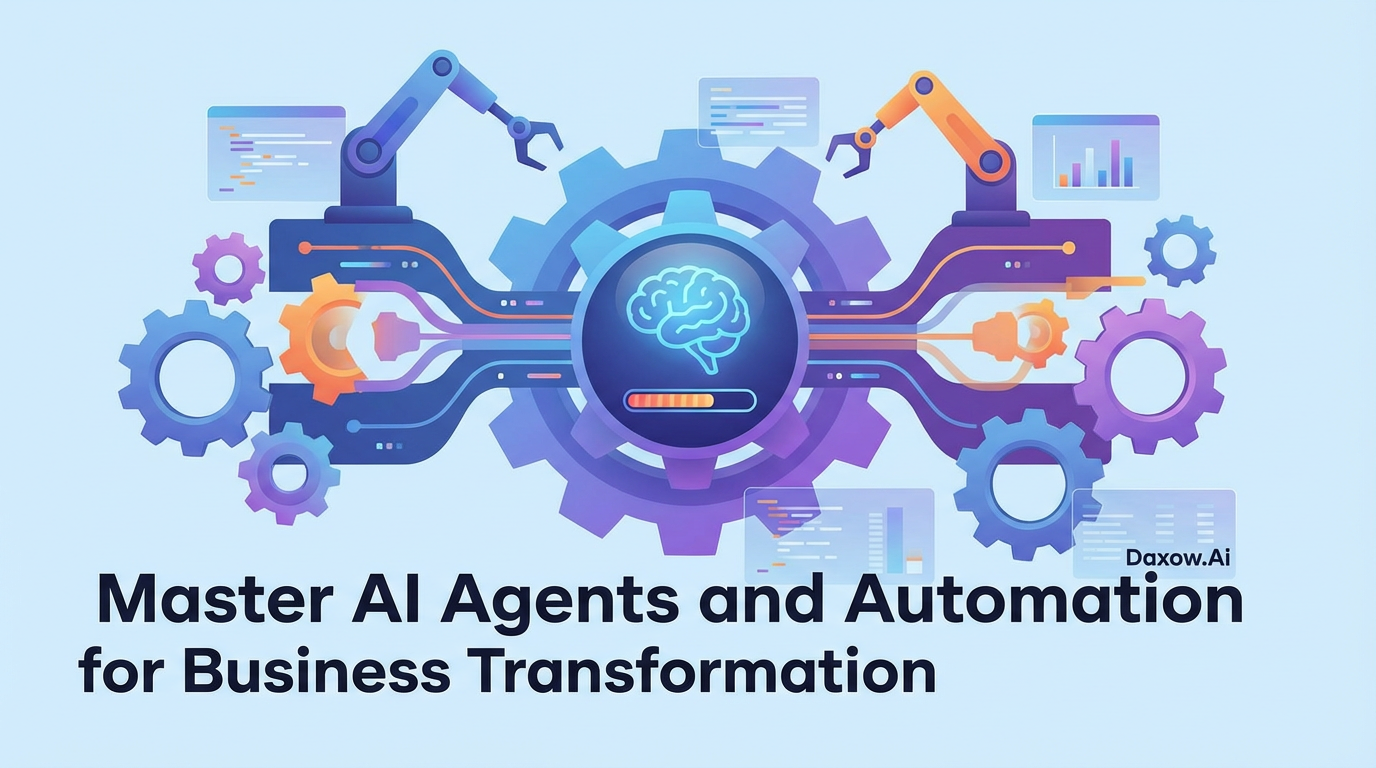
Practical guide to implementing AI agents and workflow automation: phased roadmap, industry use cases, ROI evidence, and how Daxow.ai delivers end-to-end solutions.
Mastering AI Agents and Automation: A Strategic Imperative for Business Transformation
Estimated reading time: 15 minutes
Key Takeaways
- AI agents enable scalable, autonomous task execution that reduces manual labor and costs.
- Automation delivers significant ROI through faster outcomes, cost savings, and operational resilience.
- Industry-specific use cases show real-business impact in e-commerce, healthcare, finance, real estate, HR, and enterprise support.
- A phased implementation framework and careful vendor selection mitigate risks for successful deployment.
- Daxow.ai offers custom AI automation solutions integrating with existing enterprise tools to drive measurable business value.
Table of Contents
- Mastering AI Agents and Automation: A Strategic Imperative for Business Transformation
- Practical Use Cases Across Industries
- Implementing AI Agents and Workflow Automation — A Practical Framework
- Technical Architecture and Integration Considerations
- Measuring ROI and Business Value
- How Daxow.ai Delivers End-to-End Business Automation
- Frequently Asked Questions
Mastering AI Agents and Automation: A Strategic Imperative for Business Transformation
Mastering AI Agents and Automation: A Strategic Imperative for Business Transformation is no longer aspirational — it is a practical requirement for companies that want to scale efficiently, improve customer experience, and reduce operational costs. Organizations that adopt AI automation and workflow automation can accelerate outcomes, reduce manual tasks, and create resilient, data-driven processes. This article explains why AI agents matter, presents clear implementation steps, and offers industry-specific use cases and ROI evidence. Throughout, we explain how Daxow.ai — an AI automation agency founded in Estonia in 2024 — designs and delivers custom AI systems that transform operations end-to-end.
Why this is strategic
- Competitive differentiation: AI agents act as autonomous digital workers that execute routine tasks, surface insights, and scale service delivery without proportional headcount increases.
- Cost and speed advantages: Targeted automation can reduce support and operational costs by 30–50% and enable teams to meet objectives 3–5x faster through streamlined workflows and reduced manual work.
- Scalability and resilience: Intelligent automation supports growth for 3–5 years or more without linear increases in staffing, creating a defensible efficiency moat.
- Data-driven decisions: Automated agents generate and standardize data that improves forecasting, personalization, and compliance across processes.
Key capabilities delivered by AI agents and automation
- Autonomous task execution (email triage, invoice processing, lead qualification)
- Conversational interfaces for 24/7 customer support automation
- Real-time monitoring and predictive alerts (fraud, churn, inventory shortages)
- Document processing and data extraction for faster workflows
- Seamless integrations with CRMs, ERPs, and third-party APIs
Practical Use Cases Across Industries
AI agents and workflow automation deliver measurable outcomes across sectors by focusing first on high-volume, low-complexity tasks and then scaling to more complex workflows.
E-commerce — Increase conversions, reduce cart abandonment
- Use case: AI-driven product recommendations, dynamic inventory alerts, and customer support chatbots.
- Impact: Chatbots and automated support resolve 70–80% of common inquiries, reducing response times and lowering support costs.
- Daxow approach: Build AI agents that integrate with product catalogs, payment platforms, and CRM systems to automate order updates, returns processing, and personalized campaigns that improve conversion rates and lifetime value.
Healthcare — Streamline scheduling and triage
- Use case: Conversational triage agents, automated appointment scheduling, and secure document intake.
- Impact: Reduces administrative burden and wait times by up to 50% while maintaining compliance through HIPAA-aligned data handling.
- Daxow approach: Implement secure data pipelines, design consent-aware chatbots, and integrate with EHR systems to automate routine administrative tasks and free clinicians for higher-value care.
Finance — Risk reduction and compliance at scale
- Use case: Real-time fraud detection agents, automated compliance reporting, and personalized advisory assistants.
- Impact: Faster anomaly detection, reduced regulatory risk, and improved customer self-service for common requests.
- Daxow approach: Deploy monitoring agents that stream transaction streams to models, automate suspicious activity alerts to human investigators, and connect outputs to governance workflows.
Real Estate — Faster lead qualification and market intelligence
- Use case: Virtual tours, automated lead qualification via chat, and price trend analysis.
- Impact: Shorter sales cycles and higher conversion from qualified leads; more efficient agent time allocation.
- Daxow approach: Combine conversational AI, lead scoring models, and CRM automation to route hot leads to sales teams and nurture colder prospects automatically.
Human Resources — Faster hiring and better employee support
- Use case: Resume screening, candidate pre-qualification, onboarding automation, and HR helpdesk bots.
- Impact: Reduce hiring time by ~40%, automate routine HR queries, and increase new-hire satisfaction.
- Daxow approach: Design decision trees and AI agents that screen and rank applicants, trigger background checks, and create tailored onboarding workflows integrated with HRIS systems.
Enterprise Support — Reduce costs and improve CSAT
- Use case: Multi-channel customer support automation and escalation agents that hand off complex cases to humans.
- Impact: Significant reductions in first-response time and improved customer satisfaction through consistent, accurate answers.
- Daxow approach: Implement omnichannel AI agents that connect chat, email, and voice, integrate knowledge bases, and establish escalation rules to preserve service quality.
Implementing AI Agents and Workflow Automation — A Practical Framework
Successful automation follows a phased, iterative approach to reduce risk and show early ROI.
Phase 1 — Strategic Assessment and Planning (4–8 weeks)
- Objectives: Define business goals, identify high-impact processes, and set metrics (cost per ticket, resolution rate, processing time).
- Deliverables: Prioritized use-case list, baseline KPIs, data audit, and a project roadmap.
- Common pitfalls: Vague objectives or selecting low-impact processes.
- How Daxow helps: Run facilitated workshops with stakeholders to map processes, quantify benefits, and build a prioritized automation backlog.
Phase 2 — Technology and Vendor Selection (6–12 weeks)
- Objectives: Choose scalable platforms and vendors with strong API capabilities, governance features, and compliance support.
- Deliverables: Architectural options, integration plan, cost estimate, and governance checklist.
- Common pitfalls: Ignoring scalability or underestimating integration complexity.
- How Daxow helps: Provide vendor evaluations, proof-of-concept assistance, and selection guidance focused on long-term TCO and data connectivity.
Phase 3 — Data Preparation and Readiness (4–8 weeks)
- Objectives: Cleanse data, build knowledge bases, establish model training sets, and document workflows.
- Deliverables: Data pipelines, training corpora, cleansing scripts, and decision trees.
- Common pitfalls: Poor data quality and lack of documentation.
- How Daxow helps: Develop ETL processes, structure knowledge bases, and validate datasets to ensure reliable AI performance.
Phase 4 — Pilot Deployment and Gradual Rollout (4–20 weeks)
- Objectives: Deploy low-risk pilots, measure KPIs, iterate on performance, and scale by channel or geography.
- Deliverables: Live pilot, observations report, updated models, and a scaling plan.
- Common pitfalls: Skipping pilots or doing wide rollouts without human oversight.
- How Daxow helps: Build and manage pilots, run A/B tests, collect user feedback, and refine models before scale.
Phase 5 — Monitoring, Optimization, and Governance (ongoing)
- Objectives: Continuously monitor performance, retrain models, and enforce governance and compliance.
- Deliverables: KPI dashboards, model retraining schedules, governance policies, and incident response plans.
- Common pitfalls: No governance or unclear ownership for model drift.
- How Daxow helps: Implement monitoring tools, define role-based governance, and provide managed services for ongoing optimization.
Designing pilots for success
- Choose a narrow scope: one channel, one task.
- Define success metrics up front and use baseline comparisons.
- Keep humans in the loop for edge cases and learning feedback.
- Plan for multilingual and multi-region expansion once accuracy and stability are proven.
Technical Architecture and Integration Considerations
Key architectural principles
- API-first integrations: Use standard APIs to connect AI agents with CRMs, ERPs, and communication platforms.
- Robust data pipelines: Ensure real-time access, validation, and lineage for all inputs and outputs.
- Context sharing between agents: Implement context protocols to allow multiple agents to coordinate and maintain conversation state.
- Hybrid human-AI workflows: Design handoff patterns where agents escalate complex cases to humans with context and recommended actions.
- Governance and privacy by design: Embed compliance (GDPR, HIPAA when required), logging, and access controls into every component.
Implementation checklist
- Map integration points and required data fields.
- Define model inputs and acceptable confidence thresholds.
- Create fallbacks and explainability mechanisms for regulated use cases.
- Establish monitoring for accuracy, latency, and business KPIs.
How Daxow implements architecture
- Daxow engineers design modular architectures that separate data ingestion, model serving, orchestration, and UX layers.
- We implement secure connectors to CRMs and business tools, ensuring seamless system integrations and data connectivity.
- For complex environments, Daxow builds orchestration layers that manage multiple AI agents and business rules to automate end-to-end processes.
Measuring ROI and Business Value
Quantifiable benefits
- Support center cost reduction: 30–50% savings in support operations with effective customer support automation.
- Faster outcomes: 3–5x acceleration in hitting operational objectives through process automation and AI agents.
- Hiring efficiency: HR automation can reduce hiring time by around 40%.
- Operational scalability: Handle multi-year volume growth without proportional staff increases.
Sample ROI calculation (illustrative)
- Company: 200-person support organization handling 100k tickets/year.
- Baseline cost: $8M/year in labor and overhead.
- Automation impact: 40% reduction in routine tickets handled by AI agents.
- Savings: $3.2M/year in redirected labor or avoided hires.
- Payback: Pilot and platform costs typically pay for themselves within months, with ongoing ROI via continuous optimization.
Qualitative value
- Improved customer satisfaction and faster time-to-resolution.
- Higher employee engagement by removing repetitive work.
- Better compliance through auditable automated workflows.
- New revenue opportunities from personalized automation (e.g., targeted offers, cross-sell).
How Daxow.ai Delivers End-to-End Business Automation
From discovery to operations, Daxow provides a full-service model focused on measurable business value.
Discovery and process analysis
- Map current workflows and identify automation targets.
- Quantify benefits and define KPIs for success.
Design and engineering
- Build AI agents tailored to your processes (lead qualification, chatbots, document automation).
- Develop workflow automation that orchestrates tasks across systems.
Integrations and data connectivity
- Connect CRMs, ERPs, ticketing systems, and databases using secure API-first integrations.
- Implement data pipelines and knowledge bases for reliable AI performance.
Deployment and change management
- Run pilots with human-in-the-loop oversight.
- Provide training and documentation for teams to adopt automation.
Monitoring and continuous improvement
- Ongoing model maintenance, KPI monitoring, and process optimization.
- Governance frameworks to ensure compliance and risk control.
Why partner with Daxow.ai
- Custom solutions: We don’t sell one-size-fits-all — we design AI agents and workflow automation for your business context.
- End-to-end delivery: From strategy and data readiness to implementation and ongoing support.
- ROI-focused: We prioritize quick wins and measurable outcomes to justify investment.
- Integration expertise: Practical experience connecting AI systems to CRMs, ERPs, and enterprise tools.
- Operational handoff: We enable your teams to manage and extend automation after delivery.
Frequently Asked Questions
Why are AI agents critical for business transformation?
AI agents automate repetitive tasks, scale operations without increasing headcount proportionally, and unlock data-driven insights that improve decision-making and customer experience.
How does Daxow.ai approach automation projects?
Daxow.ai follows a phased approach: assessing strategy and goals, selecting vendors, preparing data, running pilots, and implementing governance to ensure scalable and measurable automation success.
Which industries benefit most from AI workflow automation?
E-commerce, healthcare, finance, real estate, human resources, and enterprise support are key industries where AI agents reduce costs, increase efficiency, and improve customer and employee experiences.
What ROI can companies expect from AI automation?
Typical ROI includes 30–50% cost reduction in support, 3–5x faster outcomes, 40% hiring time reduction, and multi-year operational scalability with continuous improvement.