
Harness AI Agents and Automation for Business Transformation
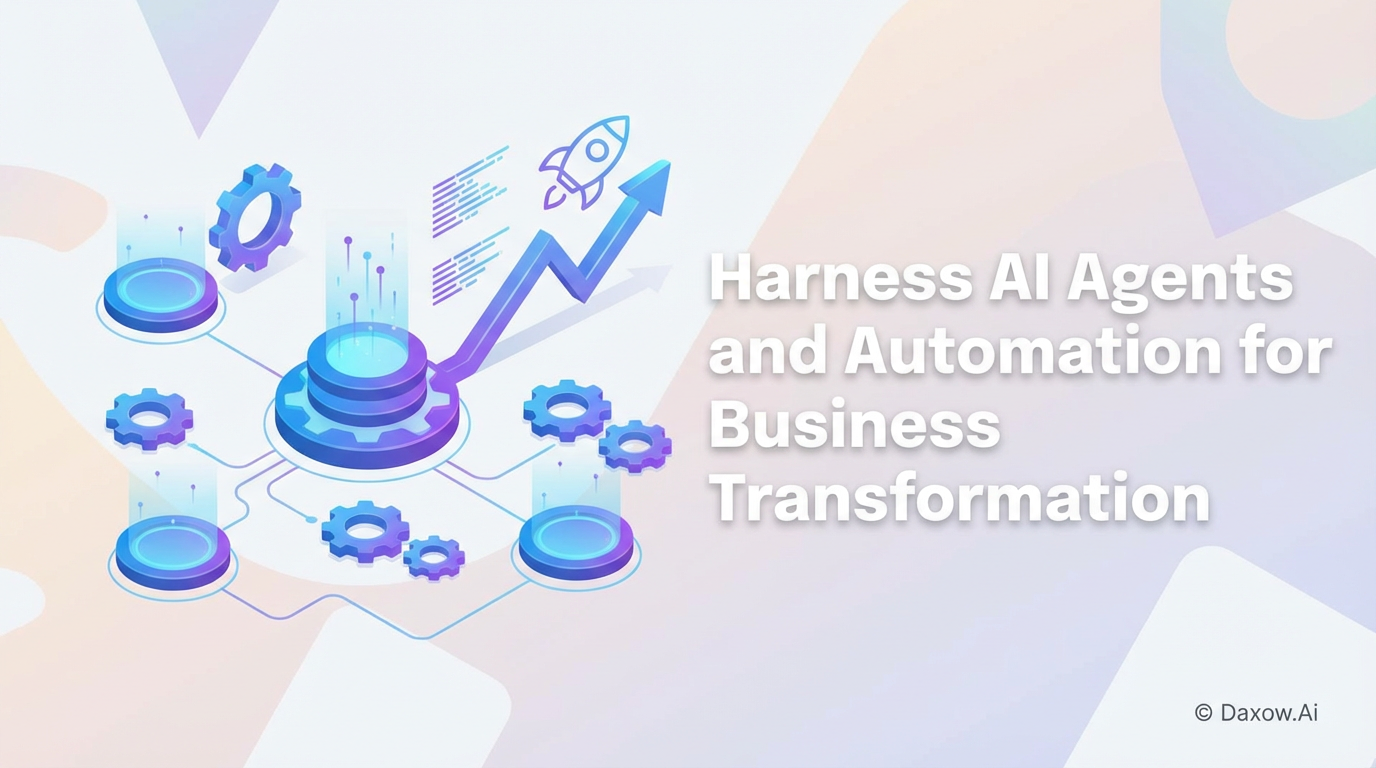
Practical guide to AI agents and automation: use cases, ROI, and a step-by-step roadmap to cut costs, boost productivity, and scale operations.
Harnessing AI Agents and Automation for Business Transformation
Estimated reading time: 15 minutes
Key Takeaways
- AI agents combined with automation reduce manual tasks, lower costs, and increase scalability.
- Key benefits include cost reduction, productivity gains, enhanced accuracy, and improved customer and employee experience.
- Industry-specific use cases demonstrate AI’s power in e-commerce, healthcare, finance, real estate, and HR.
- A structured implementation roadmap ensures successful adoption and measurable ROI.
- Daxow.ai provides custom AI automation solutions designed for real-world business impact and governance.
Table of Contents
- Harnessing AI Agents and Automation for Business Transformation — What it Means for Your Company
- Key Benefits and Business Outcomes of AI Automation
- Proven Use Cases Across Industries
- Implementation Roadmap: From Assessment to Scale
- Practical Example — Multi-Agent Workflow for Invoice-to-Pay Automation
- How Daxow.ai Designs and Delivers Custom AI Automation Solutions
- Measuring ROI and KPIs to Track Success
- Common Pitfalls and Best Practices
- Final Thoughts — Take Action Now
- Frequently Asked Questions
Harnessing AI Agents and Automation for Business Transformation — What it Means for Your Company
AI agents are autonomous software entities that perceive inputs, reason over data, and take actions to achieve goals. When combined with workflow automation (including RPA and intelligent workflows), they transform manual, error-prone tasks into reliable, scalable processes. For decision-makers, that means faster turnarounds, lower costs, and higher throughput — often with a 20–50% reduction in operational expenses in targeted areas and multi-fold productivity gains.
Key capabilities provided by AI agents and automation:
- Continuous 24/7 operations with consistent quality.
- Decision automation for routine and semi-structured tasks.
- Real-time analytics that surface operational bottlenecks.
- Seamless integrations between CRMs, ERPs, and other business systems.
Key Benefits and Business Outcomes of AI Automation
Organizations that adopt AI automation and AI agents correctly realize both immediate and sustained gains. The primary business outcomes include:
Cost Reduction and Productivity
- Reduce manual tasks by 40–70%, shrinking labor costs tied to repetitive processes.
- Scale transaction volumes without proportional headcount increases, enabling up to 10x capacity gains.
Accuracy and Risk Reduction
- Lower errors in reconciliations, data entry, and compliance checks from typical manual error rates of 5–10% to under 1%.
- Automate audit trails and policy enforcement to reduce regulatory risk.
Customer and Employee Experience
- Improve customer response times and resolution rates through customer support automation and chatbots that resolve up to 70–80% of routine queries.
- Free employees for strategic work, improving engagement and retention.
Measurable ROI
- Typical payback periods for targeted AI automation projects are under 9 months.
- Early pilots often deliver 3–6x ROI within the first year when aligned with high-impact workflows.
Proven Use Cases Across Industries
Below are practical examples that demonstrate how AI agents and workflow automation deliver business value across sectors. Each use case highlights a concrete problem, the AI-driven approach, and the expected outcomes.
E-commerce — Personalization, Support, and Inventory
Problem: High cart abandonment, slow support, and inventory mismatches reduce conversion.
AI automation approach:
- Deploy conversational AI agents to manage pre- and post-purchase queries across chat, email, and voice.
- Use predictive agents for dynamic pricing and inventory forecasting that sync with the storefront and warehouse systems.
Outcomes:
- Resolve 70–80% of customer inquiries autonomously, cut response times to seconds, and increase conversions by 15–30%.
Healthcare — Scheduling, Claims, and Triage
Problem: Administrative burden delays care and increases costs.
AI automation approach:
- Conversational agents handle appointment scheduling and basic triage.
- Document automation extracts data from claims and routes exceptions to human review.
Outcomes:
- Reduce administrative workload by 40%, speed claims processing, and improve patient satisfaction.
Finance — Fraud Detection and Compliance
Problem: High volume of transactions requires constant monitoring and audit readiness.
AI automation approach:
- Multi-agent systems that detect anomalies in real time and orchestrate investigations.
- Automated compliance checks that generate audit-ready reports.
Outcomes:
- Faster fraud detection with reduced false positives, lower compliance risk, and quicker loan approvals.
Real Estate — Lead Qualification and Transaction Speed
Problem: Slow lead qualification and manual contract review delay sales.
AI automation approach:
- Virtual agents qualify leads through interactive tours and automated questionnaires.
- Contract analysis agents extract key terms and flag deviations from standard templates.
Outcomes:
- Speed transactions by up to 50%, reduce manual listing work, and increase lead-to-client conversion.
HR — Recruitment, Onboarding, and Retention
Problem: Lengthy recruitment cycles and repetitive onboarding tasks.
AI automation approach:
- Resume screening agents with bias-aware models.
- Onboarding agents that automate document collection, benefits enrollment, and policy training.
Outcomes:
- Cut recruitment time by up to 60%, improve candidate experience, and better predict attrition.
Implementation Roadmap: From Assessment to Scale
Successful AI automation follows a disciplined, phased approach. Use this actionable roadmap to reduce risk and accelerate value.
Phase 1 — Define Goals and Assess Processes (4–8 weeks)
- Align projects with strategic objectives (cost reduction, faster service, compliance).
- Map current "as-is" workflows and identify high-volume, low-complexity candidates for automation.
- Document decision logic and data touchpoints.
Metrics to benchmark: baseline costs, cycle times, error rates.
Phase 2 — Evaluate Data and Technology (6–12 weeks)
- Assess data quality and availability; address gaps with cleansing and indexing.
- Choose platforms that support integrations with your CRM, ERP, ticketing, and document systems.
- Build a cross-functional team including process owners, IT, and compliance.
Metric to monitor: data quality score and integration readiness.
Phase 3 — Pilot Deployment (4–6 weeks)
- Launch a narrow pilot (for example: customer support chatbot or invoice automation).
- Track resolution rates, cycle time reductions, and CSAT.
- Collect end-user feedback and refine agent behavior.
Success criteria: measurable improvement against pilot KPIs and stakeholder buy-in.
Phase 4 — Integrate and Roll Out Gradually
- Extend automation to adjacent processes and channels.
- Implement escalation rules and human-in-the-loop for exceptions.
- Standardize integrations and deploy monitoring dashboards.
Metrics to expand: ROI, error reduction, and throughput.
Phase 5 — Monitor, Optimize, and Govern
- Establish review cycles and continuous improvement practices.
- Retrain models with fresh data, tune decision thresholds, and monitor drift.
- Enforce security and compliance policies throughout the lifecycle.
Metric to sustain: long-term ROI and reduced exception rates.
Practical Example — Multi-Agent Workflow for Invoice-to-Pay Automation
Problem: Accounts payable teams spend excessive time on invoice validation, approvals, and exception handling.
Multi-agent solution:
- Extraction Agent: Uses document automation to extract invoice data and validate line items.
- Matching Agent: Reconciles invoices with purchase orders and receipts using business rules.
- Exception Agent: Identifies discrepancies, compiles context, and routes to the right approver with suggested resolutions.
- Payment Agent: Triggers payments and records audit trails when approvals are met.
Outcomes:
- Reduce invoice processing time from days to hours, cut manual approvals by 60–80%, and produce audit-ready records automatically.
How Daxow.ai Designs and Delivers Custom AI Automation Solutions
At Daxow.ai, we combine domain expertise with a pragmatic engineering approach to deliver end-to-end business automation.
Our approach:
- Discovery and Process Analysis: We map your workflows to identify the highest-impact automation opportunities and quantify expected ROI.
- Custom AI Agent Design: We architect multi-agent systems tailored to your processes — including natural language agents, decision agents, and orchestration layers.
- Integration and Data Connectivity: We connect agents to CRMs, ERPs, ticketing, and document stores for seamless end-to-end automation.
- Implementation and Change Management: We run pilots, enable stakeholders, and provide training to ensure adoption.
- Ongoing Optimization and Governance: We monitor performance, retrain models, and enforce security and compliance.
Why partner with Daxow.ai:
- End-to-end delivery from strategy through production.
- Deep experience building AI agents that execute real tasks — not just prototypes.
- Focus on quantifiable business outcomes and rapid payback.
- Scalable architecture designed for real-world integrations and governance.
Measuring ROI and KPIs to Track Success
To secure executive support and justify scaling, track the right metrics from day one.
Primary KPIs:
- Cost per transaction and total process cost.
- Cycle time and throughput.
- Error or exception rate.
- Customer satisfaction (CSAT) and resolution rates.
- Employee time spent on value versus non-value tasks.
- Revenue impact (e.g., conversion uplift, retention improvements).
How to present results:
- Use before-and-after dashboards that show cost savings, capacity gains, and time to payback.
- Break ROI into direct labor savings, error reduction, and revenue uplifts.
- Report both hard savings and strategic benefits like improved compliance and employee capacity.
Common Pitfalls and Best Practices
Avoid these common mistakes to maximize the chance of success.
Pitfalls to avoid:
- Skipping data preparation — models and agents need clean, structured data.
- Over-scoping pilots — choose narrow, measurable use cases to prove value.
- Ignoring governance — deploy without controls and you risk compliance and security failures.
Best practices:
- Start with clear business outcomes, not technology. Prioritize automation opportunities with tangible ROI.
- Invest in knowledge bases and training data to improve agent accuracy over time.
- Implement human-in-the-loop for exceptions and continuous feedback loops.
- Scale iteratively, documenting integration patterns and reuseable components.
Final Thoughts — Take Action Now
Harnessing AI Agents and Automation for Business Transformation is a pragmatic path to operational resilience and market advantage. Organizations that move deliberately — starting with prioritized pilots, solid data foundations, and strong integrations — consistently achieve faster execution and superior ROI.
If you want to reduce manual tasks, improve productivity, and deploy AI agents that perform real business work, Daxow.ai can help design and implement a tailored solution for your company. Book a free consultation, request a process analysis for your company, or contact us to build a custom AI system that automates key workflows and drives measurable business results.
Frequently Asked Questions
What is an AI agent?
An AI agent is an autonomous software entity designed to perceive inputs, analyze data, and take actions to achieve specific goals, often as part of an automated workflow.
How quickly can companies see ROI from AI automation?
Typical payback periods for targeted AI automation projects are under 9 months, with some pilot programs delivering 3–6x ROI within the first year.
Which industries benefit most from AI agents and automation?
While AI automation has broad applicability, industries such as e-commerce, healthcare, finance, real estate, and human resources have demonstrated significant value from early adoption.
How does Daxow.ai support integration with existing business systems?
Daxow.ai specializes in seamless integrations with CRMs, ERPs, ticketing, and document management systems to ensure end-to-end automation that fits within your existing technology stack.