
AI Agents and Automation for Business Transformation
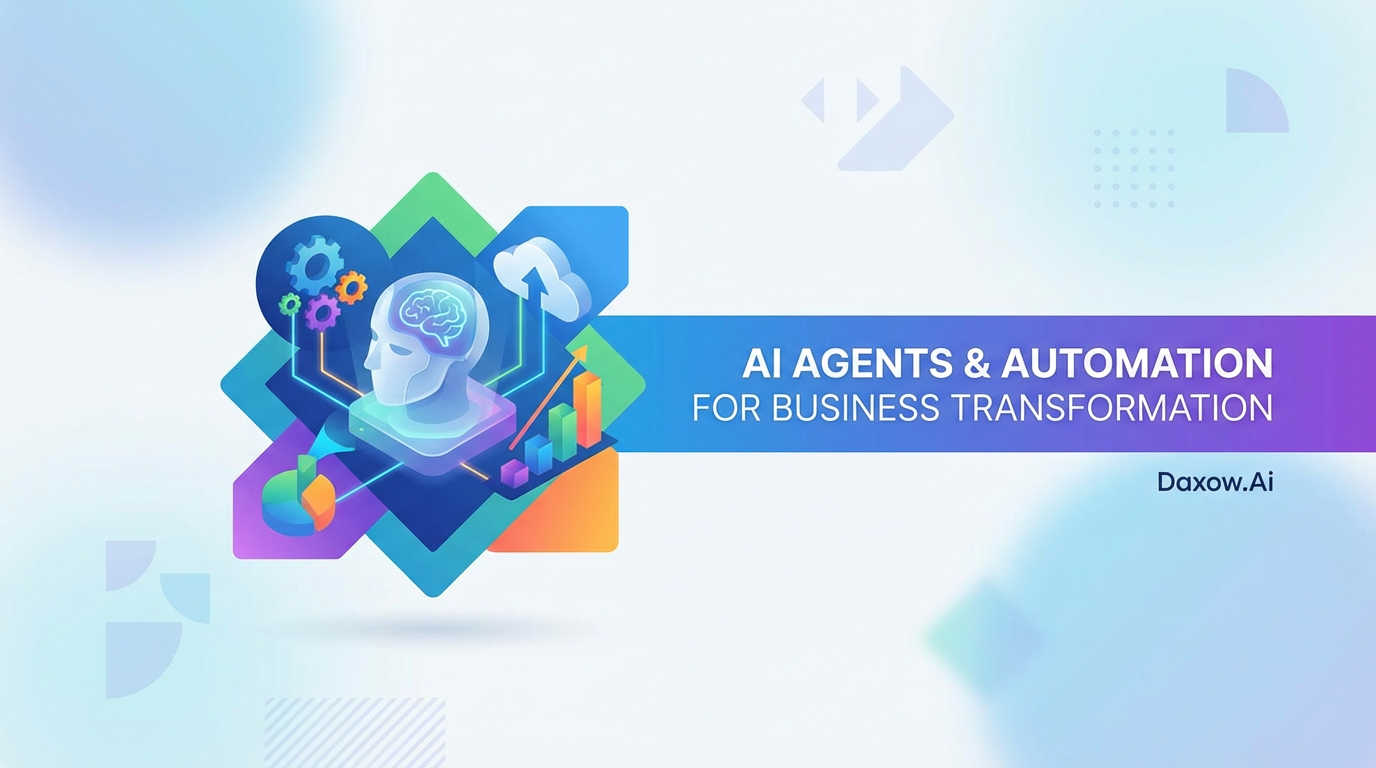
Practical guide to implementing AI agents and workflow automation with use cases, phased steps, ROI metrics, and Daxow.ai services to pilot and scale solutions.
Leveraging AI Agents and Automation for Business Transformation
Estimated reading time: 15 minutes
Key Takeaways
- AI agents and automation shift businesses from manual, reactive workflows to proactive, intelligent systems.
- Practical use cases span industries such as e-commerce, healthcare, finance, real estate, HR, and sales.
- A structured, data-driven implementation approach is essential for sustainable success.
- Daxow.ai provides end-to-end AI automation services including process discovery, agent design, and governance.
- Measuring ROI involves tracking cost reductions, productivity gains, cycle times, and customer experience metrics.
Table of Contents
- Leveraging AI Agents and Automation for Business Transformation — Why it matters
- The difference between legacy automation and AI agents
- Practical use cases — How businesses apply AI agents and automation
- Implementing AI automation — A structured, data-driven approach
- Designing AI agents and workflow automation with Daxow.ai
- Measuring ROI and business value
- Operational considerations and common pitfalls
- Example implementation — a concise case scenario
- Next steps — turning strategy into action
- Frequently Asked Questions
Leveraging AI Agents and Automation for Business Transformation — Why it matters
AI agents and workflow automation move organizations from reactive, manual processes to proactive, intelligent systems. At the core, an AI agent is an autonomous software system that uses natural language processing, predictive analytics, and decision logic to execute multi-step tasks with minimal human intervention. When combined with workflow automation, these systems:
- Automate repetitive work such as data entry, invoice processing, and first-line support.
- Orchestrate cross-system processes by connecting CRM, ERP, ticketing, and document systems.
- Provide predictive insights for demand forecasting, risk assessment, and personalized recommendations.
- Operate 24/7 at scale without a proportional headcount increase.
Business outcomes include faster cycle times, lower operational cost, and improved customer satisfaction. Typical effects seen in structured deployments include 30–50% cost reductions in automated processes, 2–5x productivity gains, and faster achievement of strategic goals.
The difference between legacy automation and AI agents
- Legacy automation follows fixed rules and breaks when inputs vary.
- AI agents adapt: they learn from data, understand language, and make conditional decisions across changing contexts.
- That adaptability unlocks higher-value use cases (e.g., dynamic pricing, conversational lead qualification) that purely rule-based automation cannot achieve.
Practical use cases — How businesses apply AI agents and automation
E-commerce
- Inventory forecasting and dynamic pricing: AI agents analyze sales patterns, seasonality, and competitor signals to update inventory and price in real time.
- Customer support automation: Chatbots resolve up to 80% of routine inquiries, cutting response times from hours to seconds and enabling scalable upsell opportunities.
- Business impact: reduced stockouts, improved conversion rates, and lower support costs.
Healthcare
- Patient triage and scheduling: Conversational agents collect symptoms, prioritize cases, and schedule appointments while respecting compliance rules.
- Document automation: Agents extract information from medical records and automate billing and prior authorizations, reducing administrative burden.
- Business impact: fewer readmissions, faster throughput, and lower administrative overhead.
Finance
- Fraud detection agents: Real-time anomaly detection across transactions prevents losses and triggers automated holds or escalations.
- Compliance and reporting automation: Agents compile reports, reconcile records, and standardize submissions to regulators.
- Business impact: reduced fraud exposure, faster approvals, and lower compliance costs.
Real estate
- Lead qualification and virtual tours: Agents qualify incoming leads 24/7, schedule viewings, and provide tailored property insights using MLS integration.
- Contract review automation: AI extracts clauses and flags inconsistencies to accelerate closings.
- Business impact: faster deal cycles, higher qualified lead conversion, and reduced legal bottlenecks.
HR and talent management
- Resume screening and interview scheduling: Recruitment agents shortlist candidates and automate interview coordination.
- Onboarding bots: Personalized onboarding plans and automated task lists reduce time-to-productivity by up to 50%.
- Business impact: improved hiring velocity, consistent candidate experience, and reduced manual HR tasks.
Sales and customer success
- Sales automation: AI agents qualify leads, draft personalized outreach, and update CRM records automatically.
- Customer success automation: Predictive churn scoring and automated escalation workflows allow teams to act proactively.
- Business impact: higher win rates, shorter sales cycles, and improved customer retention.
Implementing AI automation — A structured, data-driven approach
1. Define goals and audit processes
- Conduct process mining to identify high-volume, repetitive tasks.
- Prioritize initiatives using an impact-effort matrix.
- Set measurable targets (e.g., reduce processing time by X%, cut FTE hours by Y).
- Key outcome: a prioritized roadmap aligned to business KPIs.
2. Assess data and prepare systems
- Audit data quality: completeness, consistency, and accessibility.
- Clean and standardize knowledge bases and document formats.
- Map integrations to core systems (CRM, ERP, ticketing, databases).
- Key outcome: a data foundation that supports reliable AI decisions.
3. Select technology and assemble the team
- Choose scalable tools with robust NLP and integration capabilities.
- Build a cross-functional team: AI engineers, product owners, ops specialists, and compliance advisors.
- Define monitoring and governance processes (audit trails, bias checks).
- Key outcome: a technology and governance design aligned with long-term scaling.
4. Pilot and test
- Deploy to a small, controlled environment.
- Collect quantitative metrics (accuracy, resolution time, cost per case) and qualitative user feedback.
- Iterate quickly to address edge cases and process exceptions.
- Key outcome: validated model performance and operational readiness.
5. Rollout and optimize
- Expand gradually to other teams or geographies.
- Implement regular model retraining and performance reviews.
- Maintain feedback loops for continuous improvement.
- Key outcome: sustainable automation that adapts to business changes.
Designing AI agents and workflow automation with Daxow.ai
At Daxow.ai, we specialize in turning the above approach into reality through end-to-end project delivery. Our services are tailored to your organization and include:
- Process discovery and mapping: We analyze current workflows to identify where AI automation will deliver the highest ROI.
- Custom AI agent design: We build agents that execute real tasks — from multi-channel customer interactions to cross-system orchestration.
- Workflow automation and integrations: We connect tools across your stack (CRM, ERP, ticketing, document repositories) to eliminate manual handoffs.
- Data preparation and governance: We implement data pipelines, validation checks, and audit trails to ensure compliance and model reliability.
- Pilot, rollout, and managed optimization: We deliver pilot projects, measure outcomes, and scale solutions while continuously refining models.
Typical project timeline and deliverables
- Week 0–2: Process audit, KPIs, and target selection.
- Week 3–8: Data preparation, integration mapping, and prototype AI agent.
- Week 9–12: Pilot deployment with live monitoring and adjustments.
- Month 4–6: Phased rollout, training, and governance setup.
- Deliverables include a prioritized automation roadmap, working AI agents, integration middleware, monitoring dashboards, and a training program for your teams.
Security, compliance, and ethics
- We build privacy-first systems with role-based access, encrypted data flows, and traceable decision logs.
- Bias detection and explainability tools are embedded to meet regulatory expectations.
- Continuous retraining processes ensure compliance posture evolves with regulations.
Measuring ROI and business value
Quantifying value is essential for executive buy-in. Use the following metrics and approaches:
- Cost reduction: Track FTE hours eliminated, error-driven rework reduction, and outsourcing savings. Automated processes commonly deliver 30–50% cost reductions in targeted areas.
- Productivity gains: Measure throughput per team member; successful automations can drive 2–5x productivity increases.
- Cycle time improvement: Record time-to-resolution for key processes (e.g., claims, orders, approvals) before and after automation.
- Customer experience: Monitor CSAT/NPS changes and response time reductions attributable to customer support automation.
- Payback period: Combine direct savings and capacity gains to estimate ROI. Many pilots recover initial investment within 3–6 months.
To ensure accuracy, implement pre-deployment baselines and post-deployment dashboards that capture both operational and financial KPIs.
Operational considerations and common pitfalls
To sustain long-term value, organizations must avoid common mistakes:
- Poor data quality: Garbage in, garbage out — remediation is a must.
- Scope creep: Start with well-defined pilots and avoid adding complexity in early phases.
- Lack of governance: Without monitoring and audit trails, automation can produce hidden risks.
- Insufficient change management: Users need training, clear escalation paths, and visible benefits.
- Over-automation: Not every task should be automated. Focus on high-volume, rule-based tasks with measurable impact.
How Daxow mitigates these risks
- We perform a rigorous data readiness assessment.
- We define tight success criteria and scope boundaries for pilots.
- We provide governance frameworks and staff training as part of delivery.
- We focus on pragmatic automation that augments human capabilities.
Example implementation — a concise case scenario
Scenario: Mid-sized e-commerce company with rising customer inquiries and inventory variability.
- Challenge: Support costs rising, stockouts causing lost revenue.
- Daxow solution:
- Deploy a conversational AI agent to handle 70% of routine customer queries with escalation paths for complex issues.
- Integrate sales and inventory data for automated forecasting and dynamic pricing rules.
- Implement a ticket orchestration workflow that synchronizes CRM updates and order management.
- Results within 6 months:
- 40% reduction in support costs
- 30% fewer stockouts
- Improved CSAT by 25%
This illustrates how combining customer support automation with workflow automation and predictive agents delivers compounded benefits across functions.
Next steps — turning strategy into action
If your organization is evaluating AI automation, start with a focused, measurable pilot that aligns to your most critical pain points. Daxow.ai offers a practical engagement model:
- Request a process analysis for your company: We run a short discovery to identify high-impact opportunities.
- Book a free consultation: We review your current systems and propose a prioritized automation roadmap.
- Engage for a pilot: We build, test, and measure a pilot that demonstrates clear ROI and operational gains.
AI agents and workflow automation offer a clear path to reduce manual tasks, increase productivity, and drive measurable business automation outcomes. With the right strategy, data readiness, and partner, organizations can realize rapid cost savings, improved customer experiences, and scalable operations. Daxow.ai specializes in designing and deploying custom AI systems that connect data, automate processes end-to-end, and deliver measurable ROI.
Frequently Asked Questions
What is an AI agent?
An AI agent is an autonomous software system that uses natural language understanding, predictive analytics, and decision-making logic to perform complex tasks across multiple systems with minimal human intervention.
How does AI automation differ from traditional automation?
Traditional automation follows fixed rules and tends to break when inputs vary. AI automation adapts to changing contexts, learns from data, and makes conditional decisions to handle diverse scenarios more effectively.
What industries benefit most from AI agents?
Industries such as e-commerce, healthcare, finance, real estate, HR, and sales have shown significant benefits by leveraging AI agents, especially where automation can reduce repetitive tasks and improve decision making.
How does Daxow.ai ensure security and compliance?
We implement privacy-first designs including role-based access, encrypted data flows, audit trails, bias detection, and continuous compliance monitoring to meet or exceed regulatory requirements.
What is the typical timeline for an AI automation project with Daxow.ai?
Typical projects progress over 4-6 months including process audit, data preparation, pilot development, and phased rollout, with deliverables such as automation roadmaps, AI agents, and monitoring dashboards.