
AI Agents and Automation: Transforming Business Operations
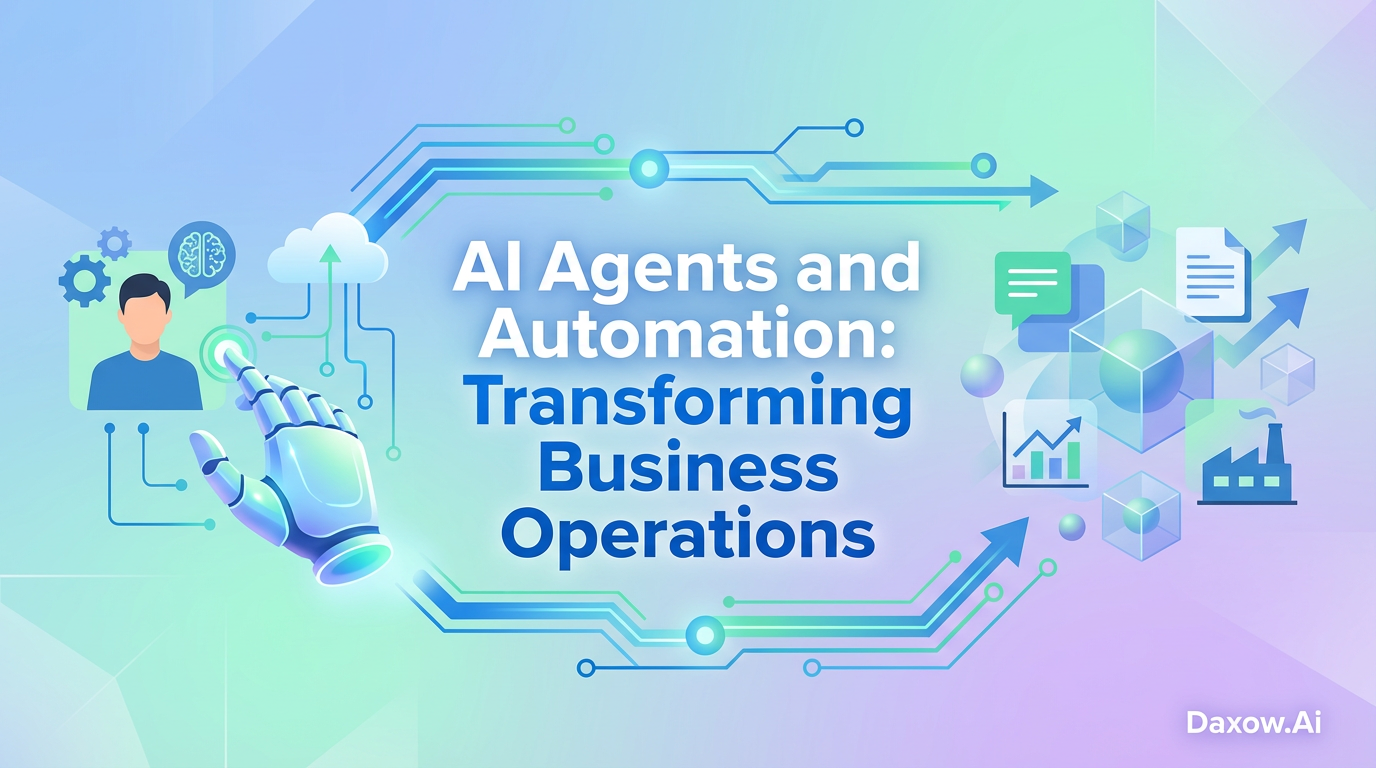
How AI agents and adaptive automation streamline workflows, cut costs 30-50%, boost productivity 2-5x, and deliver scalable ROI across industries with Daxow.ai.
AI Agents and Automation: Transforming Business Operations for the AI Era
Estimated reading time: 15 minutes
Key Takeaways
- AI agents act as autonomous executors, delivering continuous, context-aware automation across complex workflows.
- Targeted AI automation can reduce operational costs by 30–50% and increase productivity 2–5x.
- Industry-specific AI agent use cases demonstrate significant improvements in e-commerce, healthcare, finance, real estate, and HR.
- Daxow.ai partners to design, build, and scale enterprise-grade AI agents with governance and ongoing optimization.
- Successful AI automation deployment requires phased implementation and alignment with business KPIs.
Table of Contents
- AI Agents and Automation: Transforming Business Operations for the AI Era
- What AI agents and automation mean for your business
- Practical use cases across industries
- How AI agents and automation drive business transformation
- Implementation steps and best practices
- Estimating ROI and tangible business value
- Real-world use case deep dives
- Why partner with Daxow.ai
- Next steps: how to get started
- Frequently Asked Questions
AI Agents and Automation: Transforming Business Operations for the AI Era
AI Agents and Automation: Transforming Business Operations for the AI Era is not a future promise — it is today's competitive imperative. Businesses that adopt intelligent automation and agentic systems replace repetitive manual work with continuous, context-aware workflows that scale. This article explains what AI agents and AI automation mean for decision-makers, presents actionable implementation steps, and delivers industry-specific use cases that demonstrate measurable productivity and cost improvements. Throughout, we show how Daxow.ai helps organizations design, build, and scale custom AI systems that reduce manual tasks, optimize workflows, and unlock sustained ROI.
What this transformation looks like in practice:
- Agents as autonomous executors: Software entities that understand context, make decisions, and act across systems.
- Automation that adapts: Workflow automation that manages exceptions, learns from feedback, and coordinates multi-step processes.
- Business outcomes: Reduced operational costs, faster cycle times, improved customer satisfaction, and higher employee productivity.
For executives and operations leaders, the promise is quantifiable: targeted processes can see 30–50% cost reductions and 2–5x productivity gains, with workflows operating 24/7 without proportional headcount increases. Daxow.ai specializes in turning those estimates into reality by building AI agents that execute real tasks, integrate with existing stacks, and deliver measurable business automation.
What AI agents and automation mean for your business
From manual toil to agentic automation
Traditional automation (RPA, scripting) is limited to predictable, rule-based tasks. AI agents combine large language models, machine learning, and integration logic to:
- Handle complex, multi-step workflows.
- Resolve exceptions using contextual reasoning.
- Communicate across systems (CRM, ERP, ticketing, analytics).
- Provide predictive insights and proactive actions.
Core capabilities and immediate benefits
- Reduce manual tasks: Automate data entry, reconciliation, document processing, and routine approvals.
- Improve productivity: Free employees for high-value work and increase throughput.
- Enhance customer experience: Use customer support automation and personalized interactions to reduce response times to seconds.
- Lower operational risk: Reduce human error in compliance, reporting, and transaction processing.
Daxow.ai helps businesses achieve these benefits by conducting process audits, designing agent architectures, and deploying production-grade automation with governance and monitoring.
Practical use cases across industries
AI agents deliver industry-specific value by automating workflows and enabling new capabilities. Below are practical, actionable examples you can replicate.
E-commerce — inventory, pricing, and support
- Use case: An AI agent monitors sales velocity, supplier lead times, and competitor pricing. It recommends restock quantities and updates prices dynamically.
- Impact: Fewer stockouts, higher margin via optimized pricing, and improved conversion rates.
- Support automation: AI-driven chatbots resolve common queries, escalate complex issues, and suggest upsells—reducing response times from hours to seconds and resolving up to 80% of routine inquiries.
- Systems integrated: ERP, commerce platform, pricing feed, CRM.
Healthcare — triage, documentation, and predictive maintenance
- Use case: A patient triage agent interprets symptom descriptions, prioritizes cases, and routes patients to the right care path.
- Impact: Faster triage, reduced administrative load on clinicians, increased throughput.
- Additional agent: Equipment-monitoring agents predict device failures, schedule maintenance, and trigger supply orders.
- Systems integrated: EHR, scheduling, inventory management.
Finance — fraud detection, claims processing, and compliance
- Use case: Transaction agents analyze behavior in real time, flag anomalies, and initiate automated workflows for verification.
- Impact: Faster fraud detection, lower loss rates, and continuous compliance reporting.
- Claims processing: Agents extract data from submitted documents, populate systems, and orchestrate approvals—cutting cycle times and error rates.
- Systems integrated: Banking platforms, fraud engines, regulatory reporting tools.
Real estate — lead qualification and property matching
- Use case: Lead qualification agents score prospects from multi-channel inputs, provide tailored listings, and schedule viewings.
- Impact: Shorter sales cycles, higher conversion rates, and more efficient agent utilization.
- Systems integrated: CRM, listing database, calendar systems.
HR — recruitment and employee lifecycle automation
- Use case: Recruitment agents screen resumes, run initial assessments, and schedule interviews while maintaining candidate communications.
- Impact: Faster hiring, reduced bias in initial screening, and streamlined onboarding that automates compliance checks and document collection.
- Systems integrated: ATS, HRIS, background-check providers.
These examples show how AI agents combine data extraction, reasoning, and orchestration to deliver measurable business automation across verticals.
How AI agents and automation drive business transformation
Three transformational roles of AI agents
- Automate standardized processes
Agents remove repetitive manual tasks—data entry, reconciliations, and routine approvals—freeing teams to focus on strategic work. - Augment human decision-making
Agents synthesize data and produce evidence-based recommendations, making human decisions faster and more accurate. - Extract data value at scale
Agents analyze large datasets to produce forecasts, detect trends, and generate insights that inform pricing, inventory, and risk strategies.
Why agents outperform rigid RPA
- Dynamic reasoning: Agents can handle exceptions through contextual understanding.
- Learning capability: Continuous improvement via feedback loops and model updates.
- Cross-system orchestration: Agents coordinate actions across CRM, ERP, ticketing, and analytics platforms.
- 24/7 operations: Agentic systems operate continuously, producing consistent outcomes without incremental staffing costs.
Daxow.ai builds agent architectures that leverage these advantages while ensuring governance, traceability, and alignment with business KPIs.
Implementation steps and best practices
Deploying AI automation successfully requires a structured, data-driven approach. Daxow.ai follows a proven roadmap that minimizes risk and accelerates value delivery.
Phase 1 — Define goals and audit processes
- Conduct process mining to identify high-volume, repetitive tasks.
- Prioritize opportunities with an impact-effort matrix.
- Define KPIs (e.g., time saved, error reduction, cost per transaction).
Phase 2 — Process discovery and mapping
- Map end-to-end workflows with cross-system handoffs.
- Identify data sources, decision points, and exception scenarios.
- Validate with stakeholders and frontline teams.
Phase 3 — Design and pilot custom AI agents
- Build focused pilots that deliver quick wins (e.g., automate invoice processing or lead qualification).
- Design agents that connect CRM, ERP, ticketing, and document storage.
- Implement human-in-the-loop controls for initial phases.
Phase 4 — Test, govern, and scale
- Monitor performance via dashboards and defined SLAs.
- Establish governance for model updates, data privacy, and audit trails.
- Iterate based on metrics and expand agent scope.
Phase 5 — Continuous optimization
- Use production data to retrain models and refine decision logic.
- Expand automation into adjacent processes for compounding gains.
- Align ongoing work with changing strategic priorities.
Best practices to follow:
- Ensure data readiness: Clean, accessible data produces reliable agents.
- Align to business KPIs: Tie automation outcomes directly to measurable business value.
- Balance autonomy with control: Start with supervised autonomy and transition to higher autonomy as confidence grows.
- Partner with experts: Work with a specialist like Daxow.ai for end-to-end delivery—discovery, build, integration, and governance.
Estimating ROI and tangible business value
AI agents deliver quantifiable returns when deployed strategically.
Typical impact metrics
- Cost reduction: 30–50% savings in targeted processes through reduced errors and lower FTE needs.
- Productivity gains: 2–5x increase in throughput for automated workflows.
- Cycle-time compression: Routine inquiries and approvals resolved in seconds to minutes instead of hours or days.
- Revenue uplift: Improved conversion and retention by enabling personalized, timely interactions.
How Daxow.ai secures ROI
- We prioritize high-impact use cases, run rapid pilots, and measure outcomes against agreed KPIs.
- We provide transparent costing models and show payback timelines.
- Our integration-first approach minimizes disruption and accelerates time-to-value.
Example: A mid-market SaaS company implemented support automation and an agentic triage layer. Within three months, first-response time dropped from two hours to 30 seconds, ticket deflection improved by 60%, and customer satisfaction increased materially — delivering payback within six months.
Real-world use case deep dives
Use Case — E-commerce dynamic pricing and inventory agent
- Inputs: Sales history, supplier lead times, competitor price feeds, promotions calendar.
- Agent tasks: Forecast demand, propose reorder quantities, adjust pricing algorithms in real time, and trigger procurement.
- Outcomes: Reduced stockouts by 40%, increased gross margins through optimized pricing, and decreased manual inventory checks by 90%.
Use Case — Finance claims automation
- Inputs: Claims documents (PDFs, emails), transaction records, policy databases.
- Agent tasks: Extract structured data, validate claims against rules, route exceptions, and populate approval systems.
- Outcomes: Claim cycle times reduced by 70%, error rates reduced by 80%, and headcount reallocated to fraud analysis and customer recovery.
Use Case — HR recruitment and onboarding agent
- Inputs: Resumes, candidate profiles, interview calendars, compliance checklists.
- Agent tasks: Screen resumes for criteria, schedule interviews, automate offer letters, and orchestrate onboarding checklists.
- Outcomes: Time-to-hire reduced by 50%, candidate dropout during onboarding reduced by 60%, and HR administrative hours reduced significantly.
Each use case demonstrates how connecting data, process logic, and model-based reasoning creates compounded operational benefits. Daxow.ai engineers the integrations and builds the governance necessary to move from pilot to enterprise scale.
Why partner with Daxow.ai
Daxow.ai offers end-to-end services tailored to business needs:
- Discovery and process analysis: We identify automation opportunities and quantify benefits.
- Custom AI agent design: We build agents that execute real tasks with integrations to CRM, ERP, ticketing, and data platforms.
- Workflow automation and orchestration: We deliver end-to-end automation that spans systems and teams.
- Governance and monitoring: We implement dashboards, human-in-the-loop controls, and compliance controls.
- Ongoing optimization and support: We continuously improve agents, retrain models, and scale automation.
Partnering with Daxow.ai means you gain a practical roadmap from process audit to enterprise-scale automation. We focus on aligning AI automation to measurable business outcomes and ensuring reliable system integrations that preserve data integrity and operational continuity.
Next steps: how to get started
If your organization is ready to reduce manual tasks, boost productivity, and implement business automation that scales, start with a focused discovery:
- Identify one or two high-volume processes.
- Define measurable KPIs (time saved, error reduction, cost per transaction).
- Run a pilot with a clearly defined success criteria.
Daxow.ai will:
- Conduct a process analysis to prioritize opportunities.
- Design a custom AI agent and integration plan.
- Deliver a pilot and measure results against KPIs.
- Scale successful pilots across your organization.
Bold action today creates lasting advantage. AI agents and AI automation deliver fast wins and strategic agility when executed with a disciplined plan and expert implementation.
Contact Daxow.ai to build your custom AI system and transform operations into a competitive asset. Book a free consultation or request a process analysis for your company.
Frequently Asked Questions
What are AI agents in the context of business automation?
AI agents are autonomous software entities that understand context, make decisions, and execute tasks across multiple systems to automate complex workflows beyond simple rule-based automation.
How can AI automation improve operational efficiency?
AI automation reduces manual tasks, manages exceptions intelligently, operates 24/7 without proportional increases in staff, and improves accuracy, leading to faster cycle times and cost savings.
What industries benefit most from AI agents?
E-commerce, healthcare, finance, real estate, and HR are key industries where AI agents deliver significant value by automating complex workflows, improving customer interactions, and reducing operational risks.
Why choose Daxow.ai for AI automation projects?
Daxow.ai offers an end-to-end approach including discovery, custom agent design, integration, governance, and ongoing optimization, ensuring AI automation aligns with your business goals and delivers measurable ROI.