
Mastering AI Agents and Automation: Roadmap to Business ROI
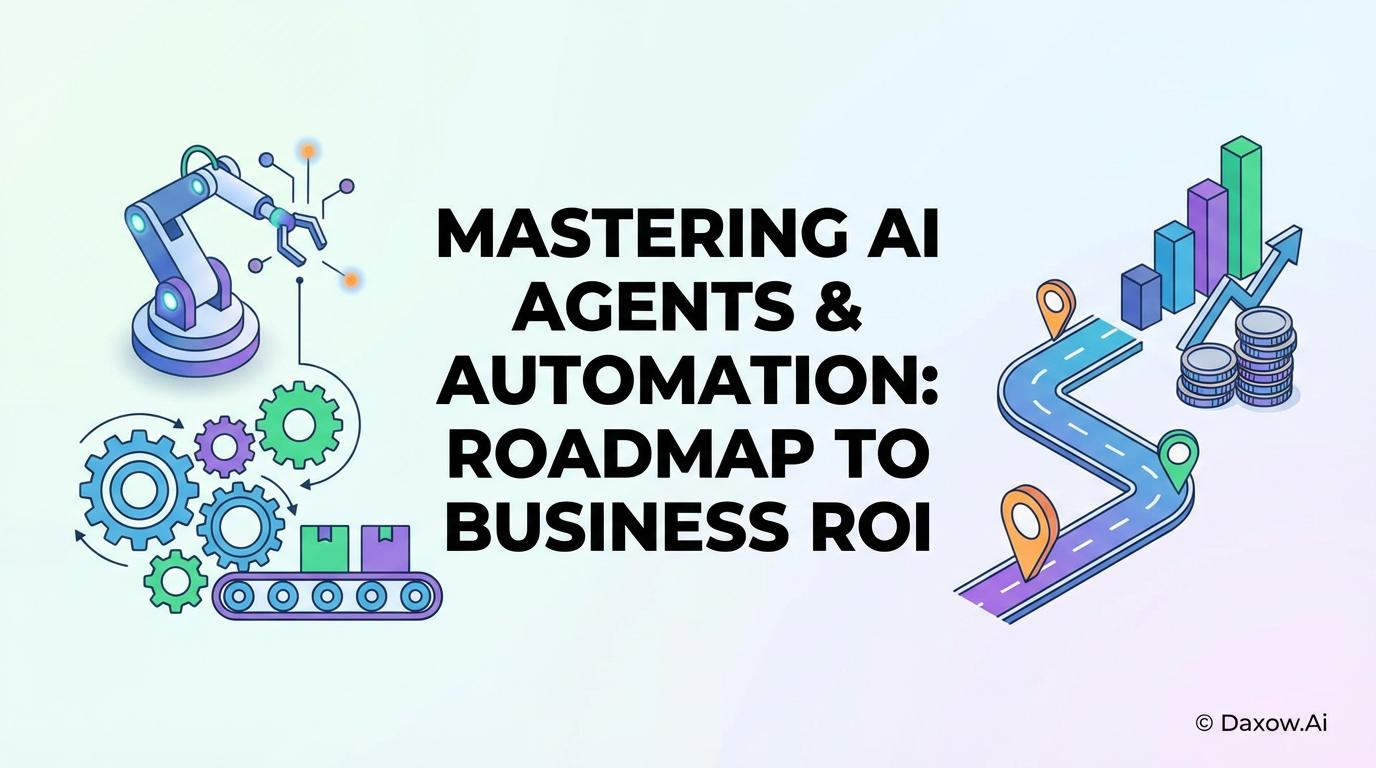
A practical guide to designing, deploying, and scaling AI agents and automation with use cases, roadmap, ROI examples, and Daxow.ai services.
Mastering AI Agents and Automation: A Strategic Imperative for Business Transformation
Estimated reading time: 15 minutes
Key Takeaways
- AI agents and automation reduce manual tasks and improve overall business productivity.
- Implementation requires strategic planning, data readiness, and governance.
- Industry-specific use cases showcase measurable value across e-commerce, healthcare, finance, real estate, and HR.
- Daxow.ai delivers end-to-end AI automation solutions tailored to business needs, ensuring ROI and scalability.
- A structured implementation roadmap and governance framework are critical to success.
Table of Contents
- Mastering AI Agents and Automation: A Strategic Imperative for Business Transformation
- What AI Agents and Automation Mean for Businesses
- Practical Use Cases Across Industries
- How AI Agents and Automation Drive Business Outcomes
- Implementation Roadmap: From Assessment to Rollout
- Technology and Governance Checklist
- Measuring ROI and Scaling Value
- How Daxow.ai Helps You Deliver Results
- Getting Started — Next Steps for Decision-Makers
- Frequently Asked Questions
Mastering AI Agents and Automation: A Strategic Imperative for Business Transformation
AI agents and workflow automation combine machine learning, natural language processing, and real-time data integration to execute tasks autonomously, orchestrate processes, and drive consistent decisions across systems. For business leaders, the strategic imperative is to convert manual, error-prone workflows into scalable, monitored systems that free human talent for higher-value work. This requires a deliberate approach: selecting the right initial use cases, ensuring data readiness, and building governance to sustain continuous improvement.
What AI Agents and Automation Mean for Businesses
Core capabilities
- Autonomous task execution: Agents perform actions such as booking appointments, creating CRM records, or triggering refunds.
- Intelligent decision-making: Models interpret unstructured inputs (emails, chat, documents) and apply rules or learned behavior.
- Workflow orchestration: Automation connects systems and enforces business rules end-to-end.
- Multichannel interaction: Agents respond across chat, email, voice, and apps, maintaining context and handoff to human agents when needed.
Key business problems addressed
- Reduce manual tasks that consume employee time and introduce errors.
- Increase productivity by automating high-volume, low-complexity workflows.
- Improve customer response times and consistency through customer support automation.
- Enhance compliance and auditability by maintaining traceable decision logs.
- Scale operations without linear increases in headcount.
Practical Use Cases Across Industries
E-commerce — Customer support automation & sales automation
- Use case: AI agents handle order inquiries, returns processing, and product recommendations.
- What is automated: Chat triage, order lookup via CRM integration, return authorizations, dynamic cross-sell suggestions.
- Expected impact: Faster resolution times, higher conversion rates from personalized recommendations, and reduced support costs by deflecting routine tickets.
- Daxow role: Design agent flows, integrate with inventory and CRM systems, and deploy automated escalation rules that hand complex issues to human agents.
Healthcare — Scheduling, triage, and administrative automation
- Use case: Patient scheduling, symptom triage, billing code extraction from documents.
- What is automated: Appointment booking, pre-visit form completion, initial symptom assessment with escalation to clinicians.
- Expected impact: Reduced administrative overhead, improved appointment utilization, and faster patient access to care.
- Daxow role: Build secure integrations with EHR systems, implement compliant data handling, and create AI agents respecting clinical escalation protocols.
Finance — Fraud detection, compliance checks, and loan processing
- Use case: Real-time transaction monitoring and automated compliance screening.
- What is automated: Anomaly detection, rule-based escalation, automated document verification for lending.
- Expected impact: Faster fraud detection, improved regulatory response times, and higher throughput of loan approvals.
- Daxow role: Connect transaction feeds, implement monitoring dashboards, and create agents that generate audit-ready evidence.
Real estate — Lead qualification and transaction orchestration
- Use case: Qualify buyer leads, schedule viewings, and manage offer workflows.
- What is automated: Initial lead qualification via chat and form intake, calendar scheduling, follow-up drip campaigns.
- Expected impact: Shorter sales cycles, higher conversion rates from qualified leads, and reduced manual follow-up.
- Daxow role: Integrate MLS and CRM data, create lead-scoring agents, and automate contract status updates.
HR — Recruitment, onboarding, and employee support
- Use case: Resume screening, interview pre-qualification, onboarding task orchestration.
- What is automated: Candidate pre-screening, scheduling interviews, FAQ handling for benefits and policies.
- Expected impact: Faster hiring time, consistent candidate experience, and lower HR administrative burden.
- Daxow role: Build recruitment automation pipelines, integrate applicant tracking systems, and deploy employee-facing chat agents.
How AI Agents and Automation Drive Business Outcomes
AI agents deliver business outcomes when engineered to operate within reliable data pipelines and system integrations. The combination of automation and agents produces several levers for value:
- Efficiency gains: Automating repetitive tasks reduces processing times and headcount pressures.
- Improved accuracy: Agents reduce human error in data entry, document processing, and compliance checks.
- Scalability: Workflows scale across channels and volume without proportional staffing increases.
- Better customer experiences: Faster, 24/7 responses and consistent service improve satisfaction and retention.
- Actionable insights: Automated systems produce structured data that inform forecasting and decision-making.
Daxow.ai specializes in building AI agents that are action-capable: they do not only advise but execute tasks—creating CRM records, updating inventories, or initiating refunds—while preserving decision logs and human override options.
Implementation Roadmap: From Assessment to Rollout
1. Strategic Assessment and Planning (4–8 weeks)
- Activities: Map current workflows, identify high-volume/low-complexity opportunities, define KPIs (cost per ticket, resolution time, throughput).
- Deliverables: Prioritized use-case list, success metrics, and data readiness assessment.
- Daxow role: Conduct process analysis and stakeholder interviews to create a targeted automation plan.
2. Technology Selection and Preparation (6–12 weeks)
- Activities: Choose platforms with API-first architecture, design integration patterns, clean and normalize data sources.
- Deliverables: System architecture, integration design, data pipeline plan.
- Daxow role: Evaluate technologies, implement secure connectors, and prepare data validation pipelines.
3. Pilot Deployment (4–10 weeks)
- Activities: Launch a limited-scope pilot, monitor KPIs, collect user feedback, iterate.
- Deliverables: Production-ready pilot agent, measurement dashboards, refined workflows.
- Daxow role: Develop and deploy pilot agents, set up monitoring, and run A/B tests to measure impact.
4. Gradual Rollout and Change Management
- Activities: Expand to additional teams and channels, implement training programs, establish governance and retraining cycles.
- Deliverables: Governance playbook, training materials, continuous improvement schedule.
- Daxow role: Provide rollout support, knowledge transfer, and ongoing optimization services.
Avoid common pitfalls
- Poor data quality: Fix sources before training agents.
- Skipping pilots: Start small to validate assumptions.
- Lack of governance: Define roles, escalation policies, and audit controls early.
- Business-IT misalignment: Maintain transparent communication and shared KPIs.
Technology and Governance Checklist
- API-first systems and secure connectors are in place.
- Data pipelines include validation and error-handling.
- KPIs are defined and measurable.
- Governance covers compliance, human-in-the-loop policies, and retraining cadence.
- Monitoring and alerting for pipeline or model drift exists.
- Clear escalation and handoff mechanisms between agents and humans are implemented.
Measuring ROI and Scaling Value
Quantifying ROI is essential to justify and scale initiatives. Organizations commonly report:
- 3–5x faster achievement of objectives after focused AI automation initiatives.
- 20–50% reductions in processing times for targeted workflows.
- Significant reductions in repetitive task labor and improved first-contact resolution in support functions.
Practical ROI example (support automation):
- Starting assumptions: 10,000 monthly tickets, average handling time 12 minutes, fully loaded agent cost $35/hour.
- Baseline cost: (10,000 * 12) / 60 * $35 = $70,000/month.
- With AI automation deflecting 40% of tickets and reducing handling time by 30% for remaining tickets:
- New tickets requiring human handling: 6,000
- New average handling time: 8.4 minutes
- New cost: (6,000 * 8.4) / 60 * $35 = $29,400/month.
- Monthly savings: $40,600 (≈58% reduction).
- This example excludes uplift from higher sales conversion or reduced churn driven by better CX.
Key performance indicators to track:
- Ticket deflection rate
- Average handling time
- First-contact resolution
- Processing throughput (invoices, loans, applications per day)
- Cost per transaction
- Customer satisfaction (CSAT or NPS)
How Daxow.ai Helps You Deliver Results
Daxow.ai provides end-to-end services to design, implement, and scale AI automation tailored to your business needs. Our approach centers on measurable business outcomes and robust integrations.
What we deliver:
- Process analysis and prioritization: We map workflows, identify the highest ROI opportunities, and define success metrics.
- Custom AI agents: We build agents that execute real tasks—integrating with CRMs, ERPs, and other tools—to automate actions and decisions.
- Workflow automation and orchestration: We connect systems and design end-to-end flows that avoid manual handoffs and data gaps.
- Data connectivity and pipelines: We ensure reliable, auditable data flows and implement validation to prevent production failures.
- Governance and compliance: We establish oversight frameworks and logging for auditability and regulatory adherence.
- Pilot-to-scale delivery: We validate through pilots, iterate with user feedback, and manage phased rollouts with change management.
- Ongoing monitoring and optimization: We retrain models, refine flows, and surface continuous improvement opportunities.
How Daxow.ai reduces operational costs and improves ROI:
- Targeted automation of high-volume tasks lowers headcount pressures and error rates.
- Actionable integrations shorten cycle times and reduce process waste.
- Continuous monitoring and retraining sustain performance, ensuring long-term value.
Learn more about our AI automation services and how we integrate with your existing systems.
Getting Started — Next Steps for Decision-Makers
If your organization is ready to move from manual processes to intelligent automation, Daxow.ai can help you start with a low-risk, high-value proof of concept.
- Book a free consultation to evaluate your top automation opportunities.
- Request a process analysis for your company to receive a prioritized roadmap.
- Contact us to build a custom AI system and pilot AI agents that execute real tasks.
Frequently Asked Questions
What are AI agents, and how do they differ from traditional automation?
AI agents are intelligent systems that autonomously perform complex tasks using machine learning and natural language processing, whereas traditional automation typically follows predefined rules without adaptive decision-making.
How does Daxow.ai ensure data security and compliance?
We implement secure integrations with industry-standard encryption and follow compliance protocols tailored to each industry, ensuring data privacy and auditability throughout automation processes.
What are the typical timelines for implementing AI automation projects?
Implementation timelines vary based on complexity but typically follow a phased roadmap from 4 weeks for assessments to 10+ weeks for pilot deployment, followed by gradual rollout and ongoing optimization.
Can AI agents handle exceptions and escalate to humans?
Yes, AI agents are designed with human-in-the-loop governance, allowing them to escalate complex or ambiguous cases to human agents seamlessly.