
Implementing AI Agents and Automation for Enterprise Growth
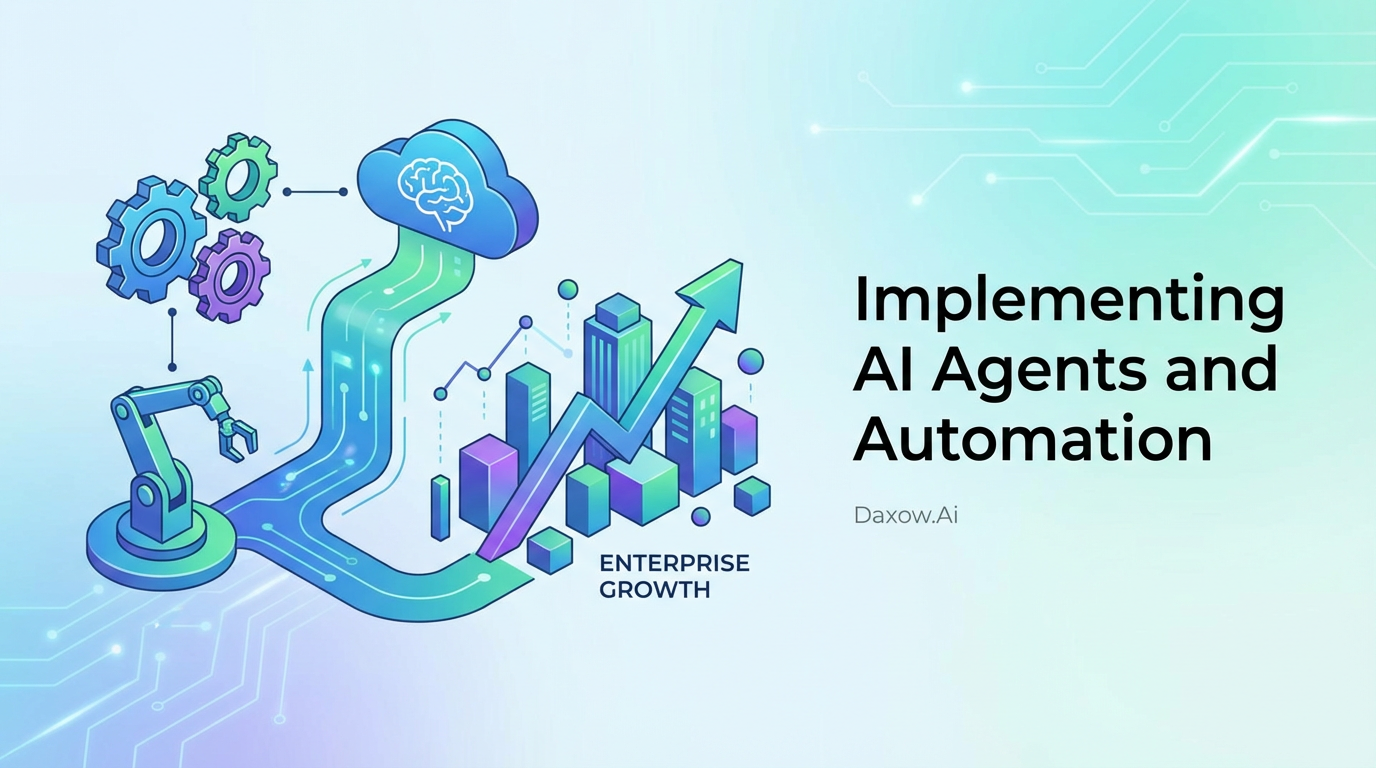
Practical guide to implementing AI agents and workflow automation for enterprises: roadmap, industry use cases, ROI expectations, and how Daxow.ai delivers results.
Unlocking Business Growth: Implementing AI Agents and Automation for Enterprise Success
Estimated reading time: 15 minutes
Key Takeaways
- AI agents and workflow automation can reduce manual work by up to 60% and deliver 200–500% ROI within 12–18 months.
- Core benefits include increased efficiency, scalability, accuracy, enhanced customer experience, and governance compliance.
- Practical use cases span industries including e-commerce, healthcare, finance, real estate, HR, and customer support.
- A phased implementation roadmap reduces risk and ensures continuous optimization and governance.
- Daxow.ai partners with businesses to design custom AI-driven automation solutions aligned with specific business goals.
Table of Contents
- Unlocking Business Growth: Implementing AI Agents and Automation for Enterprise Success
- Practical use cases: Where AI agents and automation deliver immediate value
- Implementation roadmap: From assessment to scaled deployment
- Measuring ROI and operational impact
- How Daxow.ai designs and builds custom AI systems
- Frequently Asked Questions
Unlocking Business Growth: Implementing AI Agents and Automation for Enterprise Success
AI agents and workflow automation transform repetitive processes into strategic assets. When implemented correctly, these technologies can reduce manual work by up to 40–60% in targeted processes, accelerate outcomes 3–5x, and deliver ROI of 200–500% within 12–18 months. For decision-makers, the most important outcomes are clear: faster cycle times, lower operating costs, improved accuracy, and a better customer experience.
Core business advantages
- Efficiency: Automate routine interactions and data processing to free teams for high-value work.
- Scalability: Handle peaks in demand without proportional headcount increases.
- Accuracy: Reduce human error through standardized, AI-driven decisioning.
- Customer impact: Deliver 24/7 personalized responses and faster resolutions.
- Governance and compliance: Embed controls and audit trails for regulated environments.
What makes AI agents different
AI agents combine NLP, machine learning, and decision engines with the ability to perform actions (API calls, database updates, multi-step workflows). Unlike simple chatbots, action-oriented AI agents execute tasks end-to-end — they can qualify a lead, update a CRM, trigger an invoice, and follow up autonomously. This capability enables true business automation beyond question-and-answer interactions.
Practical use cases: Where AI agents and automation deliver immediate value
E-commerce — reduce cart abandonment and improve fulfillment
- Use cases:
- AI agents personalize product recommendations across channels.
- Automated order validation and fulfillment routing reduce delays.
- Chatbot-led customer service handles returns, tracking, and FAQs.
- Expected impact:
- Higher conversion rates, fewer abandoned carts.
- Faster order resolution and optimized inventory forecasting.
- How Daxow helps:
- Integrate AI agents with e-commerce platforms and ERPs.
- Build recommendation engines and automate fulfillment workflows.
Healthcare — streamline administrative workflows and patient engagement
- Use cases:
- Automated patient triage using NLP to prioritize appointments.
- Scheduling and follow-up reminders with secure data handling.
- Prior authorization automation and claims processing.
- Expected impact:
- 30–50% reduction in administrative burden, faster patient throughput.
- Better compliance and reduced manual errors in claims.
- How Daxow helps:
- Implement HIPAA-aware automation, integrate with EHRs, and deploy triage agents that escalate to clinicians when needed.
Finance — improve risk controls and speed underwriting
- Use cases:
- Real-time transaction monitoring for fraud detection.
- Automated compliance reporting and KYC workflows.
- Loan application automation with risk scoring and decisioning.
- Expected impact:
- Faster approvals, lower fraud losses, and improved auditability.
- Consistent regulatory reporting with less manual effort.
- How Daxow helps:
- Build agents that combine ML models and rule engines, integrate with core banking systems, and provide explainability for auditors.
Real estate — accelerate lead qualification and deal cycles
- Use cases:
- Conversational agents qualify leads, schedule viewings, and follow up automatically.
- Market analysis agents generate pricing guidance from multiple data sources.
- Expected impact:
- Shorter sales cycles, higher lead conversion rates.
- Agents that support agents — amplifying human brokers’ productivity.
- How Daxow helps:
- Connect data sources, automate CRM updates, and craft multi-channel engagement flows that nurture prospects.
HR — automate hiring and onboarding
- Use cases:
- Resume screening and candidate scoring.
- Automated interview scheduling, onboarding checklists, and compliance tasks.
- Sentiment analysis of employee feedback to predict turnover.
- Expected impact:
- Faster time-to-hire, consistent onboarding experiences, reduced attrition risk.
- How Daxow helps:
- Deploy recruitment agents that integrate with ATS tools and automate routine HR workflows.
Customer support and sales automation — the cross-industry multiplier
- Use cases:
- Customer support automation handles 70–80% of routine inquiries.
- Sales automation qualifies and routes leads, schedules demos, and triggers follow-ups.
- Expected impact:
- Lower support costs, faster SLAs, higher sales throughput.
- How Daxow helps:
- Build omnichannel agents that connect to knowledge bases and CRMs to complete transactions without human intervention unless escalation is required.
Implementation roadmap: From assessment to scaled deployment
Phase 1 — Assessment and planning (4–8 weeks)
- Key actions:
- Map current workflows and identify high-impact, low-complexity candidates.
- Define measurable KPIs: cost reduction targets, resolution rates, throughput.
- Audit data quality, security, and compliance requirements.
- Deliverables: Prioritized automation backlog and success metrics.
- Daxow role: Conduct process analysis and identify quick-win pilots.
Phase 2 — Technology selection and vendor evaluation (6–12 weeks)
- Key actions:
- Choose platforms that support integrations, action-oriented agents, and compliance.
- Evaluate model hosting, data residency, and SLAs.
- Deliverables: Solution architecture and vendor short-list.
- Daxow role: Recommend and implement best-fit technology stacks; manage vendor relationships.
Phase 3 — Preparation and pilot (4–8 weeks)
- Key actions:
- Cleanse and structure data, build knowledge bases, and create test cases.
- Run pilots on a limited scope to measure performance against KPIs.
- Deliverables: Pilot results, user feedback, and iteration plan.
- Daxow role: Build pilot AI agents, instrument monitoring, and refine based on real usage.
Phase 4 — Deployment and continuous optimization
- Key actions:
- Roll out across teams and channels gradually.
- Implement governance (access controls, audit logs) and change management.
- Retrain models periodically to mitigate drift.
- Deliverables: Full production deployment with monitoring dashboards and governance.
- Daxow role: Manage rollout, provide training, and operate ongoing optimization and support.
Best practices for success
- Start small: run pilots on well-defined processes to prove value.
- Ensure data readiness: quality data is the foundation for reliable AI.
- Build cross-functional teams: combine business, IT, and AI expertise.
- Embed governance: compliance, explainability, and ethical guardrails are non-negotiable.
- Measure continuously: use KPIs (cost per interaction, throughput, NPS) to guide iterations.
Measuring ROI and operational impact
KPIs to track
- Cost per interaction or transaction.
- Throughput and resolution time.
- Error rates and rework percentage.
- Customer satisfaction (CSAT/NPS) and employee productivity metrics.
- Compliance and audit findings.
Typical ROI and timelines
- Measurable outcomes within 3–6 months from pilot completion.
- ROI of 200–500% within 12–18 months for optimized deployments.
- Labor savings can reach 30–50%, with process-specific reductions of 40–60%.
- Automating routine inquiries can cover 70–80% of volume, freeing staff for higher-value tasks.
How to build a business case
- Start with a baseline: current cost, cycle time, and error rates.
- Model projected improvements per KPI and map them to cost savings or revenue uplift.
- Include implementation costs, ongoing support, and model maintenance.
- Run sensitivity scenarios (conservative, likely, aggressive) to understand payback.
How Daxow.ai designs and builds custom AI systems
Daxow.ai was founded to help companies realize the business outcomes described above. Our approach is pragmatic, ROI-driven, and hands-on.
Services aligned to business objectives
- AI Agents: design and deploy action-driven agents that execute tasks across systems.
- Workflow Automation: orchestrate multi-step processes that span teams and tools.
- Chatbots & Support Automation: reduce support costs and improve response times.
- Lead Qualification & Sales Automation: automate routing, qualification, and outreach.
- Data Extraction & Document Automation: turn unstructured documents into actionable records.
- Integrations: connect agents to CRMs, ERPs, ticketing systems, and custom APIs.
End-to-end delivery model
- Discovery and process mapping to identify highest-value opportunities.
- Prototype and pilot development to prove outcomes quickly.
- Production deployment with full integration into your tech stack.
- Continuous operations, including monitoring, retraining, and feature iteration.
- Compliance and security built into every solution.
Why partner with Daxow
- Outcome-focused: we measure success by business impact, not technology for its own sake.
- Custom engineering: solutions crafted for your systems, data, and regulatory landscape.
- Operational ownership: we provide the runway from pilot to production and ongoing support.
- Cross-industry expertise: practical experience across e-commerce, healthcare, finance, real estate, and HR.
Frequently Asked Questions
What distinguishes AI agents from chatbots?
AI agents are action-oriented systems that perform end-to-end tasks such as updating CRMs, triggering workflows, and making decisions autonomously, whereas chatbots typically handle simple question-and-answer interactions.
How soon can we expect to see ROI after implementing AI agents?
Measurable outcomes often begin within 3–6 months post-pilot, with ROIs ranging from 200–500% typically achieved within 12–18 months of optimized deployment.
Can AI automation comply with industry regulations?
Yes, Daxow.ai integrates governance controls, audit trails, and compliance features such as HIPAA-aware workflows to ensure automation adheres to relevant regulations.
How does Daxow.ai support ongoing optimization?
We continuously monitor deployments, retrain models to adapt to changing data, and iterate features to sustain and enhance business impact over time.