
Mastering AI Agents and Automation for Modern Enterprises
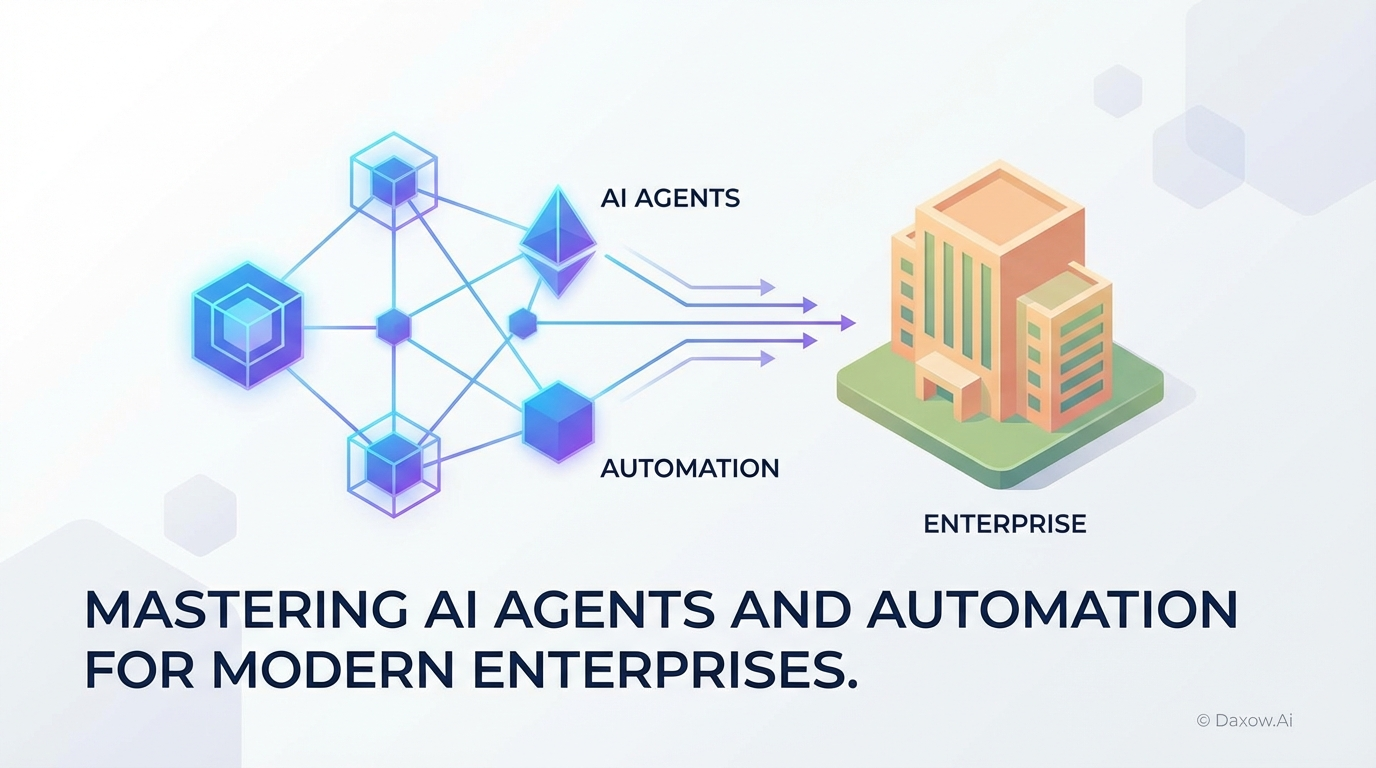
Guide to implementing AI agents and workflow automation in enterprises — use cases, phased roadmap, governance, and how Daxow.ai delivers measurable ROI.
Mastering AI Agents and Automation: Transforming Business Operations for the Modern Enterprise
Estimated reading time: 15 minutes
Key Takeaways
- AI agents and workflow automation enable operational scale without proportional headcount and improve customer outcomes.
- Strategic implementation drives measurable cost savings, faster processing, and better business metrics.
- Practical use cases demonstrate AI’s impact in e-commerce, healthcare, finance, real estate, and HR.
- A phased approach to adoption with governance and compliance ensures risk-managed success.
- Daxow.ai provides custom AI agents, integration, and ongoing support to realize end-to-end automation benefits.
Table of Contents
- Mastering AI Agents and Automation: Transforming Business Operations for the Modern Enterprise
- Strategic Implications for Decision-Makers
- Practical Use Cases and Industry Examples
- Implementation Steps and Best Practices
- Governance, Compliance, and Cultural Change
- Measuring ROI and Scaling Value
- How Daxow.ai Delivers Business Automation That Embeds into Your Operations
- Quick Start Checklist for Leaders
- Frequently Asked Questions
Mastering AI Agents and Automation: Transforming Business Operations for the Modern Enterprise
Mastering AI Agents and Automation: Transforming Business Operations for the Modern Enterprise is no longer a theoretical advantage — it is a strategic imperative. Organizations that adopt AI automation and workflow automation move routine work from human hands to reliable, scalable systems. This shift reduces manual tasks, increases productivity, and frees teams to focus on high-value decisions. In this article we translate research-backed best practices into actionable guidance for leaders across industries, with practical use cases and an implementation roadmap tailored to enterprise needs. We also explain how Daxow.ai designs and delivers custom AI agents and end-to-end automation that drive measurable ROI.
Why this matters now
- Operational scale without proportional headcount: AI agents can run high-volume, rule-based processes continuously and accurately.
- Better customer outcomes: Faster response times and fewer errors increase satisfaction and retention.
- Tangible financial impact: Pilot-to-scale programs report operational throughput improvements of 3–5x and cost reductions of 20–50% in targeted areas.
- Strategic reallocation of talent: Teams shift from data entry and repetitive processing to strategic customer engagement and product development.
What AI agents and workflow automation actually do
- AI agents combine machine learning, natural language processing, and rule-based logic to autonomously execute tasks, make decisions, and trigger downstream workflows.
- Workflow automation connects systems (CRMs, ERPs, ticketing tools, HRIS) so that data moves seamlessly, approvals happen automatically, and exceptions route to the right human with context.
- Together, they reduce manual tasks, accelerate cycle times, and create audit trails for compliance.
Strategic Implications for Decision-Makers
Business outcomes to expect
- Faster processing: Examples include invoice reconciliation completed in minutes instead of days and customer issue resolution times cut by a majority.
- Cost savings: Focused automation often yields 20–50% reductions in operational costs for targeted processes.
- Improved metrics: Expect higher first-contact resolution rates, lower error rates, and better Net Promoter Scores when customer touchpoints are automated intelligently.
- Scalability: Businesses can handle volume spikes without hiring large temporary teams.
Risk-managed adoption
- Adopt a phased approach: assess, pilot, iterate, scale.
- Ensure governance to avoid “agentic sprawl” and to meet regulatory requirements (GDPR, HIPAA where relevant).
- Prioritize data quality — AI performance mirrors the quality of its inputs.
Practical Use Cases and Industry Examples
E-commerce — order-to-cash and customer support automation
Problem: High volumes of customer inquiries, returns, and stock-outs create friction and increase cart abandonment.
AI solution: Deploy AI agents that:
- Handle 70–80% of incoming customer chat and email queries via integrated chatbots.
- Automate order validation, fraud checks, and shipping label generation.
- Predict inventory needs with demand forecasting and trigger replenishment workflows.
Benefits:
- Reduced fulfillment times and fewer manual interventions.
- Lower cart abandonment through proactive messaging.
Daxow.ai approach:
- Integrate AI agents with your ecommerce platform, CRM, and fulfillment systems.
- Build a knowledge base for consistent customer responses and set escalation rules for complex cases.
- Provide monitoring dashboards to track resolution rates and inventory KPIs.
Healthcare — scheduling, triage, and record automation
Problem: Administrative burden and scheduling bottlenecks reduce patient access and increase staff workload.
AI solution: Implement AI agents that:
- Triage symptom inputs, recommend next steps, and schedule appointments based on clinician availability.
- Extract structured data from referrals and lab results to update EHRs.
- Automate billing and insurance eligibility checks.
Benefits:
- Faster patient scheduling, reduced no-shows, and lower admin overhead.
- Improved compliance through auditable workflows.
Daxow.ai approach:
- Design HIPAA-compliant integrations and secure data pipelines.
- Build escalation protocols that route clinical exceptions to care teams with full context.
- Train staff and maintain change logs to meet regulatory requirements.
Finance — automated reconciliation and fraud monitoring
Problem: Manual invoice processing and compliance checks are slow and prone to error.
AI solution: AI agents that:
- Perform invoice and payment matching using natural language parsing and rules.
- Monitor transactions in real time for anomalies and auto-raise investigations.
- Generate compliance reports automatically for audits.
Benefits:
- Faster close cycles and fewer reconciliation discrepancies.
- Reduced fraud exposure and improved audit readiness.
Daxow.ai approach:
- Connect AI agents to accounting systems and banks via secure APIs.
- Implement configurable decision trees and human-in-the-loop workflows for exception handling.
- Provide ROI modeling and KPI dashboards (cycle time, exception rates, cost per invoice).
Real estate — lead qualification and transaction automation
Problem: High-volume lead intake and lengthy contract processing delay deals.
AI solution: Use AI agents to:
- Qualify leads using conversational agents that capture requirements and schedule viewings.
- Automate document capture, signature workflows, and contract validation.
- Analyze market data to suggest pricing and time-to-list.
Benefits:
- Faster lead-to-deal conversion and fewer manual listing errors.
- Consistent client experiences and improved agent productivity.
Daxow.ai approach:
- Integrate with CRM systems and digital signature platforms.
- Implement automated workflows that enforce compliance steps and maintain a single source of truth for transactions.
HR — recruitment, onboarding, and employee services
Problem: Recruitment backlogs and routine HR queries consume specialist time.
AI solution: Deploy AI agents that:
- Screen resumes, rank candidates by fit, and auto-schedule interviews.
- Automate onboarding checklists, document verification, and benefits enrollment.
- Power employee support bots for payroll, leave, and policy questions.
Benefits:
- Faster hiring cycles and more consistent onboarding experiences.
- Reduced HR operational workload and improved employee satisfaction.
Daxow.ai approach:
- Connect AI to ATS, HRIS, and single-sign-on systems.
- Build reusable automation modules for screening and onboarding with audit trails.
Implementation Steps and Best Practices
Phase 1 — Assess and plan (4–8 weeks)
- Map current workflows and identify high-volume, rule-based processes.
- Measure baselines: cycle times, cost per transaction, error rates, and customer satisfaction.
- Define clear KPIs and a target business case (e.g., 30% cost reduction for invoice processing).
- Daxow service: We perform a comprehensive process analysis, map integrations, and build a prioritized automation roadmap.
Phase 2 — Select technology and vendors (6–12 weeks)
- Choose platforms that support seamless integrations, compliance, and growth.
- Evaluate vendors on API capabilities, security posture, and long-term support.
- Daxow service: We recommend and implement best-fit technology stacks, from custom AI agents to enterprise automation platforms, ensuring future scalability.
Phase 3 — Prepare and build (4–8 weeks)
- Clean and standardize data; build knowledge bases and document workflows.
- Assemble a cross-functional team including operations, IT, and business owners.
- Daxow service: Our engineers and automation consultants build the AI agents, design decision logic, and implement integrations with existing systems.
Phase 4 — Pilot and iterate
- Launch a single use case and monitor KPIs closely.
- Use human-in-the-loop processes to handle edge cases and continually improve models.
- Daxow service: We run the pilot, analyze results, and refine agents rapidly based on real-world performance data.
Phase 5 — Scale gradually
- Expand to additional processes, channels, and geographies with governance checks.
- Maintain continuous monitoring, retraining, and compliance audits.
- Daxow service: We provide ongoing optimization, maintenance, and support as you scale.
Governance, Compliance, and Cultural Change
Establish clear governance
- Create policies for agent behavior, escalation criteria, and change control.
- Avoid uncontrolled proliferation of ad hoc bots by cataloging all agents and ownership.
- Daxow.ai helps create governance frameworks and provides role-based access controls.
Address compliance and data security
- Ensure encryption in transit and at rest, data minimization, and retention policies.
- For regulated industries, maintain audit trails and human approvals where required.
- Daxow.ai designs compliant architectures and helps prepare documentation for audits.
Drive adoption through change management
- Communicate benefits, provide training, and measure adoption metrics.
- Start with small wins to build momentum and trust across teams.
- Daxow.ai offers training programs and adoption playbooks tailored to your organization.
Measuring ROI and Scaling Value
Key performance indicators to track
- Cycle time reduction (e.g., invoice processing time).
- Percentage of requests resolved by AI agents without escalation.
- Error rate and rework percentage.
- Cost per transaction and overall operational spend.
- Customer satisfaction and Net Promoter Score.
Expected timelines and outcomes
- Pilot results: measurable improvements often visible within weeks.
- Full implementation: realize the majority of projected savings and throughput gains within 6–12 months for prioritized workflows.
- Long-term value: continuous optimization enables handling growth without proportional increases in headcount and positions your organization for future AI-driven innovations.
How Daxow.ai Delivers Business Automation That Embeds into Your Operations
- End-to-end service: From process mapping to production deployment and monitoring, Daxow.ai manages the full lifecycle of AI automation projects.
- Custom AI agents: We design agents that perform real tasks — qualify leads, resolve tickets, reconcile invoices, and more — integrating with CRMs, ERPs, knowledge bases, and communication channels.
- Workflow automation: We transform manual processes into resilient workflows with clear escalation rules and human-in-the-loop controls.
- Systems integration and data connectivity: Daxow.ai connects disparate systems to remove data silos and ensure accurate, timely information flows.
- Operational ROI focus: We prioritize high-impact use cases that reduce manual tasks, improve productivity, and deliver measurable cost savings within realistic timelines.
- Governance and compliance: We help implement secure, auditable solutions that meet industry regulations.
- Continuous improvement: Post-deployment, we monitor agent performance, retrain models, and implement enhancements to sustain and grow value.
Quick Start Checklist for Leaders
- Identify 2–3 high-volume processes with clear KPIs.
- Measure current baselines and define target outcomes.
- Secure executive sponsorship and assemble a cross-functional team.
- Choose a partner that can integrate with your systems and deliver measurable ROI.
- Start with a short pilot, learn, and scale.
Conclusion — act now to capture competitive advantage
Mastering AI Agents and Automation: Transforming Business Operations for the Modern Enterprise is achievable with a structured, business-first approach. The evidence is clear: organizations that implement AI automation strategically realize faster processing, lower costs, and improved customer experiences. Daxow.ai partners with companies to map processes, build custom AI agents, and implement workflow automation that reduces manual tasks and drives productivity.
Book a free consultation with Daxow.ai to request a process analysis for your company and begin designing a custom AI system that drives measurable ROI and operational transformation. Contact us to build a custom AI system and start your automation journey.
Frequently Asked Questions
What are AI agents and how do they work in business automation?
AI agents combine machine learning, natural language processing, and rule-based logic to perform tasks autonomously. They execute workflows, make decisions, and interact with systems and humans to automate routine and complex business processes.
How can businesses ensure data security when adopting AI automation?
Businesses should implement encryption in transit and at rest, minimize data collection, enforce retention policies, and maintain audit trails. Partnering with providers like Daxow.ai ensures compliance with regulations such as GDPR and HIPAA through secure system design and governance.
What is the typical timeline for implementing AI agents in an enterprise?
A structured implementation includes five phases spanning roughly 6 to 12 months. This covers assessment, technology selection, building, piloting, and gradual scaling to realize operational benefits and measurable ROI.
How does Daxow.ai support ongoing optimization of AI automation?
Daxow.ai provides continuous monitoring of AI agent performance, retrains models based on new data, and implements enhancements. We maintain active governance and compliance to ensure sustained operational improvements and adaptability.