
Master AI Agents & Automation to Unlock Growth
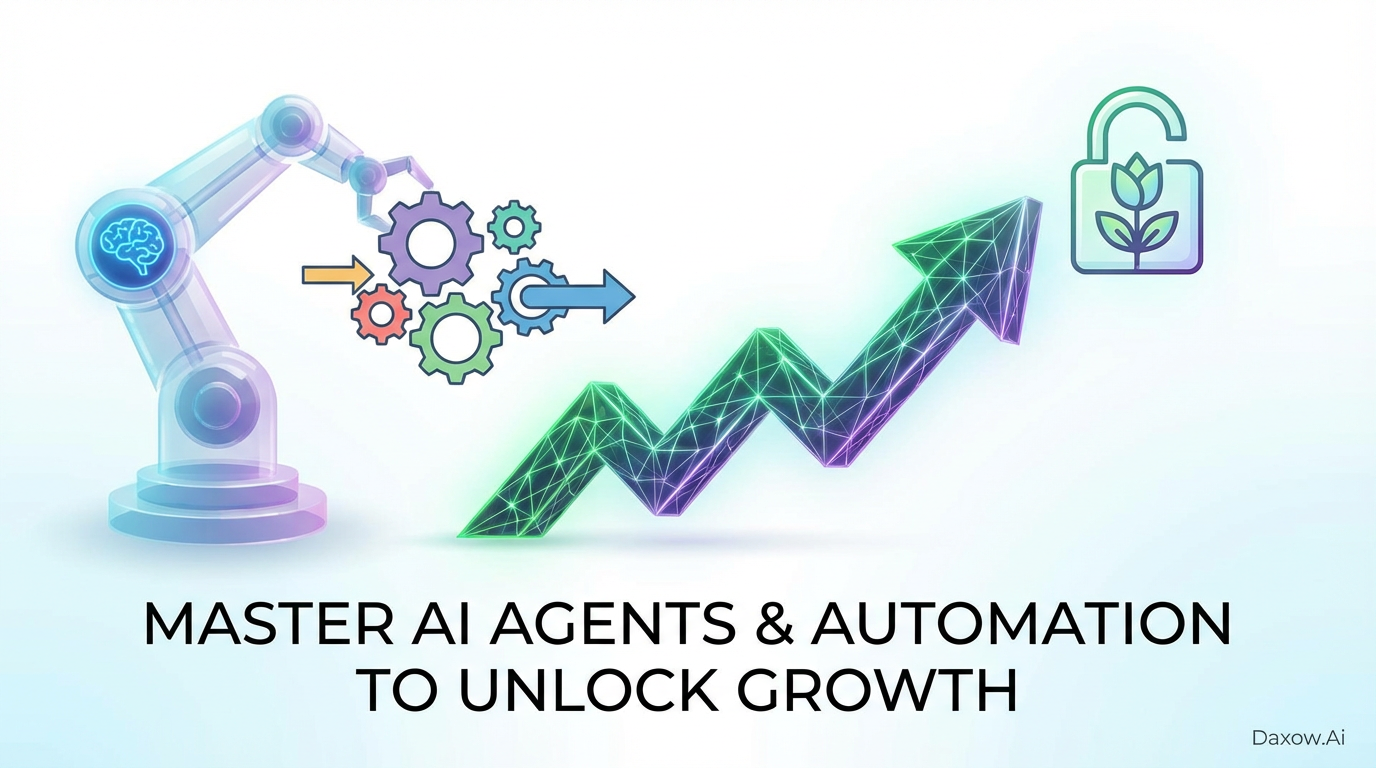
Practical framework to plan, pilot, and scale AI agents and workflow automation; use cases, KPIs, and how Daxow.ai delivers measurable ROI in months.
Unlocking Business Growth: Mastering AI Agents and Automation Implementation
Estimated reading time: 15 minutes
Key Takeaways
- AI agents and automation enable scalable, efficient operations with measurable ROI.
- Structured phased framework guides successful AI implementation with clear KPIs and risk controls.
- Industry use cases highlight practical benefits across e-commerce, healthcare, finance, real estate, and HR.
- Daxow.ai provides tailored AI systems integrating seamlessly with business platforms.
- Common pitfalls include data readiness and adoption challenges, mitigated through best practices.
Table of Contents
- Introduction
- Why This Matters Now
- Unlocking Business Growth: Mastering AI Agents and Automation Implementation — a Practical Framework
- Practical Use Cases and Industry Examples of AI Agents and Automation
- How AI Agents and Automation Create Measurable Business Value
- Implementation Pitfalls and How to Avoid Them
- How Daxow.ai Partners with You — From Analysis to Autonomous Execution
- Getting Started — A Checklist for Decision-Makers
- Conclusion and Next Step
- Frequently Asked Questions
Introduction
Unlocking Business Growth: Mastering AI Agents and Automation Implementation is the strategic playbook companies need to move from fragmented manual processes to resilient, revenue-driving operations. For business owners, operations leaders, CTOs, and department heads, this topic is not theoretical: it defines how organizations reduce manual work, accelerate productivity, and deliver consistent customer experiences at scale. In this article we unpack practical steps, measurable outcomes, and industry use cases — and show how Daxow.ai builds custom AI systems and AI agents to deliver real business automation.
Why This Matters Now
- Markets demand speed, accuracy, and 24/7 service.
- AI automation and workflow automation unlock scalable operations without linear headcount growth.
- Early adopters report accelerated time-to-value and clear ROI in months, not years.
This guide synthesizes proven implementation practices and delivers actionable next steps you can use immediately.
Unlocking Business Growth: Mastering AI Agents and Automation Implementation — a Practical Framework
Phase 1 — Assessment and Planning (4–8 weeks)
- Identify candidate processes: high-volume, rule-based, repetitive tasks with clear inputs and outputs. Examples: invoice processing, lead qualification, ticket triage.
- Define measurable goals: cost reduction targets, SLAs, throughput increases (for example, 30% cost reduction, 50% faster response times).
- Data readiness check: audit data quality, accessibility, and compliance obligations (e.g., HIPAA, financial regulations).
- Outcome: prioritized roadmap of 1–3 pilot use cases with baseline metrics and success criteria.
Phase 2 — Technology and Vendor Selection (6–12 weeks)
- Evaluate platforms for integration capability (CRM, ERP, support tools), security, and model governance.
- Choose solutions that support both pre-built connectors and custom integrations to avoid data silos.
- Include scalability and manageability in vendor scoring; prefer options that allow iterative model updates.
- Outcome: selected stack and technical architecture diagram that maps data flows and touchpoints.
Phase 3 — Team Assembly and Preparation (4–8 weeks)
- Build a cross-functional team: IT, data engineers, product owners, subject-matter experts, and change managers.
- Clean and structure training data, build knowledge bases and decision trees for agents, and document end-to-end workflows.
- Train staff on new processes and establish adoption targets (aim for 80%+ adoption through training and change programs).
- Outcome: production-ready data, process documentation, and trained stakeholders.
Phase 4 — Pilot Deployment and Rollout (4–20 weeks)
- Launch a narrow pilot on selected channel(s). Monitor KPIs: error rate, time-to-resolution, cost per transaction, CSAT.
- Iterate quickly: update knowledge bases, refine decision logic, and retrain models based on real-world feedback.
- Gradually expand scope after pilot meets targets, ensuring monitoring and rollback plans are in place.
- Outcome: validated use case with measurable impact and playbook for scale.
Phase 5 — Ongoing Optimization
- Implement continuous monitoring: performance metrics, bias detection, and model drift alerts.
- Schedule periodic retraining and process reviews.
- Measure long-term business KPIs: cost savings, throughput, revenue uplift, and customer satisfaction improvements.
- Outcome: sustained effectiveness and continuous improvement cycle.
Practical Use Cases and Industry Examples of AI Agents and Automation
E-commerce — Converting Scale into Revenue
Use case
- AI agents automate order validation, inventory reconciliation, returns processing, and personalized recommendations.
Workflow example
- Customer places order → AI agent validates payment and inventory → Automated order confirmation and shipping label generation → Inventory update in ERP → Personalized cross-sell email triggered.
Impact and KPIs
- Reduce manual tasks in order handling by up to 70%.
- Typical outcomes: 15–25% revenue uplift from personalization, 3x faster order processing, and decreased cart abandonment.
How Daxow helps
We integrate AI agents with e-commerce platforms, ERP, and CRMs to ensure real-time data flow and automate fulfillment and customer outreach. Learn more about our e-commerce automation solutions.
Healthcare — Reducing Administrative Burden While Preserving Compliance
Use case
- Appointment scheduling, patient triage, insurance verification, and compliance checks automated via AI agents.
Workflow example
- Patient request → AI triage bot collects symptoms and prioritizes urgency → Appointment scheduled or routed to clinician → Billing and claims pre-checked for coverage.
Impact and KPIs
- Improve productivity by cutting administrative tasks and reducing wait times.
- Outcomes: faster triage, fewer missed appointments, and improved patient satisfaction.
How Daxow helps
Daxow builds HIPAA-aware agents and connects them with EHR systems to automate scheduling and administrative workflows while maintaining auditability.
Finance — Faster Approvals and Stronger Controls
Use case
- Invoice processing, fraud detection, compliance reporting, and exception handling automated with AI agents and workflow automation.
Workflow example
- Invoice received → Data extraction agent digitizes invoice → Validation against PO → Flag anomalies to fraud detection model → Automated approval or human escalation.
Impact and KPIs
- Reduce manual tasks like data entry by up to 90% for rule-based work.
- Outcomes: 20–50% cost reductions, faster payment cycles, and improved compliance reporting.
How Daxow helps
We deploy AI agents to extract structured data, connect to accounting systems, and automate reconciliation while enforcing internal controls.
Real Estate — Faster Lead Conversion and Smarter Matchmaking
Use case
- Lead qualification, property matching, scheduling viewings, and personalized follow-ups automated by agents.
Workflow example
- Lead form submitted → AI agent scores lead and matches to properties → Automated messages schedule tours → Nurture flows run until conversion.
Impact and KPIs
- Faster response time, higher-qualified lead rates, and reduced agent workload.
- Outcomes: improved conversion rates and faster time-to-contract.
How Daxow helps
Daxow integrates agents with MLS, CRM, and calendaring systems so agents execute tasks end-to-end on behalf of sales teams.
HR — Efficient Hiring and Employee Support
Use case
- Resume screening, interview scheduling, onboarding workflows, and employee Q&A automated with AI agents.
Workflow example
- Candidate applies → Screening agent ranks applicants → Top candidates receive automated interview invites → Onboarding tasks automatically provision accounts and training.
Impact and KPIs
- Faster time-to-hire, consistent screening, and reduced administrative overhead.
- Outcomes: improved quality of hire and lower recruiting costs.
How Daxow helps
We implement secure, bias-aware screening agents and integrate onboarding flows with HRIS and identity systems.
How AI Agents and Automation Create Measurable Business Value
Cost Savings and Productivity Gains
- Immediate wins: Automate high-volume, low-complexity tasks to reduce processing costs by 20–50%.
- Scale safely: Handle more volume without hiring proportional staff — typical capacity increases of 3–5x for automated processes.
- Daxow approach: We prioritize quick-win pilots that produce measurable savings within 6–12 months.
Risk Reduction and Compliance
- Automation enforces standardized processes and audit trails, reducing human error and ensuring regulatory adherence.
- Daxow builds secure integrations and maintains traceability so compliance teams can audit automated decisions.
Improved Customer Experience and Revenue Uplift
- AI-driven personalization and faster responses increase conversions and CSAT.
- Example outcomes: e-commerce personalization drives 15–25% revenue uplift; support automation delivers 3x faster resolutions.
- Daxow configures omnichannel AI agents that maintain context across chat, email, and voice to preserve customer experience.
Implementation Pitfalls and How to Avoid Them
Pitfall — Poor Data Readiness
- Mitigation: Conduct thorough data audits and remediation before training models. Create canonical sources of truth and automated data pipelines.
Pitfall — Over-ambitious Scope
- Mitigation: Start with high-volume, low-complexity tasks. Deliver early wins to build stakeholder confidence.
Pitfall — Integration Failures
- Mitigation: Design flexible connectors and use middleware when necessary. Test integrations in staging environments with realistic load.
Pitfall — Low Adoption
- Mitigation: Invest in change management and user training. Monitor usage metrics and iterate on UX to drive 80%+ adoption.
How Daxow.ai Partners with You — From Analysis to Autonomous Execution
What We Do — Core Services
- Process discovery and prioritization: We map workflows and identify automation impact.
- Custom AI agent development: We build agents capable of multi-step, autonomous tasks integrated with your tools.
- Workflow automation and orchestration: We connect agents with CRMs, ERPs, support platforms, and databases for seamless execution.
- Secure integrations and data connectivity: We design data flows that honor compliance and maintain data integrity.
- Pilot-to-scale delivery: We run pilots, measure KPIs, and scale proven automations across the organization.
Typical Engagement Steps with Daxow
- Kickoff and process analysis (2–4 weeks): We document workflows and select pilot candidates.
- Rapid prototype (4–8 weeks): We deliver an initial AI agent and integration proof-of-concept.
- Pilot and refinement (4–12 weeks): We measure, iterate, and tune performance against agreed KPIs.
- Scale and embed (ongoing): We roll out automations across departments, train teams, and set up governance for continuous improvement.
Real Results
- Clients report average efficiency gains of ~40% after end-to-end automation.
- Many engagements reach payback within 6–12 months, with sustained uplift in productivity and customer satisfaction.
Getting Started — A Checklist for Decision-Makers
- Identify 1–3 pilot processes with clear inputs, outputs, and baseline metrics.
- Set measurable goals (cost, time, quality) and ownership for each KPI.
- Complete a data readiness assessment and compliance checklist.
- Assemble a cross-functional team with clear roles and a change manager.
- Commit to a phased approach: pilot, measure, scale.
- Partner with a provider that offers integration expertise and end-to-end delivery, including agent development and monitoring.
Conclusion and Next Step
AI agents and workflow automation are not just efficiency tools — they are strategic levers for unlocking growth, improving customer experiences, and turning operational processes into competitive advantages. Done correctly, automation reduces manual tasks, improves productivity, and delivers measurable ROI within months.
Book a free consultation with Daxow.ai to request a process analysis for your company and explore a tailored roadmap to build AI agents that execute real work, integrate with your systems, and scale your business automation.
Frequently Asked Questions
What types of business processes are best suited for AI agents?
High-volume, rule-based, repetitive processes with clear inputs and outputs such as invoice processing, lead qualification, and scheduling are ideal candidates for AI agent automation.
How quickly can companies expect ROI from AI automation?
Early adopters often report clear ROI within months, typically between 6 to 12 months, depending on the scope, process complexity, and pilot success.
How does Daxow ensure compliance in regulated industries?
Daxow builds secure and traceable AI integrations that comply with industry standards such as HIPAA and financial regulations, enabling audit trails and data governance.
What are common challenges during AI automation implementation?
Common challenges include poor data readiness, over-ambitious scope, integration failures, and low user adoption. Proper planning, phased delivery, and strong change management help mitigate these pitfalls.