
AI Agents & Automation: Business Playbook for Leaders
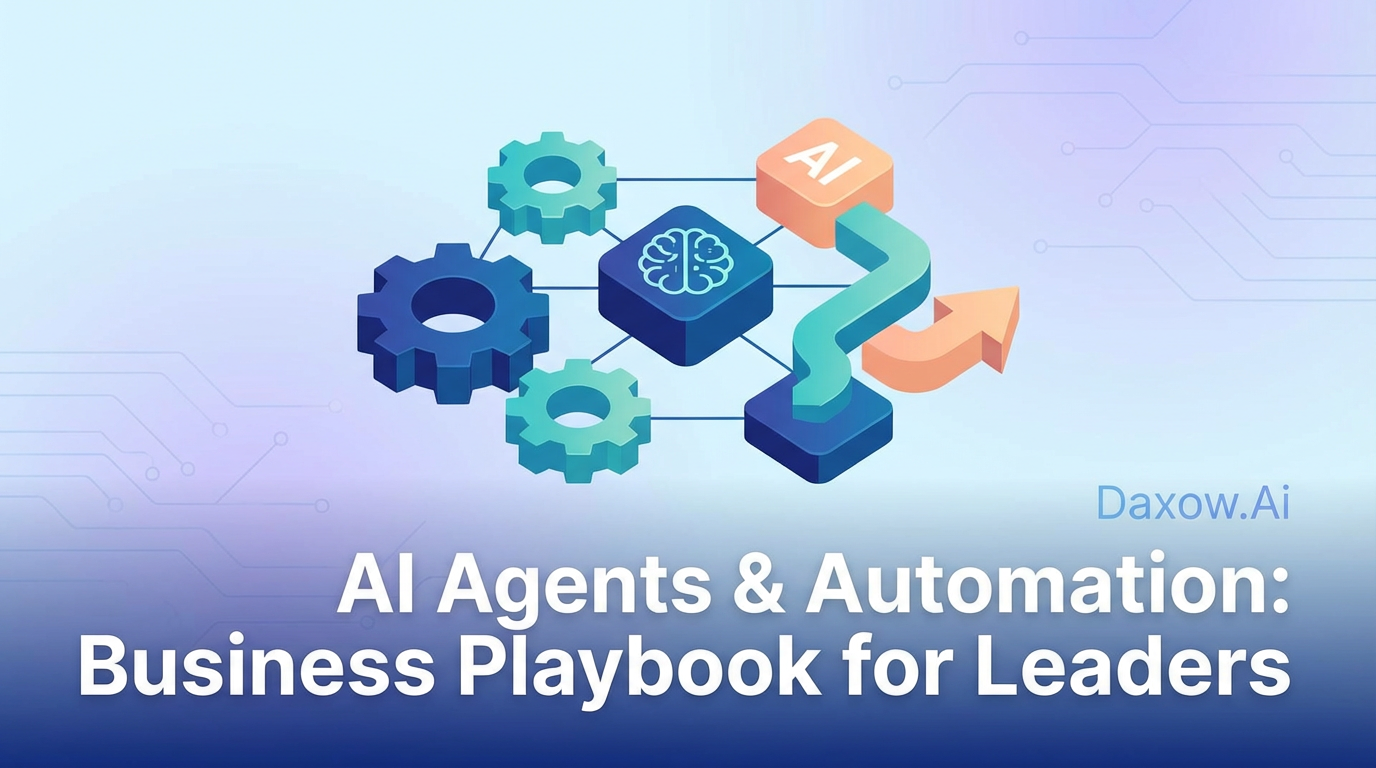
A practical playbook for deploying AI agents and workflow automation to boost efficiency, reduce costs, and scale operations — includes use cases, steps, and ROI.
AI Agents and Automation: Transforming Business Operations for the AI Era
Estimated reading time: 15 minutes
Key Takeaways
- AI agents represent a shift from robotic process automation (RPA) to adaptive, intelligent systems capable of context-aware decision making.
- Benefits include improved operational efficiency, cross-functional agility, scalable growth, and strategic empowerment.
- Industry-specific use cases demonstrate measurable impacts in ecommerce, healthcare, finance, real estate, and HR.
- Successful AI automation requires integrated data systems, multi-agent collaboration, and human-in-the-loop governance.
- A structured, workflow-centric implementation process helps deliver sustainable business value and measurable ROI.
Table of Contents
- Introduction
- What AI Agents Are — and Why They Matter
- Key Business Benefits at a Glance
- Practical Use Cases Across Industries
- How AI Agents and Workflow Automation Drive Business Value
- Implementation Steps and Best Practices for Business Automation
- ROI and Measuring Success
- Real-world Example: End-to-End Automation Blueprint for Customer Support
- Conclusion and Call to Action
- Frequently Asked Questions
Introduction
AI Agents and Automation: Transforming Business Operations for the AI Era is accelerating how organizations reduce manual work, boost productivity, and reimagine workflows. For business owners, operations leaders, and technology decision-makers, this shift moves organizations beyond brittle robotic process automation toward intelligent, context-aware systems that can reason, coordinate across systems, and execute complex, multi-step tasks. This article synthesizes recent research and practical experience into an actionable playbook for leaders who want to deliver measurable business value with AI automation.
What AI Agents Are — and Why They Matter
- AI agents are autonomous, intelligent systems powered by machine learning and large language models that go beyond simple scripting to handle complex workflows, learn from interactions, and make contextual decisions under human oversight.
- This represents a move from RPA to agentic process automation (APA): systems that adapt to exceptions, synthesize data across silos, and provide actionable recommendations rather than only executing predefined rules.
- Business implication: AI agents reduce manual intervention, minimize errors, and allow teams to focus on strategic work while agents handle repetitive, variable, and data-intensive tasks.
Key Business Benefits at a Glance
- Operational efficiency: Automate complex, multi-step processes and exception resolution that traditional automation cannot handle.
- Cross-functional agility: Integrate systems and break down silos so processes span CRM, ERP, support tools, and analytics platforms.
- Scalable growth: Handle “long-tail” tasks programmatically without proportional headcount increases.
- Strategic empowerment: Provide real-time recommendations and predictive insights to support faster, better decisions.
Practical Use Cases Across Industries
AI agents deliver tailored value by addressing industry-specific pain points. Below are concrete use cases, measurable impacts, and implementation notes for decision-makers.
E-commerce
- Use case: Multi-agent orchestration for inventory management, personalized product recommendations, and customer support automation.
- Impact: Real-time synchronization between sales channels and logistics reduces stockouts and improves fulfillment speed. Expect uplift in customer satisfaction and conversion when personalization is applied at scale.
- Implementation note: Integrate agents with your inventory system, CRM, and support platform to enable end-to-end order lifecycle automation and automated exception handling.
Healthcare
- Use case: Symptom triage agents, scheduling automation, and administrative document classification (e.g., claim forms, referrals).
- Impact: Administrative time reductions of up to 40% and improved compliance through accurate records processing. Faster triage improves patient routing and resource allocation.
- Implementation note: Prioritize data privacy and governance; agents should operate with strict controls and human-in-the-loop for clinical decisions.
Finance
- Use case: Fraud detection agents, contract intelligence extraction, and compliance reporting across transaction systems.
- Impact: Faster audits, lower risk exposure, and improved decisioning for lending and underwriting. Organizations report substantial reductions in time-to-insight.
- Implementation note: Combine high-frequency monitoring agents with periodic audit agents to maintain continuous compliance and oversight.
Real Estate
- Use case: Market-data synthesis for valuations, AI-guided virtual tours, and lead qualification based on buyer intent signals.
- Impact: Faster deal cycles and improved lead-to-contract conversion through personalized outreach and automated follow-ups.
- Implementation note: Connect listing platforms, CRM, and marketing systems; use agents to surface warm leads and automate scheduling.
HR and Talent Management
- Use case: Resume screening, onboarding workflows, and performance analytics aggregating unstructured inputs.
- Impact: Faster recruitment cycles (up to 60% improvement), reduced bias through objective screening criteria, and proactive talent retention analytics.
- Implementation note: Maintain transparency and auditability in hiring agents; keep humans in decision loops for final hiring calls.
How AI Agents and Workflow Automation Drive Business Value
- Combining automation with reasoning: Agents synthesize dispersed data, apply business rules, and reason to resolve exceptions—far beyond rule-based bots.
- Multi-agent systems can collaborate; for example, a lead-qualification agent routes qualified leads to a sales-assistant agent that schedules follow-ups and triggers personalized emails.
- System integration and data connectivity: Agents deliver more value when connected to ERP, CRM, support desks, analytics, and data lakes.
- Daxow’s role: We design integrations and data pipelines so agents have the contextual awareness required to act autonomously and correctly, while maintaining governance and traceability.
- Task delegation and decision augmentation: Use agents to free teams from repetitive tasks (e.g., data entry, ticket triage, basic contract review).
- Agents augment human decisions with predictive recommendations—sales prioritization scores, risk flags in finance, or patient routing suggestions in healthcare.
- Scalability without linear headcount growth: Agents handle “long-tail” problem sets and adapt as new scenarios arise, enabling organizations to scale processes without proportional staffing increases.
- Daxow services that enable value:
- AI Agents: Design and build agentic systems that execute real tasks, including multi-agent orchestration and human-in-the-loop governance.
- Workflow Automation: Reimagine processes end-to-end to eliminate manual handoffs and automate decision points.
- Chatbots & Customer Support Automation: Deploy support agents that handle first-line queries, escalate appropriately, and reduce resolution times.
- Lead Qualification & Sales Automation: Automate qualification, scoring, and routing to accelerate pipeline velocity.
- Data Extraction & Document Automation: Convert unstructured documents into usable data for downstream agents.
- Integrations & Connectivity: Connect agents to your tools and CRMs to ensure context-rich decisions and traceability.
Implementation Steps and Best Practices for Business Automation
A structured, workflow-centric approach is essential to avoid experimentation that yields little business value. Follow these practical steps.
- Assess workflows: Map end-to-end processes and identify high-impact candidates for automation—prioritize complex, multi-step tasks with high volume or high cost.
Deliverable: Workflow heatmap showing time, cost, exception rates, and potential ROI. - Build the foundation: Standardize and harmonize data. Ensure agents can access clean, reliable sources (ERP, CRM, support logs).
Deliverable: Data catalog, integration plan, and API layer for agent access. - Select and orchestrate agents: Choose the right architecture—single-use agents for targeted tasks, multi-agent systems for complex orchestration. Decide platform components (LLMs, orchestration framework, connectors).
Deliverable: Agent design document with responsibilities, inputs/outputs, and failure modes. - Pilot and iterate: Run controlled pilots with human oversight. Measure against KPIs: time savings, error rates, cost per transaction, and customer satisfaction.
Deliverable: Pilot report with measured outcomes and a scaling roadmap. - Foster collaboration and governance: Involve CIOs, domain experts, and business leaders. Define human-in-the-loop policies, escalation paths, and ethical guidelines.
Deliverable: Governance policy, roles & responsibilities, and monitoring dashboards. - Monitor, optimize, and scale: Continuously monitor agent performance, retrain models, and refine workflows to handle new exceptions.
Deliverable: Continuous improvement plan with retraining cadence and performance SLAs.
Best practices
- Start small and prove value. Quick wins build momentum and executive buy-in.
- Balance autonomy with control. Keep humans in the loop for high-risk decisions.
- Measure outcomes, not outputs. Track business KPIs rather than technical metrics alone.
- Leverage external expertise. Partner with an agency experienced in systems integration and agent design to accelerate delivery.
Implementation timeline (example)
- Week 0–4: Discovery, workflow mapping, data assessment.
- Week 4–8: Foundation build—data pipelines and integrations.
- Week 8–12: Agent development and internal testing.
- Week 12–16: Pilot deployment with human oversight and KPI measurement.
- Month 4–12: Scale, iterate, and expand agent scope.
ROI and Measuring Success
Quantifying ROI helps secure sponsorship and sets expectations for scaling. AI agents typically produce measurable results within months.
Expected outcomes
- Efficiency gains: Organizations report improvements in productivity of 40–67% in targeted areas when agents streamline sales or internal operations.
- Time savings: Administrative and repetitive tasks can see 30–60% time reductions, freeing teams for high-value initiatives.
- Error reduction: Automation and better data synthesis lower error rates—often by up to 50% in document processing and compliance tasks.
- Financial returns: Daxow clients commonly see 3–5x ROI within the first year when automation targets high-volume, high-cost processes.
KPIs to track
- Time saved per process and overall weekly hours reclaimed.
- Error or exception rate before and after deployment.
- Cost per transaction or case handled.
- Customer metrics: response time, resolution time, NPS and CSAT.
- Revenue impact metrics: lead-to-conversion time, average deal size changes, churn reduction.
Real-world Example: End-to-End Automation Blueprint for Customer Support
Problem statement
High volume of repetitive support tickets, inconsistent responses, long resolution times, and high operational cost.
Blueprint steps
- Discovery and mapping: Identify top 20 support issues by volume and time-to-resolution.
- Data foundation: Integrate ticketing system, knowledge base, CRM, and product telemetry into a unified context layer.
- Agent design: Tier 1 Support Agent handles FAQs, account lookups, and simple triage with escalation to human agents. Escalation Agent gathers context and proposed fixes, prepares summary for Level 2 specialists.
- Orchestration and human loop: Agents propose resolution; if confidence is high, agent closes ticket and logs action. If not, it routes to human with the agent’s diagnostic summary.
- Measure and iterate: KPIs: First-contact resolution rate, mean time to resolution, ticket deflection rate, and CSAT.
- Scale: Expand agents to handle billing disputes, refunds, and post-resolution follow-ups with personalized outreach.
Expected outcomes
- Ticket deflection of 30–50% for typical FAQ and simple issues.
- Resolution time reduction by up to 60% for automated flows.
- Improved CSAT from faster answers and consistent quality.
How Daxow helps implement this blueprint
- We conduct the workflow assessment to identify high-impact automation opportunities.
- We build data connectors and secure API layers to unify context for agents.
- We design multi-agent orchestration with human-in-the-loop safeguards and monitoring dashboards.
- We run pilots, measure outcomes against agreed KPIs, and scale proven agents across the organization.
Conclusion and Call to Action
AI Agents and Automation: Transforming Business Operations for the AI Era is not a future promise—it is an immediate, competitively decisive opportunity. Organizations that adopt agentic automation strategically see rapid productivity gains, lower operational costs, and improved customer experiences. The right approach combines careful workflow analysis, robust data foundations, targeted pilots, and governed scaling.
If you want to reduce manual tasks, boost productivity, and deploy AI agents that perform real business work, Daxow can help. We design custom AI automation systems, integrate them with your tools and CRMs, and deliver end-to-end process automation that drives measurable ROI.
Contact Daxow today to:
- Book a free consultation
- Request a process analysis for your company
- Start building a custom AI system that reduces manual tasks and accelerates growth
Request your consultation now and begin transforming operations with practical, secure, and scalable AI automation.
Frequently Asked Questions
What distinguishes AI agents from traditional robotic process automation?
AI agents leverage machine learning and large language models to autonomously handle complex workflows, adapt to exceptions, and make contextual decisions, going beyond the rule-based scripting typical of traditional RPA.
How do AI agents improve operational efficiency?
They automate complex, multi-step processes that involve exception handling and decision-making, reducing manual work, minimizing errors, and freeing teams for strategic activities.
What industries benefit most from AI agent automation?
E-commerce, healthcare, finance, real estate, and HR are key industries with practical, high-impact use cases demonstrated by AI agents.
How does Daxow support implementation of AI agents?
Daxow provides end-to-end services including workflow assessment, data integration, agent design and orchestration, pilot execution, monitoring, and scaling while ensuring governance and human-in-the-loop processes.