
AI Agents and Automation: The 2026 Playbook for Business Leaders
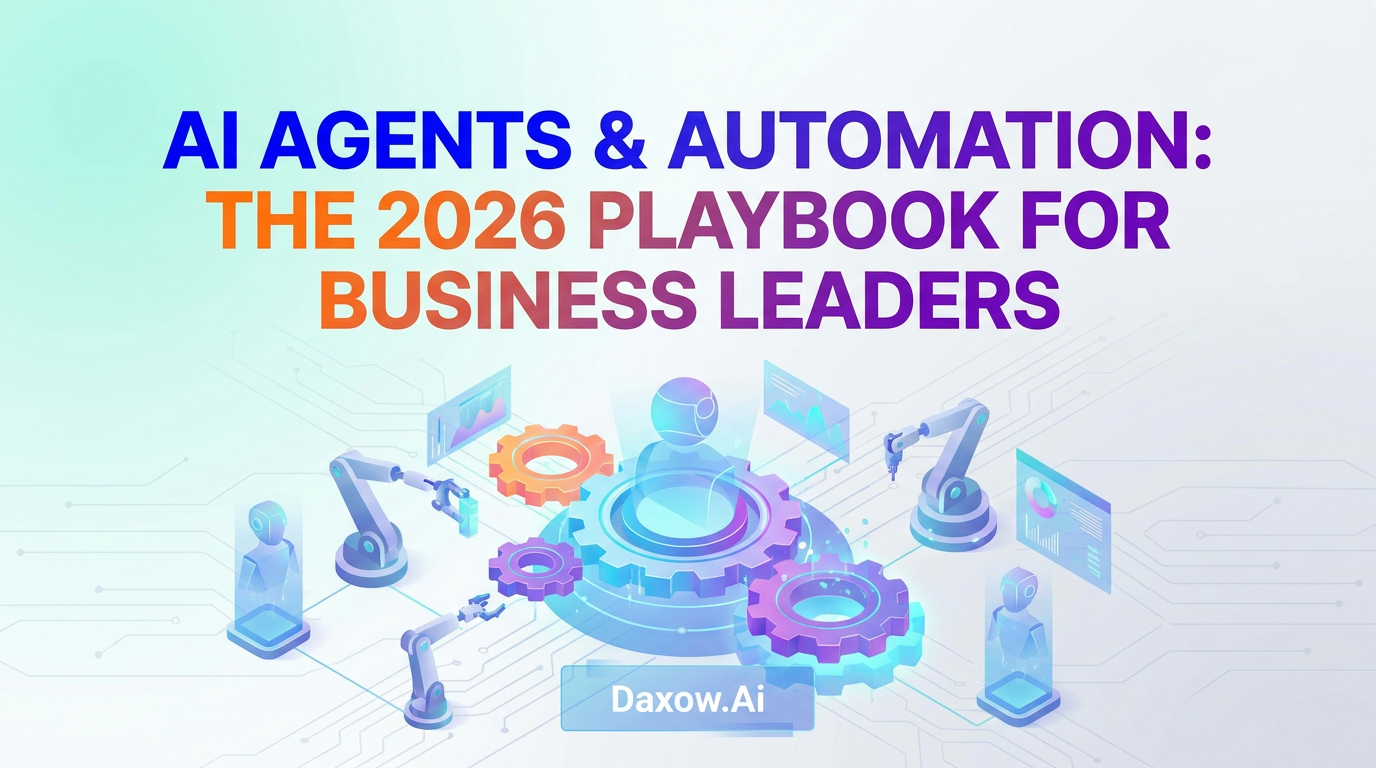
2026 playbook for deploying AI agents and workflow automation: use cases, implementation roadmap, governance, KPIs, and how Daxow.ai drives measurable ROI.
AI Agents and Automation: The 2026 Playbook for Business Leaders
Estimated reading time: 14 minutes
Key Takeaways
- AI agents extend traditional automation by interpreting unstructured data and orchestrating workflows intelligently.
- High-impact AI automation use cases span e-commerce, healthcare, finance, real estate, and HR.
- Successful implementations combine AI perception and decision layers with deterministic workflow execution and human oversight.
- A disciplined roadmap with clear KPIs, governance, and iteration drives scalable AI automation deployments.
- Daxow.ai partners with organizations to build modular, custom AI agents integrated into existing systems for measurable business outcomes.
Table of Contents
- AI Agents and Automation: The 2026 Playbook for Business Leaders — What it means for your company
- Practical Use Cases Across Industries
- How AI Agents and Workflow Automation Work Together
- Implementation Roadmap — From pilot to scale
- Measuring ROI and Business Value
- How Daxow.ai Helps You Build AI Automation that Works
- Executive Next Steps
- Frequently Asked Questions
AI Agents and Automation: The 2026 Playbook for Business Leaders — What it means for your company
Understanding the difference between classic automation and AI agents is the foundation of a successful transformation.
- Traditional workflow automation (RPA, scripts, macros) executes well-defined, rule-based tasks on structured data.
- AI agents add interpretation, reasoning, planning, and action across systems. They can read unstructured inputs (emails, documents, chats), prioritize work, and orchestrate workflows across tools.
Why this matters:
- Faster decisions: Agents can prioritize and act in near real-time.
- Reduced manual tasks: Routine coordination and data extraction are automated.
- Higher productivity: Staff focus on judgment, relationships, and strategy rather than copying, checking, and coordinating.
- Improved data usage: Unstructured sources become operational inputs.
Strategic implications for leadership:
- Treat agents as new digital teammates with defined roles, access, and governance.
- Start with high-frequency, high-impact workflows where automation will deliver immediate ROI.
- Measure outcomes (efficiency, quality, risk) and iterate.
Practical Use Cases Across Industries
E-commerce — Customer support automation and sales automation
Core outcomes: lower support costs, higher conversion, faster issue resolution.
- AI Customer Support Agent
- Reads inbound messages, classifies intent, pulls order data, drafts responses, and escalates complex issues.
- KPI examples: reduce average handle time by 40%, lower escalation rate by 60%, improve CSAT.
- Lead qualification & personalized recommendations
- Respond to inquiries 24/7, qualify leads, send personalized product suggestions, and drive email/SMS campaigns.
- KPI examples: increase conversion rate from leads by 15–30%, lift AOV via personalized bundles.
- Order issue resolution agent
- Detects delayed shipments, proactively communicates solutions (refunds, re-ships), and reduces churn.
Healthcare — Administrative automation and care coordination
Core outcomes: more clinician time, fewer administrative errors, improved patient experience.
- Patient intake & triage assistant
- Collects intake data, summarizes for clinicians, suggests triage actions, and schedules appointments.
- KPI examples: reduce intake processing time by 70%, reduce no-show rates via automated reminders.
- Clinical documentation assistant
- Converts consultations and dictations into structured notes and draft discharge summaries for clinician review.
- KPI examples: increase clinician face time by 20–40%, reduce transcription costs.
Finance — Accounts payable, KYC, and monitoring
Core outcomes: faster closings, reduced fraud risk, consistent compliance.
- Invoice processing & AP agent
- Extracts invoice data, matches POs, flags exceptions, and posts to ERP systems.
- KPI examples: cut invoice processing time by 60%, reduce invoice exceptions and late payments.
- KYC / onboarding agent
- Automates document ingestion, identity verification, and summarizes risk for compliance review.
- KPI examples: shorten onboarding time by 50%, reduce manual review hours.
Real Estate — Lead conversion and transaction coordination
Core outcomes: faster sales cycles, fewer missed deadlines, improved agent productivity.
- Lead qualification and scheduling agent
- Qualifies portal leads, books viewings, and updates CRM.
- KPI examples: increase qualified leads, shorten time-to-viewing by 80%.
- Transaction coordination agent
- Tracks milestones from offer to closing, reminds stakeholders, and manages documents.
- KPI examples: reduce closing delays, lower administrative workload for agents.
HR & People Operations — Recruiting, onboarding, and HR automation
Core outcomes: faster hiring, consistent onboarding, reduced repetitive HR tickets.
- Recruiting coordinator agent
- Screens resumes, summarizes candidate fit, schedules interviews, and drafts communications.
- KPI examples: reduce time-to-hire, increase interview-to-offer conversion.
- Onboarding orchestration agent
- Coordinates IT, HR, facilities tasks, tracks completion, and serves as a virtual onboarding assistant.
- KPI examples: reduce new-hire setup time, improve early employee engagement.
How AI Agents and Workflow Automation Work Together
Combining agents with deterministic automation yields the best balance of flexibility and reliability.
- Perception layer (AI agents): Ingests emails, documents, and events; understands intent and context.
- Decision layer (agents + rules): Reasoning, planning, and confidence-based decisions.
- Execution layer (workflow automation): Deterministic tasks executed via APIs, RPA, or integration middleware.
- Human-in-the-loop: Escalations, approvals, and oversight for low-confidence or high-risk actions.
Design pattern examples:
- Agent identifies issue → agent proposes action with evidence → workflow engine executes approved action → audit log captured.
- Agent operates in shadow mode for X weeks to collect baseline data → tuned thresholds → phased autonomy.
This layered approach preserves reliability while unlocking advanced capabilities like end-to-end business automation and autonomous orchestration.
Implementation Roadmap — From pilot to scale
Daxow.ai recommends a disciplined, business-first roadmap that minimizes risk and maximizes measurable value.
- Identify high-value, feasible workflows
- Criteria: high volume, clear business impact, and enough structure for automation.
- Examples: support triage, invoice processing, lead qualification.
- Define goals and KPIs
- Efficiency (time per transaction), quality (error and escalation rates), and financial metrics (cost per case, revenue lift).
- Map the current process in detail
- Capture inputs, decision points, exceptions, and systems involved.
- Design the human + agent operating model
- Define ownership, confidence thresholds, escalation paths, and agent responsibilities.
- Choose architecture and tooling
- LLM/agent platform + integration layer + workflow orchestrator + data/security controls.
- Prefer modular agent services (e.g., “Support Triage Agent”) for reuse.
- Build a constrained pilot
- Start in sandbox or shadow mode, limited scope, mixed autonomy.
- Measure against baseline and tune behavior.
- Governance and risk controls
- Role-based access, audit trails, performance dashboards, and drift detection.
- Name a business owner for every agent and run regular risk reviews.
- Iterate and scale
- Use pilot learnings to expand horizontally and vertically.
- Integrate agents into teams to handle multi-step goals across departments.
Measuring ROI and Business Value
To justify investment, quantify value across three dimensions: efficiency, effectiveness, and risk reduction.
Efficiency: doing more with the same resources
- Metrics: reduced time per case, FTE hours saved, avoided hires.
- Typical outcomes: 30–70% reduction in manual work for targeted processes.
Effectiveness: doing the right things better
- Metrics: conversion lift, CSAT, error rate reduction.
- Typical outcomes: faster lead response increases close rates; consistent policy application reduces rework.
Risk and compliance: reducing downside
- Metrics: fewer compliance incidents, SLA adherence, auditability.
- Typical outcomes: standardized workflows reduce regulatory exposures and remediation costs.
How to present ROI:
- Build a three-year projection: labor savings, revenue lift, and reduced risk costs.
- Include implementation and operating costs (platform, integrations, monitoring).
- Show payback period and expected uplift in productivity.
How Daxow.ai Helps You Build AI Automation that Works
Daxow.ai specializes in designing and delivering end-to-end, custom AI automation solutions that produce measurable business outcomes.
What we do:
- Discovery and process analysis
- We map workflows, quantify pain points, and identify high-impact pilots.
- Custom agent design and build
- We design modular AI agents that execute real tasks: reading documents, classifying intent, planning actions, and calling APIs.
- Workflow automation and integration
- We integrate agents with CRMs, ERPs, ticketing systems, and communication tools to enable reliable execution.
- Governance, security, and monitoring
- We implement role-based access, audit trails, and performance dashboards to maintain control and compliance.
- Operate and iterate
- We run pilots in shadow and live modes, tune models, and expand agents across the business.
Why Daxow.ai:
- Business-first approach: We start with measurable KPIs and build automation to meet them.
- End-to-end delivery: From process analysis to deployment and ongoing operations.
- Industry experience: Proven use cases in e-commerce, healthcare, finance, real estate, and HR.
- Modular, scalable design: Reusable agents and integration patterns accelerate rollouts and reduce cost.
Typical engagement model
- Week 0–4: Process analysis and pilot scoping.
- Week 4–12: Pilot build, integration, and shadow testing.
- Week 12–24: Controlled rollout, monitoring, and KPI validation.
- Ongoing: Scale, harden, and expand to adjacent processes.
Executive Next Steps
If you are ready to reduce manual tasks, increase productivity, and implement practical business automation, take these three actions now:
- Choose one measurable workflow (support triage, invoice processing, lead qualification).
- Commit to a 90-day constrained pilot with clear KPIs.
- Assign a business owner and schedule a governance review cadence.
Daxow.ai can run the discovery and pilot with your team, deliver fast time-to-value, and provide the architecture and governance to scale.
Bold next step: Book a free consultation or request a process analysis for your company to get a tailored roadmap and cost/benefit estimate. Contact us to build a custom AI system that reduces operational costs, improves ROI, and turns AI agents into reliable digital teammates.
Frequently Asked Questions
What distinguishes AI agents from traditional automation?
AI agents interpret unstructured data, reason, plan, and act across multiple systems dynamically, whereas traditional automation executes predefined rules on structured data.
How does Daxow.ai ensure governance and compliance?
Through role-based access controls, audit trails, performance dashboards, and regular risk reviews with business owners for each AI agent.
Which industries benefit most from AI agents?
E-commerce, healthcare, finance, real estate, and HR have proven high-impact use cases for AI agents and automation.
What is the recommended approach to scaling AI automation?
Start with a constrained pilot focused on high-value workflows, measure KPIs, iterate, and then expand horizontally and vertically with integrated governance.