
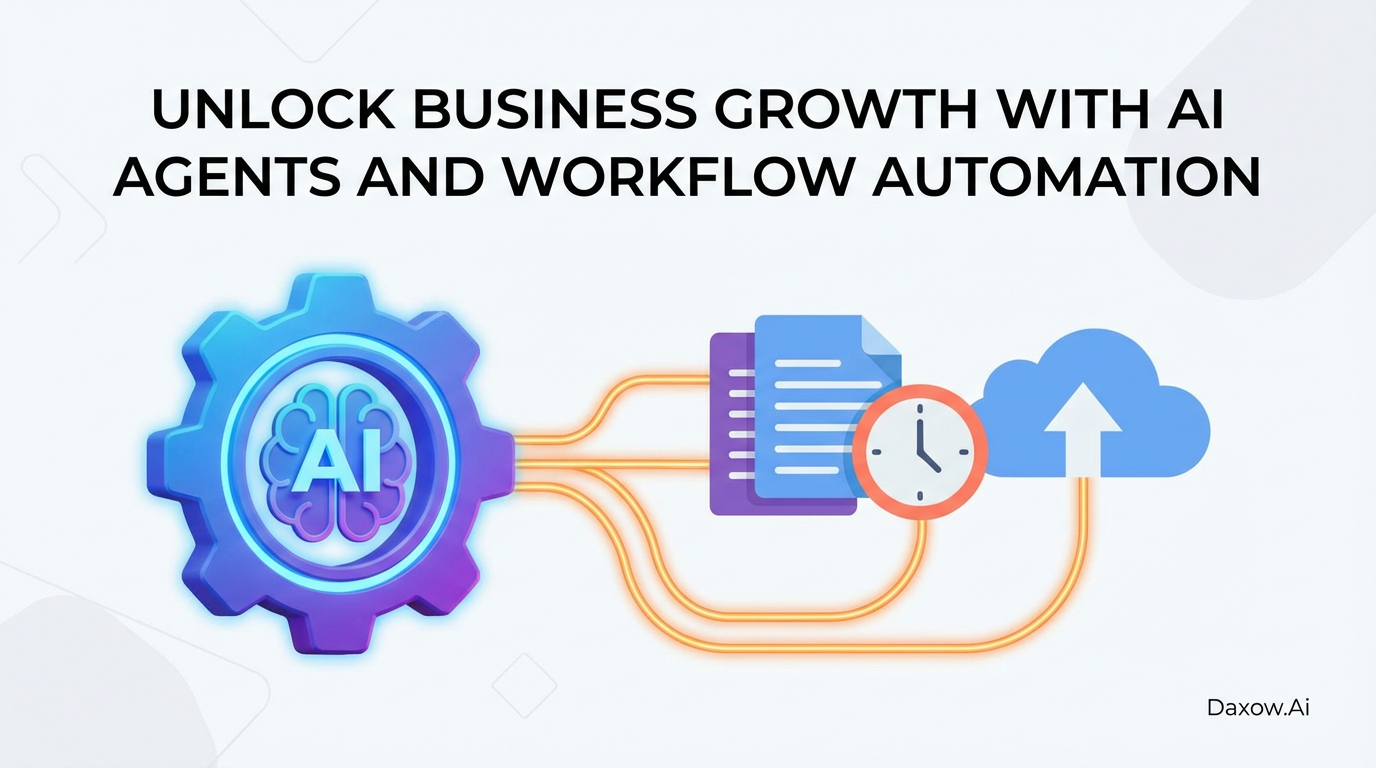
Unlock Business Growth with AI Agents and Workflow Automation
Learn how AI agents and workflow automation streamline processes, cut costs, and scale service. Industry use cases, a 90-day pilot roadmap, and Daxow.ai services.
Unlocking Business Growth: AI Agents and Automation in Process Optimization
Estimated reading time: 15 minutes
Key Takeaways
- AI agents and automation transform manual workflows into scalable, autonomous systems with measurable ROI.
- Key industry applications include e-commerce, healthcare, finance, real estate, HR, and customer support.
- A phased implementation framework ensures goal alignment, data governance, right team setup, prototyping, and continuous improvement.
- Measuring key performance indicators like cycle time, cost, error rates, and NPS validates automation value.
- Daxow.ai offers end-to-end AI automation services delivering productivity gains and cost savings backed by data-driven outcomes.
Table of Contents
- Unlocking Business Growth: AI Agents and Automation in Process Optimization
- Where AI Agents and Automation Deliver the Biggest Impact
- How to Implement AI Agents and Workflow Automation — An Actionable Framework
- Measuring ROI and Business Value of AI Automation
- Practical Roadmap — A 90-Day Pilot to Prove Value
- How Daxow.ai Helps — End-to-End AI Automation for Measurable Outcomes
- Frequently Asked Questions
Unlocking Business Growth: AI Agents and Automation in Process Optimization
What the trend means for business leaders
AI agents and workflow automation move companies from manual processing to systems that operate autonomously, learn from data, and make real-time decisions. In practice this means:
- Eliminating repetitive manual tasks such as data entry and invoice routing.
- Improving decision quality using predictive models and NLP to guide customer and operational choices.
- Scaling service capacity without proportional headcount increases through 24/7 intelligent automation.
- Shifting teams to high-value work by freeing employees from routine processes.
For decision-makers, the opportunity is measurable: faster cycle times, reduced operational costs, and higher customer satisfaction scores. Companies that adopt AI automation strategically report improvements in metrics like processing time, cost per transaction, and Net Promoter Score.
Where AI Agents and Automation Deliver the Biggest Impact
E-commerce — Order-to-cash and customer experience
Use case:
- Automate order validation, inventory reconciliation, and returns processing.
- Deploy chatbots for 24/7 customer support that handle order status, refunds, and basic troubleshooting.
Impact:
- Reduced fulfillment errors and faster delivery times.
- Lower support cost per transaction and improved NPS.
How Daxow helps:
- Build AI agents that integrate with e-commerce platforms and ERPs to automate order routing and exception handling.
- Implement workflow automation to connect inventory, shipping, and finance systems for end-to-end business automation.
Healthcare — Scheduling, billing, and preliminary triage
Use case:
- Automate patient scheduling, insurance verification, and billing reconciliation.
- Use AI agents to extract key data from unstructured medical records and flag critical anomalies.
Impact:
- Improved compliance and faster billing cycles.
- Reduced administrative overhead, allowing clinicians to spend more time on care.
How Daxow helps:
- Design secure integrations with EHR systems and implement document automation for clinical workflows.
- Deploy AI-driven triage agents that prioritize cases and alert staff when intervention is required.
Finance — Invoicing, fraud detection, and compliance
Use case:
- Automate invoice capture, validation, and payment reconciliation.
- Apply predictive models for fraud detection and anomaly scoring.
Impact:
- Faster close cycles and lower error rates.
- Reduced financial risk and more efficient audits.
How Daxow helps:
- Create data extraction pipelines and validation agents that reduce manual reconciliation.
- Integrate automation with core accounting systems and build monitoring dashboards to measure cost savings.
Real estate — Lead qualification and contract processing
Use case:
- Automate lead scoring, scheduling property viewings, and contract reviews.
- Use AI to generate market insights and automate listing updates.
Impact:
- Faster deal cycles and higher conversion rates.
- Reduced administrative friction for agents and better lead-to-close metrics.
How Daxow helps:
- Deploy lead qualification agents that integrate with CRM systems and route high-intent leads to sales teams.
- Automate document review for contracts and add approval workflow automation to reduce time-to-signature.
HR — Recruitment, onboarding, and employee services
Use case:
- Automate resume screening, interview scheduling, and onboarding checklists.
- Use conversational agents to answer employee questions about policies and benefits.
Impact:
- Shorter time-to-hire and reduced recruiter workload.
- Consistent onboarding experience and fewer HR support tickets.
How Daxow helps:
- Implement AI-driven screening and workflow automation that plugs into HRIS and ATS systems.
- Build conversational AI for internal self-service that reduces repetitive HR inquiries.
Customer support & Sales Automation — 24/7 resolution and lead conversion
Use case:
- Deploy customer support automation for first-tier queries and escalation routing.
- Automate lead follow-ups, qualification, and meeting scheduling.
Impact:
- Faster response times and increased lead conversion rates.
- Lower cost-per-contact and higher sales team productivity.
How Daxow helps:
- Build omnichannel chatbots and support automation that seamlessly transfer to humans when needed.
- Create sales automation agents for lead nurturing and pipeline hygiene that integrate with CRMs.
How to Implement AI Agents and Workflow Automation — An Actionable Framework
Phase 1 — Define goals and prioritize processes
Actions:
- Set measurable objectives (e.g., reduce processing time by 30% or lower cost per invoice by 40%).
- Map end-to-end processes and identify high-volume, rule-based tasks suitable for automation.
- Use an AI-first scorecard to assess readiness and prioritize pilots.
Pitfalls to avoid:
- Vague objectives that lead to scope creep.
- Selecting complex, low-impact processes for early pilots.
Daxow approach:
- Conduct a process analysis workshop and deliver a prioritized automation roadmap with expected ROI per process.
Phase 2 — Assess data quality and governance
Actions:
- Audit data sources for completeness, accuracy, and compliance.
- Standardize formats and set up data pipelines for ingestion and validation.
Pitfalls to avoid:
- Poor data quality undermining model performance.
- Ignoring regulatory requirements and privacy constraints.
Daxow approach:
- Implement secure data connectors, anonymization where required, and establish governance policies to ensure reliable inputs for AI agents.
Phase 3 — Select tools and build the right team
Actions:
- Choose platforms that support integrations, scalability, and monitoring.
- Establish a cross-functional team: product owner, engineers, data scientist, domain expert, and operations lead.
Pitfalls to avoid:
- Siloed teams and one-off proofs without operational ownership.
- Vendor lock-in without clear exit or integration strategies.
Daxow approach:
- Recommend technology stacks tailored to your environment and embed knowledge transfer and documentation so your team owns outcomes.
Phase 4 — Prototype, test, and deploy
Actions:
- Start with a focused pilot on a non-critical but high-value process.
- Measure model performance (accuracy, F1 score) and business KPIs.
- Use phased deployment and human-in-the-loop validation where needed.
Pitfalls to avoid:
- Rushing to full-scale deployment without adequate real-world testing.
- Overreliance on offline metrics without business validation.
Daxow approach:
- Run iterative sprints with production-grade pilots, monitored rollouts, and escalation rules configured for safety and compliance.
Phase 5 — Monitor, measure, and iterate
Actions:
- Track KPIs via dashboards: cycle time, cost per transaction, error rates, NPS, and automation coverage.
- Retrain models and update rules based on feedback loops.
Pitfalls to avoid:
- Neglecting model drift and operational monitoring leading to performance degradation.
- Failing to track business KPIs and attributing outcomes inaccurately.
Daxow approach:
- Provide ongoing support: monitoring, retraining, SLA-backed maintenance, and continuous optimization to sustain gains.
Measuring ROI and Business Value of AI Automation
Quantifying value is essential to scale AI automation across the enterprise. Use these steps and metrics to demonstrate impact:
Key metrics to measure:
- Processing time reduction (baseline vs. post-automation).
- Cost per transaction and labor hours saved.
- Error rate reduction and compliance incidents avoided.
- Customer metrics: response time, closure rate, and NPS improvements.
- Time to value: many initiatives see payback within 6–12 months.
Example ROI scenarios:
- An e-commerce firm automates returns and reduces handling time by 50%, saving headcount hours equivalent to a six-figure personnel cost reduction annually.
- A finance team automates invoice processing and reduces exceptions by 70%, enabling faster close cycles and fewer late-payment penalties.
How Daxow ensures measurable ROI:
- Baseline measurement before the pilot.
- KPI design tied to financial outcomes (cost savings, revenue uplift).
- Regular ROI reporting and a continuous improvement plan that turns initial wins into enterprise-level automation.
Practical Roadmap — A 90-Day Pilot to Prove Value
If you need a pragmatic starting point, follow this 90-day roadmap to validate AI automation quickly:
Days 0–14: Discovery and prioritization
- Run a process audit and confirm the pilot scope.
- Define success metrics and integration requirements.
Days 15–45: Build and prototype
- Implement data connectors, build the initial AI agent or workflow.
- Create test harnesses and human-in-the-loop validation.
Days 46–75: Pilot and monitor
- Deploy the pilot to a controlled population.
- Collect business and performance metrics daily; refine rules and models.
Days 76–90: Evaluate and scale plan
- Present results against baselines and calculate projected ROI.
- Produce a scale-up plan with timelines, costs, and governance.
This approach provides rapid, low-risk validation and a clear path to enterprise deployment.
How Daxow.ai Helps — End-to-End AI Automation for Measurable Outcomes
Daxow.ai delivers full lifecycle services to transform processes using AI agents and workflow automation:
- Strategy & Process Analysis: We map workflows, identify high-impact opportunities, and build a prioritized roadmap tied to business outcomes.
- Custom AI Agents: We design agentic systems that execute tasks, route exceptions, and adapt with minimal human oversight.
- Workflow Automation & Integrations: We connect legacy systems, CRMs, ERPs, and data sources to enable end-to-end automation.
- Chatbots & Customer Support Automation: We build conversational AI that reduces support costs and improves customer satisfaction.
- Lead Qualification & Sales Automation: We automate lead scoring, follow-ups, and scheduling to increase pipeline velocity.
- Data Extraction & Document Automation: We automate capture, validation, and routing of unstructured documents to eliminate manual work.
- Monitoring & Continuous Improvement: We provide dashboards, retraining, and operational support to sustain performance and ROI.
Throughout the engagement, Daxow focuses on measurable improvements: reducing manual tasks, improving productivity, lowering operational costs, and delivering a clear ROI narrative for executives. Learn more on our services page or explore how our custom AI agents can transform your workflows.
Frequently Asked Questions
What types of business processes can AI agents automate?
AI agents can automate rule-based, repetitive, and high-volume tasks across functions like order processing, billing, lead management, scheduling, and customer support, among others.
How soon can my organization see ROI from AI automation?
Many initiatives achieve payback within 6 to 12 months, depending on the complexity, process scope, and scale of automation implemented.
How does Daxow ensure data security and compliance?
Daxow deploys secure data connectors, enforces anonymization, and follows governance policies aligned with regulatory requirements to protect sensitive data throughout AI automation solutions.
Can AI automation integrate with existing IT systems?
Yes, Daxow specializes in integrating AI agents and automation workflows with ERPs, CRMs, EHRs, and other legacy systems for seamless end-to-end process automation.