
AI Agents and Automation for Process Optimization
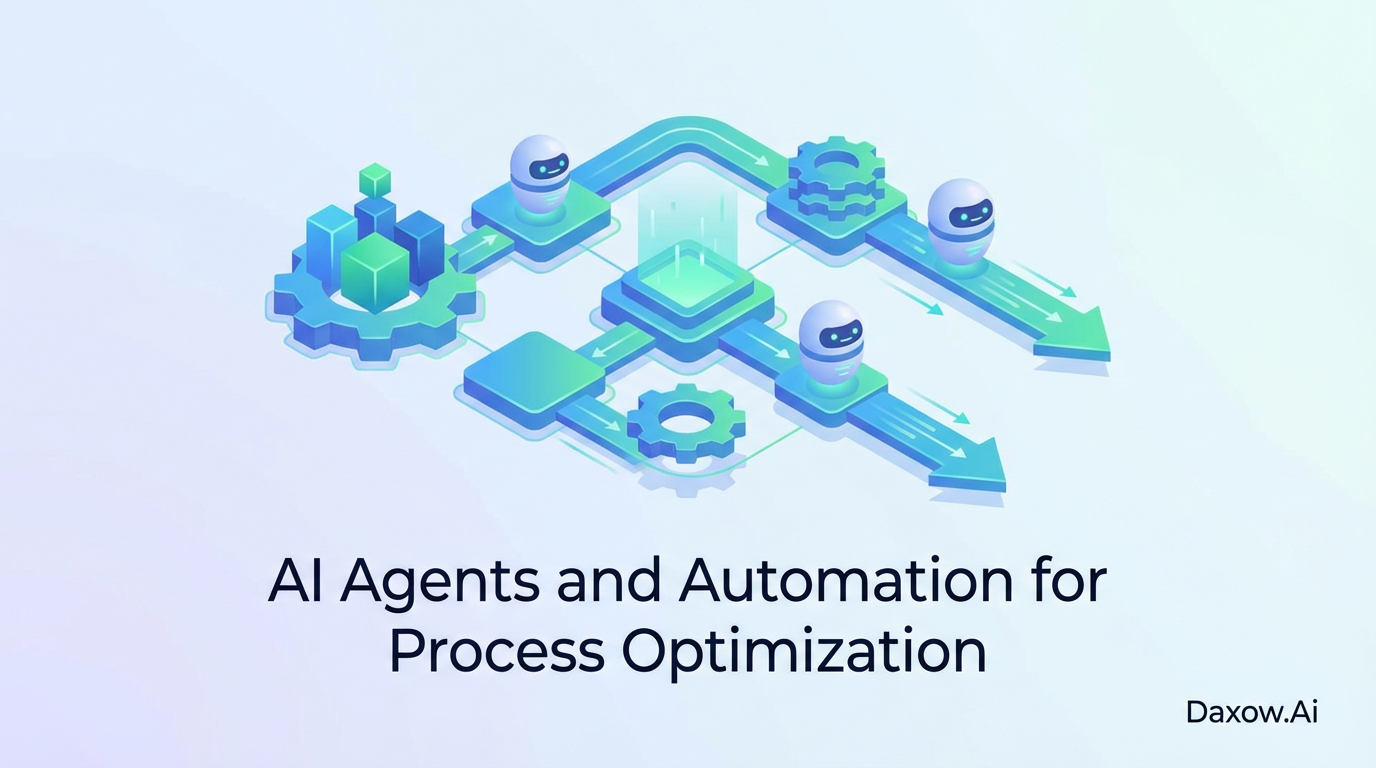
AI agents and automation that optimize high-volume processes, cut costs, and boost productivity. Includes phased implementation, use cases, and Daxow.ai services.
Unlocking Business Transformation: AI Agents and Automation in Process Optimization
Estimated reading time: 14 minutes
Key Takeaways
- AI agents and automation reduce manual, repetitive tasks while boosting productivity and customer satisfaction.
- End-to-end AI systems use autonomy, learning, and orchestration across multiple platforms to optimize processes.
- Industry-specific use cases demonstrate measurable benefits such as reduced cycle times, error rates, and operational costs.
- A phased, research-backed implementation playbook ensures smooth adoption and scalable automation growth.
- Measuring ROI and applying governance frameworks help sustain performance and mitigate risks.
- Daxow.ai provides tailored AI automation solutions with strong integrations, compliance, and ongoing optimization.
Table of Contents
- Unlocking Business Transformation: AI Agents and Automation in Process Optimization
- Why AI Agents and Automation Matter for Business Value
- Practical Use Cases Across Industries
- How to Implement AI Agents and Automation — A Phased Playbook
- Measuring ROI and Scaling Automation
- How Daxow.ai Helps You Unlock Transformation
- Practical Example — A Typical Daxow.ai Engagement
- Common Challenges and How to Overcome Them
- Final Considerations for Decision-Makers
- Frequently Asked Questions
Unlocking Business Transformation: AI Agents and Automation in Process Optimization
AI agents and automation transform high-volume, predictable processes into self-running systems that deliver faster outcomes and lower costs. These systems combine workflow automation with machine learning to handle structured and unstructured data, make decisions, trigger cross-system actions, and learn over time. The result: teams spend less time on repetitive tasks and more time on strategy, innovation, and customer engagement.
Why this matters now
- Cost pressure and labor constraints: Organizations face rising labor costs and demand for faster service. Automation creates capacity without proportional headcount increases.
- Customer expectations: Faster, personalized service drives retention and revenue. Customer support automation and AI agents can cut response times and improve satisfaction.
- Data-driven advantage: AI agents use real-time data to predict issues, optimize flows, and reduce errors, enabling smarter decisions at scale.
Why AI Agents and Automation Matter for Business Value
What AI agents do differently
- Autonomy with learning: Unlike rule-only bots, AI agents learn from data and improve over time.
- End-to-end orchestration: Agents coordinate tasks across systems — CRM, ERP, ticketing, and document stores — to close loops automatically.
- Unstructured data handling: Natural language processing and document extraction turn invoices, contracts, and emails into actionable items.
Core business benefits
- Reduce manual tasks: Target routine, high-volume processes to free teams for high-value work.
- Boost productivity: Typical implementations report significant productivity uplifts (20–70% depending on process).
- Improve accuracy: Automation reduces human error in data entry, compliance checks, and reconciliation.
- Faster customer interactions: Chatbots and AI agents provide 24/7 responses and triage complex requests to the right teams.
- Scalable operations: Systems scale throughput without linear headcount growth.
Practical Use Cases Across Industries
E-commerce — order-to-cash automation
Use case: Automate order validation, inventory checks, fraud scoring, fulfillment triggers, and customer notifications.
Impact: Reduce fulfillment times by up to 40% and lower cart abandonment through real-time personalization and faster confirmations.
Implementation tip: Integrate AI agents with commerce platform, warehouse management, and payment gateways to automate exceptions and refunds.
Healthcare — patient intake and claims processing
Use case: Automate appointment scheduling, patient triage via conversational agents, and claims validation from scanned documents.
Impact: Faster patient triage, improved compliance, and lower administrative costs.
Implementation tip: Prioritize data privacy and compliance; start with non-critical admin workflows to validate accuracy before clinical automation.
Finance — invoice matching and compliance
Use case: Use document extraction and ML models to match invoices to purchase orders, flag anomalies, and perform regulatory checks.
Impact: Reduced reconciliation time, fewer errors, and accelerated audit cycles.
Implementation tip: Combine RPA for structured tasks with ML for anomaly detection; maintain audit logs for governance.
Real Estate — lead qualification and contract automation
Use case: Automate lead capture, qualification scoring, listing updates, and initial contract review.
Impact: Faster deal cycles, higher-quality leads, and more time for agent negotiation.
Implementation tip: Build AI agents that surface only high-value leads and draft standard contract clauses for attorney review.
HR — recruitment and onboarding
Use case: Automate resume screening, pre-interview questionnaires, offer management, and onboarding checklists.
Impact: Reduce hiring time by up to 50%, improve candidate experience, and free HR for people-centered work.
Implementation tip: Ensure transparency in screening criteria and provide candidates an easy path to human support.
How to Implement AI Agents and Automation — A Phased Playbook
1. Define goals and prioritize processes
- Conduct a process audit to identify high-volume, rule-based workflows with measurable KPIs (cycle time, error rate, cost per transaction).
- Use an AI-first scorecard to assess readiness, desired outcomes (cost reduction, NPS improvement), and target ROI.
2. Assess data quality and accessibility
- Audit data sources for completeness and consistency.
- Standardize formats and build secure pipelines for model training.
- Address privacy and compliance early to avoid rework.
3. Design the solution and select tools
- Choose platforms that support integrations (APIs, webhooks) and hybrid architectures combining RPA and ML.
- Design AI agents as part of workflow orchestration: define triggers, decision thresholds, escalation paths, and fallback to human review.
- Assemble a cross-functional team: domain experts, engineers, data scientists, and project managers.
4. Prototype and test
- Build a minimum viable automation for a single process segment.
- Use quantitative measures (accuracy, F1 score, processing time) and qualitative feedback from users.
- Iterate based on pilot results before enterprise rollout.
5. Deploy, monitor, and govern
- Roll out in phases with clear KPIs and dashboards to track throughput, error rates, and user satisfaction.
- Retrain models with fresh data and log decisions for explainability.
- Implement governance to prevent shadow AI and enforce ethical practices.
Best practices and risk mitigation
- Early audits for data quality.
- Cross-functional training to close skills gaps.
- Phased IT involvement to manage integrations and security.
- Defined KPI framework set prior to launch to measure ROI.
Measuring ROI and Scaling Automation
Key metrics to track
- Cost per transaction and reduction in labor hours.
- Throughput speed and cycle time improvement.
- Error rates and rework frequency.
- Customer satisfaction (NPS, CSAT) and resolution time.
- Revenue impact from faster sales cycles or higher conversion rates.
Typical ROI expectations
- Implementations commonly deliver 3–5x returns within 12–18 months for targeted processes.
- Efficiency gains range widely (20–70%) depending on the process and automation depth.
- Use baseline performance data for accurate ROI projection and prioritize processes with the shortest payback.
How Daxow.ai Helps You Unlock Transformation
End-to-end automation design
We map your workflows, identify automation opportunities, and build tailored AI agents that execute tasks across systems. Our approach aligns technical design with business objectives, linking automation to clear KPIs.
Building AI agents that execute real tasks
We develop agents that combine natural language understanding, document extraction, predictive models, and workflow orchestration to perform real work — from triaging customer support tickets to reconciling invoices and executing marketing follow-ups.
Integrations and systems connectivity
Daxow.ai ensures robust integrations with existing CRMs, ERPs, ticketing platforms, and data lakes. We focus on secure, maintainable connectors and event-driven flows so automation behaves reliably in production.
Reducing operational costs and improving ROI
Our pilots target low-risk, high-impact processes to unlock quick wins. We provide monitoring dashboards and iterative improvement cycles to sustain and grow ROI.
Governance, compliance, and change management
Daxow.ai embeds governance frameworks to manage model performance, bias checks, and data privacy. We deliver stakeholder training and adoption programs to prevent shadow AI and accelerate operationalization.
Practical Example — A Typical Daxow.ai Engagement
Step-by-step example:
- Discovery workshop: Map current workflows and agree success metrics.
- Data readiness assessment: Clean, label, and secure datasets for training.
- Prototype: Deploy an AI agent for one process (e.g., invoice processing).
- Pilot: Validate accuracy, cycle time improvements, and integrate feedback loops.
- Scale: Expand automation to adjacent processes and integrate with other systems.
- Ongoing optimization: Monitor models and adapt to process changes.
Outcomes you can expect:
- Faster cycle times, fewer errors, and measurable cost reductions.
- Improved customer and employee experience through faster responses and reduced manual workload.
- Modular, scalable automation that grows with your business.
Common Challenges and How to Overcome Them
- Poor data quality: Address with early audits and data engineering investments.
- Skills gaps: Use cross-functional teams and practical training to bridge domain and technical expertise.
- Platform fragmentation: Prioritize flexible integration layers and phased rollouts.
- Measuring success: Define KPIs before deployment and maintain transparent dashboards.
Final Considerations for Decision-Makers
- Prioritize processes that are repetitive, high-volume, and measurable.
- Start with pilots that provide quick, visible wins to build momentum.
- Maintain a balance between automation and human oversight to preserve customer trust and handle edge cases.
- Align automation strategy with broader digital transformation goals to avoid point solutions that don’t scale.
Unlocking Business Transformation: AI Agents and Automation in Process Optimization is a pragmatic path to sustained operational advantage. By focusing on measurable outcomes, strong data foundations, and phased deployments, organizations can realize significant cost savings, productivity gains, and improved customer experiences.
If you want a practical roadmap tailored to your organization, contact Daxow.ai to request a process analysis or book a free consultation. We will assess your workflows, identify high-impact automation opportunities, and design a custom AI system that reduces manual tasks, improves productivity, and delivers measurable ROI. Contact us today to start automating your business for growth.
Frequently Asked Questions
What are AI agents in business automation?
AI agents are intelligent software systems that autonomously perform tasks by learning from data and orchestrating workflows across multiple platforms, enabling end-to-end automation of complex business processes.
How do AI agents improve productivity?
By automating repetitive and rule-based tasks with learning capabilities, AI agents reduce manual effort, minimize errors, and enable teams to focus on strategic, creative, and customer-centric activities.
Which industries benefit most from AI-driven automation?
E-commerce, healthcare, finance, real estate, and human resources are prime examples where AI agents optimize order-to-cash, patient intake, invoice processing, lead management, and recruitment workflows, among others.
How does Daxow.ai ensure compliance and governance?
Daxow.ai embeds governance frameworks into AI systems that monitor model performance, conduct bias assessments, maintain audit logs, manage data privacy, and provide stakeholder training for responsible AI adoption.