
AI Agents and Automation for Intelligent Process Optimization
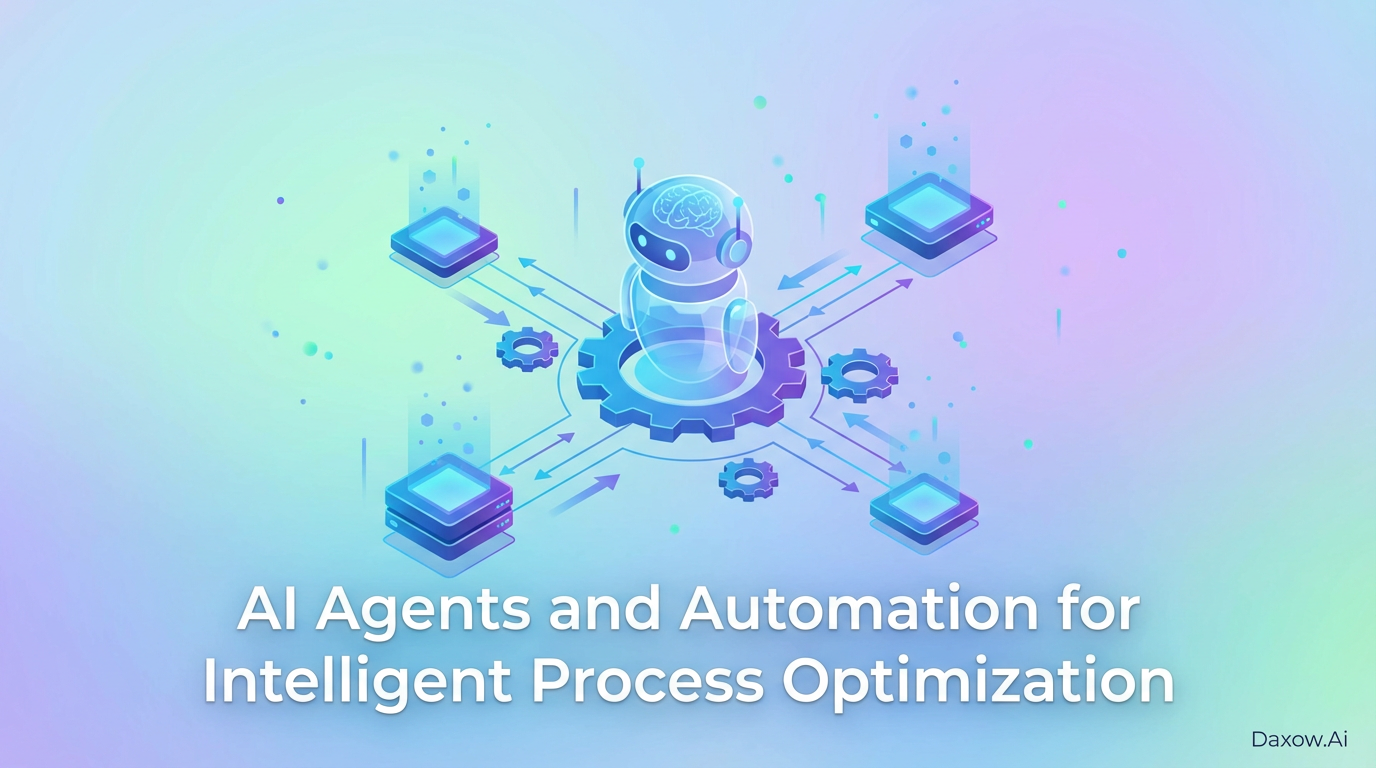
Use AI agents and workflow automation to optimize processes, cut costs, improve CX, and scale operations. Practical use cases, implementation steps, and Daxow.ai services.
Unlocking Business Transformation: AI Agents and Automation for Intelligent Process Optimization
Estimated reading time: 15 minutes
Key Takeaways
- AI agents and workflow automation combine to create hyperautomation, streamlining processes and enabling continuous improvement.
- Businesses can achieve 20–50% operational efficiency gains and improved customer experience by adopting AI-first strategies.
- Practical use cases span industries including e-commerce, healthcare, finance, real estate, HR, and customer support.
- Daxow.ai offers tailored AI automation solutions integrating with existing systems to deliver measurable outcomes.
- A proven implementation roadmap and best practices help mitigate risks and maximize ROI.
Table of Contents
- Unlocking Business Transformation: AI Agents and Automation for Intelligent Process Optimization
- Why AI Agents and Automation Matter for Your Business
- Practical Use Cases — AI Agents and Automation Across Industries
- How Daxow.ai Designs and Delivers AI Automation Solutions
- Implementation Steps and Best Practices
- Measuring ROI and Scaling Automation
- Common Pitfalls and How to Avoid Them
- Practical Next Steps for Decision-Makers
- Frequently Asked Questions
Unlocking Business Transformation: AI Agents and Automation for Intelligent Process Optimization
Unlocking Business Transformation: AI Agents and Automation for Intelligent Process Optimization is no longer a theoretical advantage — it is the practical roadmap for organizations that want to reduce manual work, improve customer experience, and scale operations with predictable ROI. Businesses that adopt AI automation and workflow automation can achieve measurable efficiency gains, faster decisions, and fewer errors while freeing teams to focus on strategic work. This article synthesizes best practices, industry use cases, and an implementation playbook to help decision-makers plan and execute AI-first transformations. It also explains how Daxow.ai partners with companies to design, build, and integrate AI agents that execute real tasks end-to-end.
- AI agents extend traditional RPA by reasoning, interacting with users, and integrating with systems via APIs and databases. They handle unstructured data, generate insights, and act autonomously on business rules.
- Workflow automation removes repetitive steps and enforces consistency across processes like invoicing, lead qualification, and claims processing.
- Combined, AI automation and agents create hyperautomation: continuous improvement cycles where models learn from outcomes and processes become more efficient over time.
Strategic implications for business leaders:
- Operational efficiency gains of 20–50% are achievable for targeted processes.
- Faster decision-making and improved CX through personalized, automated interactions.
- Risk reduction by automating compliance tasks and monitoring for anomalies.
Why AI Agents and Automation Matter for Your Business
Aligning automation with business objectives
Effective automation starts with clear objectives. Whether the goal is to reduce operational costs, improve Net Promoter Score (NPS), or accelerate revenue cycles, every automation initiative must map to measurable outcomes.
- Define target KPIs (e.g., reduce processing time by 40%, improve first-contact resolution by 25%).
- Apply an AI-first scorecard to assess data readiness, infrastructure, and skill gaps.
- Start with high-ROI processes that are stable, rules-based, and high-volume.
The business value drivers
- Productivity: Automate repetitive tasks to boost team productivity and shorten cycle times.
- Cost reduction: Cut operating costs by eliminating manual data entry, rework, and duplicate efforts.
- Scalability: Systems that learn from transactions scale without linear increases in headcount.
- Resilience: Automated monitoring and alerts reduce downtime and detect anomalies early.
Practical Use Cases — AI Agents and Automation Across Industries
E-commerce
Use case: Dynamic inventory forecasting and customer support automation
- AI agents analyze sales trends, supplier lead times, and seasonality to generate reorder recommendations and reduce stockouts.
- Chatbots and conversational AI resolve common inquiries 24/7, escalate complex cases, and draft targeted promotions based on cart abandonment signals.
- Impact: Reduced stockouts, higher conversion rates, and lower support costs; measurable uplift in revenue and customer lifetime value.
Healthcare
Use case: Clinical triage and document automation
- AI agents extract structured data from referral forms, medical records, and lab reports to pre-fill EHR fields and accelerate administrative workflows.
- Symptom-triage assistants use NLP to prioritize cases and suggest next steps to clinicians while enforcing privacy and compliance controls.
- Impact: Reduced administrative burden, faster patient routing, and improved compliance with privacy standards.
Finance
Use case: Real-time fraud detection and automated compliance reporting
- AI agents monitor transactions for anomalous patterns, trigger alerts, and initiate block/hold workflows when thresholds are crossed.
- Automation compiles audit-ready compliance reports and reconciles entries across systems.
- Impact: Lower fraud loss, faster audit cycles, and reduced regulatory risk.
Real Estate
Use case: Lead qualification and market analytics
- Conversational AI qualifies inbound leads by collecting intent and budget, then routes hot prospects to sales with enriched profiles.
- Agents extract property details from documents, synthesize market trends, and recommend pricing strategies.
- Impact: Faster deal cycles, improved lead conversion, and optimized pricing decisions.
HR and Administrative Teams
Use case: Automated recruiting and employee sentiment analysis
- AI agents screen resumes, schedule interviews, and run first-stage assessments, freeing recruiters for candidate engagement.
- Text analytics monitor employee feedback to detect retention risks or engagement issues.
- Impact: Reduced time-to-hire and lower attrition, with better allocation of HR resources.
Customer Support Automation
Use case: Hybrid agent workflows for high-touch issues
- Chatbots handle routine inquiries, while AI agents summarize interactions and provide agents with suggested responses for complex tickets.
- Automation integrates with CRMs to update records and trigger cross-functional tasks (billing, fulfillment).
- Impact: Higher first-contact resolution, faster response times, and consistent service levels.
How Daxow.ai Designs and Delivers AI Automation Solutions
Daxow.ai builds tailored AI systems that connect to your existing stack, automate end-to-end workflows, and produce measurable business outcomes.
Discovery and process analysis
- We map current workflows, identify manual tasks that reduce manual tasks, and quantify baseline metrics.
- We prioritize automation candidates using a business-value matrix: volume, pain, and technical feasibility.
Custom AI agent design and prototyping
- Daxow.ai designs AI agents that combine LLMs, machine learning models, and rule engines to perform decision-making and action execution.
- We prototype quickly using sample data to validate hypotheses and refine user interactions.
Integration and system connectivity
- Our architects connect agents to CRMs, ERPs, ticketing systems, and databases to ensure seamless data flow.
- We implement secure APIs, role-based access controls, and data governance to prevent shadow AI and preserve compliance.
Deployment, monitoring, and continuous improvement
- We deploy with phased rollouts, A/B tests, and dashboards to monitor KPIs (accuracy, throughput, cost per transaction).
- Ongoing model retraining, bias monitoring, and governance ensure long-term performance and business alignment.
Services relevant to your organization
- AI agents that execute tasks automatically across tools.
- Workflow automation to orchestrate processes end-to-end.
- Customer support automation with chatbots and agent-assist features.
- Sales automation and lead qualification systems that convert more leads.
- Data extraction & document automation for unstructured content.
- Integrations with business tools and CRMs to centralize operations.
Implementation Steps and Best Practices
This practical roadmap reflects proven steps for reducing risk and accelerating ROI.
- Define business outcomes and KPIs
- Set clear targets (cost reduction, processing time, NPS).
- Use small pilots tied to measurable financial outcomes.
- Assess data and infrastructure
- Audit data quality, lineage, and access.
- Modernize pipelines to standardize formats and enable model training.
- Choose the right tools and models
- Balance off-the-shelf platforms with custom models where needed.
- Select technologies that support easy integrations and monitoring.
- Build cross-functional teams
- Assemble product owners, engineers, data scientists, compliance leads, and domain experts.
- Provide training and guidelines to avoid shadow AI and ensure adoption.
- Test rigorously and deploy iteratively
- Validate models with holdout datasets and real-world pilot data.
- Roll out in phases and collect user feedback to refine workflows.
- Monitor and govern continuously
- Implement dashboards for performance, drift detection, and business impact.
- Maintain documentation and governance policies for ethics and compliance.
Best practices summary:
- Start small with high ROI; prove value before scaling.
- Prioritize integration to avoid siloed automation that adds complexity.
- Measure against KPIs such as cycle time, cost per transaction, and user satisfaction.
- Plan for people change: invest in reskilling and change management.
Measuring ROI and Scaling Automation
Quantifying impact is essential for executive buy-in and continued investment.
- Short-term ROI: Pilot projects often show payback in 6–12 months through labor savings and error reduction.
- Mid-term gains: Consolidation of processes and retraining models increase efficiency and reduce costs by 20–40%.
- Long-term value: Systems that continuously learn can deliver 30–50% productivity improvements and up to 25% revenue uplift through optimized operations.
Key metrics to track:
- Operational throughput and cycle times.
- Cost per transaction and total cost of ownership.
- Accuracy and F1 score for automated decisions.
- Customer-facing KPIs: NPS, CSAT, first-contact resolution.
- Business KPIs: conversion rates, churn reduction, revenue impact.
Common Pitfalls and How to Avoid Them
Avoidable issues often derail projects early. Daxow.ai mitigates these risks through experience and governance.
- Data quality gaps: We standardize pipelines and run early data audits to prevent downstream issues.
- Legacy integration hurdles: We build robust API wrappers and run pilot integrations before full rollouts.
- Skill shortages and shadow AI: We embed cross-training and clear policies to reduce unauthorized tool use and ensure ethical AI.
- Model drift and performance decay: We implement automated monitoring and scheduled retraining to maintain performance.
Practical Next Steps for Decision-Makers
If you lead operations, support, sales, or technology, take the following steps to begin transformation:
- Conduct a 2–4 week process analysis to identify top automation candidates.
- Quantify potential savings and select one pilot with clear KPIs.
- Mobilize a small cross-functional team and engage a partner to accelerate delivery.
How Daxow.ai supports these steps:
- We perform process discovery and produce a prioritized automation roadmap.
- We deliver rapid prototypes and pilot deployments to validate outcomes.
- We provide full implementation including integrations, monitoring, and governance.
Frequently Asked Questions
What is the difference between AI agents and traditional automation?
AI agents extend traditional automation by reasoning, handling unstructured data, interacting with users, and acting autonomously based on business rules. Traditional automation typically follows rigid, rule-based workflows without learning capabilities.
How does Daxow.ai ensure compliance and governance in AI automation?
Daxow.ai implements role-based access controls, data governance frameworks, continuous monitoring, and bias detection mechanisms to ensure that AI systems comply with privacy laws and ethical standards.
What industries benefit most from AI agents and automation?
Industries such as e-commerce, healthcare, finance, real estate, HR, and customer support have demonstrated significant gains in efficiency, accuracy, and customer experience by adopting AI agents and automation.
How can I start with AI automation in my business?
Begin by defining measurable business outcomes, assessing your data readiness, selecting high-ROI processes, and partnering with experts like Daxow.ai to design and implement tailored solutions.