
AI Agents & Automation for Business Process Optimization
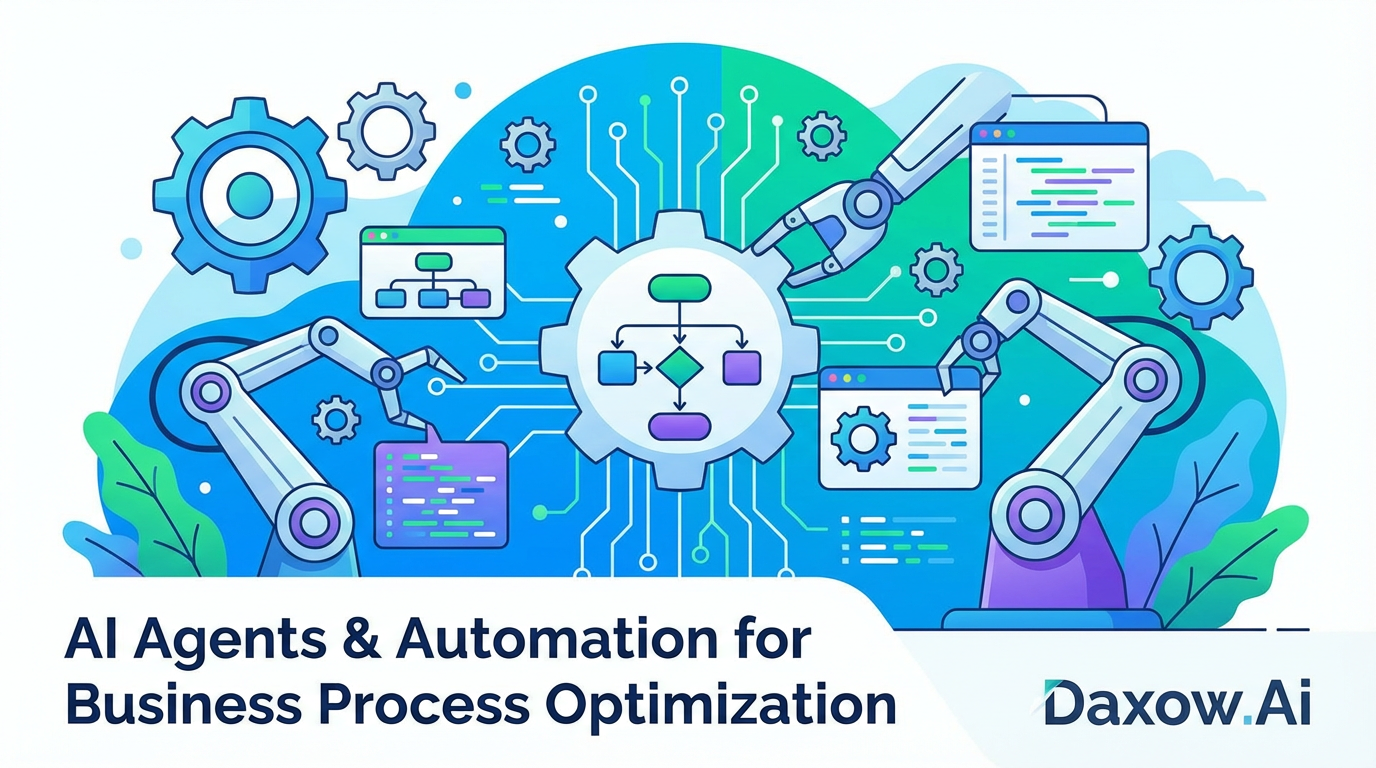
Learn how AI agents and automation cut costs and boost productivity (20–50%) with use cases, implementation steps, and Daxow.ai solutions.
Unlocking Business Transformation: AI Agents and Automation for Intelligent Process Optimization
Estimated reading time: 15 minutes
Key Takeaways
- AI agents and automation reduce manual tasks, delivering up to 60% operational cost savings and 50% productivity gains.
- Automation improves accuracy, accelerates decision-making, and enhances customer experiences across industries.
- Daxow.ai offers custom AI solutions designed for enterprise-grade automation with measurable ROI and sustainable scale.
- Successful AI automation requires clear goals, high-quality data, cross-functional teams, and iterative deployment.
- Industries such as e-commerce, healthcare, finance, real estate, and HR benefit measurably from AI-driven transformation.
Table of Contents
- Unlocking Business Transformation: AI Agents and Automation for Intelligent Process Optimization
- Strategic importance for businesses
- Practical use cases: AI agents and automation across industries
- How AI agents and automation drive results
- Implementation steps and best practices
- ROI and business value — what leaders can expect
- How Daxow.ai delivers end-to-end AI automation
- Real-world example — a typical Daxow.ai engagement
- Getting started — a practical next step for decision-makers
- Frequently Asked Questions
Unlocking Business Transformation: AI Agents and Automation for Intelligent Process Optimization
Unlocking Business Transformation: AI Agents and Automation for Intelligent Process Optimization is no longer a futuristic slogan — it is a practical roadmap for leaders who must reduce manual tasks, increase productivity, and deliver measurable business automation outcomes today. Organizations that deploy AI automation and AI agents across critical workflows report dramatic improvements: targeted processes can see operational cost reductions of up to 40–60%, while broader deployments commonly deliver 20–50% productivity gains. This article explains why that shift matters, outlines concrete use cases across industries, provides a clear implementation blueprint, and explains how Daxow.ai builds end-to-end custom AI solutions that deliver ROI and sustainable scale.
Why this matters now
- Scale without linear headcount growth. AI agents automate repetitive, rules-based tasks and handle high-volume communications, enabling teams to scale outputs without proportional hiring.
- Higher accuracy and lower friction. Workflow automation reduces human error in data entry, invoicing, compliance reporting, and other mission-critical processes.
- Better customer outcomes. Customer support automation and sales automation deliver faster response times, personalized engagement, and improved NPS.
- Faster decision-making. AI-driven insights reduce latency in forecasting, anomaly detection, and resource allocation across operations.
These outcomes translate into tangible benefits: lower operational expenses, faster time-to-market, improved compliance, and new revenue from predictive insights and personalized service models.
Strategic importance for businesses
Where AI agents and workflow automation provide the most value
- Eliminate repetitive work: Automate data entry, invoice processing, and routine customer inquiries to free skilled staff for strategic tasks.
- Unify fragmented data: Break down silos by connecting CRMs, ERPs, document repositories, and communication channels for consistent decision-making.
- Mitigate risk: Detect anomalies, fraud, or supply chain disruptions early using pattern recognition and real-time alerts.
- Improve customer experience: Use conversational AI to provide 24/7 support, qualify leads, and route high-value prospects to sales immediately.
Executive metrics to track
- Reduction in manual hours and FTEs associated with targeted processes
- Percentage reduction in error rates and rework
- Time-to-response for customer support and lead follow-up
- Process cycle time reductions and cost-per-transaction improvements
- Revenue uplift from faster sales cycles and personalized upsells
Practical use cases: AI agents and automation across industries
E‑commerce — Personalization and conversion optimization
Problem: High inquiry volume and manual product tagging slow response times and reduce conversion rates.
AI solution:
- Deploy AI agents as omnichannel chatbots for complex queries and returns.
- Automate product data enrichment and generate SEO-optimized descriptions.
- Use workflow automation to trigger targeted promotions based on customer behavior.
Business impact:
- Faster response times and 24/7 support.
- Higher conversion and retention from personalized messaging.
- Reduced manual catalog work, lowering operational costs and time-to-list.
Healthcare — Administrative automation and document processing
Problem: Patient onboarding and documentation are time-consuming and error-prone.
AI solution:
- Use document automation to extract structured data from forms, EHRs, and referrals.
- Build AI agents that coordinate appointment scheduling and follow-ups.
- Predict resource needs (staff, beds, supplies) using demand forecasting models.
Business impact:
- Reduced administrative burden and improved patient throughput.
- Improved data accuracy for analytics and compliance.
- Better allocation of clinical resources and reduced wait times.
Finance — Fraud detection, reporting, and compliance
Problem: High-volume transactions require continuous surveillance and regulatory reporting.
AI solution:
- Implement AI agents that monitor transactions for anomalous patterns and escalate suspicious activity.
- Automate KYC, AML checks, and regulatory report generation.
- Use predictive models to forecast cash flow and credit risk.
Business impact:
- Faster detection of fraud and reduced financial exposure.
- Lower compliance costs with automated reporting.
- Enhanced decision-making speed in lending and treasury.
Real estate — Lead qualification and pricing intelligence
Problem: Slow lead response and inefficient property valuation processes cost deals.
AI solution:
- Conversational agents pre-qualify inbound leads and schedule viewings.
- Automated valuation models ingest market and property data to produce pricing recommendations.
- Workflow automation updates listings and syndicates changes across platforms.
Business impact:
- Shorter sales cycles and higher conversion rates.
- Fewer manual steps in listing management.
- Better risk management through data-driven pricing.
HR and recruiting — Faster hiring and better employee experience
Problem: Screening resumes and onboarding new hires consumes valuable recruiter time.
AI solution:
- Resume screening agents that shortlist candidates based on skills, experience, and role fit.
- Automate onboarding tasks such as form submission, access provisioning, and training scheduling.
- Monitor workforce analytics to identify retention and engagement trends.
Business impact:
- Reduction in time-to-hire by 30–50%.
- Better candidate experience with immediate communications and clear next steps.
- Data-driven talent planning and diversity improvements.
How AI agents and automation drive results
From scripted RPA to intelligent agents
Traditional RPA handles repetitive, rule-based tasks but is brittle when processes change. AI agents combine machine learning, natural language understanding, and orchestration to:
- Execute multi-step processes autonomously.
- Interpret unstructured inputs (emails, documents, voice).
- Adapt through feedback loops and retraining.
- Integrate across systems to close end-to-end loops.
What an AI agent can do for your business
- Process and validate invoices, then post them to your ERP.
- Read incoming emails and route urgent matters to the right teams.
- Automatically qualify and score leads, then update the CRM and alert sales.
- Monitor supply chains for disruptions and recommend contingency actions.
These capabilities reduce manual tasks, shorten cycle times, and increase accuracy — the foundations of measurable productivity improvements.
Implementation steps and best practices
1. Define clear goals and identify high-impact processes
- Map workflows and quantify manual effort, cycle time, and error rates.
- Prioritize processes that are repetitive, rule-based, and high-volume.
- Set measurable targets (cost reduction, time saved, response targets).
2. Assess data and select the right tools
- Audit data quality and lineage; remediate gaps before deployment.
- Choose platforms with robust integration capabilities to avoid silos.
- Ensure compliance with privacy and security requirements.
3. Build a cross-functional team
- Include business owners, IT, data engineers, and frontline staff.
- Establish clear governance for model updates and human-AI handoffs.
- Provide training to promote adoption and reduce resistance.
4. Test, deploy, and monitor
- Run pilots with well-defined success metrics.
- Validate models with holdout datasets and real-world testing.
- Implement monitoring dashboards, automated alerts, and retraining schedules to counter model drift.
5. Iterate and scale
- Expand from pilot processes to adjacent workflows.
- Use lessons learned to standardize templates and playbooks.
- Measure ROI and reallocate savings to fund further automation.
Common pitfalls and mitigation strategies
- Poor data quality → Standardize pipelines and enforce data governance.
- Integration challenges → Prioritize tools with legacy and API compatibility.
- High upfront costs → Start with quick-win pilots with short payback periods.
- Team resistance → Involve stakeholders early and demonstrate early wins.
ROI and business value — what leaders can expect
- Short-term wins: Many pilots achieve payback in under 12 months by automating invoice processing, lead qualification, or first-line support.
- Operational impact: Expect 20–50% productivity gains and process-specific cost reductions of 40–60% where automation replaces manual, repetitive work.
- Strategic benefits: Improved customer satisfaction, faster product launches, and new revenue from data-driven services or personalized offers.
- Long-term resilience: Continuous monitoring and retraining ensure models remain effective and deliver ongoing value.
How Daxow.ai delivers end-to-end AI automation
Discovery and process analysis
- We start with a focused process analysis to identify high-impact opportunities.
- Deliverable: A prioritized automation roadmap with estimated ROI and timelines.
Custom AI system design
- We design AI agents and workflow automation tailored to your systems and objectives.
- This includes data pipelines, model selection, and human-in-the-loop controls.
Integration and engineering
- We integrate AI agents with CRMs, ERPs, ticketing systems, and document repositories.
- Daxow architects secure, scalable pipelines and ensures seamless data connectivity.
Deployment and change management
- We run rapid pilots to validate outcomes and optimize performance.
- We train teams and implement governance to ensure adoption and compliance.
Operate and scale
- Ongoing monitoring, retraining, and roadmap execution to scale automation across the organization.
- We measure KPIs and provide executive dashboards for continuous improvement.
Solutions we commonly build
- AI Agents for customer support automation and lead qualification.
- Workflow automation for finance, HR, and operations.
- Document automation and data extraction for compliance and analytics.
- Sales automation integrated with CRMs to accelerate deal velocity.
Real-world example — a typical Daxow.ai engagement
- Problem: Mid-size financial services firm suffers from slow KYC onboarding and manual compliance reporting.
- Discovery: Daxow.ai maps the onboarding workflow and identifies document processing and manual review as primary bottlenecks.
- Pilot: Deploy document automation to extract ID data, link to customer profiles, and run automated checks. An AI agent triages questionable cases for manual review.
- Outcome: Onboarding time reduced by 60%, compliance reporting time cut by 50%, and operational costs lowered significantly. Payback achieved within 9 months.
Getting started — a practical next step for decision-makers
- Start with a short process analysis to identify one or two quick wins.
- Define target KPIs and agree on a pilot scope with clear success criteria.
- Prioritize integrations and data readiness to accelerate deployment.
- Budget for monitoring and change management — these are essential for durable impact.
Unlocking Business Transformation: AI Agents and Automation for Intelligent Process Optimization is achievable with a pragmatic, data-driven approach. AI automation and AI agents are not just efficiency tools — they are strategic levers that reduce manual tasks, improve customer experiences, and create measurable ROI. Daxow.ai builds custom systems that integrate with your existing stack, automate end-to-end workflows, and deliver sustainable cost reduction and productivity gains.
Book a free consultation with Daxow.ai to request a process analysis for your company and begin building a custom AI system tailored to your goals. Contact us today to turn automation potential into measurable business results.
Frequently Asked Questions
What industries benefit most from AI agents and automation?
Industries such as e-commerce, healthcare, finance, real estate, and HR see substantial benefits due to high-volume, repetitive tasks and data-driven operations.
How soon can a company expect ROI from AI automation?
Many pilots achieve payback within 9 to 12 months by automating high-impact processes like invoice processing, lead qualification, or customer support.
What makes Daxow.ai different from other AI automation providers?
Daxow.ai offers custom-designed AI agents and workflow automation with end-to-end integration, pragmatic implementation, and enterprise-grade scalability focused on measurable business outcomes.
Is AI automation suitable for small and mid-size businesses?
Yes, AI automation designed with scalable architecture and clear ROI targets can provide efficiency and competitive advantages for businesses of varying sizes.