
AI Agents and Automation: A Practical Business Roadmap
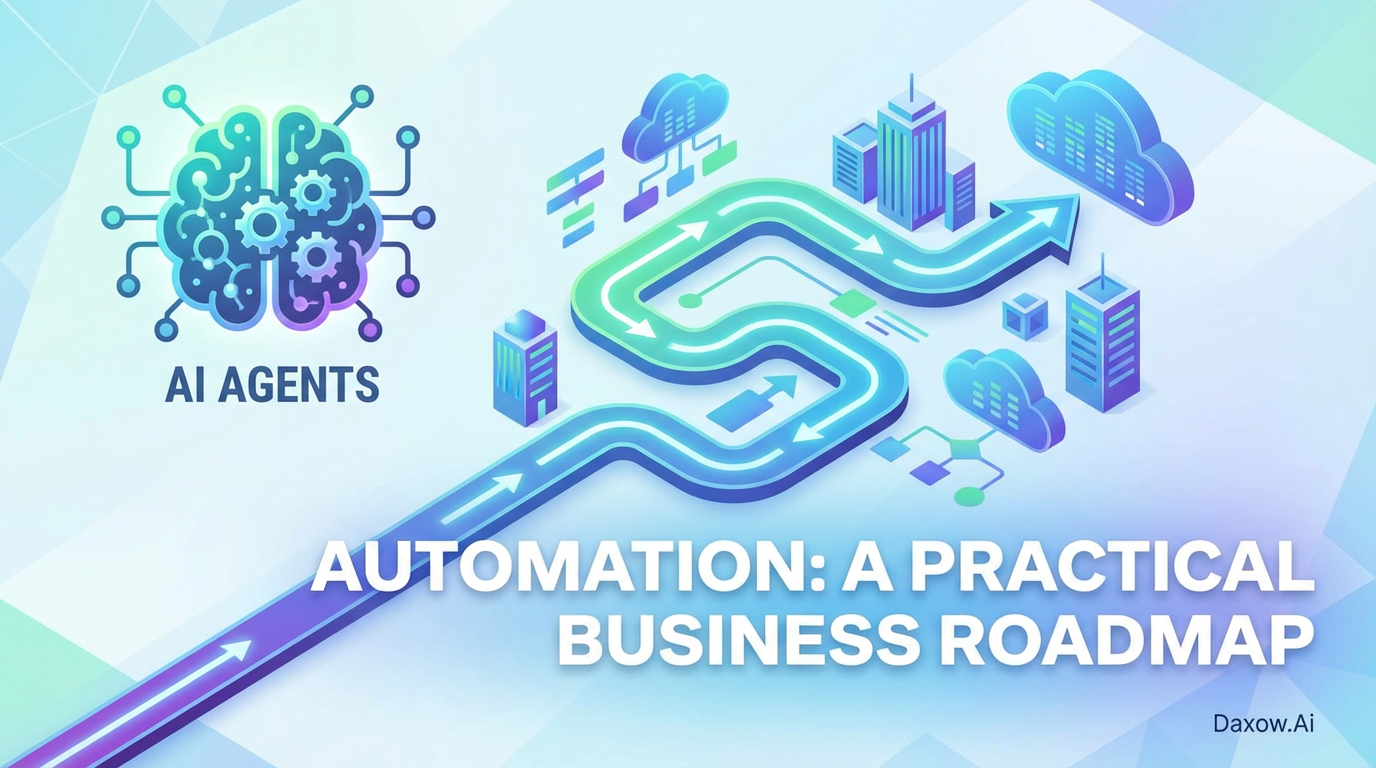
Guide to AI agents & automation: benefits, ROI, use cases, and a phased roadmap with Daxow.ai for scalable deployments.
Unlocking Business Efficiency with AI Agents and Automation: A Practical Guide for Decision-Makers
Estimated reading time: 15 minutes
Key Takeaways
- AI agents and workflow automation drastically reduce manual tasks and improve productivity by up to 3x.
- Practical use cases span e-commerce, healthcare, finance, real estate, HR, and customer support.
- A phased implementation roadmap ensures measurable ROI and scalable adoption.
- Daxow.ai delivers custom AI systems integrating automation with core business tools to optimize operational efficiency.
- Continuous improvement, data accuracy, and cross-functional governance are essential for sustained success.
Table of Contents
- Introduction
- Unlocking Business Efficiency with AI Agents and Automation: Why it matters
- Practical Use Cases Across Industries
- How AI Agents and Automation Drive Results
- Implementation Roadmap: From pilot to enterprise-scale automation
- Best practices to sustain success
- Realistic Use Case Examples with Outputs
- Calculating ROI and Planning KPIs
- How Daxow.ai helps you execute and scale
- Getting started: three pragmatic next steps
- Conclusion and call to action
- Frequently Asked Questions
Introduction
Unlocking Business Efficiency with AI Agents and Automation is no longer an experimental initiative — it is a strategic imperative. Business leaders, operations managers, and technology teams are under pressure to reduce manual work, increase productivity, and deliver customer experiences that scale. This article explains why AI automation and AI agents deliver measurable business value, outlines a practical implementation roadmap, and presents real-world use cases across industries. Throughout, we show how Daxow.ai — an AI automation agency founded in Estonia in 2024 — helps companies design, deploy, and scale custom AI systems that reduce operational costs and improve ROI.
Unlocking Business Efficiency with AI Agents and Automation: Why it matters
AI agents and workflow automation transform repetitive, high-volume tasks into reliable, auditable, and fast processes. These intelligent systems combine natural language processing, machine learning, and workflow orchestration to execute end-to-end processes, integrate with core business systems, and continuously improve from data.
Key business impacts:
- Reduce manual tasks: Automate data entry, ticket triage, and routine approvals to free staff for higher-value work.
- Improve productivity: Achieve up to 3x faster process completion for selected workflows.
- Lower operational costs: Realize 20–50% savings on routine process costs through automation and smarter decisioning.
- Enhance customer experience: Faster response times and more accurate answers increase satisfaction and retention.
- Scale predictably: Handle peak volumes without proportional headcount increases.
These benefits arise when organizations prioritize high-impact use cases, secure clean data, and adopt a phased rollout — the approach that delivers quick wins and builds momentum for enterprise-wide business automation.
Practical Use Cases Across Industries
Use case — Order processing and customer support (E-commerce)
- Automate order validation, inventory checks, and exception routing.
- AI agents handle common customer queries via chat and email, process returns, and escalate complex requests.
- Business impact: Reduce order fulfillment errors, shorten resolution times, and lower support costs. Expect improvements such as 30–50% faster handling of returns and a significant drop in cart abandonment due to clearer communications.
Use case — Patient triage and scheduling (Healthcare)
- Chatbots collect symptom information, triage urgency, and schedule appointments into provider calendars with HIPAA-compliant logging.
- AI agents ensure follow-up reminders and automate routine record updates.
- Business impact: Improve access to care, reduce no-shows, and reallocate administrative staff to patient-centric tasks while maintaining compliance.
Use case — Invoice reconciliation and compliance checks (Finance)
- Agents match invoices to purchase orders, highlight anomalies, and prepare exception reports for human review.
- Real-time transaction monitoring enables faster fraud detection and automated low-risk approvals.
- Business impact: Reduce reconciliation cycles and regulatory risk, with typical time- and cost-savings on back-office processing.
Use case — Lead qualification and transaction acceleration (Real Estate)
- AI agents qualify inbound leads, schedule virtual tours, and generate preliminary valuations.
- Integrations with CRM systems automate follow-up sequences and document checks.
- Business impact: Shorten sales cycles and increase conversion rates by focusing human agents on high-intent prospects.
Use case — Resume screening and onboarding (HR and Talent)
- NLP-driven screening surfaces top candidates and initiates structured onboarding workflows.
- Self-service HR agents answer benefits questions and process routine requests.
- Business impact: Cut recruitment time by up to 50% and reduce HR overhead for routine employee inquiries.
Use case — Multi-channel support and lead routing (Customer Support and Sales Automation)
- AI agents orchestrate ticket intake, categorize issues, and route to the right queue or escalate to humans.
- Sales automation agents qualify leads and prepare contextual briefing notes for reps.
- Business impact: Higher first-contact resolution, faster lead response times, and improved sales productivity.
How AI Agents and Automation Drive Results
AI agents differ from simple chatbots by orchestrating multi-step workflows across systems, learning from outcomes, and making context-aware decisions. The combination of automation for rule-based steps and AI for reasoning yields more robust solutions.
Core capabilities that deliver impact
- Execute end-to-end processes: Intake, verify, act, escalate, and close — with complete audit trails.
- Enhance decision-making: Use predictive models for churn forecasting, inventory replenishment, and fraud scoring.
- Scale operations: Support multilingual interactions and peak loads without hiring additional staff.
- Maintain compliance and quality: Enforce policies automatically, log decisions, and retrain models using curated data.
Typical measurable outcomes
- Faster resolution times: 3x improvements in selected processes.
- Cost reduction: 20–50% savings on routine tasks.
- Improved accuracy: Fewer manual errors and higher data consistency.
- Payback period: Many pilots reach payback within 6–12 months when properly scoped.
Implementation Roadmap: From pilot to enterprise-scale automation
Phase 1 — Assessment & Planning (4–8 weeks)
- Objectives: Define measurable goals (e.g., 30% cost reduction), map current processes, and audit data quality.
- Deliverables: Baseline KPIs, process maps, and prioritized use-case list.
- Daxow role: Conduct process discovery workshops and produce a business-case dossier.
Phase 2 — Technology Selection & Architecture (6–12 weeks)
- Objectives: Choose scalable, secure platforms and integrations (CRM, ERP, ticketing, HR systems).
- Deliverables: Solution architecture, integration plan, and compliance checklist.
- Daxow role: Recommend stack options, build proof-of-concept connectors, and advise on vendor selection.
Phase 3 — Data Preparation & Knowledge Build (4–8 weeks)
- Objectives: Clean and structure data, create knowledge bases, and define decision rules.
- Deliverables: Training datasets, knowledge graphs, and integration endpoints.
- Daxow role: Perform data engineering, create controlled labeling workflows, and set up retraining pipelines.
Phase 4 — Pilot Deployment (4–12 weeks)
- Objectives: Launch a limited-scope pilot (e.g., email triage or invoice automation), validate KPIs, and collect user feedback.
- Deliverables: Pilot system, monitoring dashboards, and iteration plan.
- Daxow role: Build the AI agent, automate workflows, and run user acceptance tests.
Phase 5 — Gradual Rollout & Continuous Optimization
- Objectives: Expand across teams and channels, retrain models, and embed continuous improvement.
- Deliverables: Organization-wide automation, governance model, and performance reports.
- Daxow role: Manage rollout, provide training, and establish SLA-driven monitoring.
Best practices to sustain success
- Start with high-volume, low-complexity tasks to achieve quick wins.
- Ensure data accuracy before automation; clean inputs mean reliable outcomes.
- Form cross-functional teams with operations, IT, and business stakeholders.
- Monitor for bias and maintain transparency in model decisions.
- Adopt continuous improvement: audit, retrain, and refine on a cadence.
Realistic Use Case Examples with Outputs
Example 1 — Customer Support Automation for a SaaS Company
- Problem: High ticket volume, long first-response times, and escalating support costs.
- Solution: Deploy an AI agent to triage tickets from chat and email, auto-resolve common issues, and escalate 15% of cases that need human attention.
- Outcome: 40% lower support cost, 80% resolution rate for common issues, and 50% faster average response time.
Example 2 — Invoice Automation for a Mid-Sized Finance Team
- Problem: Manual reconciliation created delays and late payments.
- Solution: Implement an AI agent that extracts invoice data, matches against PO/GRN records, and flags exceptions.
- Outcome: 50% reduction in processing time, fewer late fees, and better vendor relationships.
Example 3 — Lead Qualification for a Real Estate Brokerage
- Problem: Leads cold quickly if not contacted promptly; agents wasted time on unqualified prospects.
- Solution: AI agent handles instant qualification, schedules tours, and pushes hot leads into the CRM for follow-up.
- Outcome: Higher conversion rates, shorter lead-to-deal times, and improved agent productivity.
Calculating ROI and Planning KPIs
To quantify impact, track clear KPIs aligned to business objectives:
- Cost per transaction (support ticket, invoice, hire)
- Time to resolution or completion
- First-contact resolution rate
- Conversion or close rates
- Employee time reallocated to higher-value work
Simple ROI example:
- Baseline: 10,000 monthly support tickets; average handling cost $6 per ticket = $60,000/month.
- Pilot impact: 40% of tickets automated; handling cost reduced to $2 for automated tickets.
- New cost: (6,000 tickets x $6) + (4,000 tickets x $2) = $36,000 + $8,000 = $44,000.
- Monthly savings: $16,000 → payback on a $60,000 project in under 4 months.
How Daxow.ai helps you execute and scale
Daxow.ai specializes in designing custom AI solutions that combine AI agents, workflow automation, and integrations with business tools and CRMs. Our approach is hands-on and outcome-driven.
What we do:
- Process discovery and ROI modeling to prioritize automation opportunities.
- Build and deploy AI agents that execute real tasks — from triage to transaction.
- Integrate systems for end-to-end workflow orchestration (CRM, ERP, ticketing, HR).
- Create secure, compliant solutions for regulated industries (healthcare, finance, etc.).
- Provide monitoring, retraining, and governance to sustain performance.
Why choose Daxow.ai:
- End-to-end delivery: From assessment to continuous improvement.
- Custom integrations: We connect to your existing stack to avoid rip-and-replace.
- Business-first engineering: Solutions mapped to measurable KPIs and ROI.
- Operational readiness: Training, documentation, and change management support.
- Agile pilots: Rapid prototyping to prove value before large investments.
Getting started: three pragmatic next steps
- Run a rapid process assessment (2–4 weeks) to identify a pilot that will reduce manual tasks and deliver measurable ROI.
- Launch a focused pilot with clearly defined KPIs and an integration plan.
- Scale the winning pilot across channels and teams with continuous monitoring.
Conclusion and call to action
AI agents and workflow automation offer a clear path to reduce manual work, boost productivity, and improve customer experiences. When implemented with clean data, a phased roadmap, and cross-functional governance, these systems deliver rapid payback and long-term strategic advantage.
Daxow.ai can help you assess your processes, design a custom AI automation strategy, and build the AI agents that execute real work — end to end. Book a free consultation or request a process analysis for your company to discover the highest-impact automation opportunities and start unlocking efficiency today. Contact us to build a custom AI system that scales with your business.
Frequently Asked Questions
What are AI agents and how do they differ from traditional automation?
AI agents orchestrate multi-step workflows, apply machine learning, and make context-aware decisions, whereas traditional automation typically follows fixed rules without learning capabilities.
How quickly can my company expect ROI from implementing AI automation?
Many pilots achieve payback within 6–12 months when projects are properly scoped and focus on high-impact processes.
Is Daxow.ai capable of integrating with existing CRM and ERP systems?
Yes, Daxow.ai specializes in custom integrations to seamlessly connect AI automation with your current technology stack without the need for rip-and-replace.
How does Daxow.ai ensure compliance, especially in regulated industries?
Our solutions include automated policy enforcement, compliant data logging, and tailored governance models to meet industry-specific regulatory requirements such as HIPAA and financial compliance.