
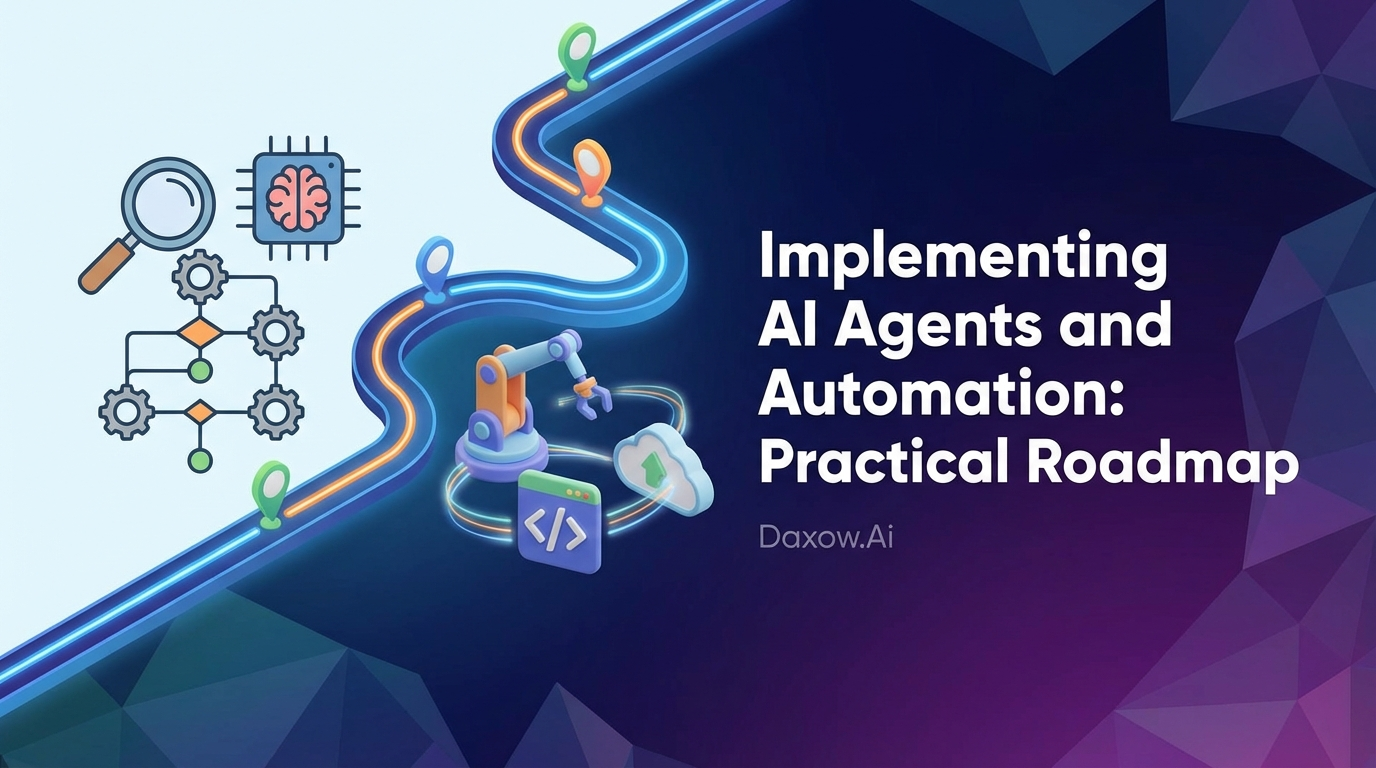
Implementing AI Agents and Automation: Practical Roadmap
Actionable playbook to implement AI agents and automation: use cases, phased roadmap, measurable ROI, and how Daxow.ai builds pilots to scale productivity.
Unlocking Business Transformation: Implementing AI Agents and Automation for Strategic Advantage
Estimated reading time: 15 minutes
Key Takeaways
- AI agents and automation significantly reduce manual tasks and improve productivity across industries.
- Industries like e-commerce, healthcare, finance, real estate, and HR benefit from tailored AI workflows.
- A phased implementation roadmap ensures risk reduction and maximizes ROI for AI automation projects.
- Daxow.ai offers end-to-end AI automation services including discovery, integration, deployment, and compliance.
- Measuring ROI with key metrics like cost reduction, resolution time, and productivity gains drives successful adoption.
Table of Contents
- Unlocking Business Transformation: Implementing AI Agents and Automation for Strategic Advantage
- Practical Use Cases Across Industries
- Implementation Roadmap: From Assessment to Scale
- Best Practices and Common Pitfalls
- Measuring ROI and Business Value
- How Daxow.ai Helps You Implement AI Agents and Automation
- Getting Started — A Practical First Step
- Frequently Asked Questions
Unlocking Business Transformation: Implementing AI Agents and Automation for Strategic Advantage
What “AI agents” and “automation” mean for your business
AI agents are autonomous systems that execute multi-step workflows, make contextual decisions, and adapt to changing inputs with minimal human intervention. Workflow automation complements agents by reliably executing repeatable rule-based tasks. Together, they enable:
- Reduced manual tasks through automation of high-volume, low-complexity processes.
- Improved productivity by freeing skilled staff for strategic work.
- Faster decision cycles via data-driven insights and continuous optimization.
Research shows organizations can realize 20–50% cost reductions in targeted processes and 25–40% productivity gains, with many clients achieving payback within 6–12 months. These systems integrate with CRMs, ERPs, and knowledge bases to deliver end-to-end business automation at scale.
How AI agents deliver business outcomes
AI agents combine approaches such as retrieval-augmented generation and rule-based orchestration to:
- Ingest and normalize data across systems.
- Execute multi-step business processes (e.g., qualify a lead, run credit checks, schedule appointments).
- Escalate edge cases to humans with contextual context and recommended actions.
- Provide audit trails and performance metrics for continuous improvement.
The outcome is scalable efficiency: fewer errors, faster throughput, consistent customer experiences, and the ability to reroute resources toward innovation.
Practical Use Cases Across Industries
E-commerce — Personalized experiences and supply chain efficiency
Use case:
AI agents handle personalized product recommendations, dynamic pricing, inventory forecasting, and 24/7 customer support resolution.
Workflow:
Customer interaction triggers agent that queries CRM and product catalog, recommends items, applies dynamic discounting rules, and updates inventory forecasts in the ERP.
Impact:
15–30% higher conversion rates, faster resolution of inquiries, and reduced cart abandonment.
Daxow approach:
- Integrate storefront, CRM, and inventory systems.
- Build recommendation engines and chat agents that escalate to human agents for high-value orders.
Healthcare — Scheduling, triage, and administrative automation
Use case: Agents manage patient scheduling, digital triage, document automation, and readmission risk prediction while ensuring HIPAA compliance.
Workflow: Patient query → symptom triage agent → recommended appointment slots → automated intake forms populated in EHR.
Impact: Reduced administrative overhead, faster patient access, and improved care coordination.
Daxow approach:
- Establish secure integrations with EHRs, implement compliance controls, and deploy monitoring and audit trails.
Finance — Fraud detection, compliance, and loan processing
Use case: Real-time fraud detection, automated compliance checks, and expedited loan decisioning.
Workflow: Transaction or application triggers agent that runs risk models, cross-checks regulatory lists, and makes conditional decisions or flags for review.
Impact: Fraud losses can be cut materially; operations scale without linear headcount growth.
Daxow approach:
- Connect to transaction systems, build guardrails for compliance, and implement model monitoring and explainability.
Real Estate — Lead qualification and transaction acceleration
Use case: Agents qualify leads, schedule viewings, generate valuations, and automate contract reviews.
Workflow: Lead capture → agent verifies details, runs comparable market analysis, offers virtual tour booking and pre-filled contract drafts.
Impact: Shorter sales cycles, higher conversion rates, and improved agent productivity.
Daxow approach:
- Integrate MLS data, CRM, and document management systems; build valuation models and negotiation workflows.
HR — Recruitment, onboarding, and retention prediction
Use case: Candidate screening, initial interviews through conversational agents, automated onboarding workflows, and turnover risk analytics.
Workflow: Application → screening agent filters candidates against job criteria → schedules interviews → triggers onboarding tasks and documentation.
Impact: Time-to-hire reduced by up to 40%, more consistent candidate experiences, and improved retention forecasting.
Daxow approach:
- Create unbiased screening logic, integrate ATS and HRIS, and implement continuous feedback loops.
Customer Support & Sales Automation — 24/7 resolution and lead acceleration
Use case: Customer support automation and sales automation to manage repetitive tickets and accelerate lead qualification.
Workflow: Support ticket triage → agent resolves simple issues or routes to the right specialist; sales lead enters CRM and is scored by an agent before handoff.
Impact: Higher resolution rates (target >80–90%), improved customer satisfaction, and faster lead-to-opportunity conversions.
Daxow approach:
- Build omnichannel support agents, integrate with helpdesk software, and create SLA-driven escalation rules.
Implementation Roadmap: From Assessment to Scale
Phase 1 — Assess & Ideate (4–8 weeks)
- Map customer and employee journeys with cross-functional teams.
- Identify high-impact, repeatable workflows (invoicing, support triage, lead qualification).
- Define success metrics (e.g., cost reduction targets, resolution rates).
- Evaluate data quality and compliance requirements.
Deliverables:
- Prioritized use-case list and target KPIs.
- Initial data readiness assessment.
Phase 2 — Select Technology & Prepare (6–12 weeks)
- Select platforms with strong integration capabilities and vendor stability for a 3–5 year horizon.
- Clean and structure data; build knowledge bases and decision trees.
- Define security and governance policies.
Deliverables:
- Integration-ready systems, data pipelines, and a prototype design.
Phase 3 — Pilot & Test (4–8 weeks)
- Launch pilots for single use cases using real-world validation sets.
- Iterate on prompts, models, and rule engines with guardrails.
- Measure against accuracy, throughput, and user satisfaction metrics.
Deliverables:
- Pilot performance report and go/no-go recommendations.
Phase 4 — Deploy & Scale (4–20 weeks)
- Gradual rollout across channels, teams, and regions.
- Implement monitoring, incident response, and continuous optimization.
Deliverables:
- Full-scale deployment plan, ROI dashboard, and optimization roadmap.
Metrics to track during implementation
- Resolution time, automation rate, cost per transaction, customer satisfaction, error rate, and compliance auditability.
- Target pilot success commonly set at 80%+ for primary KPIs before scale.
Best Practices and Common Pitfalls
Follow these to accelerate success and avoid expensive missteps:
- Start small, win fast: Focus on high-impact, low-complexity workflows first.
- Ensure data readiness: Clean, well-documented data is a non-negotiable foundation.
- Design for human-in-the-loop: Escalate ambiguous cases and keep audit trails.
- Build cross-functional teams: Involve product, engineering, operations, and legal early.
- Monitor continuously: Use KPIs and model monitoring to prevent drift.
Common pitfalls:
- Over-scoping initial projects.
- Ignoring governance and compliance needs.
- Underinvesting in integration and change management.
Measuring ROI and Business Value
Quantifying value drives stakeholder buy-in. Research-backed outcomes include:
- 3–5x faster goal realization versus traditional automation.
- 20–50% operational cost savings in targeted areas.
- 25–40% productivity gains from reduced manual tasks.
- Industry-specific results: 15–30% uplift in e-commerce conversion, reduced fraud losses by up to 50% in finance.
Daxow experience:
- Clients typically realize payback in 6–12 months on focused pilots.
- Long-term value accrues from reduced headcount growth, improved customer lifetime value, and strategic insights captured from aggregated data flows.
How Daxow.ai Helps You Implement AI Agents and Automation
Discovery and process analysis
- We run structured workshops to map workflows, quantify manual tasks, and prioritize high-ROI use cases.
- Deliverable: a targeted automation roadmap aligned to business KPIs.
Design and prototyping
- Rapid prototyping of AI agents and workflow automation to validate assumptions.
- Deliverable: pilot-ready agents, integration patterns, and measurable success criteria.
Integration and systems engineering
- We connect AI agents to CRMs, ERPs, ticketing systems, and knowledge bases for seamless data flow.
- Deliverable: production-grade integrations with secure, auditable pipelines.
Deployment, monitoring, and continuous improvement
- We deploy pilots, monitor performance, and iterate with A/B tests and model retraining.
- Deliverable: operational dashboards, governance controls, and a continuous optimization plan.
Compliance, security, and governance
- Daxow embeds privacy, audit trails, and industry-specific controls (HIPAA, finance regulations) into every solution.
- Deliverable: compliant workflows and documented governance.
Example client engagements (illustrative)
- E-commerce retailer: Implemented AI agents for recommendations and support, yielding a 20% lift in conversion and 30% fewer support contacts routed to humans.
- Financial services firm: Deployed fraud and compliance agents that reduced manual review time by 60% and lowered fraud losses.
- Healthcare network: Automated scheduling and intake processes, reducing patient wait times and cutting administrative overhead.
Getting Started — A Practical First Step
If you are evaluating AI automation and want to reduce manual tasks while improving customer support automation and sales automation, begin with a focused process analysis:
- Identify 2–3 repetitive processes that consume significant time.
- Define clear KPIs (cost per transaction, resolution time, conversion uplift).
- Pilot with a production-grade agent that integrates with your critical systems.
AI automation and AI agents are proven levers for companies that want to transform operations, reduce costs, and boost productivity. Daxow.ai builds custom systems that integrate with your stack, automate end-to-end workflows, and deliver measurable business value. If you are ready to move from exploration to results, book a free consultation with Daxow.ai or request a process analysis for your company. Contact us to build a custom AI system that reduces manual tasks, improves productivity, and accelerates your business transformation.
Frequently Asked Questions
What exactly are AI agents and how do they differ from traditional automation?
AI agents are autonomous systems that can execute complex, multi-step workflows with contextual decision-making and adaptability, unlike traditional automation which typically follows fixed, rule-based tasks.
How quickly can a business expect ROI from implementing AI agents?
Many organizations achieve payback within 6 to 12 months through cost reductions and productivity gains facilitated by AI agents and automation.
What industries benefit most from AI automation?
E-commerce, healthcare, finance, real estate, HR, and customer support are key industries where AI agents deliver measurable value and efficiency improvements.
How does Daxow.ai ensure compliance with industry regulations like HIPAA?
Daxow.ai embeds compliance controls, privacy protections, audit trails, and monitoring into every AI automation solution, tailored to specific regulations such as HIPAA and financial standards.