
AI Agents & Automation: A Practical Roadmap for Business
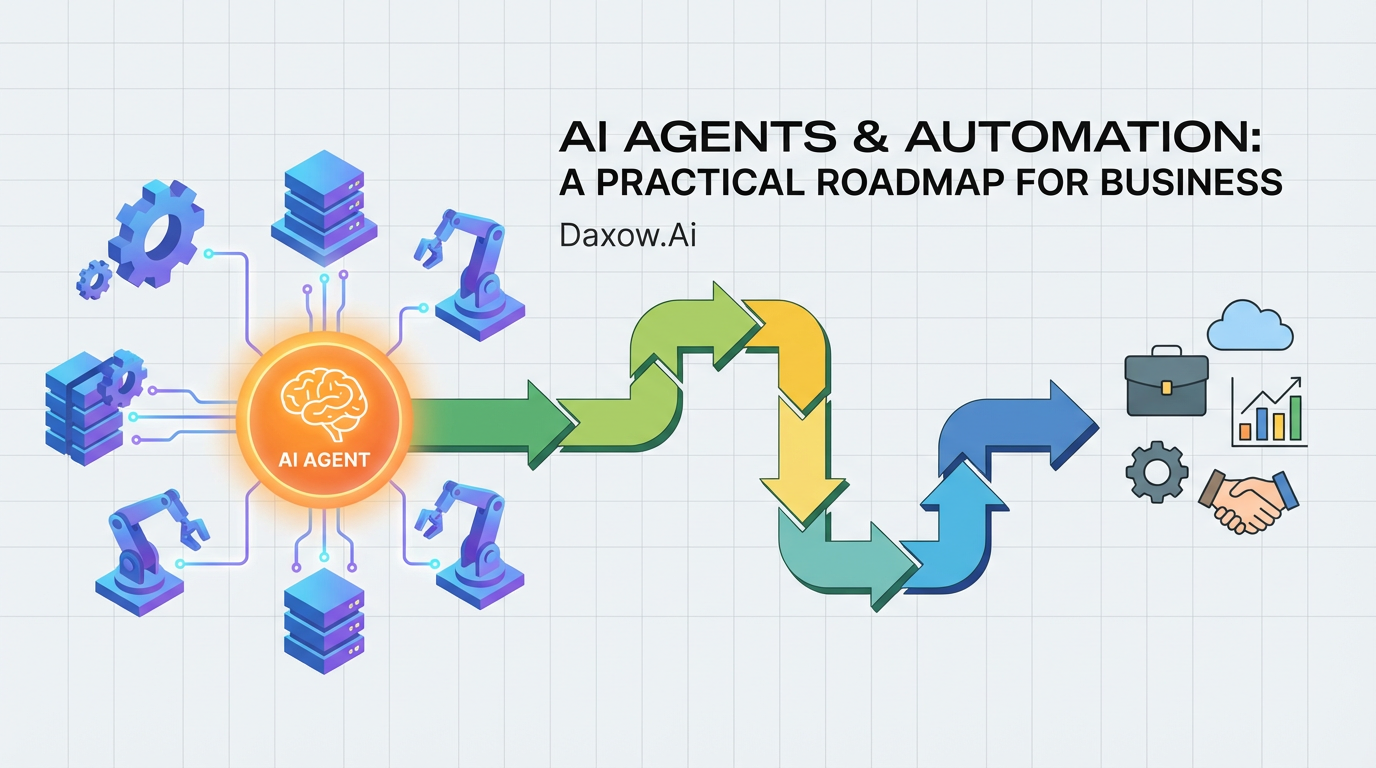
Practical guide to deploying AI agents and workflow automation with use cases, ROI metrics, and a phased implementation roadmap from Daxow.ai.
Leveraging AI Agents and Automation for Business Transformation
Estimated reading time: 15 minutes
Key Takeaways
- AI agents and automation drive operational resilience, faster decision-making, and reduce errors in regulated environments.
- Practical use cases span e-commerce, healthcare, finance, real estate, HR, and customer support.
- Measurable business value includes cost savings, productivity gains, faster time-to-value, and revenue uplift.
- A structured implementation roadmap and best practices minimize risks and ensure successful adoption.
- Daxow.ai provides custom AI agents, workflow automation, and ongoing monitoring tailored for your business.
Table of Contents
- Leveraging AI Agents and Automation for Business Transformation — what it means for your organization
- Practical use cases and industry impact
- How AI agents and automation drive measurable business value
- Implementation roadmap — practical steps to successful automation
- Best practices and governance for long-term success
- Building AI agents that execute real tasks — practical architecture and examples
- Overcoming common implementation challenges
- Next steps — building a practical plan for your business
- Frequently Asked Questions
Leveraging AI Agents and Automation for Business Transformation — what it means for your organization
AI agents and automation are autonomous systems that execute tasks, make decisions, and optimize workflows with minimal human intervention. For business leaders, they represent a shift from manual, error-prone processes to intelligent, scalable systems.
- Operational resilience: AI agents handle high-volume tasks such as data entry, ticket routing, or invoice processing, reducing downtime and scaling with demand.
- Data-driven decision-making: Automation integrates disparate data sources to provide real-time analytics and proactive insights.
- Risk and compliance control: Built-in validation and audit trails reduce errors and support regulatory requirements in sectors like finance and healthcare.
Why this matters now:
- Faster execution and fewer mistakes translate into direct cost savings.
- Teams are freed to pursue strategic initiatives, increasing overall productivity.
- Quick wins in high-volume, rule-based processes build internal trust and enable broader automation programs.
Practical use cases and industry impact
E-commerce — order-to-cash and personalization
Use case:
- Automate order processing, invoice generation, fulfillment triggers, returns handling, and personalized product recommendations.
Expected outcomes:
- Up to 50% faster fulfillment and fewer fulfillment errors.
- Improved conversion and repeat purchase rate through personalized recommendations.
How Daxow.ai helps:
- Build AI agents that orchestrate order validation, inventory checks, and ERP or warehouse integrations.
- Implement workflow automation that routes exceptions to human operators only when needed.
- Monitor KPIs to continuously tune recommendation models and inventory predictions.
Healthcare — patient triage and administrative automation
Use case:
- Automate patient appointment scheduling, pre-visit intake, triage via NLP, and records compliance checks.
Expected outcomes:
- Reduced administrative burden and faster response times while maintaining data security and compliance.
How Daxow.ai helps:
- Create secure AI agents that integrate with EHR systems and implement privacy-first data pipelines.
- Deploy natural language workflows for patient intake and automated escalation to clinicians based on triage results.
Finance — fraud detection and approval workflows
Use case:
- Automate anomaly detection, loan/credit approvals, and regulatory reporting.
Expected outcomes:
- Reduced errors, faster audits, and shorter approval cycles.
How Daxow.ai helps:
- Train and deploy models for anomaly detection integrated with transaction systems.
- Combine rules-based automation with ML scoring to accelerate approvals while preserving guardrails for compliance.
Real estate — lead qualification and listings automation
Use case:
- Automate lead capture, qualification scoring, property matching, and contract routing.
Expected outcomes:
- Faster deal closures and higher quality of agent time.
How Daxow.ai helps:
- Build AI agents that parse inbound leads, enrich records from public data, and schedule viewings or follow-ups in the CRM.
HR — recruiting and onboarding automation
Use case:
- Automate resume screening, interview scheduling, onboarding document handling, and retention analytics.
Expected outcomes:
- 30–40% shorter hiring cycles, better new hire experience.
How Daxow.ai helps:
- Deploy workflow automation for candidate scoring and background checks.
- Implement onboarding agents that guide new hires through paperwork and training, reducing manual admin.
Customer support and sales automation
Use case:
- Chatbots and support agents that handle tier-1 tickets, route complex issues, and qualify sales leads.
Expected outcomes:
- Faster first response times, higher agent productivity, and improved conversion rates.
How Daxow.ai helps:
- Combine customer support automation with CRM integrations for seamless ticket resolution and sales handoffs.
- Build AI agents that execute follow-up sequences, book demos, and escalate priority leads to sales reps.
How AI agents and automation drive measurable business value
The business case for AI automation rests on measurable improvements across cost, speed, and revenue.
Key value levers:
- Reduced manual tasks: Automating repetitive processes delivers direct labor cost savings and reduces error rates.
- Productivity gains: Teams can handle higher volumes without proportional headcount increases.
- Faster time-to-value: Automating high-volume processes like invoicing often delivers payback within 6–12 months.
- Revenue uplift: Better lead qualification and personalization increase conversion and customer lifetime value.
Metrics to track:
- Throughput (transactions processed per period)
- Processing time or cycle time reductions
- Error rate and rework reduction
- Cost per transaction or ticket
- Customer satisfaction (CSAT/NPS) and conversion rates
Example ROI snapshot:
Automating invoice processing for a mid-sized company may reduce processing time by 50%, cut error rates in half, and pay back automation costs within one year through labor savings and faster cash collection.
Implementation roadmap — practical steps to successful automation
1. Define clear goals and metrics
Action items:
- Conduct a bottleneck audit and identify top pain points.
- Prioritize use cases by impact and effort.
- Define success metrics (e.g., 20% cost reduction, 30% faster turnaround).
How Daxow.ai supports:
- Facilitate stakeholder workshops and impact-effort mapping.
- Deliver a prioritized automation roadmap tied to measurable KPIs.
2. Assess and prepare data
Action items:
- Inventory relevant data sources and assess quality.
- Cleanse, standardize, and ensure compliance-ready pipelines.
- Perform process mining to document variations and exceptions.
How Daxow.ai supports:
- Implement secure data connectors and data conditioning pipelines.
- Provide privacy-by-design approaches, especially for regulated industries.
3. Choose technology and build models
Action items:
- Select appropriate AI approaches (NLP, classification, anomaly detection).
- Leverage transfer learning and modular models to reduce training time.
- Ensure systems are integrable with existing CRMs, ERPs, and cloud platforms.
How Daxow.ai supports:
- Design custom AI agents and select the right model architectures.
- Implement modular automation components that connect to your tech stack.
4. Pilot, deploy, and integrate
Action items:
- Run a small pilot on a high-impact process.
- Integrate with business tools and workflow platforms.
- Ensure clear exception handling and human-in-the-loop controls.
How Daxow.ai supports:
- Manage end-to-end deployment from pilot to production.
- Create robust integrations with common business suites and CRMs.
5. Monitor, govern, and optimize
Action items:
- Set review cycles (monthly/quarterly) and dashboards for KPIs.
- Implement governance for security, performance, and compliance.
- Use feedback loops to retrain models and tune workflows.
How Daxow.ai supports:
- Provide monitoring dashboards and ongoing optimization services.
- Establish governance frameworks and runbooks for scale.
Best practices and governance for long-term success
Successful programs combine technical rigor with organizational alignment. Use these best practices to maximize impact.
- Align automation to strategic outcomes: Start with value, not technology.
- Engage frontline teams: Their input drives realistic process mapping and adoption.
- Use cloud-native, scalable infrastructure: Ensure your automation can grow with demand.
- Adopt phased rollouts: Demonstrate quick wins and expand iteratively.
- Implement strong governance: Include security, auditability, model validation, and compliance checks.
- Track both operational and business KPIs: Combine system metrics with revenue and satisfaction indicators.
Building AI agents that execute real tasks — practical architecture and examples
AI agents that genuinely reduce manual work combine several components: connectors, orchestration, ML/NLP engines, and human-in-the-loop controls.
Example: Sales automation agent
- Inputs: Lead form, email, CRM record, website behavior.
- Actions: Enrich lead profile, score lead with ML model, qualify via conversation (chatbot), schedule meeting, create CRM task.
- Integrations: Email provider, calendar, CRM, analytics.
- Outcome: Faster lead response, higher-quality handoffs, reduced manual admin for sales reps.
Example: Customer support automation agent
- Inputs: Incoming ticket, historical ticket data, knowledge base.
- Actions: Classify intent, suggest resolution articles, automate simple fixes, escalate complex issues to appropriate teams.
- Integrations: Support platform, knowledge base, monitoring tools.
- Outcome: Reduced first response time and improved agent productivity.
How Daxow.ai builds these agents:
- We analyze existing workflows and data flows.
- We design agent orchestration layers that execute tasks end-to-end.
- We integrate with existing systems to avoid data silos.
- We implement monitoring and continuous-learning pipelines so agents improve over time.
Overcoming common implementation challenges
Common obstacles include legacy systems, data quality, and organizational resistance. Practical ways to address them:
- Legacy integrations: Use middleware and API wrappers to bridge systems without replacing them.
- Data quality: Start with high-impact, well-structured data sets and expand as data hygiene improves.
- Change management: Provide training, transparent metrics, and early wins to build trust.
- Compliance concerns: Incorporate privacy and audit features from day one, especially in regulated industries.
Daxow.ai approach:
- We design integration-first solutions that respect existing investments.
- We run pilot programs aimed at fast ROI and demonstrable improvements.
- We provide training and governance support to ensure adoption and compliance.
Next steps — building a practical plan for your business
If your organization needs to reduce manual tasks, improve productivity, or scale operations with less headcount, AI automation and AI agents are proven levers. The practical path forward is clear: identify high-impact workflows, pilot quickly, and scale with robust governance.
At Daxow.ai we deliver:
- End-to-end process analysis and automation roadmaps.
- Custom AI agents that execute real business tasks.
- Integrations with CRMs, ERPs, and productivity suites.
- Ongoing monitoring, optimization, and governance.
Bold decision-makers focus on measurable outcomes. If you want to reduce manual tasks, automate customer support, or deploy sales automation with measurable ROI, take the next step.
Contact us to build a custom AI system — book a free consultation or request a process analysis for your company today via our contact page.
Frequently Asked Questions
What are AI agents and how do they differ from traditional automation?
AI agents are autonomous systems that can execute complex tasks, make decisions, and learn over time with minimal human intervention. Unlike traditional automation, which follows fixed rules, AI agents adapt to new data and scenarios, enabling more intelligent and scalable workflows.
How quickly can a company expect to see ROI from AI automation initiatives?
ROI depends on the process complexity and volume, but typical payback periods range from 6 to 12 months, especially when automating high-volume, rule-based tasks like invoicing or lead qualification.
Is AI automation suitable for highly regulated industries?
Yes. AI automation can include built-in validation, audit trails, and privacy-first data handling to meet compliance requirements in regulated sectors such as finance, healthcare, and legal.
How does Daxow.ai support ongoing optimization post-deployment?
Daxow.ai provides continuous monitoring dashboards, retraining pipelines, and governance frameworks to ensure that AI agents improve over time and remain aligned with evolving business goals and compliance needs.