
AI Agents and Automation: Unlocking Business Transformation in 2026
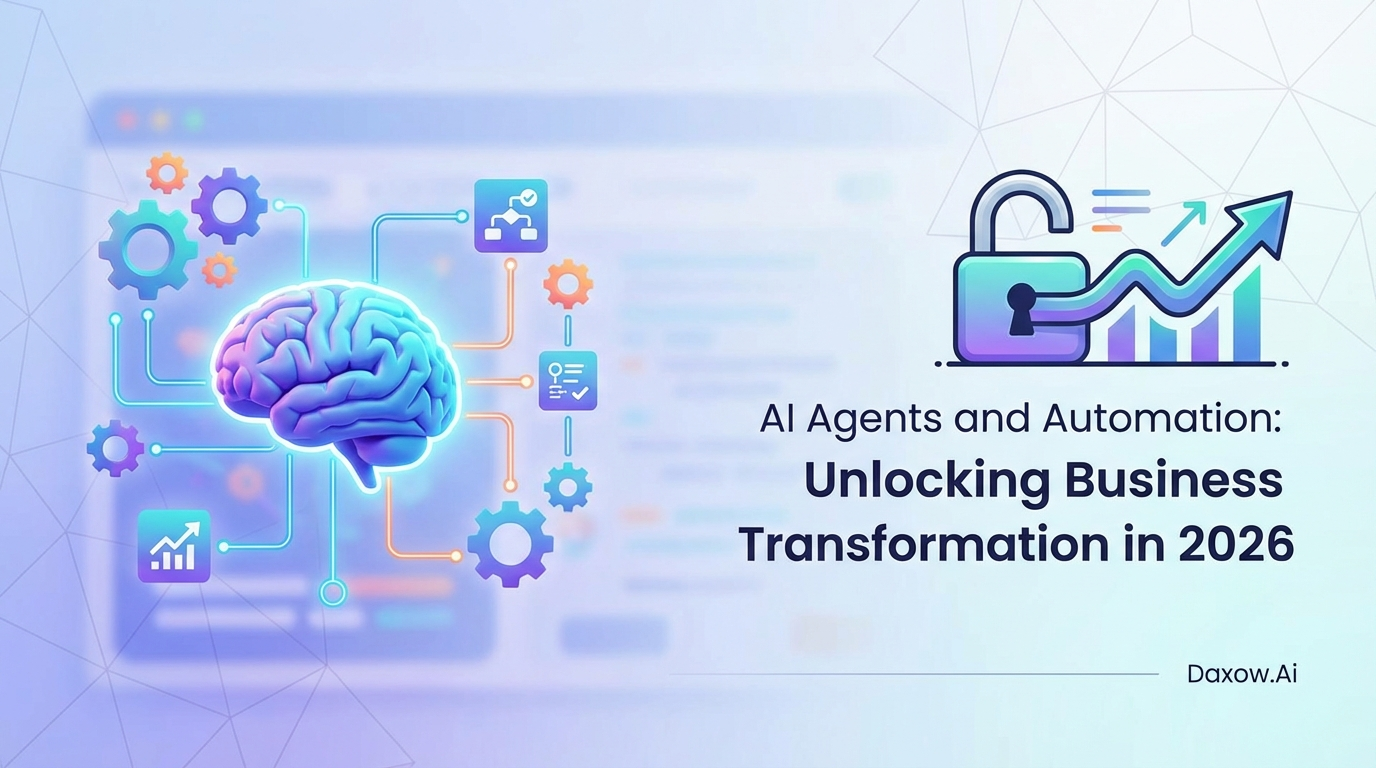
Learn how AI agents and workflow automation deliver measurable ROI in 6–12 months, with industry use cases and a practical Daxow.ai implementation roadmap.
Unlocking Business Transformation: AI Agents and Automation in 2026
Estimated reading time: 15 minutes
Key Takeaways
- AI agents and automation enable faster, cost-effective business operations with measurable ROI within 6–12 months.
- Modern AI shifts from rule-based automation to intelligent, adaptive workflows that improve productivity and customer experience.
- Cross-industry use cases demonstrate diverse AI-driven benefits in e-commerce, healthcare, finance, real estate, and HR.
- A clear, staged implementation roadmap is essential to scale AI automation successfully and maintain governance.
- Daxow.ai delivers custom AI automation solutions focused on integration, security, and business outcomes.
Table of Contents
- Unlocking Business Transformation: AI Agents and Automation in 2026
- Why this shift matters for business leaders
- How AI agents and automation drive results
- Practical use cases across industries
- Implementation roadmap — from idea to scale
- Best practices to maximize impact
- Measuring ROI and business value
- How Daxow.ai helps you unlock transformation
- Practical example — a typical Daxow.ai engagement
- Common pitfalls and how to avoid them
- Frequently Asked Questions
Unlocking Business Transformation: AI Agents and Automation in 2026
AI agents and workflow automation now operate as autonomous systems that reason, act, and integrate across enterprise applications in real time. Their strategic value lies in converting fragmented data into actionable workflows, enabling businesses to automate routine work while escalating complex decisions to humans. The result is faster operations, lower costs, and improved customer satisfaction—often with measurable returns within 6–12 months.
Why this shift matters for business leaders
From reactive automation to proactive intelligence
Traditional business automation followed rigid rules. Modern AI agents add reasoning, adaptation, and decision-making. They handle exceptions, learn from feedback, and coordinate across tools—moving companies from task automation to hyperautomation.
Business outcomes that matter
- Productivity: Automating repetitive tasks frees skilled staff for strategic work.
- Cost reduction: Routine task automation typically delivers 20–50% savings on operational costs.
- Speed and scale: Processes that once required manual intervention now complete in seconds, with agents handling volume spikes without added headcount.
- Customer experience: Faster resolutions and personalized interactions increase satisfaction and revenue.
How AI agents and automation drive results
Core technical patterns
- API-first integration: Agents connect to CRMs, ERPs, ticketing systems, and databases to maintain a single source of truth.
- Real-time data pipelines: Continuous data flow allows agents to act on fresh signals—fraud detection, inventory alerts, or urgent support cases.
- Human-in-the-loop governance: Critical approvals and compliance checks remain under human oversight while agents handle triage and routine decisions.
- Feedback loops: Agents learn from outcomes and user corrections, improving accuracy without constant retraining.
Operational orchestration in practice
A common pattern: an AI agent reads CRM records, validates data integrity, enriches a lead with third-party signals, executes business rules, and either closes the loop (e.g., route to sales) or escalates to a human. This orchestration eliminates siloed processes and reduces manual handoffs.
Practical use cases across industries
E-commerce — Personalized CX and fulfillment speed
Use case: AI agents handle customer chat triage, product recommendations, and inventory forecasting.
- Business value: Reduce response times from minutes to seconds, increase conversion rates through dynamic cross-sell, and reduce stockouts with proactive reorder signals.
- KPI examples: Average response time, conversion lift, inventory turnover improvement.
- Implementation note: Start with chat triage and order status automation; add forecasting after two months of quality data.
Healthcare — Scheduling, triage, and records management
Use case: Agents automate patient scheduling, perform preliminary symptom triage with NLP, and flag documentation anomalies.
- Business value: Reduce administrative burden up to 40%, improve appointment utilization, and enable faster clinical interventions.
- KPI examples: Time-to-schedule, no-show rate, documentation error rate.
- Implementation note: Keep clinicians in the loop for triage escalations; prioritize privacy and compliance in design.
Finance — Real-time risk and compliance automation
Use case: Agents monitor transactions for fraud patterns, execute compliance checks, and reconcile accounts.
- Business value: Faster detection of anomalous activity and lower manual reconciliation hours; reported fraud reductions of up to 40% in comparable implementations.
- KPI examples: Fraud detection lead time, false positive rate, reconciliation cycle time.
- Implementation note: Use human reviewers for borderline cases and tune models with representative historical data.
Real estate — Lead qualification and listing automation
Use case: Agents qualify inbound leads, schedule viewings, and auto-generate listing summaries with imagery tags.
- Business value: Faster lead-to-viewing times, higher agent productivity, and improved close rates.
- KPI examples: Leads qualified per hour, time-to-first-contact, lead-to-deal conversion rate.
- Implementation note: Combine behavior signals from website interactions with CRM history for richer qualification.
HR — Intelligent recruitment and onboarding
Use case: Agents screen resumes, schedule interviews, and manage onboarding checklists.
- Business value: Faster hiring processes (up to 30% speed improvements reported), better candidate experience, and reduced time spent on administrative tasks.
- KPI examples: Time-to-hire, onboarding completion rate, first-month retention.
- Implementation note: Ensure bias mitigation in screening models and human oversight for final decisions.
Implementation roadmap — from idea to scale
1) Strategic assessment and planning (4–8 weeks)
- Activities: Map current workflows, identify high-volume manual tasks, define KPIs (e.g., 30% cost reduction, 50% faster resolution).
- Deliverables: Process inventory, data readiness assessment, prioritized backlog of automation candidates.
2) Technology selection and preparation
- Activities: Choose platforms with strong API and integration capabilities, establish data pipelines, and build knowledge bases and decision trees.
- Deliverables: Integration map, data schema, compliance checklist.
3) Pilot deployment
- Activities: Launch on low-risk, high-impact processes (e.g., invoice processing or chat triage). Monitor metrics, collect user feedback, and iterate.
- Deliverables: Pilot results dashboard, refined model parameters, user feedback log.
4) Gradual rollout and change management
- Activities: Train end-users, expand to additional teams or regions, and introduce governance roles.
- Deliverables: Training materials, rollout schedule, escalation playbooks.
5) Monitor, optimize, and govern
- Activities: Implement monitoring for performance, bias, and drift. Schedule periodic retraining and audits.
- Deliverables: Ongoing KPI reports, retraining plan, governance policy.
Best practices to maximize impact
- Start small and prove value: Pilot on high-volume, low-risk tasks to build momentum.
- Prioritize data readiness: Clean, connected data enables reliable automation.
- Adopt API-first and MCP-aware integrations: This future-proofs interoperability and reduces costly rewrites.
- Blend teams: Cross-functional squads with IT, business owners, and AI specialists accelerate outcomes.
- Measure relentlessly: Define success criteria upfront and track ROI continuously.
- Maintain human oversight: Use agents for routine decisions and humans for high-stakes outcomes.
Measuring ROI and business value
AI automation produces both direct and indirect returns. Key metrics to track:
- Efficiency gains: reduction in full-time equivalent (FTE) hours and faster process cycle times.
- Cost savings: lower processing costs per transaction or case.
- Revenue uplift: increased conversion rates or higher upsell volumes from better qualified leads.
- Risk reduction: fewer compliance breaches and faster fraud detection.
- Employee value: improved staff satisfaction as manual, repetitive tasks decline.
Typical outcomes observed in enterprise projects:
- 3x faster implementations compared to siloed AI projects.
- 20–50% cost reduction on routine tasks.
- Full ROI often realized within 6–12 months when projects are aligned to clear KPIs and supported by robust governance.
How Daxow.ai helps you unlock transformation
What we do
- Discovery and process analysis: We map workflows to identify where AI agents and workflow automation deliver the most value.
- Custom AI agent design: We build agents that execute real tasks—triage support tickets, qualify sales leads, reconcile invoices, or orchestrate cross-system workflows.
- End-to-end automation: From data extraction and document automation to full process orchestration with ERP and CRM integrations, we deliver production-ready systems.
- Systems integration: We implement API-first connectors and ensure secure, compliant data flows across enterprise tools.
- Change management and training: We help teams adopt new workflows and retain institutional knowledge.
Why clients choose Daxow.ai
- Result-oriented delivery: We tie automation to KPIs and measurable outcomes—speed, cost, and revenue.
- Industry-agnostic expertise: We have proven patterns across e-commerce, finance, healthcare, real estate, and HR.
- Governed, secure deployments: We embed governance, audit trails, and bias checks into production systems.
- Rapid time-to-value: Focused pilot-to-scale pathways deliver ROI within months, not years.
Practical example — a typical Daxow.ai engagement
- Step 1: Discovery (weeks 1–4)
- Outcome: Prioritized list of 3 automation pilots (e.g., customer support triage, invoice processing, lead qualification).
- Step 2: Pilot build (weeks 5–12)
- Outcome: Production-ready agent for support triage, integrated with CRM and ticketing system. KPI target: 40% reduction in response time.
- Step 3: Optimize and expand (months 4–9)
- Outcome: Add invoice automation and sales automation agents, link to ERP and marketing stack, realize consolidated ROI dashboard.
- Step 4: Scale and govern (month 9+)
- Outcome: Organization-wide automation playbook, governance policies, and a roadmap for new automations.
Common pitfalls and how to avoid them
- Poor data quality: Mitigate with thorough data profiling and cleansing before automation.
- Scope creep: Define clear success criteria and limit pilot scope.
- Over-automation: Retain human control for high-risk decisions.
- Lack of integration strategy: Adopt API-first architectures and standard protocols to prevent future rework.
Frequently Asked Questions
What industries benefit most from AI agents and automation?
Industries such as e-commerce, healthcare, finance, real estate, and HR benefit significantly from AI agents and automation by enhancing efficiency, accuracy, and customer experience.
How quickly can my business see ROI from AI automation?
Typical ROI timelines range from 6 to 12 months, depending on project alignment with KPIs and the robustness of governance and integration strategies.
Can AI agents fully replace humans?
AI agents excel at automating routine tasks and triage, but human oversight remains critical for strategic decisions, compliance, and high-stakes outcomes.
What makes Daxow.ai different from other AI automation providers?
Daxow.ai combines custom AI agent design, end-to-end automation, and rigorous governance with a proven, industry-agnostic methodology to accelerate time-to-value and maximize measurable business results.