
AI Agents & Automation: Practical Roadmap to Business Growth
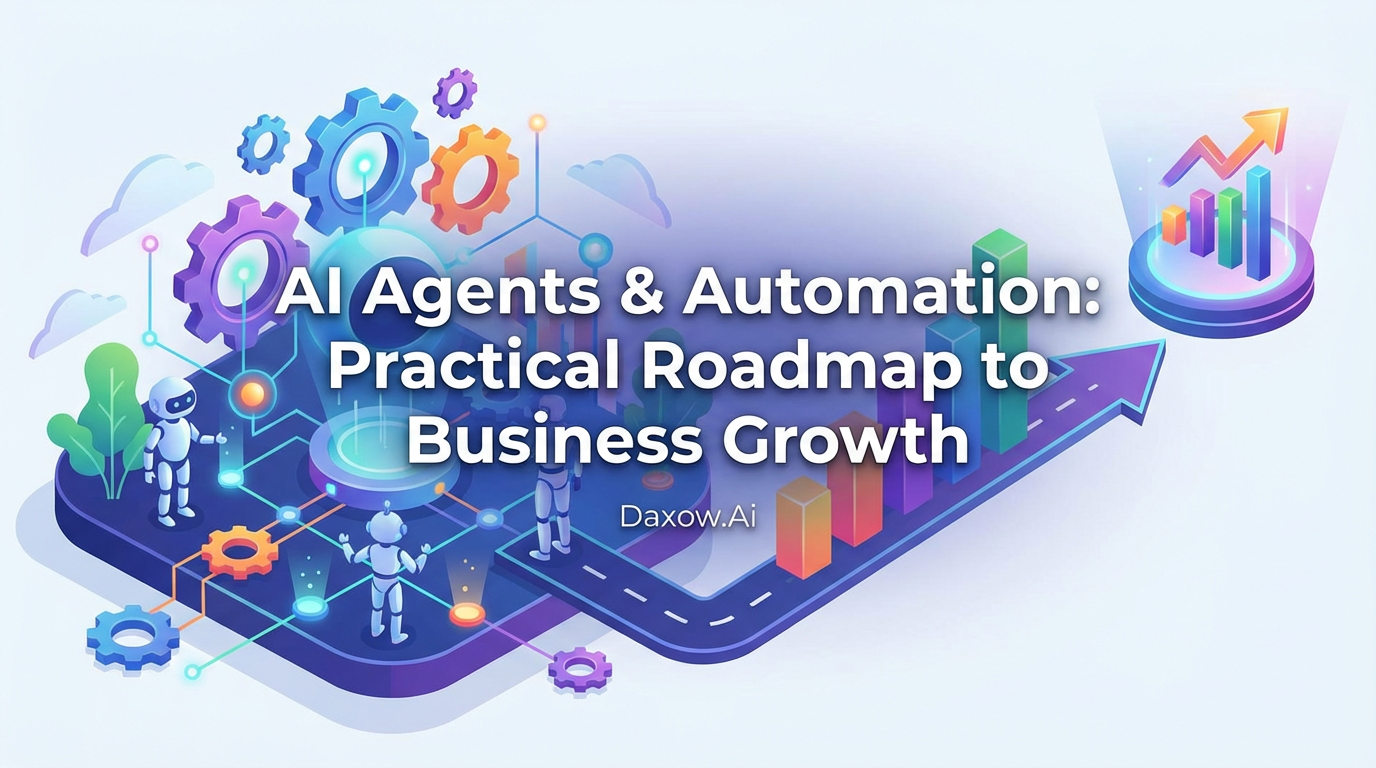
Practical guide to implementing AI agents and workflow automation with use cases, step-by-step framework, ROI benchmarks, and Daxow.ai's end-to-end solutions.
Unlocking Business Growth: Implementing AI Agents and Automation for Intelligent Process Transformation
Estimated reading time: 15 minutes
Key Takeaways
- AI agents combined with workflow automation transform manual, repetitive tasks into intelligent, autonomous processes.
- Implementing AI-driven automation delivers measurable business value including cost reduction, increased productivity, and enhanced customer experience.
- Industry-specific use cases show clear ROI signals across e-commerce, healthcare, finance, real estate, HR, and customer support.
- A step-by-step implementation framework ensures strategic adoption and continuous improvement of AI automation initiatives.
- Daxow.ai offers end-to-end custom AI agent design, integration, and managed services to accelerate business transformation.
Table of Contents
- Introduction
- Unlocking Business Growth
- What AI Agents and Automation Mean for Businesses
- Practical Use Cases Across Industries
- How to Implement: A Step-by-Step Framework
- Measuring ROI and Business Value
- How Daxow.ai Helps Deliver End-to-End Business Automation
- Getting Started: Quick Wins and Pilot Ideas
- Conclusion and Next Steps
- Frequently Asked Questions
Introduction
Unlocking Business Growth: Implementing AI Agents and Automation for Intelligent Process Transformation is not a theoretical exercise — it is a practical roadmap for decision-makers who must convert manual, error-prone operations into scalable, intelligent workflows. This article explains what AI agents and workflow automation deliver in measurable business value, provides industry-specific use cases, lays out a step-by-step implementation framework, and shows how Daxow.ai designs and deploys custom AI systems that reduce manual tasks, increase productivity, and improve customer outcomes.
Read on for an analytical, actionable guide that helps business leaders prioritize investments in AI automation and start capturing ROI quickly.
Unlocking Business Growth: Implementing AI Agents and Automation for Intelligent Process Transformation
The combination of AI agents and automation transforms transactional, repetitive work into autonomously executed processes that learn over time. An AI agent is an autonomous software entity that perceives inputs, makes decisions, and executes actions across systems. When embedded into workflow automation, these agents extend beyond rule-based robotic process automation to handle complex decisions, exceptions, and personalized customer interactions.
Why this matters now:
- Market differentiation: Organizations that adopt intelligent automation gain speed, accuracy, and consistency — key competitive advantages.
- Scalable productivity: AI-driven workflows handle volume spikes without proportional headcount increases.
- Cost and error reduction: Automated end-to-end processes reduce labor cost and operational errors, improving margins.
- Faster innovation cycles: Low-code integrations and continuous learning models accelerate feature rollout and business adjustment.
This article turns research-backed best practices into a clear program you can follow to implement business automation effectively.
What AI Agents and Automation Mean for Businesses
Capabilities and outcomes
- Autonomous execution of multi-step processes (e.g., invoice-to-pay, lead-to-close).
- Natural language interactions for customer support automation and virtual assistants.
- Predictive analytics for demand forecasting, risk detection, and dynamic pricing.
- Document intelligence and data extraction to replace manual entry.
Key measurable outcomes:
- Reduced manual tasks: Free staff from repetitive work such as data entry and routine triage.
- Improved productivity: Teams complete more work with the same or fewer resources.
- Enhanced customer experiences: Faster and more consistent responses via chatbots and automated case routing.
- Operational resilience: Processes continue to perform during volume spikes or staffing gaps.
How AI agents differ from traditional automation
- Traditional RPA follows explicit rules and struggles with ambiguity.
- AI agents combine ML models, natural language understanding, and orchestration logic to handle uncertainty, escalate exceptions, and adapt over time.
- The result: automation that is both flexible and actionable for real business problems.
Practical Use Cases Across Industries
E-commerce
Use case: End-to-end order-to-cash automation
- What it does: Automates inventory checks, fraud detection, personalized upsell messages, and payment reconciliation.
- Impact: 40–60% reduction in processing time for orders; lower fulfillment errors; increased average order value through personalized recommendations.
- Daxow.ai role: Build AI agents that integrate e-commerce platforms, fraud ML models, and CRM workflows to automate order exceptions and scale peak season volumes.
Healthcare
Use case: Patient triage and scheduling automation
- What it does: Triage chatbots capture symptoms, prioritize urgency, and schedule appointments while ensuring compliance.
- Impact: Faster triage, improved patient satisfaction, reduced administrative burden on staff.
- Daxow.ai role: Deploy HIPAA-conscious AI agents that extract clinical intent from conversations, connect to EHR systems, and automate follow-up communications.
Finance
Use case: Invoice matching and anomaly detection
- What it does: Automates PO matching, flags suspicious transactions, and prepares audit-ready records.
- Impact: Reduced audit times, fewer payment errors, and improved compliance posture.
- Daxow.ai role: Combine document automation, ML-based anomaly detection, and ERP integration to cut reconciliation cycles and reduce manual reviews.
Real Estate
Use case: Lead qualification and market analysis
- What it does: Automates qualification of inbound leads, schedules tours, and predicts price trends.
- Impact: Faster lead conversion, higher agent productivity, and better pricing decisions.
- Daxow.ai role: Create AI agents that score leads from multiple channels, trigger follow-up workflows, and surface market insights to sales teams.
HR and Recruitment
Use case: Resume screening and onboarding automation
- What it does: Parses resumes, ranks candidates by fit, automates interview scheduling and onboarding documentation.
- Impact: Up to 50% reduction in hiring time and improved candidate experience.
- Daxow.ai role: Integrate applicant tracking systems, deploy bias-mitigation controls, and automate onboarding checklists for new hires.
Customer Support
Use case: Multichannel customer support automation
- What it does: AI agents handle tier-1 queries, route complex issues to specialists with context, and generate knowledge base updates.
- Impact: Higher first-contact resolution, reduced support headcount for routine tasks, and improved CSAT.
- Daxow.ai role: Build conversational AI that integrates with ticketing systems and CRM to automate case resolution and follow-up.
How to Implement: A Step-by-Step Framework
Successful AI automation is systematic. Use the following phased approach to reduce risk and accelerate value.
Step 1 — Define goals and prioritize processes
- Conduct stakeholder interviews to align on business outcomes (cost reduction, speed, NPS).
- Create an AI-first scorecard to rank processes by volume, manual effort, error rates, and compliance sensitivity.
- Best practice: Start with high-volume, low-risk processes that deliver measurable ROI.
Step 2 — Audit and prepare your data
- Inventory data sources, assess quality, and standardize formats.
- Address gaps early: clean data and create access patterns that support model training.
- Best practice: Establish privacy and governance rules to ensure regulatory compliance from day one.
Step 3 — Select tools and assemble the team
- Choose platforms that support integrations with your CRM, ERP, and internal systems.
- Build a cross-functional team: domain experts, data engineers, ML engineers, and product owners.
- Best practice: Prefer low-code platforms for rapid prototyping and enterprise-grade APIs for scale.
Step 4 — Develop, test, and deploy iteratively
- Prototype with small pilot projects and measurable KPIs.
- Use validation datasets and metrics (precision, recall, SLA adherence).
- Best practice: Design for failure — include clear escalation paths and fallback human-in-the-loop controls.
Step 5 — Monitor, retrain, and scale
- Implement dashboards for real-time KPIs and automated alerts for drift.
- Retrain models regularly and incorporate user feedback.
- Best practice: Treat deployment as continuous improvement — automate retraining where feasible.
Common pitfalls and how to avoid them
- Scope creep: lock objectives and success metrics before development.
- Poor data quality: invest in data preparation; it determines model effectiveness.
- Siloed teams: embed cross-functional governance to accelerate adoption.
Measuring ROI and Business Value
Quantify benefits using operational and financial KPIs:
- Operational KPIs: processing time reduction, first-contact resolution rates, error rate, throughput.
- Financial KPIs: cost per transaction, labor hours saved, revenue uplift from faster sales cycles.
- Customer KPIs: NPS, CSAT, response times.
Benchmarks seen in practice:
- 20–40% cost reductions in automated processes.
- 30%+ productivity gains in targeted teams.
- Pilot breakeven often achieved in 6–12 months for high-impact workflows.
Track ROI with a clear baseline and compare incremental improvements month-over-month. Use A/B testing where possible to isolate impact before full-scale rollouts.
How Daxow.ai Helps Deliver End-to-End Business Automation
Daxow.ai builds custom AI agents and workflow automation tailored to your organization’s processes and technology landscape. Our approach focuses on delivering measurable business outcomes.
What Daxow.ai offers:
- Discovery and process analysis to map current workflows and identify quick wins.
- Custom AI agent design that executes real tasks: triage, qualification, routing, reconciliation.
- End-to-end automation: from document extraction and data enrichment to workflow orchestration and systems integration.
- System integrations with CRMs, ERPs, ticketing systems, and other enterprise tools for continuous data connectivity.
- Governance and compliance frameworks to ensure ethical and auditable AI.
- Monitoring, retraining, and managed services to maintain and scale automation.
Typical engagement flow:
- Process analysis and goal-setting (we identify where to reduce manual tasks and maximize productivity).
- Prototype and pilot (no-code or low-code proof-of-value).
- Full development and integration (secure connectors to business systems).
- Deployment, monitoring, and scaling (automated KPIs and operational dashboards).
By focusing on business value rather than technology for its own sake, Daxow.ai helps companies convert AI initiatives into sustainable cost savings and improved customer experiences.
Learn more about our custom AI solutions and workflow automation capabilities.
Getting Started: Quick Wins and Pilot Ideas
If you want to de-risk your automation program and show early ROI, consider these pilots:
- Automate invoice processing and matching to reduce AP cycle time.
- Deploy a customer support chatbot that handles 60%+ of tier-1 queries.
- Build a lead qualification agent that enriches and scores inbound leads for sales automation.
- Implement document extraction for contracts and claims processing to reduce manual data entry.
Quick-win criteria:
- High manual volume
- Clear mapping to a measurable KPI
- Low regulatory complexity (for pilots)
Daxow.ai can run a targeted process analysis to prioritize pilots that yield rapid payback and prepare a roadmap for enterprise-wide transformation.
Conclusion and Next Steps
AI agents and workflow automation are no longer experimental — they are strategic imperatives for organizations that want to reduce manual tasks, increase productivity, and unlock new value. By following a structured implementation framework, measuring the right KPIs, and partnering with an experienced provider, companies can achieve significant cost savings and service improvements while positioning themselves for future growth.
Ready to begin your transformation? Book a free consultation with Daxow.ai to request a process analysis for your company and explore a custom AI system that automates your most critical workflows. Contact us to build a tailored automation roadmap and start capturing measurable ROI.
Frequently Asked Questions
What are AI agents and how do they differ from traditional automation?
AI agents are autonomous software entities that perceive inputs, make decisions, and execute actions. Unlike traditional rule-based automation, AI agents handle ambiguity, learn over time, and manage complex processes with natural language understanding and machine learning.
How quickly can businesses expect ROI from AI automation?
Many businesses see pilot breakeven within 6–12 months for high-impact workflows, with cost reductions typically between 20–40% and productivity gains over 30% in targeted teams.
Which industries benefit most from AI workflow automation?
AI automation brings value across many sectors including e-commerce, healthcare, finance, real estate, HR, and customer support, with tailored use cases and measurable outcomes for each.
How does Daxow.ai support ongoing AI automation initiatives?
Daxow.ai offers end-to-end services including process analysis, custom AI agent development, system integration, governance frameworks, and ongoing monitoring and retraining to ensure continuous value delivery.