
Harnessing AI Agents and Automation for Business Transformation
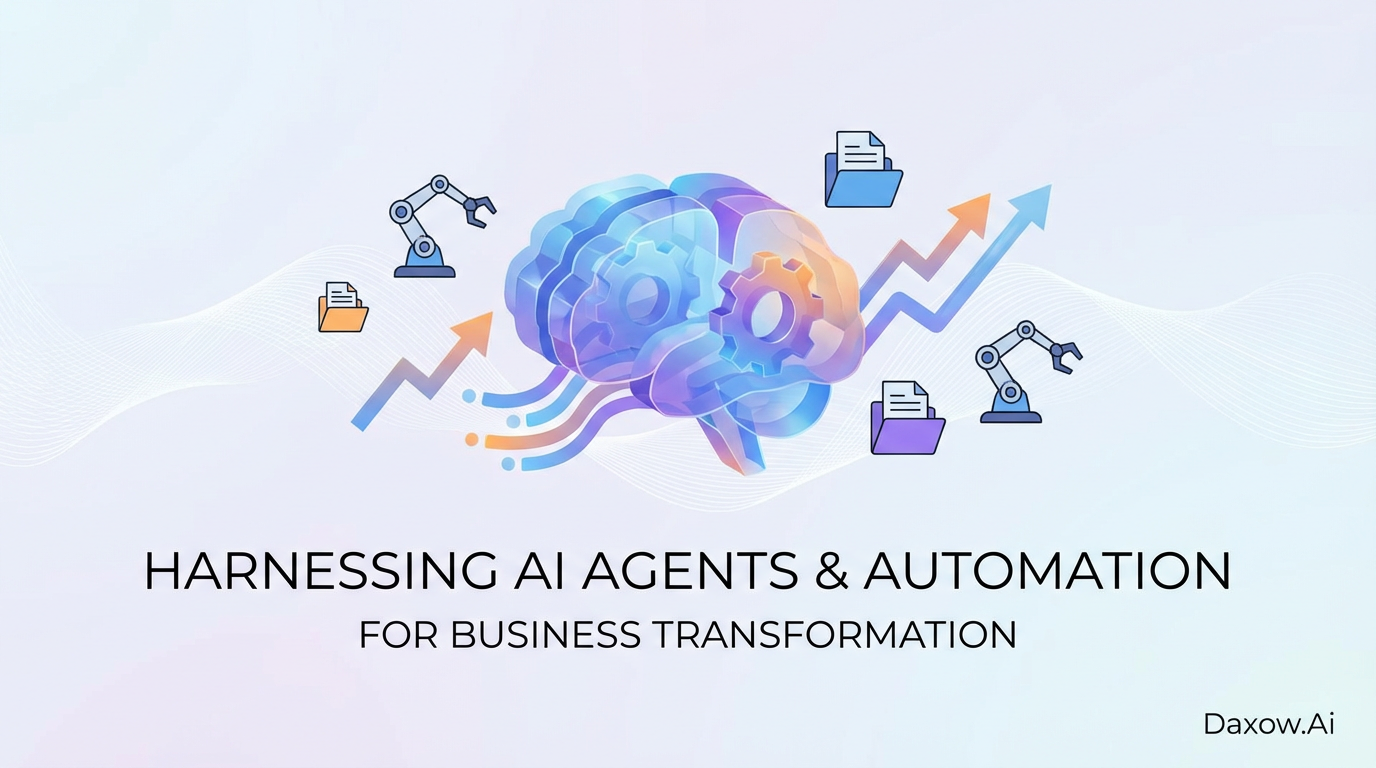
AI agents and automation that cut costs, speed processes, and boost ROI across industries. Daxow.ai delivers tailored, secure AI automation solutions.
Harnessing AI Agents and Automation for Business Transformation
Estimated reading time: 12 minutes
Key Takeaways
- AI agents and automation reduce manual tasks and improve productivity across industries.
- Automation drives measurable business outcomes including cost reduction, time savings, and enhanced customer experience.
- Industry-specific AI solutions can optimize e-commerce, healthcare, finance, real estate, HR, and customer support workflows.
- A focused implementation roadmap helps organizations realize ROI quickly and sustainably.
- Daxow.ai provides end-to-end AI system design, integration, and continuous improvement services tailored to your business needs.
Table of Contents
- Harnessing AI Agents and Automation for Business Transformation — Why It Matters
- Practical Use Cases: AI Agents and Automation Across Industries
- How AI Agents and Automation Drive Value
- Implementation Roadmap for Business Automation
- Measuring ROI and Business Impact
- How Daxow.ai Builds and Integrates Custom AI Systems
- Actionable Checklist: Quick Wins to Start Automating
- Frequently Asked Questions
Harnessing AI Agents and Automation for Business Transformation — Why It Matters
Organizations that adopt AI agents and business automation move from reactive, manual processes to proactive, adaptive systems. These technologies address core operational pain points:
- Reduce manual tasks: Routine data entry, routing, and approvals are prime candidates for automation.
- Improve productivity: Automation and intelligent agents free staff to focus on strategic work, boosting throughput.
- Enhance customer experience: 24/7 support automation and personalized interactions increase satisfaction and retention.
- Drive agility and scalability: AI agents monitor trends, predict disruptions, and execute responses autonomously, enabling growth without proportional headcount increases.
Research-backed outcomes show significant gains: operational cost reductions of 20–50%, process time improvements of 30–50%, and efficiency gains of 20–70%, with payback periods often under 12 months when priorities align with business objectives. These figures represent the tangible benefits decision-makers should expect when implementing thoughtful AI automation programs.
Practical Use Cases: AI Agents and Automation Across Industries
E-commerce — Personalization, Pricing, Inventory
- Use case: AI agents analyze customer behavior and transaction history to generate personalized product recommendations and dynamic pricing.
- Outcome: Reduced stockouts by up to 30%, improved conversion rates, and optimized margins through demand forecasting and predictive restocking.
- How Daxow helps: We integrate AI models with your e-commerce platform and ERP to automate pricing rules, sync inventory signals, and deliver personalized experiences via automated chat and email flows.
Healthcare — Triage, Scheduling, Clinical Support
- Use case: Autonomous agents triage incoming patient enquiries, schedule appointments, and flag abnormal EHR patterns for clinician review.
- Outcome: Faster interventions, reduced administrative burden, and better compliance with privacy standards when properly implemented.
- How Daxow helps: We build secure, HIPAA-compliant workflows that connect clinical systems, automate scheduling, and provide clinicians with AI-augmented decision support.
Finance — Fraud Detection, Compliance, Lending
- Use case: Real-time transaction monitoring agents detect anomalies, automate case creation, and prioritize investigations.
- Outcome: Reduced false positives, accelerated loan approvals, and improved auditability.
- How Daxow helps: We deploy ML models and rule engines integrated with payment platforms and core banking systems to automate monitoring, reporting, and case management.
Real Estate — Valuations, Lead Qualification, Virtual Tours
- Use case: AI agents aggregate market data, property attributes, and historical sales to produce instant appraisals and qualify inbound leads.
- Outcome: Faster lead follow-up, higher-quality pipelines, and automated virtual tours that shorten sales cycles.
- How Daxow helps: We combine data extraction, CRM integrations, and conversational AI to nurture prospects and automate valuation workflows.
Human Resources — Recruitment, Onboarding, Retention
- Use case: AI-powered resume screening, interview scheduling, and sentiment analysis on employee feedback.
- Outcome: Reduced hiring time by 40–50%, better candidate fit, and predictive insights into employee turnover.
- How Daxow helps: We automate talent intake workflows, connect ATS and HRIS systems, and supply dashboards for predictive workforce planning.
Customer Support & Sales Automation
- Use case: Chatbots and AI agents resolve common support requests, escalate complex cases, and qualify leads before handing them to sales.
- Outcome: 24/7 service, lower handle times, and more focused human agents on high-value interactions.
- How Daxow helps: We design omnichannel chatbots and AI agents that integrate with CRM and ticketing systems to automate triage, responses, and lead routing.
How AI Agents and Automation Drive Value
AI agents are distinct from traditional rule-based automation because they can reason with unstructured data, use natural language, and continuously learn from feedback. Together, AI agents and workflow automation deliver:
- End-to-end execution: Agents can query multiple systems, generate documents, and execute cross-system approvals.
- Faster insights: Real-time analytics and predictive models inform operational decisions and strategy.
- Higher accuracy: Machine learning reduces human error; in many deployments error rates drop to below 1% for automated tasks.
- Scalability: Systems handle 2–5x workloads without linear headcount increases.
These capabilities translate to clear business metrics: lower operational expenses, faster time-to-market, improved customer satisfaction, and stronger compliance frameworks.
Implementation Roadmap for Business Automation
1. Define Clear, Measurable Goals
- Focus on strategic outcomes, not technology. Examples: reduce average response time by 50%, cut processing costs by 30%, or increase qualified leads by 35%.
- Use an impact-effort matrix to prioritize use cases.
2. Assess Readiness and Data Quality
- Audit systems, data sources, and access points.
- Standardize formats and build secure pipelines for consistent inputs.
3. Assemble a Cross-Functional Team
- Combine domain experts, data scientists, engineers, and operations managers.
- Include stakeholders from legal and compliance to address risk early.
4. Select and Integrate Tools
- Match technology to task: NLP for customer support, ML forecasting for inventory, RPA for structured repetitive tasks.
- Prioritize platforms with pre-built integrations to CRMs, ERPs, and ticketing systems to reduce development overhead.
5. Develop, Train, and Deploy Incrementally
- Start with low-effort, high-impact pilots to demonstrate value quickly.
- Use transfer learning and pre-trained models to accelerate development.
- Test rigorously in production-like environments before scaling.
6. Monitor, Optimize, and Scale
- Implement continuous retraining, bias detection, and performance dashboards.
- Create feedback loops from users to refine agent behavior and processes.
Best Practices and Pitfalls to Avoid
- Best practice: Involve end-users early to uncover hidden process inefficiencies.
- Best practice: Prioritize ethical AI — transparency, fairness, and auditability.
- Pitfall: Ignoring data governance — poor data equals poor model outcomes.
- Pitfall: Over-automation of creative or judgment-heavy tasks without human oversight.
Measuring ROI and Business Impact
Quantifying returns is essential for buy-in. Use these metrics to evaluate success:
- Cost savings: reduction in FTE hours multiplied by fully loaded costs.
- Throughput: number of cases processed per hour/day.
- Quality: error rates and compliance incidents.
- Revenue impact: time-to-quote, conversion rates, upsell lift from personalized outreach.
- Time-to-market: reduction in process cycle times.
Typical results observed in proven implementations include payback within 12 months, process time reductions of 30–50%, and the ability to handle multiple times the workload without hiring proportionally. Daxow.ai works with clients to baseline these KPIs during the discovery phase so investment outcomes are transparent and measurable.
How Daxow.ai Builds and Integrates Custom AI Systems
Discovery & Process Analysis
- We map current workflows, identify friction points, and prioritize use cases by ROI potential.
- Deliverable: a prioritized automation roadmap with expected benefits and implementation timelines.
Design & Proof of Value
- We design AI agents and automations tailored to your systems and data.
- We run focused pilots to validate impact before broader rollout.
End-to-End Implementation
- Services include model development, workflow automation, API and CRM integrations, and secure deployment.
- We build agents that execute real tasks: scheduling, data extraction, lead qualification, and decision routing.
Integration & Data Connectivity
- We connect disparate systems — CRMs, ERPs, ticketing, databases — to create a unified automation layer.
- Our integrations ensure data consistency and real-time triggers for agents.
Monitoring, Governance & Continuous Improvement
- We implement monitoring dashboards, automatic retraining pipelines, and governance processes for bias detection and compliance.
- We support scaling and iterating on models and automations as business needs evolve.
Cost and ROI Focus
- Our engagements center on measurable outcomes: reduced operational costs, uplift in productivity, and improved customer KPIs.
- We provide cost models and phased rollouts to minimize risk and demonstrate early wins.
Actionable Checklist: Quick Wins to Start Automating
- Identify 2–3 repetitive, high-volume processes (support triage, invoice processing, lead qualification).
- Measure current baseline metrics for those processes (time, cost, error rate).
- Run a 6–8 week pilot focused on a single workflow to validate impact.
- Integrate automation with your CRM or ERP to avoid data silos.
- Establish KPIs and a governance plan for performance and fairness.
- Plan for incremental scaling after evidence of ROI.
Example Quick Win: Automate Lead Qualification
- Implement a conversational AI agent for initial lead contact.
- Use scoring models to qualify and route leads to sales reps automatically.
- Expected impact: faster lead response, higher conversion rates, and reduced manual qualification time.
Conclusion and Next Steps
Harnessing AI Agents and Automation for Business Transformation delivers measurable, scalable business value when executed with focus, strong data foundations, and cross-functional collaboration. Whether you need AI agents to run customer support 24/7, automate complex multi-step workflows, or integrate intelligent decision-making into sales and operations, Daxow.ai provides end-to-end services — from discovery and pilot to integration and continuous improvement — to reduce manual tasks, boost productivity, and improve ROI.
Book a free consultation with Daxow.ai to request a process analysis for your company and discover the highest-impact automation opportunities we can implement for you. Contact us to build a custom AI system that transforms your operations and drives sustained business value.
Frequently Asked Questions
What are AI agents and how do they differ from traditional automation?
AI agents leverage machine learning and natural language processing to handle unstructured data, reason dynamically, and continuously improve with feedback, unlike traditional rule-based automation which follows static scripts.
How do I measure ROI from AI automation?
Measure ROI by tracking cost savings, throughput improvements, error rate reductions, revenue uplift, and time-to-market acceleration. Establish baseline metrics before implementation and compare them regularly post-deployment.
What industries benefit most from AI automation?
While almost all industries benefit, sectors such as e-commerce, healthcare, finance, real estate, human resources, and customer support see notable impact due to repetitive tasks and complex data workflows.
How does Daxow.ai support integration with existing systems?
Daxow.ai connects with your current CRMs, ERPs, ticketing, and databases to build unified automation layers, ensuring seamless data flow and real-time AI agent triggers without disrupting your operations.