
AI Agents for Autonomous Task Execution & Workflow Automation
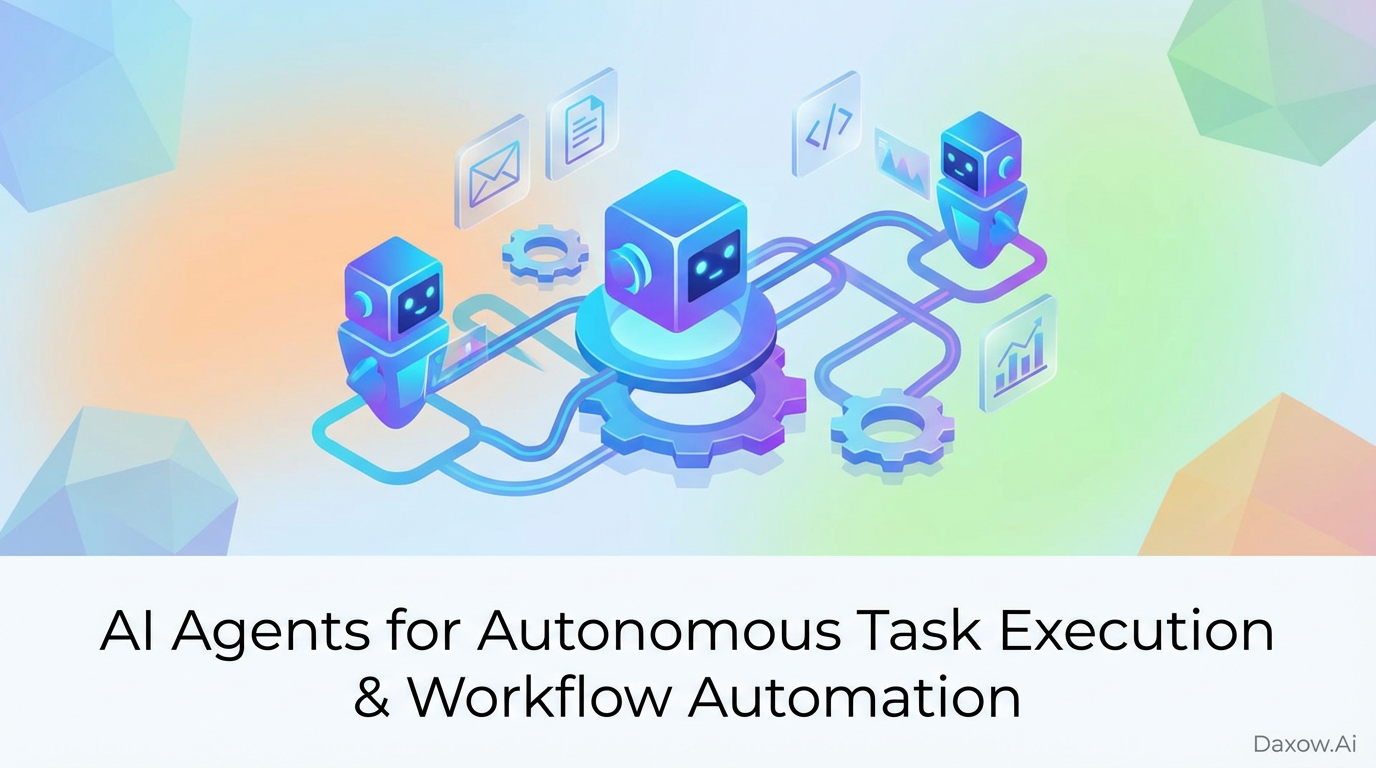
Guide to implementing AI agents to automate workflows, cut manual work, and boost productivity—includes use cases, ROI metrics, and Daxow.ai roadmap.
AI Agents for Autonomous Task Execution: How to Automate Workflows and Boost Productivity
Estimated reading time: 14 minutes
Key Takeaways
- AI agents automate complex workflows by understanding context, making decisions, and integrating with business tools.
- Organizations achieve measurable benefits including time savings, cost reduction, faster response, and higher conversions.
- Successful implementation depends on clear process mapping, data quality, iterative deployment, and governance.
- Use cases span e-commerce, finance, healthcare, real estate, HR, sales, and support—each with distinct automation gains.
- Daxow.ai provides tailored AI agent design, integration, compliance, and continuous improvement services to scale automation.
Table of Contents
- AI agents for autonomous task execution — what they are and why they matter
- Research-backed business benefits of AI agents and workflow automation
- Practical use cases and industry examples
- How to implement AI agents for workflow automation — a practical roadmap
- Measuring ROI and reducing manual tasks
- Common risks and how to mitigate them
- How Daxow.ai delivers value with AI agents and business automation
- Frequently Asked Questions
AI agents for autonomous task execution — what they are and why they matter
Definition and core capabilities
AI agents are software entities that combine AI (including large language models, computer vision, and decision models) with automation frameworks to perform tasks autonomously. Core capabilities include:
- Natural language understanding and generation to interpret requests and draft responses.
- Integration with business tools (CRMs, ERPs, ticketing systems) to read and write data.
- Workflow orchestration to chain tasks, retries, and conditional logic.
- Continuous learning and monitoring to improve performance over time.
Why organizations invest in AI agents
Organizations adopt AI agents to achieve a set of practical, measurable objectives:
- Reduce manual tasks that consume staff time.
- Improve productivity by shortening cycle times and enabling staff to focus on higher-value work.
- Standardize customer experiences and lower error rates.
- Scale operations without linear increases in headcount.
AI agents are not a replacement for strategy or people; they are tools to amplify human teams and deliver business automation across recurring processes.
Research-backed business benefits of AI agents and workflow automation
Tangible gains observed across implementations
Industry programs and vendor implementations consistently report measurable improvements when AI agents and workflow automation are applied:
- Time savings: Repetitive tasks such as data entry, document processing, and lead qualification often see time reductions of 50% or more.
- Faster response times: Customer support automation reduces first-response times substantially, improving customer satisfaction scores.
- Cost reduction: By automating routine tasks and improving agent productivity, organizations lower operational costs while preserving service levels.
- Higher conversion and revenue: Sales automation and intelligent lead qualification increase qualified pipeline velocity and conversion rates.
Critical success factors highlighted by research
Research and field experience point to several success factors:
- Clear process mapping before automation reduces rework.
- High-quality data and integrations are essential; agents perform only as well as the data they access.
- Iterative deployment (pilot → expand) limits risk and accelerates learning.
- Governance and monitoring ensure performance, compliance, and trust.
Practical use cases and industry examples
E-commerce — automated order management and post‑purchase support
Problem: High volume of routine inquiries about order status, returns, and tracking consumes support resources.
Agent solution:
- An AI agent reads incoming messages, queries order systems via API, updates customers with status, and initiates returns when needed.
- Workflow automation triggers shipment label creation and notifies warehouse systems.
Outcome: Reduced average handling time, 24/7 support availability, and a measurable drop in repeat inquiries.
How Daxow helps: Daxow designs the agent, integrates with e-commerce platforms and logistics partners, and sets up monitoring and escalation rules.
Finance — invoice processing and reconciliation
Problem: Manual invoice entry, validation, and matching across systems is slow and error-prone.
Agent solution:
- Document AI extracts invoice data, validates line items and totals, and posts journals to the ERP.
- Exceptions are routed to human reviewers with contextual summaries.
Outcome: Faster close cycles, fewer posting errors, and reduced AP headcount hours.
How Daxow helps: Daxow builds custom data extraction models, connectors to financial systems, and exception workflows.
Healthcare — patient intake and administrative workflows
Problem: Administrative burden on clinical staff leads to delays and higher operational costs.
Agent solution:
- AI agents automate patient intake by extracting information from forms, verifying insurance, and scheduling appointments.
- Agents trigger pre-visit checklists and prepare clinician summaries.
Outcome: Shorter intake times, improved patient experience, and more efficient use of clinical time.
How Daxow helps: Daxow ensures HIPAA-compliant integrations, customizes agents for medical workflows, and provides secure data handling.
Real Estate — lead qualification and transaction coordination
Problem: Agents and coordinators spend time qualifying leads and coordinating documents across stakeholders.
Agent solution:
- An AI agent qualifies leads using multi-channel signals, books viewings, and prepares transaction checklists.
- Documents are auto-populated and routed to the right parties for e-signature.
Outcome: Higher lead-to-show rates, faster transaction cycles, and reduced administrative overhead.
How Daxow helps: Daxow integrates CRM and listing systems, builds lead-scoring logic, and orchestrates contract workflows.
HR & Administration — recruiting automation and onboarding
Problem: Recruiters spend hours screening resumes and scheduling interviews.
Agent solution:
- AI agents screen resumes against job criteria, shortlist candidates, automate interview scheduling, and trigger onboarding tasks post-hire.
Outcome: Shorter time-to-hire, reduced recruiter workload, and smoother new hire experiences.
How Daxow helps: Daxow crafts screening models, links ATS systems, and builds automated onboarding checklists.
Sales & Customer Support — sales automation and customer support automation
Problem: Sales teams lose time on low-value tasks and miss follow-ups. Support teams wrestle with high ticket volumes.
Agent solution:
- Sales automation agents prioritize leads, draft personalized outreach, and log activities to the CRM.
- Customer support agents triage tickets, resolve standard issues autonomously, and escalate only complex cases.
Outcome: Improved conversion rates, faster resolutions, and reduced support costs.
How Daxow helps: Daxow integrates AI agents with CRMs, builds conversational flows, and sets up analytics dashboards.
How to implement AI agents for workflow automation — a practical roadmap
1. Discovery and process mapping
Start by mapping current workflows. Identify high-volume, repeatable tasks with clear decision rules.
- Deliverable: Prioritized automation backlog.
How Daxow helps: Daxow runs process discovery workshops and identifies quick wins and high-impact automation candidates.
2. Data readiness and integration plan
Assess data quality, access points, and integrations needed (APIs, databases, documents).
- Deliverable: Integration and data preparation plan.
How Daxow helps: Daxow connects systems (CRMs, ERPs, ticketing), implements data extraction pipelines, and ensures secure access.
3. Prototype and pilot
Build a narrow pilot agent for one use case. Validate accuracy, latency, and business outcomes.
- Deliverable: Pilot agent with KPIs and acceptance criteria.
How Daxow helps: Daxow develops prototypes, sets up sandbox environments, and runs A/B testing.
4. Governance, compliance, and safety
Define policies for data privacy, model explainability, decision logging, and human-in-the-loop controls.
- Deliverable: Governance framework and audit logs.
How Daxow helps: Daxow embeds compliance by design, provides role-based access, and implements monitoring tools.
5. Scale and optimize
After successful pilots, expand agents across processes, add more integrations, and refine models using production data.
- Deliverable: Scaled automation platform with continuous improvement processes.
How Daxow helps: Daxow manages full lifecycle — from scaling automation to operational support and performance tuning.
Measuring ROI and reducing manual tasks
Key metrics to track
- Time saved (hours per month) and FTE equivalents.
- Cost savings and reduced operational spend.
- Process cycle time reductions (e.g., average ticket resolution time).
- Customer and employee satisfaction scores.
- Revenue impacts: higher conversion rates, faster sales cycles.
Quick ROI framework
- Quantify current cost of process (labor hours × fully loaded cost).
- Estimate automation fraction (what percentage can be automated).
- Calculate expected reduction in manual effort and error rates.
- Compare against implementation and ongoing costs to get payback period and ROI.
Key point: Many organizations see payback in months on high-volume processes.
Common risks and how to mitigate them
Risk: Poor data and model performance
Mitigation:
- Start with narrow tasks.
- Use human-in-the-loop review for edge cases.
- Monitor model drift and retrain as needed.
Risk: Integration complexity
Mitigation:
- Use standardized APIs and middleware.
- Prioritize integrations that unlock the most value.
- Maintain a robust testing environment.
Risk: Governance and compliance failures
Mitigation:
- Implement logging, audit trails, and access controls.
- Ensure data residency and privacy requirements are met.
- Involve legal and compliance teams early.
How Daxow.ai delivers value with AI agents and business automation
- End-to-end process automation: Daxow maps workflows, builds agents, and automates execution across tools.
- Custom AI agents: We tailor agents to your processes so they act with business context and integrate with your systems.
- System integrations and data connectivity: Daxow connects CRMs, ERPs, and internal databases to ensure agents have authoritative data.
- Operational cost reduction and ROI focus: We prioritize automations with the highest ROI and deliver measurable savings.
- Continuous improvement: Post-deployment, Daxow monitors agent performance, collects feedback, and refines models to improve accuracy and outcomes.
Introduction
AI agents for autonomous task execution are rapidly changing how organizations run operations, interact with customers, and scale services. For business leaders focused on reducing manual tasks and improving productivity, AI agents unlock a new level of business automation: systems that understand context, make decisions, and execute end-to-end workflows across tools and teams. This article explains what AI agents are, summarizes research-backed benefits, presents practical use cases across industries, and provides a step‑by‑step roadmap to implement AI-driven workflow automation — with clear examples of how Daxow.ai helps design, build, and scale these systems.
Frequently Asked Questions
What are AI agents?
AI agents are intelligent software programs that autonomously perform tasks by understanding natural language, integrating with business tools, and orchestrating workflows without human intervention.
How do AI agents improve productivity?
By automating repetitive and high-volume tasks, AI agents reduce manual workload, shorten cycle times, and allow staff to focus on more strategic, value-adding work.
What industries benefit most from AI agents?
E-commerce, finance, healthcare, real estate, HR, sales, and customer support are among industries seeing significant gains from AI agent automation.
How can Daxow.ai assist with AI agent implementation?
Daxow.ai partners with organizations to discover opportunities, design custom AI agents, integrate with existing systems, ensure compliance, and continuously optimize automated workflows to maximize ROI.