

AI Agents for Business Automation: Use Cases & Roadmap
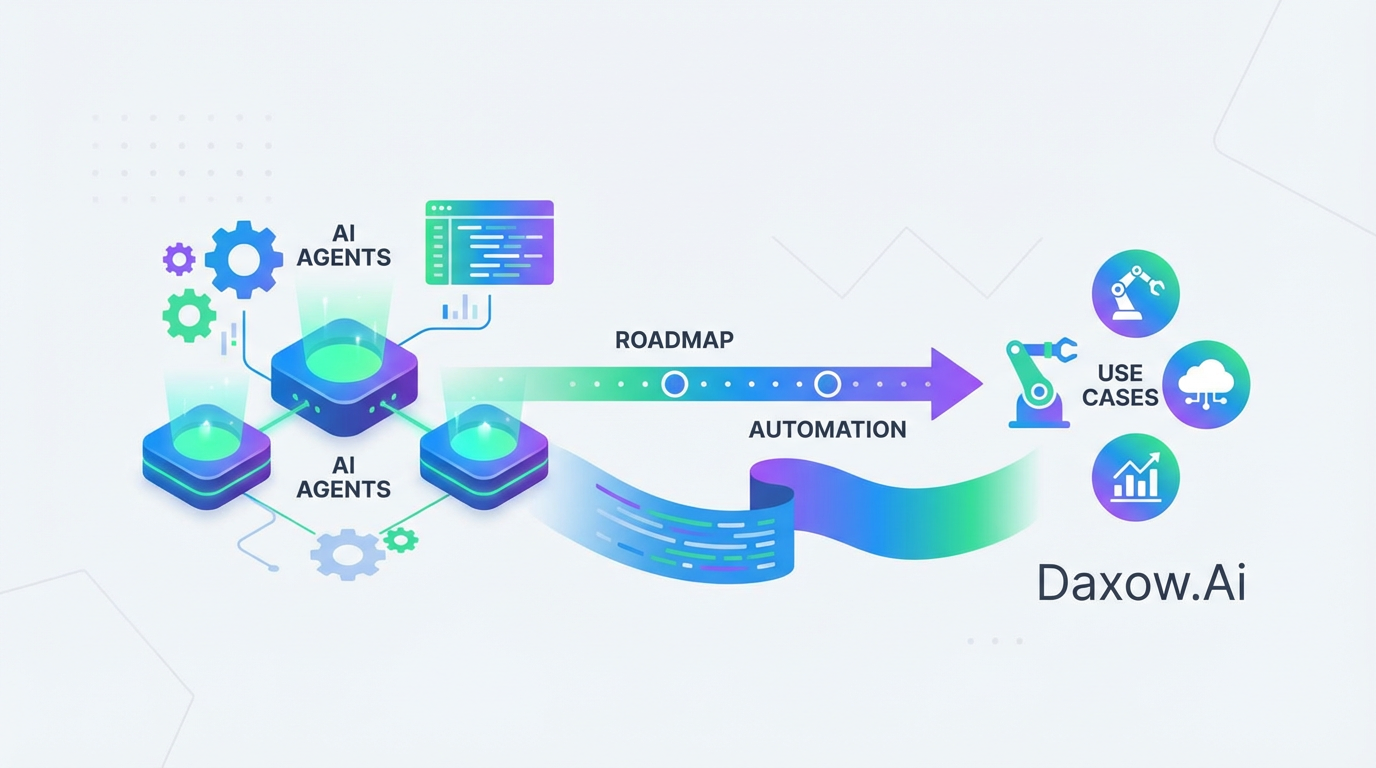
Discover how AI agents streamline operations with industry use cases, a 7-step implementation roadmap, and how Daxow.ai builds custom agent systems for ROI.
AI Agents: Transforming Business Operations with Autonomous Intelligence
Estimated reading time: 12 minutes
Key Takeaways
- AI agents automate complex workflows with minimal human intervention, increasing efficiency and reducing costs.
- Cross-industry applications include e-commerce, healthcare, finance, real estate, HR, and customer support.
- Implementing AI agents requires strategic planning, iterative pilots, and robust governance frameworks.
- Daxow.ai offers end-to-end AI agent development to unlock measurable ROI and seamless system integration.
- Effective deployment includes human-in-the-loop safeguards, modular tool orchestration, and continuous performance monitoring.
Table of Contents
- AI Agents: Transforming Business Operations with Autonomous Intelligence
- Practical Use Cases and Industry Examples for AI agents and AI automation
- How AI Agents and Automation Drive Business Transformation
- Implementation Roadmap — From pilot to production-scale workflow automation
- Measuring ROI and Business Value
- Best Practices and Governance for Safe, Effective Agent Deployment
- How Daxow.ai Builds and Delivers Custom AI Agent Solutions
- Example Daxow.ai Client Scenario — From manual process to autonomous agent
- Getting Started — Practical next steps for your organization
- Frequently Asked Questions
AI Agents: Transforming Business Operations with Autonomous Intelligence
What are AI agents and why they matter
AI agents are autonomous software systems powered by large language models and advanced planning modules that perceive environments, decide, plan actions, and execute tasks with minimal human intervention. Unlike scripted automation, agents learn from interactions and outcomes, enabling them to handle complex, variable processes across departments.
For decision-makers, the business value is clear:
- Scalability: Agents run 24/7, scaling processes without proportional headcount increases.
- Autonomy: They make context-aware decisions and adapt to changing conditions.
- Efficiency: Early adopters report up to 40% faster case resolutions and 25% higher lead conversions.
- Cost reduction: Automating repetitive work reduces operational overhead and frees human talent for strategic tasks.
Practical Use Cases and Industry Examples for AI agents and AI automation
E-commerce — Inventory, personalization, and fulfillment
Use case:
- An AI agent monitors sales velocity and external signals (marketing campaigns, seasonality).
- It forecasts demand, triggers purchase orders via ERP APIs, and updates inventory records.
- It personalizes recommendations on the storefront using behavioral models.
Impact:
- Reduce stockouts by up to 60%, improve customer satisfaction, and lower holding costs.
- Sales automation improves conversion by delivering targeted offers in real time.
Healthcare — Patient triage and scheduling
Use case:
- Agents triage incoming patient inquiries using symptom classifiers.
- They schedule appointments through EHR APIs, validate insurance, and escalate complex cases to clinicians with summarized context.
Impact:
- Faster patient response times and fewer administrative errors.
- Customer support automation ensures low-risk cases are handled automatically while preserving clinician oversight for sensitive decisions.
Finance — Invoice processing and compliance
Use case:
- Agents extract invoice data, validate line items, run fraud checks, and push approved payments to AP systems.
- They perform Monte Carlo-based risk assessments for complex portfolios.
Impact:
- Invoice processing time can be reduced by 50%, lowering late fees and improving cash flow.
- Improved audit trails and compliance through automated logging and human-in-the-loop checkpoints.
Real Estate — Lead qualification and deal acceleration
Use case:
- Agents analyze CRM signals, website behavior, and third-party data to score leads.
- They generate property reports, draft contract templates, and schedule viewings.
Impact:
- Faster deal cycles and higher lead conversion through timely, personalized outreach and automated follow-ups.
HR — Recruitment and onboarding
Use case:
- Agents screen resumes, shortlist candidates, schedule interviews, and manage onboarding checklists.
- They surface retention risk signals based on engagement and performance data.
Impact:
- Recruiter productivity increases; administrative tasks are reduced, enabling strategic hiring decisions.
Customer Support — Tiered automated assistance
Use case:
- Agents handle L1 queries, resolve common issues through knowledge base integration, and escalate complex tickets with contextual summaries.
- They update CRM and generate follow-up tasks automatically.
Impact:
- Up to 60% fewer L1 support calls, faster resolution, and improved NPS through consistent, 24/7 support.
How AI Agents and Automation Drive Business Transformation
Core capabilities that create value
AI agents combine several capabilities that make them uniquely effective:
- Reasoning and planning: Agents use search and planning algorithms (e.g., Monte Carlo planning) to sequence multi-step tasks.
- Tool integration: Direct API, RPA, and database connections let agents act within CRM, ERP, ticketing, and other business systems.
- Data ingestion: Support for structured and unstructured sources, with preprocessing and vector storage for efficient retrieval.
- Human-in-the-loop: Safeguards and escalation paths for sensitive decisions to meet governance and compliance needs.
- Personalization: Behavioral models predict intent and tailor agent actions to individual users or accounts.
Platform and governance considerations
Scaling agent fleets requires centralized governance: role-based access, audit trails, performance monitoring, and feature toggles. A governed approach lets organizations automate aggressively while maintaining compliance and transparency.
Implementation Roadmap — From pilot to production-scale workflow automation
Step 1 — Define value and select high-impact use cases
- Run cross-functional workshops to identify pain points and anchor them to KPIs (e.g., cut invoice time by 50%).
- Prioritize use cases with clear owners, measurable outcomes, and accessible data.
Step 2 — Assess readiness
- Checklist: clean data, API-accessible systems, cross-functional stakeholders, and governance policies.
- Determine integration complexity and security requirements.
Step 3 — Design agentic architecture
- Define agent identity, goals, tools, and memory model.
- Lay out data pipelines (ingest, preprocess, vectorize) and reasoning layers.
- Plan for modular tool orchestration to enable safe expansion.
Step 4 — Integrate data and workflows
- Connect to CRM, ERP, ticketing, and document stores via secure APIs or RPA.
- Ensure data quality and lineage—this is the competitive moat for accurate reasoning.
Step 5 — Pilot, test, and iterate
- Launch a Minimal Viable Agent (MVA) for one workflow.
- Use A/B testing and feedback loops; introduce memory and multimodality only after baseline performance.
Step 6 — Deploy with MLOps
- Implement orchestration (LangChain-like frameworks), model versioning, monitoring, and rollback capabilities.
- Build sandbox tools for experimentation and safe release processes.
Step 7 — Scale with governance
- Add audits, role-based controls, performance dashboards, and human handoffs.
- Establish SLAs and continuous improvement cycles.
Each step is an opportunity for rapid value capture. Start small, demonstrate ROI, then scale.
Measuring ROI and Business Value
Quantifying impact sharpens prioritization and accelerates adoption. Key metrics to track:
- Time-to-resolution for support tickets.
- Percentage reduction in manual tasks and FTE hours saved.
- Lead conversion uplift and sales cycle reduction.
- Cost-per-transaction improvements for finance or operations.
- Payback period (many mid-sized pilots show ROI within 3–6 months).
Example: A mid-sized company automates invoice ingestion and approval. The agent cuts processing time by 50%, reduces late payments, and lowers AP headcount hours—achieving payback in 4 months and a 20% annual cost reduction.
Best Practices and Governance for Safe, Effective Agent Deployment
Follow these principles to preserve trust while scaling automation:
- Start with an MVP and measure impact before expanding scope.
- Incremental layering: Add capabilities (memory, multimodality) after baseline success.
- Tool orchestration: Use modular APIs to manage expansions safely.
- Four pillars for readiness: strategic alignment, data readiness, technical infrastructure, and governance.
- Human-in-the-loop for sensitive decisions and clear escalation flows.
How Daxow.ai Builds and Delivers Custom AI Agent Solutions
End-to-end process: from discovery to production
- Discovery: We run workshops to map workflows, identify automation candidates, and define KPIs.
- Design: We architect agent identities, data pipelines, and tool integrations aligned with your stack.
- Build: We implement agents that connect to CRM, ERP, ticketing, and document systems using secure APIs and RPA where needed.
- Pilot: We deploy an MVA, measure results, and iterate with rapid sprints.
- Operate: We provide MLOps, monitoring, governance, and continuous improvement.
What Daxow.ai delivers
- AI Agents that execute real tasks — from triage and scheduling to multi-step deal execution.
- Workflow automation that integrates systems, reduces manual handoffs, and shortens cycle times.
- Customer support automation and chatbots that reduce L1 volume and improve CSAT.
- Sales automation and lead qualification agents that increase conversion through timely actions.
- Data extraction & document automation that unlocks unstructured information for downstream reasoning.
- System integrations that create a single source of truth across CRM, ERP, and internal tools.
How we ensure ROI and compliance
- KPI-focused pilots with transparent measurement.
- Human-in-the-loop designs and audit logs for compliance.
- Scalable governance frameworks to ensure safe fleet expansion.
Learn more about Daxow.ai solutions and how we can partner to modernize your operations with autonomous AI agents.
Example Daxow.ai Client Scenario — From manual process to autonomous agent
Problem: A mid-market retailer struggles with manual inventory forecasting and frequent stockouts during promotions.
Daxow.ai solution:
- Workshop to define success metrics and data sources.
- Build an agent that ingests POS, marketing calendars, supplier lead times, and external demand signals.
- Integrate with the ERP to trigger purchase orders and update inventory levels.
- Deploy pilot for top-selling SKUs, measure stockout rate and working capital impacts.
Outcome:
- Stockouts for pilot SKUs fell by 55%.
- Purchasing cycles shortened and warehouse efficiency improved.
- The pilot reached payback within 5 months, enabling enterprise-wide rollout.
Getting Started — Practical next steps for your organization
- Identify one high-impact workflow with clear KPIs and data availability.
- Assemble a cross-functional sponsor group (operations, IT, compliance).
- Run a 2–4 week discovery workshop to map the pilot and estimate ROI.
- Execute an MVA pilot and measure outcomes before scaling.
Frequently Asked Questions
What distinguishes AI agents from traditional automation?
AI agents use learning and reasoning to adapt to changing conditions and solve complex tasks autonomously, whereas traditional automation follows fixed, scripted rules without adaptation.
What industries benefit most from implementing AI agents?
Industries such as e-commerce, healthcare, finance, real estate, HR, and customer support gain immediate value by streamlining workflows, reducing errors, and scaling personalized interactions.
How does Daxow.ai ensure regulatory compliance with AI agents?
Daxow.ai incorporates human-in-the-loop mechanisms, audit trails, role-based access controls, and governance frameworks tailored to industry regulations for safe and compliant AI deployment.
What is the typical timeline to see ROI from AI agent implementations?
Most mid-sized pilots demonstrate measurable ROI within 3 to 6 months, depending on the use case complexity and organizational readiness.