
AI Agents and Automation: Unlock Business Growth
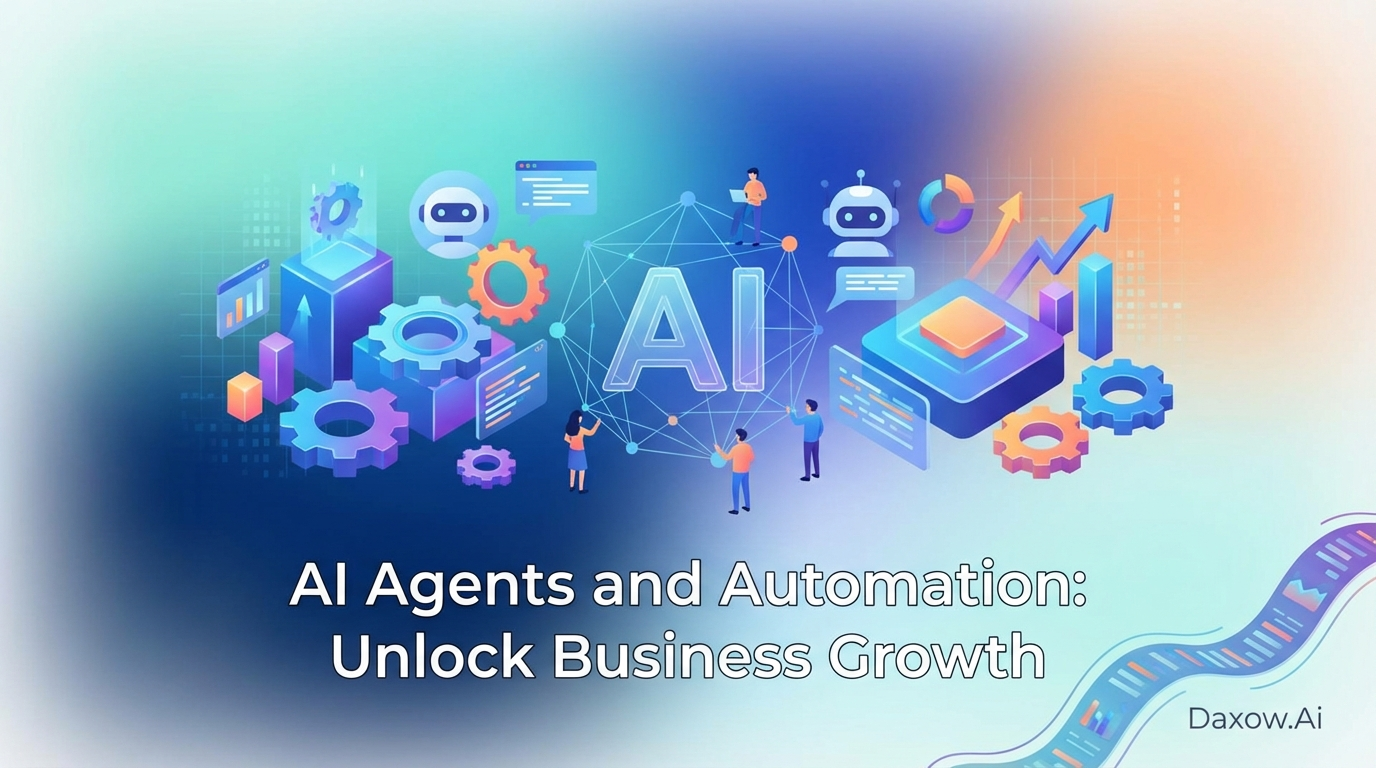
Strategic guide to AI agents and automation: steps, industry use cases, and how Daxow.ai builds end-to-end systems to cut costs and boost productivity.
Unlocking Business Growth: The Strategic Imperative of AI Agents and Automation
Estimated reading time: 15 minutes
Key Takeaways
- AI agents and automation enable scalability, reduce manual tasks, and improve customer experience while cutting operational costs.
- Successful AI deployment involves tailored solutions, cross-system integration, and governance to support business transformation.
- Industry-specific use cases demonstrate measurable impact in e-commerce, healthcare, finance, real estate, HR, and customer support.
- Adopting a phased, goal-driven approach with strong data readiness and change management maximizes return on investment.
- Daxow.ai delivers custom AI automation systems integrated with existing business tools for end-to-end workflow optimization and measurable ROI.
Table of Contents
- Unlocking Business Growth: The Strategic Imperative of AI Agents and Automation
- Practical Use Cases Across Industries
- How AI Agents and Automation Drive Business Transformation
- Implementation Steps and Best Practices
- Measuring ROI and Business Value
- Real-world Example — End-to-end Automation with AI Agents
- Frequently Asked Questions
Unlocking Business Growth: The Strategic Imperative of AI Agents and Automation
AI agents and automation have evolved from competitive tools to strategic necessities for modern organizations. By leveraging machine learning, natural language processing, and generative AI, these technologies execute tasks autonomously, optimize workflows, and generate real-time insights.
- Scalability without proportional headcount: AI agents efficiently manage high volumes of tasks.
- Higher accuracy in high-volume operations: Automation reduces errors in data-intensive processes.
- Real-time insights: Pattern recognition in large datasets powers faster, informed decisions.
- Cost reduction: Specific workflow deployments can cut operational expenses by up to 40%.
- Enhanced customer satisfaction: Personalized and speedy interactions boost engagement.
Key Business Outcomes
- Reduce manual tasks: Automate repetitive data entry, document processing, and routine queries.
- Boost productivity: Empower human teams to focus on strategic initiatives.
- Improve decision-making: Use predictive analytics for proactive risk management.
- Deliver consistent customer experiences: Automate support and sales actions for faster responses and higher conversion.
How Daxow.ai Accelerates Impact
- We map workflows to find automation opportunities.
- Build AI agents that perform meaningful tasks — from lead qualification to document data extraction.
- Integrate AI automation with your CRM, ERP, and collaboration platforms for seamless operations.
Practical Use Cases Across Industries
Successful AI and automation solutions must be precisely tailored to each industry’s realities. Here are key examples demonstrating measurable business impact and practical implementation guidance.
E-commerce — increase conversion and reduce churn
- Use case: AI agents qualify leads, recommend products, and predict supply chain issues.
- Business impact: Fewer abandoned carts, optimized inventory, better lifetime value.
- Implementation tips:
- Integrate product catalog and CRM.
- Automate follow-ups based on purchase signals.
- Use predictive stock shortage models linked to procurement.
- How Daxow.ai helps: Designing recommendation engines, deploying lead-qualification agents, and linking to logistics platforms for inventory accuracy.
Healthcare — accelerate patient workflows while maintaining compliance
- Use case: Automate patient intake, record summaries, and clinician triage.
- Business impact: Faster diagnostics, lower administrative load, improved satisfaction.
- Implementation tips:
- Ensure strict governance and audit trails.
- Use RPA for structured data, NLP for unstructured notes.
- Escalate sensitive cases for human review.
- How Daxow.ai helps: Building compliant automation integrated with EHR platforms to reduce admin time.
Finance — strengthen controls and speed reconciliation
- Use case: Fraud detection, invoice reconciliation, document-to-ledger automation.
- Business impact: Lower errors, faster audits, reduced risk.
- Implementation tips:
- Start with rule-based workflows like invoice matching.
- Add anomaly detection for exceptions review.
- Ensure audit traceability.
- How Daxow.ai helps: End-to-end automation pipelines with dashboards for compliance teams.
Real Estate — streamline lead management and listings
- Use case: Create property listings, qualify inquiries, schedule showings.
- Business impact: Faster lead cycles, higher close rates.
- Implementation tips:
- Combine conversational AI with calendar and CRM.
- Automate listing creation from structured data and images.
- How Daxow.ai helps: AI agents that orchestrate inquiry handling, prequalification, and scheduling.
HR — faster hiring and better employee support
- Use case: Resume screening, candidate prequalification, automated Q&A.
- Business impact: Shorter time-to-hire, enhanced candidate experience, reduced HR effort.
- Implementation tips:
- Use structured scoring for resume filtering.
- Deploy chatbots with escalation paths for complex queries.
- How Daxow.ai helps: Hiring bots and support assistants integrated with ATS and HRIS.
Customer Support — combine automation with human empathy
- Use case: Chatbots handle Tier 1, AI summarizes cases, escalate complex tickets.
- Business impact: Faster resolution, greater capacity, lower costs.
- Implementation tips:
- Build intent detection with human fallback.
- Use AI to summarize multi-touch interactions.
- How Daxow.ai helps: Support automation that elevates first-contact resolution and integrates with billing and product systems.
How AI Agents and Automation Drive Business Transformation
From isolated automations to hyperautomation
AI automation reaches maturity when organizations shift from standalone bots to orchestrated AI agents working across workflows. This hyperautomation integrates RPA, AI, and business tools to streamline full processes, eliminating fragmentation and silos.
Integration and data connectivity
Connecting AI agents with core systems like CRMs, ERPs, payment gateways, and analytics ensures consistent data flow and cohesive customer and operational experiences.
AI agents that execute real tasks
Unlike simple query bots, modern AI agents trigger workflows, update systems, generate documents, and coordinate multi-team activities. For example, a lead-qualification agent can score prospects, update CRM records, schedule demos, and notify sales reps automatically.
How Daxow.ai enables transformation
- Implementing seamless integration architectures.
- Designing agents that perform governed, real-world tasks.
- Providing continuous monitoring and optimization to maintain evolving business value.
Implementation Steps and Best Practices
A pragmatic, phased approach lowers risk and accelerates ROI. Follow these key steps and avoid common pitfalls.
Step 1 — Define goals and identify high-impact processes
- Set measurable KPIs, e.g. 30% efficiency gain in invoice processing.
- Focus on repetitive, high-volume workflows for rapid returns.
- Beware: vague objectives lead to scope creep.
Step 2 — Assess data quality and readiness
- Audit for data cleanliness, structure, and compliance.
- Standardize formats and create accessible pipelines.
- Beware: inconsistent data causes errors and mistrust.
Step 3 — Select and integrate tools
- Choose scalable, integratable platforms with solid vendor support.
- Avoid isolated point solutions that increase silos.
- Beware: legacy incompatibilities delaying deployment.
Step 4 — Build a cross-functional team
- Include technical experts, business stakeholders, and change managers.
- Invest in training to drive adoption and reduce resistance.
- Beware: underestimating change management risks adoption failures.
Step 5 — Pilot, monitor, and optimize
- Run small pilots with clear success criteria and tracked metrics.
- Measure throughput, accuracy, cost savings, and satisfaction.
- Implement feedback loops and continuous retraining to prevent model drift.
- Beware: neglecting monitoring risks degrading performance.
Step 6 — Embed ethics and compliance
- Include privacy checks, bias monitoring, and audit trails.
- Ensure compliance from project inception.
- Beware: ad-hoc deployments risk legal and reputational damage.
How Daxow.ai supports each step
- Conduct process discovery workshops.
- Perform data readiness assessments and design integrations.
- Manage pilots, KPIs, and transitions to production.
- Embed governance and compliance into every solution.
Measuring ROI and Business Value
Quantifiable metrics help make AI investments defensible and guide ongoing improvements.
Common ROI metrics
- Processing time reductions: 20–50% faster throughput in automated workflows.
- Error rates: Target error rates under 1% in document processes.
- Cost reduction: Up to 40% lower operational costs in focused workflows.
- Productivity: Staff reallocation to high-value tasks measured by output per FTE.
- Customer metrics: Higher NPS, improved SLA compliance, increased sales conversion.
How to structure measurement
- Establish baseline metrics before automation deployment.
- Use A/B testing comparing manual and automated results.
- Track both quantitative (cost, time, errors) and qualitative (satisfaction, feedback) metrics.
- Create dashboards and alerts for decision-maker visibility.
Daxow.ai’s approach to measurable value
- Defines KPIs at project kickoff with real-time dashboards.
- Executes structured pilots proving rapid value.
- Prioritizes automations offering quick payback and strategic advantage.
Real-world Example — End-to-end Automation with AI Agents
Scenario
A mid-size B2B software company faced slow lead qualification and overwhelmed support teams, with fragmented data across CRM, helpdesk, and analytics tools.
Problem
- Sales teams spent excessive time manually qualifying inbound leads.
- Support SLAs were slipping due to repetitive Tier 1 requests.
- Data scattered across multiple systems hindered efficiency.
Solution delivered by Daxow.ai
- Built an AI lead-qualification agent that scored leads using CRM, website, and past data, auto-creating qualified opportunities and scheduling calls.
- Deployed a chatbot to resolve common queries, summarize conversations, and escalate complex tickets with pre-populated context cards.
- Integrated CRM, helpdesk, and analytics for unified data consistency.
- Established governance with feedback loops and performance dashboards.
Results
- 60% reduction in sales qualification time, accelerating pipeline velocity.
- 70% faster support first-response times, boosting customer satisfaction.
- Over 30% cut in operational costs for lead qualification and routine support.
- Business leaders gained real-time KPI visibility on conversion and support metrics.
Daxow.ai’s role
Daxow.ai led process discovery, data integration, AI agent development, and ongoing monitoring to ensure sustained performance aligned with business goals.
Frequently Asked Questions
What are AI agents and how do they differ from traditional automation?
AI agents use advanced AI technologies including machine learning and natural language processing to autonomously make decisions and execute complex tasks, whereas traditional automation typically follows predefined rules and simple repetitive actions.
How do I know which processes to automate first?
Start by identifying high-volume, repetitive workflows with clear, measurable KPIs where automation can quickly deliver ROI and reduce manual effort.
What industries benefit most from AI agents and automation?
AI agents bring value across industries such as e-commerce, healthcare, finance, real estate, HR, and customer support by addressing specific operational challenges and compliance needs.
How does Daxow.ai ensure compliance and ethical AI use?
Daxow.ai integrates privacy checks, bias monitoring, audit trails, and governance frameworks into every AI solution to align with regulatory and ethical standards from project inception.
Can AI agents integrate with our existing business systems?
Yes, Daxow.ai specializes in seamless integration with CRMs, ERPs, collaboration platforms, and other core systems to ensure data consistency and smooth workflow automation.