
AI Agents for Business Automation: Cut Manual Work & Boost ROI
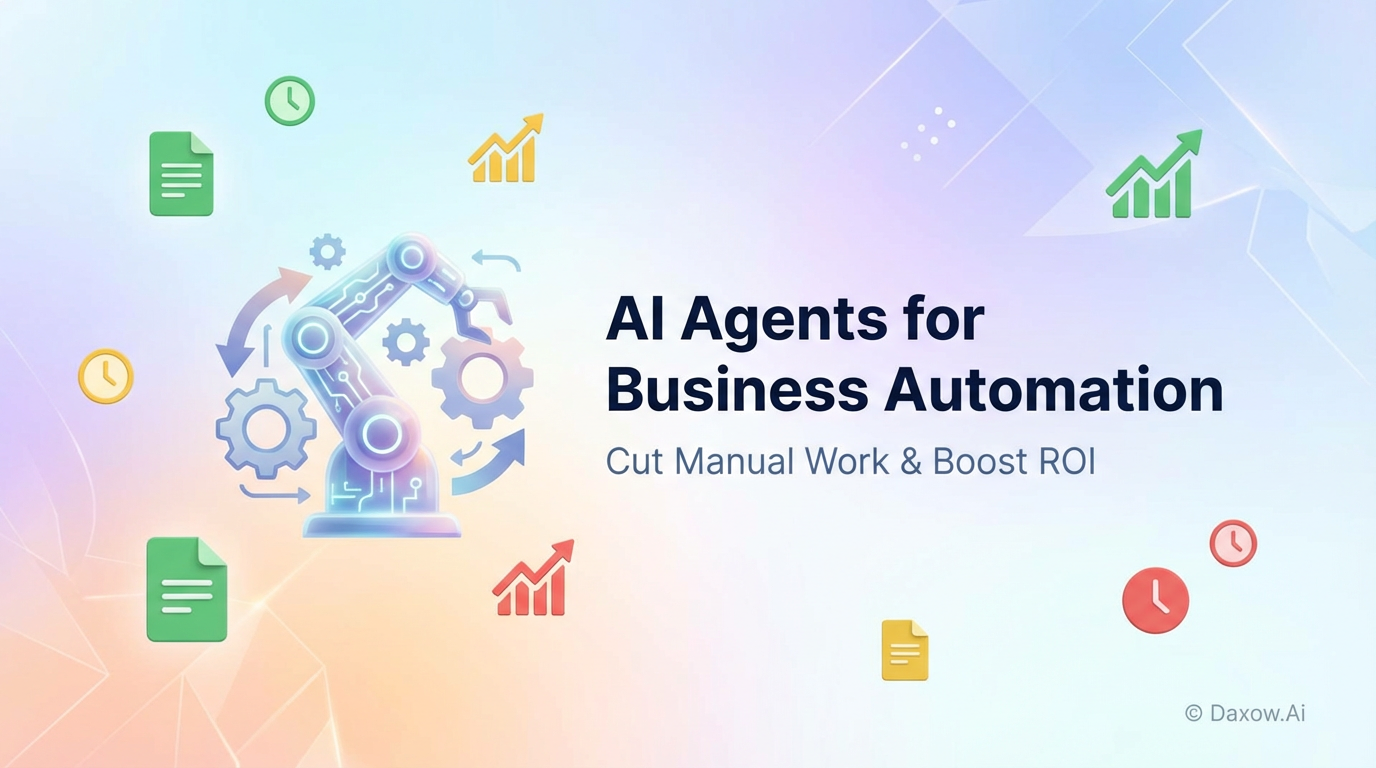
Discover how AI agents automate workflows to cut manual tasks, boost productivity, and deliver ROI, with use cases and a Daxow.ai implementation roadmap.
AI Agents for Business Automation: How to Reduce Manual Tasks and Boost Productivity
Estimated reading time: 12 minutes
Key Takeaways
- AI agents autonomously automate complex business tasks beyond traditional rule-based automation.
- Automation reduces manual effort, cuts costs, improves accuracy, and accelerates productivity.
- Industry-specific use cases showcase AI agents’ versatility from e-commerce to healthcare.
- Daxow.ai provides end-to-end AI automation design, integration, deployment, and continuous improvement.
- Successful AI adoption requires process discovery, pilot development, and stakeholder alignment.
Table of Contents
- AI Agents for Business Automation — What They Are and Why They Matter
- Business Value: How AI Agents Reduce Manual Tasks and Boost Productivity
- Use Cases Across Industries
- Designing and Implementing AI Agents and Workflow Automation
- Technology Stack and Security Considerations
- Best Practices and Common Pitfalls
- How Daxow.ai Builds Custom AI Systems That Execute Real Tasks
- Actionable Next Steps for Decision-Makers
- Conclusion and Call to Action
- Frequently Asked Questions
AI Agents for Business Automation — What They Are and Why They Matter
AI agents are software systems that perform tasks autonomously or semi-autonomously by perceiving inputs, making decisions, and executing actions across applications and data sources. Unlike rule-only automation, AI agents combine machine learning, natural language understanding, and process orchestration to handle unstructured data, adapt to changes, and escalate complex cases to humans when needed.
Why they matter:
- Higher automation scope: AI agents can handle complex, non-deterministic tasks that traditional automation cannot.
- Improved productivity: They free knowledge workers from repetitive manual tasks so teams focus on higher-value work.
- Better customer experience: Agents can respond to customers faster and with more personalized, accurate information.
- Scalability: AI agents scale without precisely proportional increases in headcount or manual oversight.
Core capabilities of AI agents:
- Natural language understanding for emails, chats, and documents.
- Intelligent document processing (IDP) to extract data from invoices, contracts, and forms.
- Workflow orchestration across CRMs, ERPs, and other enterprise systems.
- Decision-making models for routing, prioritization, and lead qualification.
- Continuous learning and monitoring to improve over time.
Business Value: How AI Agents Reduce Manual Tasks and Boost Productivity
When implemented correctly, AI automation delivers measurable benefits across operations, support, sales, and compliance functions. Here’s how organizations capture value.
Time and cost savings
- Reduce manual tasks: AI agents automate data entry, triage, routing, and response drafting. This can cut the time employees spend on low-value work by a substantial margin.
- Lower operating costs: By shifting routine tasks to AI, companies reduce the need for temporary staff or overtime while maintaining throughput.
Quality and speed
- Fewer errors: Automated data extraction and validation reduce human error in processing documents and records.
- Faster resolution times: Customer support automation and AI-assisted workflows improve response times and SLAs.
Scalable productivity
- 24/7 operation: AI agents run continuously, handling peak volumes without degraded performance.
- Consistent processes: Workflow automation ensures consistent application of business rules and compliance requirements.
Quantifying impact: a simple ROI approach
- Baseline the manual time spent on a process (hours/month).
- Estimate the percentage of that process AI agents can automate.
- Calculate labor cost savings and add expected reduction in error-related costs.
- Add efficiency gains (e.g., revenue preserved or increased due to faster lead qualification).
Example calculation (illustrative):
Team spends 1,000 hours/month on invoice processing at $30/hour = $30,000/month.
AI agent automates 70% of the work → 700 hours saved = $21,000/month.
Plus 30% reduction in late-payment penalties and improved vendor terms → additional savings.
This simple model demonstrates how targeted automation quickly improves the bottom line.
Use Cases Across Industries
E-commerce and Retail
- Order exception handling: AI agents detect order anomalies, match payments, and route exceptions automatically. This reduces fulfillment delays.
- Customer returns and refunds: Automate intake, eligibility checks, and refund initiation across systems.
- Personalized upsell flows: AI agents analyze customer history and trigger real-time personalized offers during checkout or post-purchase.
Sales and Marketing Automation
- Lead qualification: AI agents score leads based on engagement and CRM data, prioritize follow-ups, and assign reps.
- Meeting scheduling and follow-up: Automate scheduling, send personalized follow-ups, and create CRM notes.
- Proposal generation: Pull product, pricing, and contract clauses automatically into customized proposals.
Customer Support Automation
- Omnichannel triage: AI agents digest chats, emails, and tickets, extract intent, and route to the right queue or self-service content.
- Automated responses: Generate draft replies or complete resolutions for low-complexity inquiries.
- Knowledge base maintenance: Monitor support interactions to identify gaps and update documentation automatically.
Finance and Accounting
- Invoice and expense processing: Intelligent document processing extracts line-item data, validates against POs, and auto-posts to ERP.
- Reconciliation: AI agents match payments, flag anomalies, and create exception workflows.
- Compliance reporting: Automate data aggregation and report generation to meet audit requirements.
Healthcare and Life Sciences
- Intake automation: Extract structured data from patient forms and referrals, pre-fill EHRs, and schedule appointments.
- Prior authorization and billing: Automate claim preparation and track approvals to reduce denials and latency.
- Clinical trial document handling: Speed up document triage, consent form processing, and regulatory submission preparation.
Real Estate and Property Management
- Tenant onboarding: Automate credit checks, lease generation, and move-in coordination.
- Maintenance workflows: AI agents classify maintenance requests, dispatch vendors, and track SLAs.
- Document automation: Extract lease terms, renewal dates, and obligations from contracts for portfolio management.
Human Resources and Admin
- Candidate screening: Automatically parse resumes, screen for fit, and schedule interview steps.
- Employee onboarding: Automate paperwork, access provisioning, and training assignments.
- Policy compliance: Monitor communications for compliance violations and create audit trails.
Designing and Implementing AI Agents and Workflow Automation
A pragmatic implementation approach ensures outcomes and reduces risk. Daxow.ai’s method is built for business value delivery.
Step 1 — Process discovery and prioritization
- Map current workflows and measure time, cost, and error rates.
- Identify high-impact, automatable processes (low variability, high volume, or compliance-sensitive).
- Daxow.ai service: Conducts a process analysis and ROI estimation to prioritize projects.
Step 2 — Proof of concept and data preparation
- Build a prototype for a targeted sub-process.
- Prepare training data and connect relevant systems (CRM, ERP, document repositories).
- Daxow.ai service: Designs fast pilots that validate business outcomes with minimal disruption.
Step 3 — Build AI agents and integrate systems
- Develop AI models (NLP, IDP) and orchestrate workflows with rule-based logic.
- Integrate through APIs, RPA connectors, and middleware to ensure seamless end-to-end execution.
- Daxow.ai service: Delivers full-stack engineering — models, orchestration, and system integrations.
Step 4 — Deployment, monitoring, and continuous improvement
- Deploy agents in production with observability dashboards and human-in-the-loop fallbacks.
- Monitor accuracy, throughput, and user acceptance; iterate on model improvements.
- Daxow.ai service: Provides managed monitoring and ongoing optimization to maintain ROI.
Technology Stack and Security Considerations
AI agents achieve value when they are connected:
- CRM and ticketing systems for sales and support automation.
- ERP and accounting systems for finance automation.
- EHRs and healthcare platforms for clinical workflows.
- APIs, message queues, and middleware for real-time orchestration.
Daxow.ai specializes in connecting disparate systems securely and reliably, turning data silos into unified, automated workflows.
Security, compliance, and data governance
- Apply role-based access, encryption, and audit logs across automation layers.
- Ensure data minimization and retention policies for privacy compliance.
- Implement explainability and human oversight where regulatory or ethical considerations demand it.
- Daxow.ai embeds governance and security controls into every automation project to protect sensitive business and customer data.
Best Practices and Common Pitfalls
Best practices
- Start with high-impact, well-defined processes to demonstrate early wins.
- Use human-in-the-loop strategies during rollout to maintain quality control.
- Measure outcomes continuously — time saved, error reduction, customer satisfaction.
- Prioritize integrations and data quality; poor data undermines AI performance.
Common pitfalls to avoid
- Over-automation: Trying to automate end-to-end without human oversight for complex decisions.
- Neglecting change management: Not preparing teams for new workflows and role changes.
- Ignoring monitoring: Lack of performance tracking leads to model drift and degraded outcomes.
Daxow.ai guides organizations through these challenges with change management, training, and monitoring playbooks.
How Daxow.ai Builds Custom AI Systems That Execute Real Tasks
Daxow.ai helps businesses move from concept to scale with a structured, outcome-driven approach:
- Discovery: We map your workflows, estimate savings, and prioritize automation candidates.
- Prototype: Rapid pilots demonstrate value in weeks, not months.
- Build: Custom AI agents are developed and integrated with your systems.
- Deploy: Agents are deployed with governance, observability, and rollback mechanisms.
- Operate: Ongoing optimization ensures sustained ROI and adaptability.
What sets our approach apart:
- End-to-end delivery: We handle data, models, orchestration, and integrations.
- Business-first mindset: Solutions are measured by operational impact and ROI.
- Domain adaptability: We tailor agents to industry-specific needs — finance, healthcare, retail, and more.
- Execution capability: We convert automated decisions into real actions across enterprise systems.
Learn more about our tailored solutions on our Services page.
Actionable Next Steps for Decision-Makers
- Conduct a process analysis: Identify the top three processes where AI agents can reduce manual tasks within 90 days.
- Pilot one high-impact use case: Start with customer support automation or lead qualification to show fast wins.
- Align stakeholders: Ensure IT, compliance, and business owners share KPIs and success criteria.
- Plan for scale: Prepare integration and data strategies so successful pilots can expand across the organization.
Conclusion and Call to Action
AI Agents for Business Automation are a practical, high-impact way to reduce manual tasks, increase productivity, and improve customer and employee experiences. With the right process analysis, prototyping, and integrations, organizations can realize significant cost savings and operational improvements quickly.
Daxow.ai specializes in designing and deploying custom AI systems that automate end-to-end workflows, integrate with your enterprise stack, and deliver measurable ROI. Book a free consultation today to request a process analysis for your company and start building AI agents that execute real tasks and transform operations.
Explore our Solutions page to see how we tailor AI automation to your business needs.
Frequently Asked Questions
What distinguishes AI agents from traditional automation tools?
AI agents combine machine learning, natural language understanding, and decision-making capabilities to handle unstructured data and complex scenarios, whereas traditional tools rely mainly on fixed rules and deterministic workflows.
How quickly can businesses expect ROI from AI agent implementation?
ROI timelines vary, but many companies see measurable cost savings and productivity gains within a few months post-implementation, especially when starting with high-impact, well-defined processes.
Can AI agents integrate with existing enterprise systems?
Yes, AI agents are designed to integrate seamlessly with CRM, ERP, EHR, and other platforms via APIs, RPA connectors, and middleware, enabling unified workflows without disrupting current IT infrastructure.
How does Daxow.ai ensure the security and compliance of AI automation projects?
Daxow.ai embeds security controls such as role-based access, encryption, audit logging, and data governance policies into every project, ensuring compliance with regulatory and ethical standards.