
Harnessing AI Agents and Automation for Business Transformation
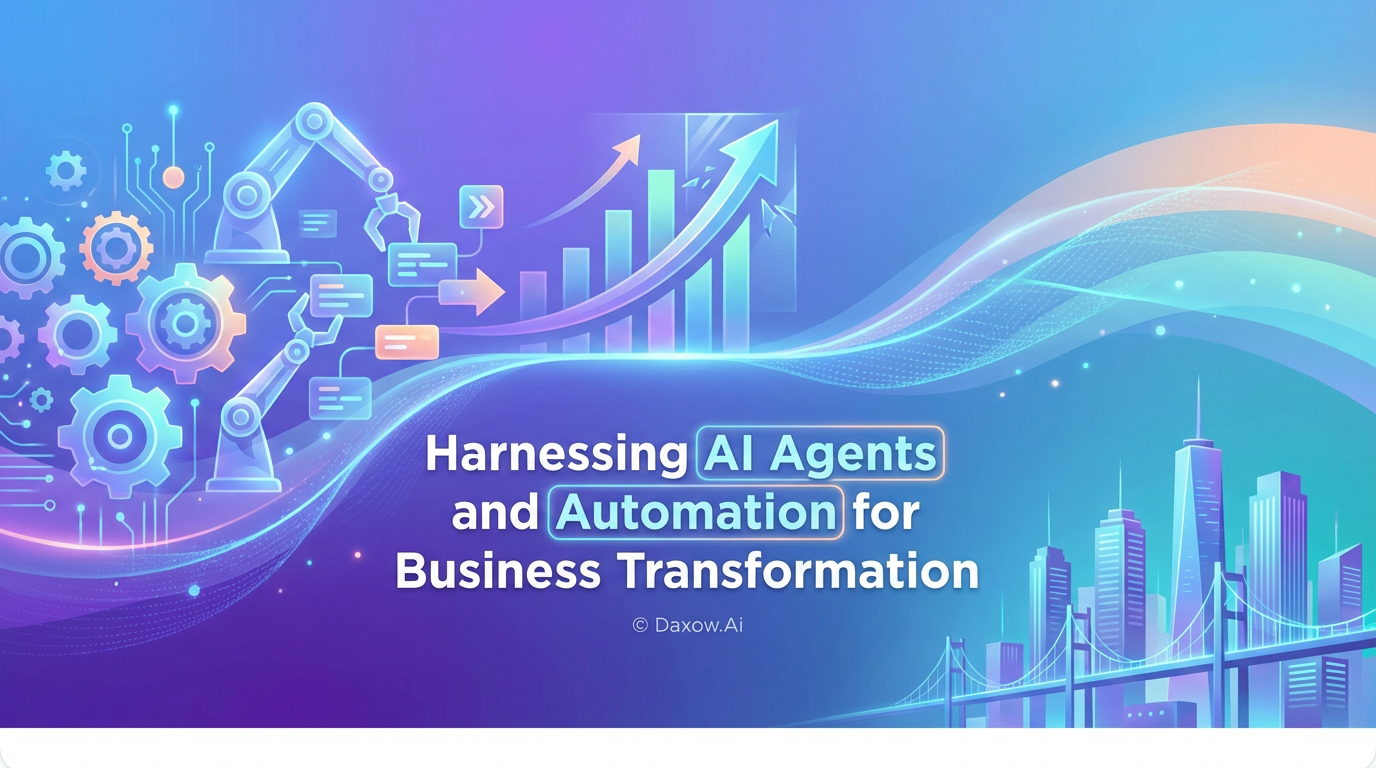
Learn how AI agents and workflow automation reduce manual work, cut costs, and speed decisions. Includes industry use cases, ROI framework and Daxow.ai roadmap.
Harnessing AI Agents and Automation for Business Transformation
Estimated reading time: 15 minutes
Key Takeaways
- AI agents and workflow automation reduce manual tasks and unlock strategic value for businesses.
- Implementation delivers faster decision-making, cost reductions, improved accuracy, and scalability.
- Practical use cases span e-commerce, healthcare, finance, real estate, HR, and sales.
- A phased roadmap ensures high ROI from pilot projects to enterprise-wide rollouts.
- Daxow.ai provides custom AI agent design, integration, governance, and continuous optimization support.
Table of Contents
- Harnessing AI Agents and Automation for Business Transformation: Strategic Value
- Practical Use Cases: Reduce Manual Tasks Across Industries
- Implementation Roadmap: From Pilot to Enterprise-scale Business Automation
- Measuring ROI and Business Value
- Technology and Integration Considerations
- Conclusion and Next Steps
- Frequently Asked Questions
Harnessing AI Agents and Automation for Business Transformation: Strategic Value
What these technologies are and why they matter
- AI agents are autonomous systems that execute multi-step tasks, interact with data sources, and make decisions with minimal human intervention. They combine natural language processing, machine learning, and business logic to perform activities such as triage, data extraction, and action execution.
- Workflow automation embeds these capabilities into end-to-end business processes. It orchestrates data flow, triggers actions in connected systems, and maintains audit trails to ensure compliance and repeatability.
- Together, they shift teams from routine execution to strategy and innovation by removing manual drudgery and enabling 24/7 operations.
Key strategic outcomes
- Faster decision-making through real-time data processing and predictive analytics.
- Cost reductions of up to 30–50% in targeted areas by reducing manual labor and error rates.
- Improved accuracy and compliance through standardized, auditable workflows.
- Scalability without headcount growth, enabling businesses to expand services or transaction volumes efficiently.
Practical Use Cases: Reduce Manual Tasks Across Industries
E-commerce: Improve conversion and customer support
- Use case: Automate personalized recommendations, inventory alerts, and customer support interactions.
- Business impact: Chatbots and AI agents can handle up to 80% of routine inquiries, reducing response times from hours to seconds and lowering support costs.
- Action plan:
- Integrate customer data and order history with an AI agent for personalized communication.
- Deploy customer support automation for returns, shipping queries, and FAQs.
- Connect AI-driven inventory monitoring to procurement and pricing systems to avoid stockouts.
- How Daxow helps: Build custom chatbots integrated with CRMs and inventory systems, design recommendation models, and put monitoring and escalation logic in place.
Healthcare: Reduce administrative burden while ensuring compliance
- Use case: Patient scheduling, symptom triage, claims processing and documentation automation.
- Business impact: Administrative workloads drop by ~40%, with faster triage and fewer scheduling conflicts.
- Action plan:
- Deploy conversational agents to pre-screen appointments and collect intake information.
- Automate document extraction and coding for claims processing.
- Implement role-based access and audit trails to meet regulatory requirements.
- How Daxow helps: Create clinical-grade conversation flows, integrate with EHR systems, and ensure privacy-compliant data pipelines.
Finance: Protect revenue and accelerate services
- Use case: Real-time fraud detection, automated compliance checks, and instant loan decisions.
- Business impact: Fraud losses and compliance errors decline significantly; reporting accuracy improves.
- Action plan:
- Implement anomaly detection models and real-time alerting agents.
- Automate KYC and compliance document verification with OCR and semantic matching.
- Build decision automation for standardized loan approvals with exception routing.
- How Daxow helps: Deploy secure, auditable AI agents that integrate with core banking systems and compliance tools.
Real Estate: Speed up lead-to-deal cycles
- Use case: Automated lead qualification, virtual tour agents, and dynamic property valuation.
- Business impact: Deal cycles accelerate by roughly 25%, with more qualified leads entering the funnel.
- Action plan:
- Use AI agents to pre-qualify leads based on criteria and schedule viewings.
- Automate listing updates across platforms and generate valuation insights.
- Route high-quality leads to sales teams with context-rich summaries.
- How Daxow helps: Build lead scoring agents, integrate MLS and CRM data, and optimize handoff workflows.
HR and Administration: Streamline onboarding and recruitment
- Use case: Resume screening, candidate outreach, employee onboarding workflows, and benefits queries.
- Business impact: Recruitment throughput improves and onboarding time can be cut by up to 50%.
- Action plan:
- Implement semantic resume screening to rank and shortlist candidates.
- Automate repetitive onboarding tasks (account setup, policy sign-offs, IT requests).
- Deploy virtual HR assistants for employee queries and benefits administration.
- How Daxow helps: Configure candidate screening models, create secure onboarding workflows, and connect HRIS systems.
Sales and Marketing: Create predictable pipeline growth
- Use case: Lead qualification, sales automation, and personalized outreach at scale.
- Business impact: Higher conversion rates and reduced manual follow-up by sales teams.
- Action plan:
- Use AI agents to qualify inbound leads and nurture them with automated sequences.
- Sync intelligence to CRMs, triggering contextual outreach and scheduling.
- Automate reporting and forecasting using aggregated signals.
- How Daxow helps: Build lead qualification pipelines, integrate with marketing automation and CRMs, and create AI assistants for sales reps.
Implementation Roadmap: From Pilot to Enterprise-scale Business Automation
A pragmatic, phased approach minimizes risk and accelerates results. Below is a concise roadmap with common timelines and deliverables.
1. Assess needs and set objectives (4–8 weeks)
- Activities: Bottleneck audit, stakeholder interviews, define KPIs (cost, time, CSAT).
- Deliverable: Prioritized list of pilot opportunities with expected impact.
- Daxow role: Conduct the process analysis, map current workflows, and estimate ROI.
2. Prepare data and systems (6–12 weeks)
- Activities: Data cleaning, knowledge base creation, integration readiness checks.
- Deliverable: Prepared data pipelines and a documented integration plan.
- Daxow role: Build secure connectors, establish governance, and create decision trees or knowledge graphs.
3. Select technology and configure AI agents (6–12 weeks)
- Activities: Choose NLP, ML, and workflow orchestration tools that align with scale and compliance needs.
- Deliverable: Technical architecture, selected stack, and prototype agent designs.
- Daxow role: Recommend and implement best-fit technologies, customizing agents for brand voice and business rules.
4. Pilot and test (2–4 weeks)
- Activities: Deploy to a controlled environment, monitor performance, collect user feedback.
- Deliverable: Pilot report with metrics, identified gaps, and improvement plan.
- Daxow role: Run the pilot, adjust models and flows, and implement monitoring dashboards.
5. Rollout and scale gradually (ongoing)
- Activities: Expand to teams, channels, and regions; standardize operations; define escalation paths.
- Deliverable: Scaled deployments, governance model, and SLA definitions.
- Daxow role: Manage phased rollouts, integrate with enterprise systems, and enable centralized control.
6. Review and continuous optimization (monthly/quarterly)
- Activities: Performance reviews, retraining models, process tuning, and new use-case discovery.
- Deliverable: Continuous improvement backlog and updated ROI tracking.
- Daxow role: Provide ongoing support, monitoring, and iterative improvements.
Best practices and pitfalls
- Start small with high-volume, low-complexity pilots to generate quick wins.
- Involve stakeholders early to increase adoption and capture domain knowledge.
- Define success metrics upfront to measure impact objectively.
- Avoid “boil the ocean” projects; instead, iterate rapidly and expand when KPIs are met.
Measuring ROI and Business Value
Essential KPIs to track
- Cost savings: reductions in FTE hours and error-related costs (target 20–50% in prioritized processes).
- Time-to-resolution: throughput improvements and faster cycle times (3–5x faster processes in many pilots).
- Customer experience: CSAT, first-contact resolution, and response times.
- Compliance and risk: audit trail coverage, reduction in compliance incidents.
- Revenue impact: conversion lift from automated lead qualification and faster approvals.
ROI calculation (simple framework)
- Estimate baseline costs (labor, error corrections, processing time).
- Quantify expected improvement (e.g., 40% reduction in processing time).
- Calculate annualized savings and compare to total project cost (implementation + maintenance).
- Many pilots recoup investment within 3–6 months, with enterprise rollouts amplifying returns thereafter.
How Daxow.ai delivers measurable ROI
- We map processes to identify the highest-impact automation opportunities.
- We design AI agents that execute real tasks — not just prototypes — and connect them to existing systems.
- We provide monitoring and governance to ensure improvements are sustained and measurable.
- We focus on cost-effective, staged rollouts so ROI is realized early and expanded across the organization.
Technology and Integration Considerations
Integration patterns that matter
- CRM integrations for sales and marketing automation.
- ERP and inventory system connections for e-commerce and operations.
- EHR and practice management systems for healthcare automation.
- Secure APIs and middleware for data exchange and orchestration.
Security, privacy, and governance
- Implement role-based access, encrypted data pipelines, and audit trails.
- Establish data retention and model governance policies.
- Maintain explainability and logs for decisions that affect customers or compliance.
How Daxow.ai supports integration and governance
- We design connectors that respect legacy systems and modern APIs.
- We implement governance frameworks to track model decisions and compliance.
- We provide secure hosting options and monitoring dashboards for operational transparency.
Conclusion and Next Steps
Harnessing AI Agents and Automation for Business Transformation delivers tangible business outcomes: reduced manual tasks, higher productivity, lower costs, and improved customer experiences. The approach is proven — start with focused pilots, measure results, and scale with governance and continuous optimization.
Daxow.ai helps you through every step: process analysis, custom AI agent design, system integrations, pilot deployment, and enterprise rollout. Our focus is on building automation that executes real tasks, delivers measurable ROI, and integrates into your existing operations.
Bold action starts with a clear next step. Book a free consultation with Daxow.ai to request a process analysis for your company and explore a tailored AI automation roadmap. Contact us to build a custom AI system that reduces manual tasks, boosts productivity, and transforms your business.
Frequently Asked Questions
What are AI agents and how do they differ from simple automation?
AI agents are autonomous systems capable of executing complex, multi-step tasks by interacting with data sources and making decisions using machine learning and natural language processing. They differ from simple automation by their ability to adapt, learn, and handle tasks requiring contextual understanding beyond predefined rules.
How can businesses measure the ROI of AI automation projects?
ROI is measured by comparing baseline costs and processing times against improvements delivered by AI automation. Key metrics include cost savings, time-to-resolution, error reduction, customer satisfaction, and revenue impact. Many pilots recoup investment within 3 to 6 months, with scaled rollouts generating larger gains.
Is workflow automation suitable for all industries?
Yes, workflow automation can be customized and integrated across industries such as e-commerce, healthcare, finance, real estate, HR, and sales. The key is aligning automation with industry-specific compliance, data privacy requirements, and business processes to ensure effectiveness and governance.
How does Daxow.ai support integration with existing enterprise systems?
Daxow.ai designs connectors that integrate seamlessly with legacy systems and modern APIs, providing secure, auditable, and compliant pipelines. We ensure systems like CRMs, ERPs, EHRs, and marketing automation platforms work together smoothly to deliver end-to-end AI-powered automation.