
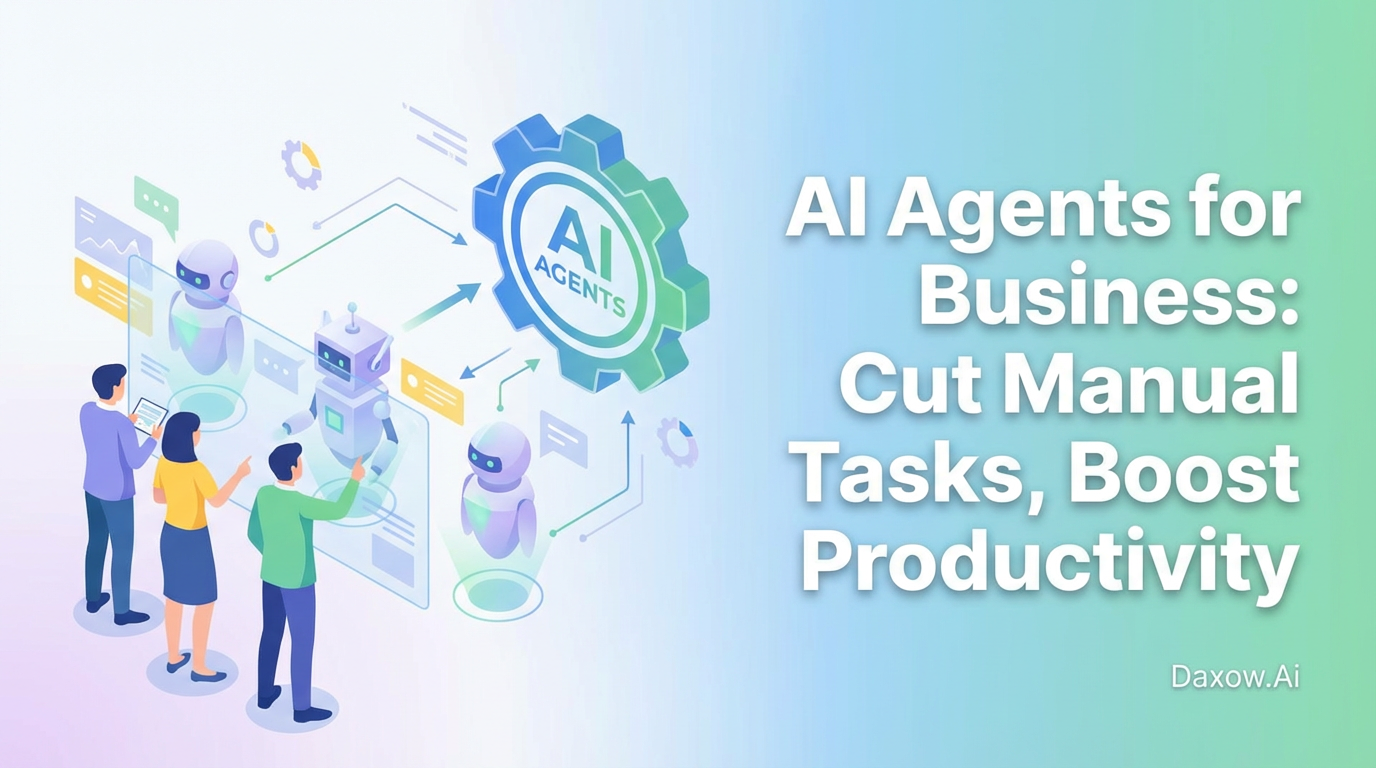
AI Agents for Business: Cut Manual Tasks, Boost Productivity
Discover how AI agents automate workflows to reduce manual tasks, improve productivity and ROI. Includes use cases, roadmap, KPIs, and Daxow.ai services.
AI agents for business automation: How to reduce manual tasks, boost productivity, and transform workflows
Estimated reading time: 15 minutes
Key Takeaways
- AI agents automate repetitive tasks, improve workflow orchestration, and integrate seamlessly with existing systems.
- Significant productivity gains and cost savings are achievable by reducing manual work across support, sales, finance, HR, and more.
- Implementing AI agents requires careful planning: process discovery, data readiness, pilot testing, and scaling with governance.
- Daxow.ai specializes in designing and deploying custom AI agents that deliver measurable ROI and sustainable business transformation.
- Effective automation includes human-in-the-loop controls, ongoing monitoring, and comprehensive change management to ensure success.
Table of Contents
- AI agents for business automation — what they are and why they matter
- How AI agents deliver value in practice
- Industry use cases — practical examples of AI agents for business automation
- Designing and implementing AI agents — a practical roadmap
- Technical and organizational considerations
- Measuring success and calculating ROI
- How Daxow.ai helps build AI agents that execute real business tasks
- Common pitfalls and how to avoid them
- Frequently Asked Questions
AI agents for business automation — what they are and why they matter
AI agents are software systems that perceive inputs (text, documents, APIs, sensor data), reason about goals, and take actions autonomously or semi-autonomously across tools and systems. Unlike one-off automations, modern AI agents combine natural language understanding, business rules, and integrations to execute complex workflows end-to-end.
Why they matter now
- Scale of repetitive work: Many teams spend upwards of 30–60% of their time on routine tasks that can be automated.
- Improved customer expectations: Faster, personalized responses are required across support and sales channels.
- Data-driven decisions: AI agents can analyze and act on structured and unstructured data in real time.
- Integration readiness: Modern APIs and cloud tools make it feasible to connect AI agents to CRMs, ERPs, ticketing systems, and document stores.
Business outcomes
- Reduce manual tasks across departments (support, HR, finance).
- Increase productivity by reallocating staff from repetitive work to strategic projects.
- Improve customer support automation with faster resolution and consistent quality.
- Drive sales automation with faster lead qualification and follow-up.
How AI agents deliver value in practice
Core capabilities of effective AI agents
- Natural Language Understanding and Generation for interpreting requests and drafting responses.
- Workflow orchestration to sequence multi-step tasks and interact with multiple systems.
- Data extraction and document automation to parse invoices, contracts, and forms.
- Integration layers to connect with CRMs, ticketing, databases, and cloud services.
- Monitoring, explainability, and safety controls for governance and compliance.
Typical value levers and KPIs
- Time saved per task (hours/week).
- Percentage reduction in manual tasks (target 30–70% depending on process).
- First-contact resolution rate and average response time for support.
- Lead-to-opportunity conversion improvements for sales automation.
- Error rate reduction for data processing and compliance tasks.
- Total cost of ownership and payback period (often under 12 months for high-volume processes).
Industry use cases — practical examples of AI agents for business automation
Customer support automation (SaaS, e-commerce, telecom)
Use case: An AI agent that triages incoming tickets, suggests responses, fulfills simple requests, and escalates complex issues to human agents with context.
Practical steps:
- Ingest support emails, chat logs, and knowledge base content.
- Classify and prioritize tickets using intent detection.
- Automatically draft responses or execute actions (password resets, order status checks) via integrations.
Business impact:
- Reduce manual tasks for support agents by up to 60% on routine queries.
- Improve response times from hours to minutes.
- Increase customer satisfaction and lower support costs.
Sales automation and lead qualification (B2B, enterprise sales)
Use case: AI agent that qualifies inbound leads, schedules meetings, and enriches CRM records.
Practical steps:
- Capture leads from web forms and marketing platforms.
- Run qualification scripts (budget/timeline/decision-maker detection) via conversational flows.
- Update CRM, assign follow-up tasks, and trigger nurture campaigns.
Business impact:
- Higher lead conversion rate due to faster outreach.
- Sales reps spend more time on qualified opportunities.
- Productivity improvements from automated data entry and follow-up.
Finance and accounting automation (invoicing, expense processing)
Use case: AI agent that extracts invoice data, matches invoices to purchase orders, and routes exceptions.
Practical steps:
- Use OCR and document understanding to parse invoices and receipts.
- Automate three-way matching and flag mismatches for review.
- Initiate payments or approvals via ERP integrations.
Business impact:
- Reduced processing time and late-payment penalties.
- Lower error rates and audit-ready trails.
- Significant labor cost reduction in accounts payable.
HR and administrative automation (onboarding, compliance)
Use case: AI agent that manages employee onboarding, generates offer letters, and gathers required documents.
Practical steps:
- Coordinate tasks across HRIS, identity provisioning, and asset assignment.
- Send automated reminders and collect e-signatures.
- Verify compliance documents with automated checks.
Business impact:
- Faster time-to-productivity for new hires.
- Reduced administrative overhead and improved compliance.
Healthcare (patient intake, prior authorization)
Use case: AI agent that extracts information from referral documents, schedules appointments, and submits prior authorization requests.
Practical steps:
- Parse clinical notes and insurance forms.
- Pre-fill authorization forms and interface with payer portals.
- Notify clinicians and administrative staff of status changes.
Business impact:
- Fewer denials and faster authorization processing.
- Reduced administrative burden on clinical staff.
- Improved patient experience.
Real estate and property management
Use case: AI agent that processes rental applications, verifies income documents, and coordinates move-in logistics.
Practical steps:
- Extract income and identity data from uploaded documents.
- Run automated checks and score applicants.
- Trigger lease generation and payment setup.
Business impact:
- Faster application decisions.
- Lower vacancy times and reduced manual screening work.
Designing and implementing AI agents — a practical roadmap
Phase 1 — Process discovery and ROI prioritization
- Map current workflows and identify points with high manual effort and repeatability.
- Quantify volumes, time spent, error rates, and stakeholder pain points.
- Prioritize processes based on ROI potential and implementation complexity.
Why this matters: Focusing on high-impact, automatable workflows ensures rapid payback.
Phase 2 — Solution design and data readiness
- Define agent goals, decision rules, and success metrics.
- Audit and prepare data sources: documents, databases, ticketing systems, CRMs.
- Design integrations and security controls (authentication, encryption, access policies).
Why this matters: Good data and clear objectives prevent scope creep and improve accuracy.
Phase 3 — Build, integrate, and pilot
- Develop the agent with modular components: NLU, orchestration, connectors, UI.
- Run a pilot with a subset of users or teams.
- Collect feedback, measure KPIs, and iterate.
Why this matters: Pilots validate assumptions and reveal integration edge cases early.
Phase 4 — Scale and govern
- Roll out to wider teams, add use cases, and monitor performance.
- Establish monitoring, auditing, and human-in-the-loop controls.
- Maintain models and retrain using real-world data.
Why this matters: Scaling requires ongoing governance to sustain accuracy and compliance.
Technical and organizational considerations
Integration and data connectivity
Effective AI agents require robust integration with business systems:
- CRMs (sales automation).
- Ticketing and support platforms (customer support automation).
- ERPs and accounting systems (finance automation).
- Document repositories and email systems (data extraction).
Daxow.ai specializes in building secure, reliable connectors and end-to-end integrations so agents can execute real tasks in your existing stack.
Security, privacy, and compliance
- Implement role-based access and least-privilege principles.
- Encrypt data in transit and at rest.
- Maintain audit trails for actions taken by AI agents.
- Ensure compliance with industry regulations (e.g., HIPAA for healthcare, GDPR).
Daxow.ai embeds governance into every solution to minimize risk and satisfy auditors.
Human-in-the-loop and change management
- Start with semi-automated modes where human review is available.
- Use feedback loops to improve agent accuracy.
- Train staff on new workflows and emphasize value shifts from manual to supervisory roles.
Daxow.ai offers training and operational support to ensure adoption and measurable change in process efficiency.
Measuring success and calculating ROI
Metrics to track
- Reduction in manual task hours.
- Improvement in response and resolution times.
- Error rate and rework reduction.
- Incremental revenue from faster sales cycles.
- Cost savings in FTE equivalents and third-party fees.
Calculate ROI by comparing annualized labor and error costs before and after implementation, and factor in implementation and maintenance costs. High-volume transactional processes often pay back within 6–12 months.
How Daxow.ai helps build AI agents that execute real business tasks
Daxow.ai combines consulting, engineering, and AI expertise to deliver end-to-end business automation:
- Discovery and process analysis to identify the highest-value automations.
- Custom AI agent design that integrates NLU, orchestration, connectors, and business rules.
- Implementation of workflow automation and CRM/ERP integrations to ensure agents can take real actions.
- Data extraction and document automation to unlock unstructured sources.
- Ongoing monitoring, model maintenance, and operational support to sustain improvements.
Daxow.ai focuses on measurable outcomes: reducing manual tasks, lowering operational costs, and improving productivity and customer experience.
Typical engagement flow with Daxow.ai
- Initial consultation and process analysis.
- Proof-of-concept pilot focused on a prioritized workflow.
- Production rollout with integrations and governance.
- Continuous improvement and expansion across departments.
Common pitfalls and how to avoid them
- Over-automation without governance: Always include human oversight for exceptions.
- Poor data quality: Invest in data preparation and validation early.
- Ignoring change management: Train users and provide clear escalation paths.
- Siloed integrations: Plan for a centralized integration layer to avoid fragile point-to-point connections.
Daxow.ai’s structured approach mitigates these risks through proven templates, integration expertise, and operational playbooks.
Frequently Asked Questions
What are AI agents in business automation?
AI agents are intelligent software systems that autonomously interpret inputs, reason about goals, and interact with multiple tools and systems to automate complex workflows end-to-end.
How quickly can businesses see ROI from AI agents?
High-volume processes often see payback within 6 to 12 months by significantly reducing manual labor, errors, and operational costs.
How does Daxow.ai ensure AI agents integrate with existing business systems?
Daxow.ai builds secure, reliable connectors for CRMs, ERPs, ticketing systems, and other platforms to enable seamless data flow and real task execution within your current technology stack.
What role does human oversight play in AI agent workflows?
Human-in-the-loop controls are critical to govern exceptional cases, maintain accuracy, and ensure compliance, especially during early adoption and pilot phases.