
Mastering AI Agents and Automation for Business Transformation
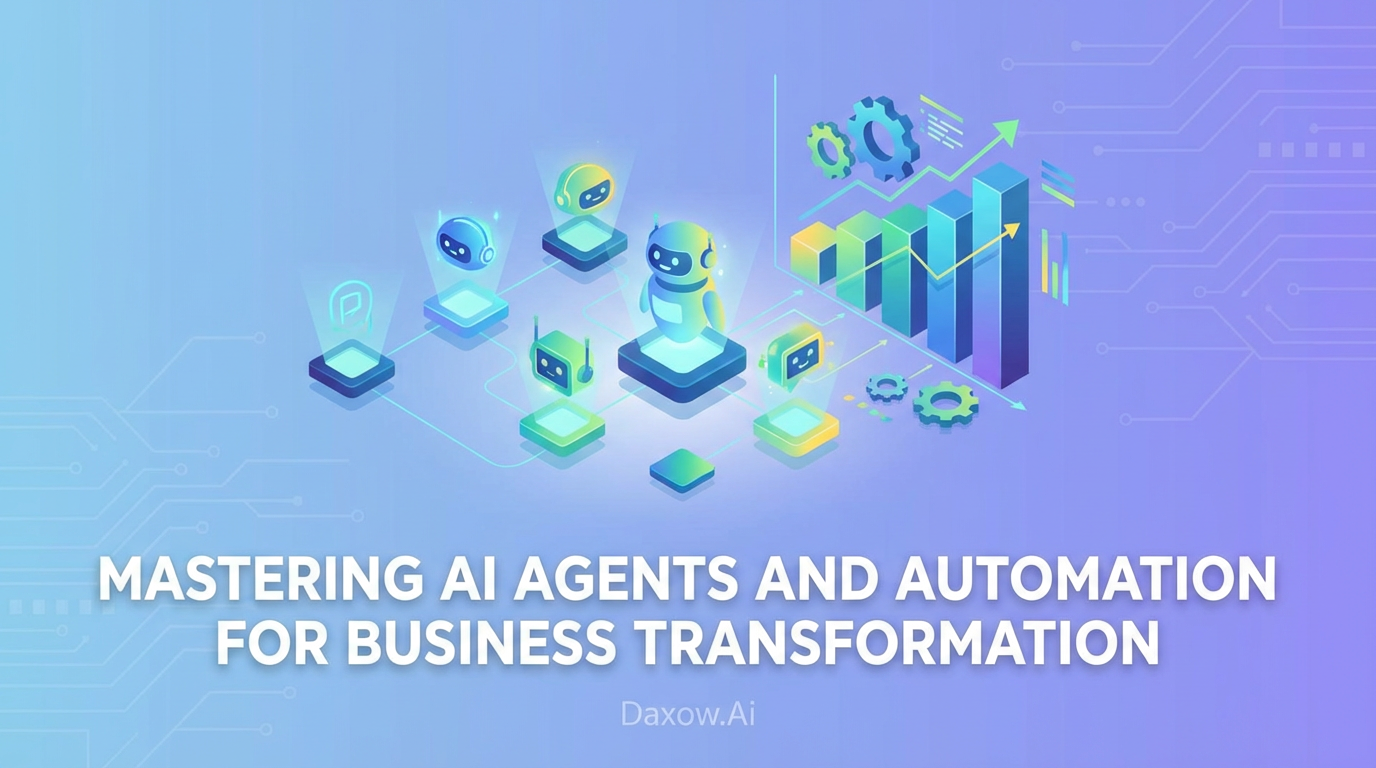
Practical guide to deploying AI agents and workflow automation for measurable ROI, industry use cases, and a phased implementation roadmap by Daxow.ai.
Mastering AI Agents and Automation: A Strategic Imperative for Business Transformation
Estimated reading time: 15 minutes
Key Takeaways
- AI agents and automation transform manual workflows into scalable, proactive systems enhancing productivity and customer experience.
- Daxow.ai delivers tailored AI solutions integrating with existing business tools for measurable ROI.
- Industry-specific use cases demonstrate significant benefits across e-commerce, healthcare, finance, real estate, and HR.
- A phased implementation roadmap reduces risk and accelerates adoption from assessment to ongoing optimization.
- Tracking key performance indicators ensures clear measurement of operational efficiency, cost savings, revenue impact, and compliance.
Table of Contents
- Introduction
- Core Components Explained
- Why This Matters: Business Outcomes
- Practical Use Cases Across Industries
- Implementation Roadmap: Phased, Practical, Accountable
- Measuring ROI and Business Value
- How Daxow.ai Delivers End-to-End Value
- Practical Next Steps for Decision-Makers
- Conclusion and Call to Action
- Frequently Asked Questions
Introduction
Mastering AI Agents and Automation: A Strategic Imperative for Business Transformation is no longer a theoretical goal — it is a competitive requirement. Organizations that adopt AI automation and AI agents move from manual, reactive workflows to proactive, scalable systems that reduce manual tasks, increase productivity, and improve customer experience. This article breaks down the practical steps, industry use cases, and measurable ROI decision-makers need to evaluate and implement business automation successfully. Throughout, we explain how Daxow.ai designs and deploys custom AI systems to automate end-to-end workflows, integrate with existing business tools, and deliver measurable outcomes.
Core Components Explained
- AI automation: Using machine learning, NLP, and rules engines to automate decisions and tasks.
- Workflow automation: Orchestrating multi-step business processes across systems and teams.
- AI agents: Autonomous actors that interact with users, systems, and data sources to complete tasks end-to-end.
- Integrations: Connecting CRMs, ERPs, ticketing systems, and knowledge bases so agents can act with full context.
Why This Matters: Business Outcomes
- Reduce manual tasks such as data entry, invoice processing, and routine inquiries.
- Improve productivity by reallocating skilled staff to strategic initiatives.
- Deliver 24/7 customer support automation and faster SLA adherence.
- Drive sales automation through automated lead qualification and personalized follow-up.
- Ensure compliance and traceability with auditable decision logs and governance.
Practical Use Cases Across Industries
E-commerce — Personalize and Scale Interactions
Problem: High volume of customer queries, fluctuating inventory, and generic product recommendations.
AI automation solution:
- Deploy AI agents for chat-based order support and returns handling.
- Use predictive inventory forecasting models for stock optimization.
- Implement personalized recommendation engines integrated into checkout flows.
Benefits:
- Higher conversion rates from tailored recommendations.
- Faster response times with automated order status and returns handling.
- Reduced stockouts and markdown losses through demand forecasting.
Daxow.ai delivers:
- Custom AI agents that integrate with your e-commerce platform and CRM.
- Workflow automation connecting order, inventory, and logistics systems.
- Continuous optimization to improve recommendation accuracy and reduce manual interventions.
Healthcare — Streamline Patient Flow and Administrative Tasks
Problem: Administrative backlogs, appointment no-shows, and manual triage burden clinicians.
AI automation solution:
- Conversational AI agents for symptom triage and scheduling.
- Automated patient onboarding and document extraction from forms.
- Intelligent routing of urgent cases to clinicians based on risk scoring.
Benefits:
- Reduced wait times and administrative overhead.
- Improved patient experience with automated, HIPAA-compliant communications.
- More efficient clinician time allocation toward care delivery.
Daxow.ai delivers:
- Secure integrations with EHRs and scheduling systems.
- Document automation for intake forms and insurance verification.
- Compliance-focused design to meet privacy and regulatory requirements.
Finance — Accuracy, Compliance, and Fraud Prevention
Problem: Manual invoice processing, compliance checks, and slow reconciliation.
AI automation solution:
- Automated invoice extraction, validation, and approval workflows.
- Real-time anomaly detection agents for fraud and transaction monitoring.
- Automated compliance checks and audit trail generation.
Benefits:
- Faster cycle times for payables and receivables.
- Reduced errors and exceptions through automated validation.
- Stronger controls for regulatory reporting.
Daxow.ai delivers:
- End-to-end invoice automation with OCR and NLP for data extraction.
- Integration with accounting systems and internal controls.
- Custom anomaly detection models tuned to your transaction profile.
Real Estate — Speed Up Deal Cycles and Lead Conversion
Problem: Slow qualification of leads, manual valuation processes, and repetitive client follow-ups.
AI automation solution:
- AI agents that qualify leads via conversational channels and schedule viewings.
- Automated property valuation models for instant pricing suggestions.
- Virtual assistant-guided tours and follow-up nurturing sequences.
Benefits:
- Faster lead conversion and higher agent productivity.
- Accelerated valuation and pricing decisions to close deals quicker.
- Enhanced customer experience with timely, personalized communications.
Daxow.ai delivers:
- Lead qualification agents integrated with your CRM and calendar.
- Valuation models trained on your local market data.
- Workflow automation that pushes qualified leads to sales reps in real time.
HR — Accelerate Hiring and Onboarding
Problem: High volume of resumes, manual screening, and inconsistent onboarding experiences.
AI automation solution:
- Resume parsing and candidate ranking using AI agents.
- Automated onboarding workflows with document verification and IT provisioning.
- Employee sentiment and turnover risk prediction for retention programs.
Benefits:
- Reduced time-to-hire and improved candidate experience.
- Lower administrative burden on HR teams.
- Better retention outcomes through proactive interventions.
Daxow.ai delivers:
- Custom candidate screening pipelines that align with your hiring criteria.
- Integrated onboarding automation connecting HRIS, IT, and facilities.
- Analytics dashboards to track hiring KPIs and employee health metrics.
Implementation Roadmap: Phased, Practical, Accountable
Phase 1 — Assessment and Planning (4–8 weeks)
- Activities: Define measurable goals (for example, 30% efficiency gain), conduct data audits, identify high-impact processes.
- Output: Targeted use cases, baseline metrics, data readiness report.
- Common pitfall: Vague objectives and ignoring data quality.
How Daxow.ai helps:
- Conducts process discovery workshops and ROI-focused assessments.
- Produces a prioritized roadmap with measurable KPIs.
Phase 2 — Technology and Vendor Selection (6–12 weeks)
- Activities: Evaluate platforms for scalability, integration capability, and compliance.
- Output: Recommended stack and integration plan.
- Common pitfall: Choosing tools that don’t integrate with core systems.
How Daxow.ai helps:
- Architects integration strategies and selects technologies that match long-term needs.
- Offers managed services to reduce vendor complexity.
Phase 3 — Preparation (4–8 weeks)
- Activities: Form cross-functional teams, clean and label data, build knowledge bases and decision trees.
- Output: Training datasets, automation playbooks, change management plan.
- Common pitfall: Inadequate change management and siloed responsibilities.
How Daxow.ai helps:
- Leads data preparation, knowledge engineering, and stakeholder alignment workshops.
- Produces documentation and training materials for fast adoption.
Phase 4 — Pilot Deployment and Rollout (4–20 weeks)
- Activities: Launch a limited-scope pilot, capture feedback, refine models, and expand gradually.
- Output: Validated pilot results, ROI measurement, scaled rollout plan.
- Common pitfall: Skipping feedback loops and scaling prematurely.
How Daxow.ai helps:
- Deploys production-grade pilots with monitoring and human-in-the-loop controls.
- Iterates quickly based on real-world performance and user feedback.
Phase 5 — Ongoing Optimization (Continuous)
- Activities: Retrain models, monitor for bias, update workflows, and measure outcomes.
- Output: Sustained performance improvements and governance program.
- Common pitfall: Neglecting updates and ethical monitoring.
How Daxow.ai helps:
- Provides continuous monitoring, retraining, and compliance checks.
- Implements governance frameworks to ensure ethical, auditable AI.
Measuring ROI and Business Value
Key Performance Indicators to Track
- Operational efficiency: average handling time, process cycle time reductions.
- Cost savings: FTE hours saved, cost per transaction, reduction in error rates.
- Revenue impact: conversion rate lift, upsell/cross-sell increments, lead-to-opportunity velocity.
- Customer experience: NPS, resolution rate, first contact resolution.
- Compliance and risk: number of compliance exceptions, audit time reduction.
What to Expect from Realistic Pilots
- Short-term wins: Automations for high-volume, low-complexity tasks often show measurable ROI within 8–12 weeks.
- Medium-term value: Scaled deployments across departments deliver compounded productivity gains over 6–18 months.
- Long-term resilience: Adaptive AI agents support 3–5 years of growth by continuously learning and integrating new data.
How Daxow.ai Delivers End-to-End Value
Our Approach
- Discovery: We map current workflows and identify high-ROI automation opportunities.
- Design: We architect AI agents and workflow automation that integrate with your CRM, ERP, and other systems.
- Build: We develop, test, and deploy production-ready agents with robust data handling and security.
- Scale: We support rollout, governance, and continuous optimization to sustain gains.
Why Partner with Daxow.ai
- Tailored solutions: We build AI agents specific to your industry context and operational processes.
- System integrations: We connect to existing tools and CRMs to ensure seamless automation.
- End-to-end delivery: From process analysis to model training, deployment, and monitoring.
- Business-focused results: Emphasis on measurable ROI, reduction in manual tasks, and improved productivity.
Practical Next Steps for Decision-Makers
- Start with a focused process analysis to identify the highest-impact opportunities.
- Run a short pilot aimed at a single measurable outcome (e.g., reduce invoice processing time by 30%).
- Establish governance and change management to accelerate adoption.
- Scale gradually based on validated metrics and continuous optimization.
Conclusion and Call to Action
Mastering AI Agents and Automation: A Strategic Imperative for Business Transformation is achievable with a pragmatic, phased approach that prioritizes data quality, integration, and measurable business outcomes. Whether you aim to implement customer support automation, sales automation, or enterprise-wide workflow automation, the right partner and roadmap make the difference between speculative hype and sustained ROI.
Book a free consultation with Daxow.ai to request a process analysis for your company. Contact us to build a custom AI system that will reduce manual tasks, boost productivity, and deliver tangible business automation outcomes.
Frequently Asked Questions
What are AI agents and how do they work?
AI agents are autonomous software entities that perceive their environment, reason about it, and perform actions to complete tasks. They can interact with users, systems, and data sources to automate complex end-to-end workflows.
How can workflow automation improve my business?
Workflow automation orchestrates multi-step business processes across teams and systems, ensuring consistency, speeding up cycles, and freeing employees from routine tasks to focus on higher-value activities.
What industries benefit most from AI automation and agents?
Industries such as e-commerce, healthcare, finance, real estate, and HR see significant benefits by automating manual tasks, improving customer experience, and accelerating decision-making with AI solutions tailored to their unique challenges.
How long does it take to see ROI from AI automation?
Pilot projects for high-volume, low-complexity automations typically show measurable ROI within 8 to 12 weeks. Scaled deployments can compound productivity gains over 6 to 18 months with long-term benefits continuing for several years.
What makes Daxow.ai different as an AI automation partner?
Daxow.ai offers tailored AI agent and automation solutions that deeply integrate with your existing systems, deliver measurable business-focused results, and provide ongoing governance and optimization to ensure sustained value.