

Unlock Business Transformation with AI Agents and Automation
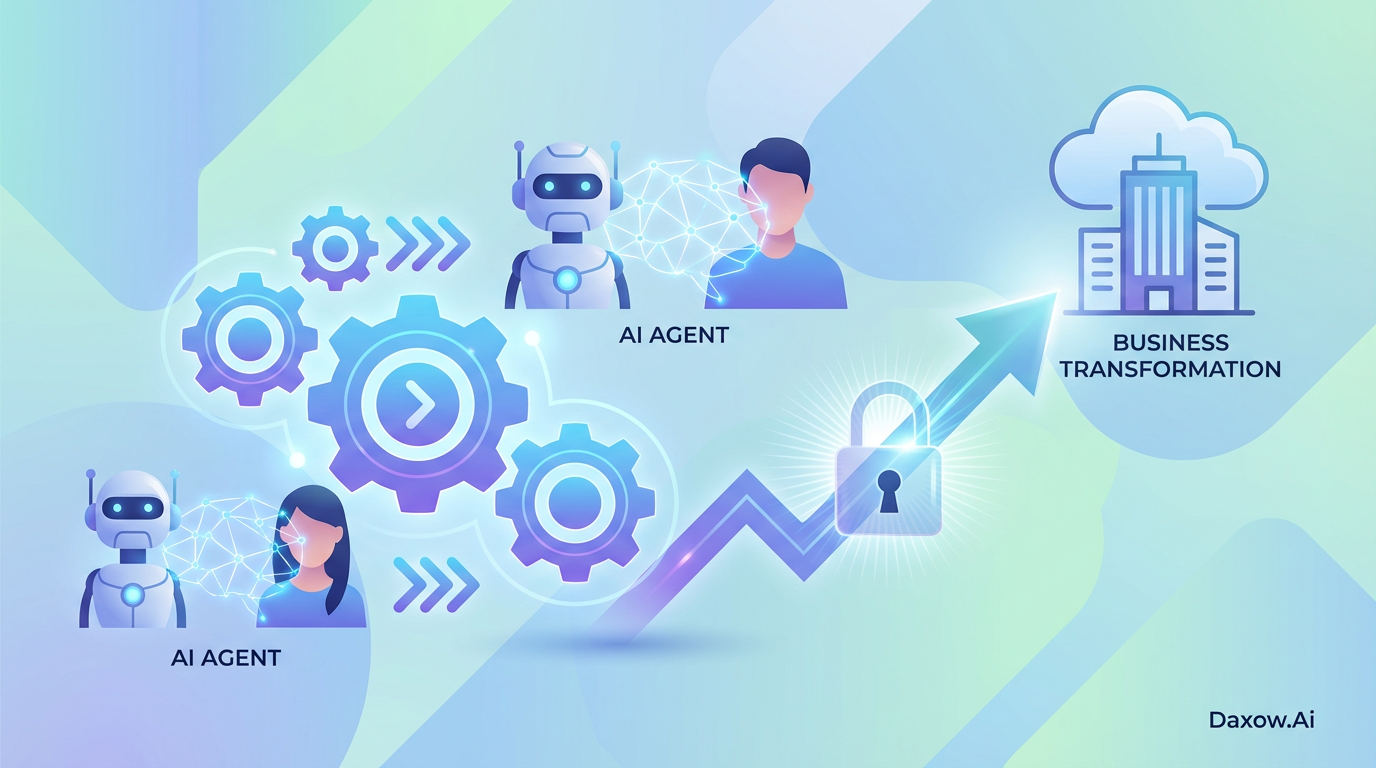
How AI agents and workflow automation deliver rapid ROI across industries. Practical use cases, implementation steps, and how Daxow.ai builds production-ready solutions.
Unlocking Business Transformation with AI Agents and Automation
Estimated reading time: 15 minutes
Key Takeaways
- AI agents combine autonomous decision-making with workflow automation to accelerate business transformation.
- Organizations achieve rapid ROI by automating high-volume, complex tasks across sales, finance, healthcare, and more.
- Industry applications demonstrate significant improvements in productivity, cost reduction, and customer experience.
- Following best practices in data readiness, pilot testing, and governance ensures successful AI automation deployments.
- Daxow.ai delivers custom AI automation solutions integrated with your enterprise systems and CRMs for end-to-end impact.
Table of Contents
- Unlocking Business Transformation with AI Agents and Automation
- What AI Agents Do — Beyond Traditional Automation
- Strategic Value and Measurable Outcomes from AI Automation
- Practical Use Cases Across Industries
- Implementation Steps and Best Practices for Successful AI Automation
- Technical Considerations — Integration, Observability, and Scale
- Measuring ROI — What Leaders Should Track
- How Daxow.ai Designs and Delivers Custom AI Automation
- Getting Started — Next Steps for Decision-Makers
Unlocking Business Transformation with AI Agents and Automation
AI agents represent the next generation of business automation: systems that perceive, reason, and execute multi-step workflows with minimal human oversight. Unlike rule-based automation that requires exhaustive scripting, AI agents adapt to ambiguous inputs, consult knowledge bases, and trigger downstream actions (for example, CRM updates, refunds, or maintenance scheduling). The net result is measurable reduction in manual work and accelerated decision-making.
- Key outcome: Organizations report substantial ROI in the first year and meaningful productivity gains across teams when AI agents address high-volume, repetitive workflows.
- Core promise: Automate end-to-end processes, free staff for strategic work, and scale capabilities without linear headcount increases.
What AI Agents Do — Beyond Traditional Automation
Core capabilities
AI agents combine several capabilities that deliver business automation value:
- Natural language understanding to interpret customer messages and internal tickets.
- Decision-making logic to prioritize, qualify, or escalate cases.
- Action execution to update systems, send emails, create tasks, and orchestrate multi-step workflows.
- Continuous learning to improve outcomes from feedback and structured data.
When to choose AI agents over classic automation
Choose AI agents when tasks involve:
- Ambiguity in inputs (free-text tickets, customer questions).
- Multi-step decisioning across systems (approve invoice → trigger payment → update ledger).
- Need for context-aware routing (customer sentiment, SLA constraints).
- Integration of structured and unstructured data (documents, emails, CRM records).
Strategic Value and Measurable Outcomes from AI Automation
Operational efficiency
- Reduce manual tasks: Automate ticket triage, invoice handling, and appointment scheduling to cut human workload by up to 40–75% on targeted workflows.
- Faster resolution: Time-to-resolution can fall from days to minutes for common inquiries, improving customer satisfaction and lowering support costs.
Financial impact
- Short payback: Well-scoped pilots commonly achieve payback in 3–6 months.
- Strong ROI: Many deployments report multiples on investment within the first year, driven by labor savings, fewer errors, and faster throughput.
Quality and risk reduction
- Fewer errors: Grounding agents in approved knowledge and systems can reduce error rates substantially compared with manual processing.
- Consistency and compliance: Agents enforce business rules and compliance checks, improving auditability and reducing regulatory risk.
Strategic outcomes
- Scalability: AI agents scale throughput without proportional increases in headcount, enabling growth with controlled costs.
- Decision intelligence: Agents synthesize large datasets for forecasting, risk scoring, and predictive actions that provide competitive advantage.
Practical Use Cases Across Industries
E‑Commerce (Retail and Sales)
Use case examples:
- Lead qualification and personalized outreach: Agents enrich leads, score intent, and create prioritized tasks for sales reps.
- Inventory and dynamic pricing: Agents monitor sales velocity, supplier status, and market signals to adjust inventory alerts and pricing recommendations.
Business impact:
- Sales productivity gains of 25–47% through prioritized workflows and automated outreach.
- Inventory reduction of write-offs by up to 25–50% with proactive reordering and forecasting.
How Daxow.ai helps:
- We connect e-commerce platforms and CRMs, design lead-scoring agents, and automate integration with marketing and sales tools. We implement continuous monitoring so models update pricing or inventory rules as conditions shift.
Healthcare
Use case examples:
- Patient triage and appointment routing: Agents pre-screen symptoms, prioritize urgent cases, and book or escalate appointments.
- Claims processing and documentation: Agents extract data from forms and route cases for clinical review.
Business impact:
- Reduced processing time by 40–60% on claims and administrative tasks.
- Lower clinical workload, enabling staff to focus on higher-value care.
How Daxow.ai helps:
- We ensure data privacy and compliance while integrating EHRs and scheduling systems. We build symptom-triage agents integrated with patient communication channels and back-office workflows.
Finance
Use case examples:
- Fraud detection and transaction monitoring: Agents analyze patterns and flag anomalies for review.
- Invoice approval and compliance automation: Agents extract invoice data, validate against purchase orders, and route approvals.
Business impact:
- False positives reduced and faster detection of risk.
- Accounting automation with error reductions and major time savings (e.g., 75% faster cycle times).
How Daxow.ai helps:
- We integrate financial systems and design agents that apply your policies, perform reconciliations, and generate audit trails. We combine rule-based checks with ML scoring for precision.
Real Estate
Use case examples:
- Property matching and document review: Agents qualify leads across channels and extract contract terms for legal review.
- Market analysis: Agents synthesize listings, transaction data, and local trends to recommend pricing strategies.
Business impact:
- Reduced legal review costs and faster transaction cycles.
- Better pricing decisions with scenario analysis for shifting demand.
How Daxow.ai helps:
- We build agents that connect MLS data, CRM leads, and document stores, automating routine checks and surfacing prioritized actions for agents and legal teams.
HR and Admin
Use case examples:
- Recruitment screening and candidate engagement: Agents screen resumes, schedule interviews, and answer candidate queries.
- Internal helpdesk automation: Agents handle time-off requests, payroll questions, and IT troubleshooting.
Business impact:
- Screening time reduced by up to 70% and large-scale conversational volumes managed automatically.
- Ticket escalations reduced, freeing HR and IT teams for strategic tasks.
How Daxow.ai helps:
- We design recruitment and onboarding flows integrated with ATS and HRIS platforms, automating repetitive interactions and maintaining compliance with HR policies.
Implementation Steps and Best Practices for Successful AI Automation
1 — Assess and prioritize
- Map workflows and identify high-volume, repetitive processes (support tickets, invoicing, lead triage).
- Quantify opportunity: time saved, error reduction, and potential cost reduction.
- Target workflows with 40%+ automation potential as initial pilots.
2 — Build data readiness
- Consolidate data sources (CRM, ERP, knowledge bases, documents).
- Clean and label data for grounding and compliance.
- Establish secure access patterns and data lineage for auditing.
3 — Select frameworks and technology
- Choose scalable agent frameworks and orchestration tools that integrate with your stack.
- Use a hybrid approach: combine deterministic automations for critical paths and ML agents for ambiguous tasks.
4 — Pilot, measure, and iterate
- Launch a small, measurable pilot (Tier-1 support, specific invoice queue, or lead channel).
- Define KPIs: time-to-resolution, automation rate, error rate, and user adoption.
- Iterate quickly and expand to adjacent workflows once targets are met.
5 — Governance, security, and compliance
- Ground agents in approved corporate data to reduce hallucinations.
- Implement role-based access, encryption, and monitoring.
- Maintain human-in-the-loop escalation for sensitive or high-risk cases.
Best practices for adoption
- Train teams and provide clear handoffs between agents and humans.
- Monitor performance continuously and tune agents with real-world feedback.
- Aim for strong adoption targets (e.g., 80–85% active users within three months).
Technical Considerations — Integration, Observability, and Scale
- System integration: Connect agents to CRMs, ticketing systems, ERP, and communication channels to enable end-to-end automation.
- Observability: Implement dashboards for throughput, error rates, and decision-quality metrics.
- Continuous learning: Capture labeled outcomes to retrain models and refine business rules.
- Security and privacy: Enforce compliance controls for finance, healthcare, and HR use cases.
- Resilience and rollback: Provide safe rollbacks and human overrides for automated changes.
Daxow.ai provides the technical architecture, secure connectors, and monitoring required to run agent fleets reliably at scale.
Measuring ROI — What Leaders Should Track
Track a balanced set of metrics to demonstrate value:
- Operational metrics: % of tasks automated, time saved per workflow, ticket escalation rate.
- Financial metrics: cost per task, total cost reduction, time-to-payback.
- Customer metrics: Net Promoter Score, first-contact resolution, time-to-resolution.
- Strategic metrics: decision accuracy, throughput scaling without headcount increase.
Typical outcomes organizations report include rapid payback, sustained productivity gains, and reduced per-task costs. Daxow.ai focuses measurement on business KPIs aligned to owners and stakeholders so outcomes are visible from month one.
How Daxow.ai Designs and Delivers Custom AI Automation
Daxow.ai’s end-to-end service model is built for business impact:
- Discovery and process analysis: We map workflows, identify automation candidates, and quantify ROI potential.
- Data and systems integration: We connect CRMs, ERPs, document repositories, and external feeds for a unified data foundation.
- Custom AI agent design: We build agents that execute real tasks — from lead qualification and invoice approval to patient triage and fraud detection — grounded in your policies and knowledge.
- Pilot deployment and scaling: We run pilot programs, measure KPIs, and scale successful agents across departments.
- Managed operations: We provide monitoring, retraining, compliance checks, and ongoing optimization to sustain value.
How this reduces costs and improves ROI:
- Reduced manual tasks, freeing staff for strategic work.
- Lower error rates and improved compliance.
- Faster decision cycles, increasing revenue capture and reducing friction.
- Seamless integration, so automated actions directly update your business systems and reporting.
Example engagement model
- Week 1–3: Process analysis and ROI modeling.
- Week 4–8: Data integration and agent design.
- Month 3: Pilot launch and KPI measurement.
- Month 4–12: Scaling, governance, and continuous improvement.
Getting Started — Next Steps for Decision-Makers
To capture the benefits of AI automation and AI agents, begin with a focused, metrics-driven pilot. Daxow.ai works with leaders across industries to identify the highest-impact processes and deliver production-ready agents that integrate into daily operations.
- If you are a business owner or operations leader, start by mapping repetitive processes that consume time and generate customer friction.
- If you are in sales or marketing, evaluate lead qualification and outreach automation to increase win rates.
- If you are in finance or HR, target invoice approvals, payroll queries, or recruitment screening for immediate gains.
Frequently Asked Questions
What are AI agents and how do they differ from traditional automation?
AI agents are autonomous systems capable of perceiving, reasoning, and executing complex workflows with minimal human oversight. Unlike traditional rule-based automation, they handle ambiguous inputs, multi-step decisioning, and continuous learning to improve outcomes.
How quickly can organizations expect ROI from AI automation?
Well-scoped pilot projects often achieve payback within 3 to 6 months, with many deployments reporting multiples on investment in the first year due to labor savings, faster throughput, and error reduction.
Which industries benefit most from AI agents?
Industries such as e-commerce, healthcare, finance, real estate, HR, and administration benefit greatly by automating workflows like lead qualification, patient triage, fraud detection, and recruitment screening.
What are best practices for implementing AI automation?
Successful implementation involves assessing and prioritizing workflows, ensuring data readiness, selecting suitable frameworks, piloting with measurable KPIs, and maintaining strong governance, security, and adoption practices.
How does Daxow.ai support the integration of AI agents with existing systems?
Daxow.ai specializes in connecting AI agents to CRMs, ERPs, document repositories, and other enterprise systems, ensuring seamless end-to-end automation and updating business processes and reporting in real time.