
AI Agents Transforming Business Operations
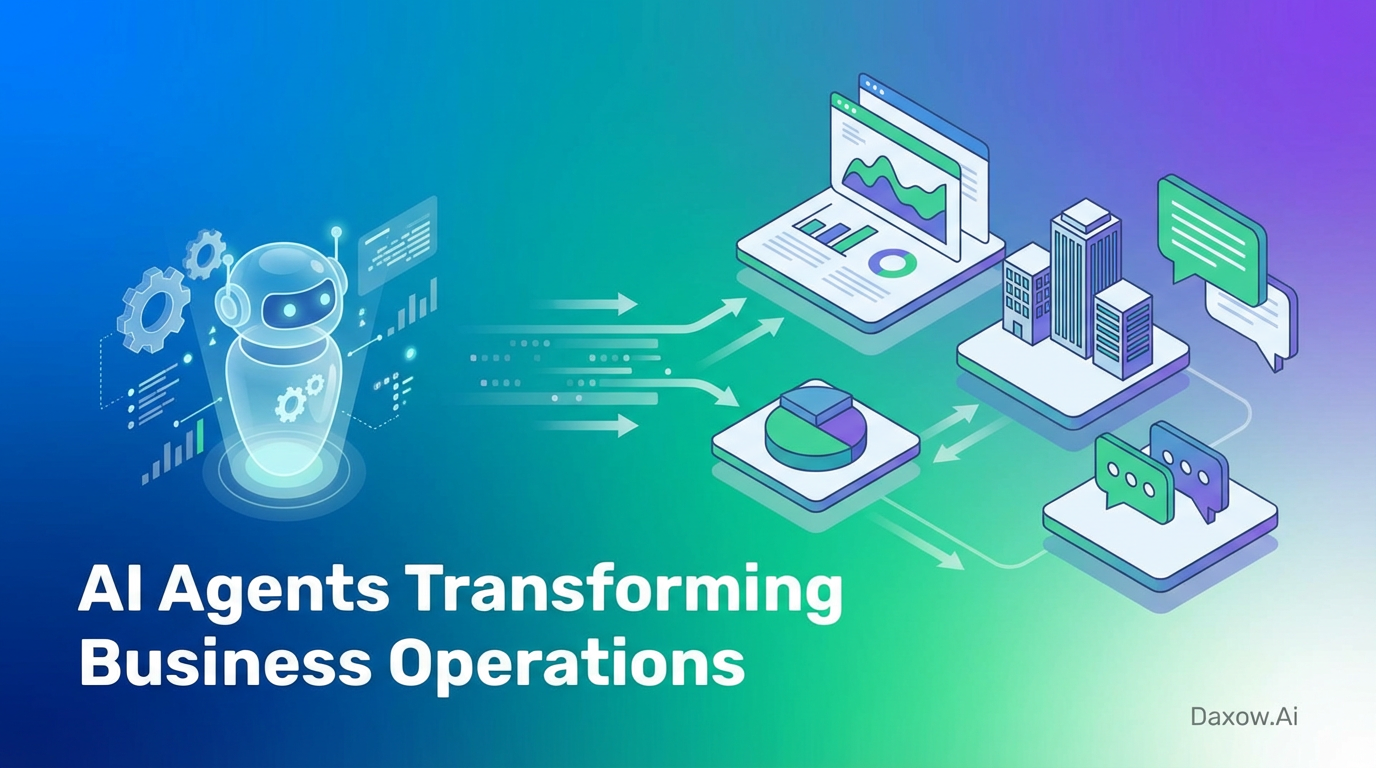
How AI agents automate judgment-based workflows to cut costs, boost ROI, and scale operations. Includes Daxow.ai's deployment roadmap.
AI Agents: Transforming Business Operations with Autonomous Intelligence
Estimated reading time: 15 minutes
Key Takeaways
- AI agents enable autonomous, judgment-based workflows with faster decisions and 24/7 operations.
- They outperform traditional automation by adapting to real-time data and handling complex, multi-step tasks.
- AI agents deliver up to 300% ROI in year one with significant time savings and error reductions.
- Industries from e-commerce to healthcare, finance, real estate, and HR benefit from tailored AI workflows.
- Successful deployment requires staged implementation: readiness, pilots, safety controls, validation, and scaling.
- Daxow.ai combines expertise, secure integrations, and custom AI agents to deliver measurable business impact.
Table of Contents
- AI Agents: Transforming Business Operations with Autonomous Intelligence
- Practical Use Cases: AI Agents Across Industries
- How AI Agents and Automation Drive Business Value
- Implementation Roadmap: Deploying AI Agents Safely and Fast
- Best Practices and Common Pitfalls
- Measuring ROI and Scaling Across the Organization
- Why Partner with Daxow.ai to Build Your AI Agents and Workflow Automation
- Frequently Asked Questions
AI Agents: Transforming Business Operations with Autonomous Intelligence
What are AI agents and why they matter
AI agents are autonomous software systems that perceive context, reason about next steps, and execute tasks via integrations and tools with minimal human intervention. Unlike rule-based scripts, they use memory, retrieval-augmented generation, and decision logic to handle ambiguous inputs and evolving conditions. For decision-makers, the key advantages are: higher automation rates on judgment-based workflows, faster decision cycles, and continuous operations without scaling headcount.
How AI agents differ from traditional automation
Traditional workflow automation follows fixed rules and falters with exceptions. AI agents, by contrast:
- Use multi-source data (CRM, ERP, databases) in real-time.
- Adapt to incomplete or noisy data.
- Escalate or defer to humans when required (human-in-the-loop).
- Execute multi-step processes end-to-end (notifications, system updates, reporting).
This shift yields tangible results: pilots report average ROIs of 300% in year one, 75% time savings on repetitive tasks, and 60–85% reductions in error rates.
Practical Use Cases: AI Agents Across Industries
E-commerce — Personalization, stock optimization, and marketing automation
Use cases:
- Intelligent product configurator that personalizes offers by analyzing browsing patterns, inventory, and external signals (trends, weather).
- Autonomous stock management that predicts demand and triggers replenishment.
Business impact: Up to 30% inventory reduction and 20% logistics cost savings. Marketing budget reallocation increasing ROAS and conversion rates by 25%+.
Daxow approach:
- Integrate data from storefronts, warehouses, and analytics platforms.
- Build an AI agent that recommends dynamic assortments, updates stock levels, and rebalances ad spend in real time.
- Deploy dashboards to monitor lift and automate rollback rules.
Healthcare — Triage, patient routing, and compliance automation
Use cases:
- Patient triage agents that assess symptoms, prioritize appointments, and route urgent cases to clinicians.
- Automated compliance monitoring for device or lab data to reduce regulatory risk.
Business impact: Handle thousands of interactions with consistent routing and reduced clinician load. Improve first-contact resolution and reduce compliance incidents.
Daxow approach:
- Design secure, privacy-first integrations with EHRs and scheduling systems.
- Create HITL safeguards for critical cases and audit logs for regulatory reviews.
- Train models on institution-specific protocols for accuracy and defensibility.
Finance — Reconciliation, anomaly detection, and forecasting
Use cases:
- Automated reconciliations that reduce processing time from days to hours.
- Continuous fraud and anomaly detection with intelligent alerting.
Business impact: Reports of 3.6x ROI and reconciliation cycles compressed to 24 hours. Significant reduction in data errors and faster decision-making.
Daxow approach:
- Connect to ledgers, payment systems, and transaction logs.
- Build AI agents that reconcile, annotate exceptions, and recommend corrective actions.
- Implement role-based approvals and full audit trails to satisfy compliance.
Real Estate — Lead qualification and dynamic pricing
Use cases:
- Lead-scoring agents that qualify inquiries, draft outreach, and schedule viewings.
- Predictive pricing agents that integrate market data and inventory for dynamic valuations.
Business impact: Shorter sales cycles by about 30% and 25–35% more qualified leads.
Daxow approach:
- Integrate MLS feeds, CRMs, and messaging platforms.
- Deploy an agent to score and nurture leads automatically, hand off hot leads to sales, and update CRM records.
HR — Recruiting assistants, onboarding, and employee support
Use cases:
- Candidate screening agents that parse resumes, score matches, and schedule interviews.
- Employee support bots that handle routine HR tasks, time-off requests, and policy questions.
Business impact: Thousands of monthly interactions handled without expanding HR headcount, improving candidate experience and reducing time-to-hire.
Daxow approach:
- Connect applicant tracking systems, HRIS, and knowledge bases.
- Configure multilingual agents with escalation rules for complex cases and metrics tracking for candidate NPS.
How AI Agents and Automation Drive Business Value
Measurable operational improvements
AI agents deliver a combination of efficiency and quality:
- 300% average ROI in year one, with payback in 3–6 months in mature deployments.
- 75% time savings on repetitive tasks and 60–85% error reduction.
- Sales teams often experience 25–47% productivity gains, while customer satisfaction can rise by ~30%.
These improvements come from automating high-volume judgments, eliminating manual handoffs, and enabling proactive actions (e.g., rerouting supply chains).
Strategic advantages beyond cost savings
- 24/7 availability for customer support and operational monitoring.
- Scalable growth without linear headcount increases.
- Faster revenue cycles through accelerated lead qualification and automated follow-up.
- Better forecasting and planning through continuous data ingestion and scenario modeling.
Implementation Roadmap: Deploying AI Agents Safely and Fast
1. Assess readiness and data quality
- Audit data sources (CRM, ERP, logs). Fragmented data can cut accuracy by up to 67%.
- Identify high-impact processes with repetitive judgments (invoicing, lead triage).
Daxow delivers a process analysis that maps systems, data flows, and integration priorities.
2. Define scope and select pilot use cases
- Start with high-ROI pilots such as lead qualification, invoice approval, or chat-support automation.
- Target measurable savings (e.g., 15–40 hours/week saved per workflow).
Daxow helps prioritize pilots using an ROI framework tailored to your KPIs.
3. Design and build with safety controls
- Implement RBAC, data sovereignty, and human-in-the-loop for critical decisions (e.g., refunds >$500).
- Use RAG to ground responses in your knowledge base and reduce hallucinations.
Daxow engineers develop the agent, connectors, and HITL workflows with compliance and auditability baked in.
4. Test, validate, and monitor
- Track semantic telemetry to detect drift; uncontrolled models can lose up to 67% accuracy in 90 days.
- Set human review thresholds and automatic rollback conditions.
Daxow sets up monitoring dashboards, incident workflows, and continuous evaluation routines.
5. Scale securely and ensure adoption
- Ensure continuous data sync, audit trails for compliance (SOX, HIPAA where applicable), and training programs.
- Aim for at least 85% adoption via targeted change management.
Daxow provides rollout plans, training, and a support SLA to maintain momentum.
6. Measure KPIs and iterate
- Monitor time-to-resolution, error rates, NPS, and downstream revenue impacts.
- Use A/B testing to validate changes and expand scope where uplift is proven.
Daxow builds KPI dashboards and ROI calculators that attribute improvements to specific automation features.
Best Practices and Common Pitfalls
- Start with business discovery to avoid over-automation; expectation gaps can reach 41% when use cases are poorly defined.
- Prioritize real-time data and HITL controls to avoid critical failures; HITL reduces failure rates significantly in high-stakes processes.
- Use gradual rollout with clear rollback paths and strict monitoring to prevent unchecked drift.
- Focus on change management: align incentives, train users, and embed automation into team KPIs.
Measuring ROI and Scaling Across the Organization
Typical financial outcomes
- 70% lower task costs in automated processes.
- 30% reduction in customer acquisition cost (CAC) in sales automation scenarios.
- 25–35% increase in qualified leads, and 50% improvement in decision precision for forecasting and risk assessments.
These gains quickly translate into payback windows measured in months, not years.
How Daxow.ai quantifies impact
- We create custom ROI models for each deployment that factor in time saved, error reduction, headcount redeployment, and revenue acceleration.
- Continuous monitoring ensures the models remain accurate as agents learn and business conditions change.
- Our approach ties automation metrics to business KPIs so leaders can see the impact on margin, NPS, and growth.
Why Partner with Daxow.ai to Build Your AI Agents and Workflow Automation
- End-to-end process automation expertise: From discovery to production, Daxow maps workflows, designs agents, and implements integrations with CRMs, ERPs, and legacy systems.
- Custom AI agents that execute real tasks: We build agents capable of multi-step actions — qualifying leads, approving invoices, routing cases, and updating systems automatically.
- Data connectivity and secure integrations: We ensure data quality, sovereignty, and continuous sync across systems to maximize accuracy and compliance.
- Operationalization and governance: RBAC, HITL, audit trails, and monitoring are standard to keep risk low and outcomes predictable.
- Proven ROI focus: We prioritize pilots with measurable returns and scale the ones that deliver the highest value.
- Cross-industry experience: Retail, finance, healthcare, real estate, HR — we bring templates and domain knowledge that shorten time-to-value.
Example engagement flow
- Phase 1: Process discovery and data readiness audit.
- Phase 2: Pilot design with measurable KPIs.
- Phase 3: Build, integrate, and QA the agent.
- Phase 4: Pilot launch, monitor, and iterate based on telemetry.
- Phase 5: Scale to adjacent workflows and continuous improvement.
Introduction
AI Agents: Transforming Business Operations with Autonomous Intelligence is no longer a theoretical advantage — it is a practical strategy for companies seeking to scale, reduce costs, and improve customer outcomes. Business leaders face pressure to automate repetitive work, accelerate decisions, and maintain service 24/7. AI agents combine advanced models, real-time integrations, and process automation to deliver measurable gains in productivity while reducing manual tasks and operational risk. This article explains how AI agents work, where they create the most value, and how Daxow.ai designs and deploys custom AI automation to convert these capabilities into real business outcomes.
Frequently Asked Questions
What distinguishes AI agents from traditional automation?
AI agents differ by using real-time multi-source data, adapting to incomplete or ambiguous inputs, executing complex multi-step workflows, and involving humans only when necessary, whereas traditional automation relies on rigid, rule-based processes.
How quickly can companies expect ROI from implementing AI agents?
Companies often see average ROIs of 300% within the first year, with payback periods ranging from 3 to 6 months depending on deployment scale and process complexity.
Which industries benefit most from AI agents?
AI agents deliver value across industries including e-commerce, healthcare, finance, real estate, and HR by automating domain-specific workflows while improving accuracy, speed, and compliance.
How does Daxow.ai ensure AI agent deployments are secure and compliant?
Daxow.ai integrates role-based access controls (RBAC), human-in-the-loop (HITL) safeguards, continuous monitoring, audit trails, and data sovereignty measures to maintain compliance with regulations like SOX and HIPAA.