
AI Agents: Transforming Enterprise Automation & ROI
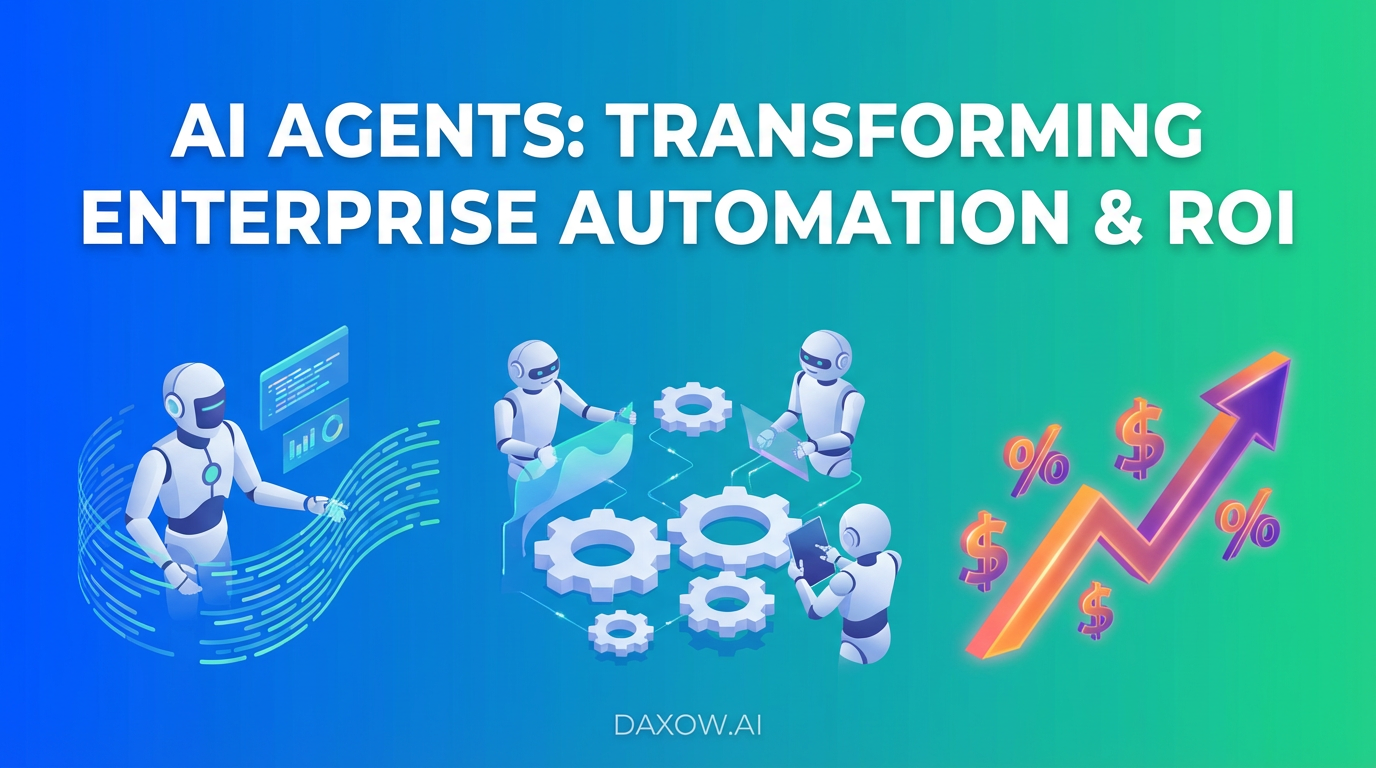
Guide to deploying AI agents for enterprise automation — use cases, ROI, governance, and a step-by-step implementation blueprint by Daxow.ai.
AI Agents: Revolutionizing Business Automation for the Modern Enterprise
Estimated reading time: 15 minutes
Key Takeaways
- AI agents automate complex workflows across multiple systems, reducing manual tasks and boosting productivity.
- Use cases span industries including e-commerce, finance, healthcare, customer support, real estate, and HR.
- Implementing AI agents involves careful planning: needs assessment, platform choice, building, pilot testing, scaling, and governance.
- Measurable ROI includes cost reduction, error minimization, improved decision speed, and higher employee engagement.
- Daxow.ai offers end-to-end AI agent design, integration, and operational support tailored to business needs.
Table of Contents
- AI Agents: Revolutionizing Business Automation for the Modern Enterprise — what it means for your organization
- Practical Use Cases: How AI agents enable AI automation across industries
- Implementing AI Agents: a practical, step-by-step blueprint
- Reducing manual work and boosting productivity — measurable outcomes and ROI
- Governance, security, and human-AI collaboration
- How Daxow.ai designs AI agents that execute real tasks and deliver ROI
- Practical examples and quick-start blueprints
- Common challenges and how to overcome them
- Next steps — start your AI automation journey
- Frequently Asked Questions
AI Agents: Revolutionizing Business Automation for the Modern Enterprise — what it means for your organization
AI agents are autonomous software programs powered by large language models, machine learning, and generative AI. Unlike rule-based bots, these agents reason, adapt to context, and orchestrate multi-step workflows across systems without constant human supervision.
Key capabilities:
- Autonomy: Execute tasks end-to-end, including exception handling.
- Reasoning: Interpret ambiguous inputs and make decisions using context.
- Integration: Bridge CRMs, ERPs, support platforms, and data lakes to create unified workflows.
- 24/7 scalability: Operate continuously without proportional headcount increases.
Business impact:
- Reduce manual tasks associated with data entry, classification, and routing.
- Improve productivity by reallocating human effort to innovation and relationship-building.
- Enhance accuracy and compliance through consistent execution and audit trails.
- Accelerate decision-making with real-time synthesis of distributed data.
Practical Use Cases: How AI agents enable AI automation across industries
E-commerce and retail
Use case:
- Inventory optimization agent analyzes sales patterns, supply lead times, and seasonal demand to trigger automated restocking and pricing adjustments.
Business value:
- Reduce stockouts and overstocks, improving sales and working capital.
- Personalization agents deliver targeted product recommendations and automated follow-up, improving conversion rates.
Customer support automation
Use case:
- A multi-agent system triages incoming tickets, auto-resolves common issues, escalates complex cases to specialists, and drafts response suggestions that agents can approve.
Business value:
- Reduce response times, increase first-contact resolution, and lower support costs while improving customer satisfaction.
Finance and accounting
Use case:
- Virtual CFO agents reconcile transactions, detect anomalies indicating fraud, produce draft compliance reports, and manage cash flow forecasts.
Business value:
- Faster month-end close, reduced audit times, and risk mitigation through continuous anomaly detection.
Healthcare
Use case:
- Patient triage agents synthesize EHR inputs, symptom descriptions, and scheduling rules to recommend next steps or route cases to clinicians.
Business value:
- More efficient use of clinical time, fewer administrative delays, and improved patient throughput.
Real estate and property management
Use case:
- Agents extract structured data from listings, automate syndication across platforms, and sync leads with CRM systems while providing automated valuation insights.
Business value:
- Faster listing-to-lead cycles, improved pricing decisions, and reduced manual data maintenance.
Human resources
Use case:
- Hiring agents screen resumes, schedule interviews, manage onboarding checklists, and monitor early employee engagement signals.
Business value:
- Shorter time-to-hire, standardized onboarding, and improved retention predictions.
These use cases show how agentic AI moves beyond point automation to orchestrate cross-functional flows and handle exceptions — delivering measurable outcomes such as the 67% productivity uplift reported in large-scale deployments.
Implementing AI Agents: a practical, step-by-step blueprint
1. Assess needs and prioritize opportunities
- Conduct a process audit to identify repetitive, data-intensive, or siloed workflows.
- Prioritize based on ROI potential: volume of transactions, cost per manual task, customer impact, and regulatory risk.
- Start small with pilot processes that produce quick wins (e.g., support ticket triage, invoice processing).
2. Select the right platform and architecture
- Choose LLM and agent platforms that support multi-agent orchestration, secure data access, and enterprise integrations.
- Plan for airtight data governance, logging, and human-in-the-loop mechanisms.
- Ensure the platform supports connectors to CRMs, ERPs, ticketing systems, and data stores.
3. Build, train, and validate agents
- Gather and cleanse domain data; create training sets for LLMs and rules for deterministic tasks.
- Design agent flows: triggers, decisions, actions, and exception paths.
- Test in sandbox environments and run shadow trials to compare agent outputs with human performance.
4. Pilot and integrate with systems
- Launch limited pilots to validate performance against KPIs (time saved, error rate reduction, cost per transaction).
- Integrate agents with downstream systems for full workflow automation: e.g., CRM updates, billing, inventory adjustments.
- Include human oversight for edge cases and continuous feedback loops for retraining.
5. Scale, monitor, and govern
- Roll out incrementally across departments, standardizing connectors and observability dashboards.
- Monitor agent performance, user satisfaction, and compliance metrics.
- Implement ethical and security controls, including access policies and audit trails.
Daxow.ai’s role at each step:
- Assessment: We map workflows and identify high-impact automation candidates.
- Design: We architect multi-agent flows tailored to your tech stack and compliance needs.
- Build & Integrate: We develop agents, connect APIs, and embed workflow automation across systems.
- Operate & Improve: We provide monitoring, retraining, and governance to sustain gains and scale ROI.
Reducing manual work and boosting productivity — measurable outcomes and ROI
AI agents deliver both immediate operational savings and long-term strategic value.
Quantifiable benefits:
- Labor cost reduction: Replace repetitive tasks with automated agent flows, lowering operational headcount needs or reallocating staff to higher-value work.
- Error reduction: Consistent execution cuts rework and compliance breaches.
- 24/7 operations: Continuous processing without shift premiums or latency.
- Speed-to-decision: Real-time data synthesis speeds approvals, cash forecasts, and customer resolutions.
Example metrics to track:
- Time saved per task (hours/week)
- Reduction in error rate (%)
- Ticket resolution time reduction (hours)
- Increase in sales conversion (%) from automated lead qualification
- Time-to-hire reduction (days)
Case evidence:
Large enterprises adopting agentic architectures report productivity uplifts in the tens of percent. These improvements stem from automating long-tail exceptions, synthesizing data across legacy systems, and enabling staff to focus on growth-oriented activities.
Governance, security, and human-AI collaboration
Governance and risk control
- Implement transparent logging and explainability for agent decisions.
- Enforce role-based access controls for data and agent execution.
- Maintain retraining pipelines and bias monitoring to ensure consistent performance.
Human-in-the-loop design
- Build approval gates for high-risk decisions and create escalation pathways.
- Use agents to augment human judgment — provide suggested actions rather than blind automation where context is critical.
- Maintain continuous feedback loops to capture exceptions and refine agent behavior.
How Daxow.ai designs AI agents that execute real tasks and deliver ROI
Daxow.ai specializes in end-to-end business automation using AI agents and workflow automation. Our approach is structured to produce rapid ROI while reducing implementation risk.
Our typical engagement:
- Discovery workshop: Map processes, stakeholders, and technology landscape.
- Process selection: Prioritize based on impact and feasibility.
- Rapid prototyping: Build an initial agent to demonstrate value within weeks.
- Integration and security: Connect agents to CRMs, ERPs, ticketing systems, and internal databases with enterprise-grade security.
- Pilot and measure: Validate KPIs and iterate with business users.
- Scale and operate: Deploy across teams with monitoring, governance, and continuous improvement.
Why Daxow.ai:
- Domain-agnostic expertise: We deliver solutions across technology, e-commerce, real estate, finance, healthcare, and more.
- Custom integration capability: We integrate agents into existing stacks to avoid rip-and-replace projects.
- Focus on measurable outcomes: We set KPI targets from day one and align automation to financial and operational objectives.
- Operational support: We provide monitoring, retraining, and governance to sustain long-term benefits.
Practical examples and quick-start blueprints
Sales automation blueprint (B2B SaaS)
Objective:
- Automate lead qualification and handover to sales.
Components:
- Lead ingestion agent that enriches leads using internal CRM data.
- Qualification agent scoring leads against ideal-customer-profile rules.
- Meeting-scheduling agent that coordinates calendars and prepares a context brief for reps.
Expected outcomes:
- Higher qualified lead throughput, faster response time, and improved conversion rates.
Customer support automation blueprint (Retail)
Objective:
- Reduce average handling time and increase automation rate.
Components:
- Support intake agent that classifies and routes tickets.
- Self-service agent that resolves common queries via knowledge base integration.
- Escalation agent that packages context and recommended responses for specialists.
Expected outcomes:
- Lower support costs, higher CSAT, and consistent SLA adherence.
Finance automation blueprint (Mid-market)
Objective:
- Streamline invoice processing and exceptions handling.
Components:
- Data extraction agent for invoices and receipts.
- Reconciliation agent that matches invoices to purchase orders and flags discrepancies.
- Approval agent that triggers payments when rules are met and routes exceptions for human review.
Expected outcomes:
- Faster AP cycles, fewer late payments, and reduced manual reconciliation hours.
Common challenges and how to overcome them
- Data quality and access: Invest in data harmonization before agent deployment. Daxow provides connectors and ETL support.
- Legacy systems and integrations: Use modular adapters and API wrappers to avoid expensive system replacement.
- Change management: Train teams on new workflows and maintain clear human oversight during transition phases.
- Over-automation risk: Start with semi-automated flows and expand autonomy as trust and performance grow.
Next steps — start your AI automation journey
Adopting AI agents is a strategic move that transforms repetitive workflows into scalable, intelligent processes. Daxow.ai helps organizations convert assessment into action with a proven, low-risk path to measurable automation outcomes.
If you are ready to:
- Reduce manual tasks that consume time and margins,
- Increase productivity across support, sales, finance, HR, or operations,
- Deploy AI agents that integrate with your existing systems and run mission-critical workflows,
Book a free consultation with Daxow.ai to assess your current processes and identify the highest-impact automation opportunities. Request a process analysis for your company and receive a tailored blueprint showing expected ROI and a pilot plan.
Contact us today to build a custom AI system and start automating effectively.
Frequently Asked Questions
What distinguishes AI agents from traditional automation bots?
AI agents leverage advanced reasoning and adapt to complex, ambiguous contexts autonomously, unlike rule-based bots which follow fixed scripts and require frequent human oversight.
How can AI agents improve customer support?
AI agents triage tickets, auto-resolve common issues, and escalate complex queries, which reduces response times, improves resolution rates, lowers costs, and enhances customer satisfaction.
Are AI agents secure to deploy with sensitive data?
Yes. Daxow.ai ensures platforms have robust data governance, role-based access controls, logging, and compliance mechanisms to safeguard sensitive information during AI automation.
What industries benefit most from AI agent automation?
Industries with repetitive, multi-system workflows such as finance, healthcare, retail, real estate, and human resources see significant benefits from AI agents.