
AI Agents: Transform Business Operations with Automation
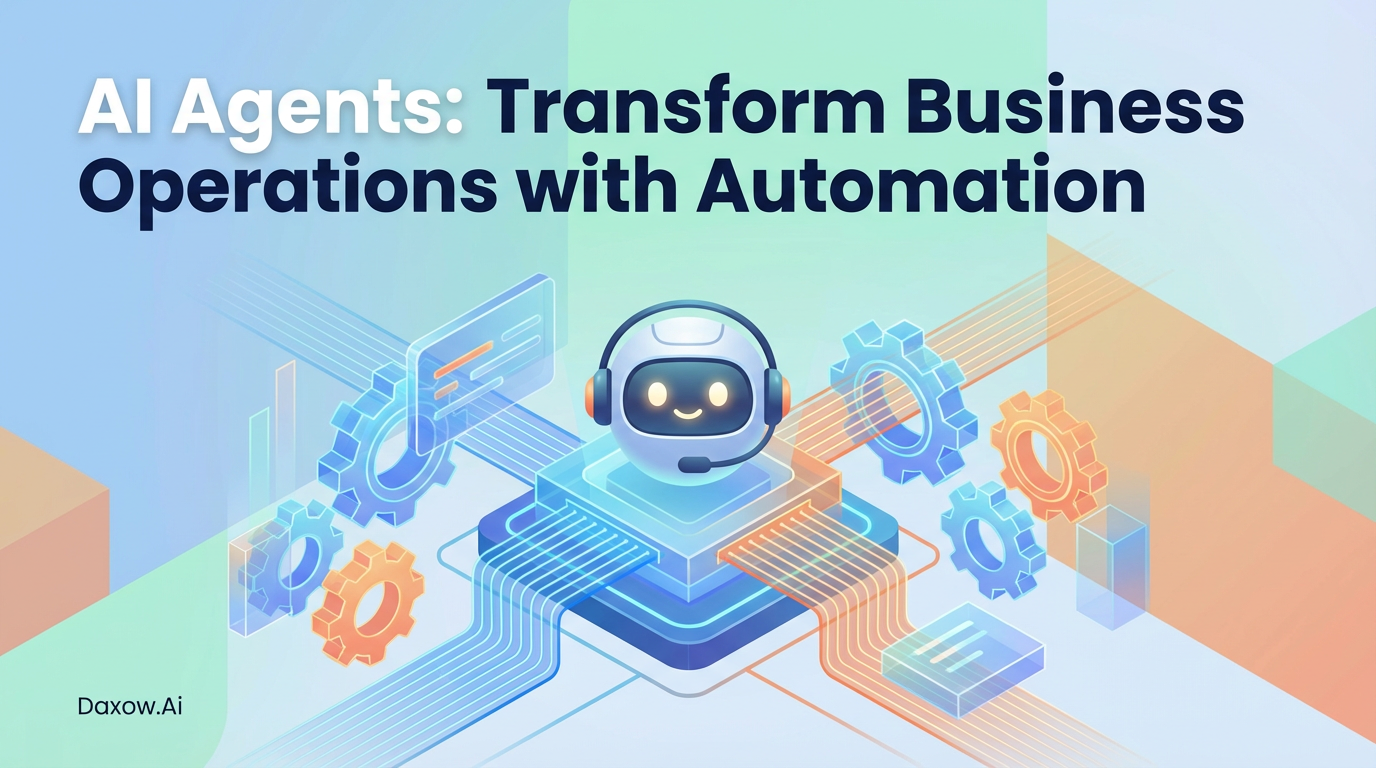
How AI agents automate workflows, boost productivity, cut costs, and deliver rapid ROI across industries, plus implementation steps and Daxow.ai's end-to-end services.
AI Agents: Transforming Business Operations with Intelligent Automation
Estimated reading time: 12 minutes
Key Takeaways
- AI agents deliver adaptable, autonomous automation that outperforms traditional rule-based systems.
- Practical AI use cases span e-commerce, healthcare, finance, real estate, and HR with measurable ROI.
- Successful implementation requires data readiness, orchestration, governance, and incremental pilots.
- Daxow.ai provides end-to-end AI automation services, driving cost reductions, productivity boosts, and faster ROI.
- Governance, risk management, and continuous improvement are critical for sustainable AI automation success.
Table of Contents
- AI Agents: Transforming Business Operations with Intelligent Automation
- What AI Agents Mean for Businesses
- Practical Use Cases Across Industries
- How AI Agents and Automation Drive Value
- Implementation Steps and Best Practices
- How Daxow.ai Builds and Delivers AI Automation
- ROI, Metrics, and Building a Business Case
- Putting It Into Practice — Example Projects and Use Cases
- Governance, Ethics, and Long-Term Operations
- Frequently Asked Questions
AI Agents: Transforming Business Operations with Intelligent Automation
What an AI agent is — and why it matters
AI agents are autonomous software systems powered by advanced models that perceive an environment, make decisions, and execute actions to achieve goals. Unlike rule-based bots, AI agents handle variable, judgment-based tasks such as lead qualification, complex customer inquiries, and compliance checks. They integrate with CRMs, ERPs, sensors, and knowledge bases via APIs and orchestration layers to act on real-time data.
Key business advantages:
- Adaptability: Agents work with incomplete or changing data and improve over time.
- Scale without linear headcount: Repetitive judgment work shifts from people to agents.
- Measurable ROI: Proven benchmarks show dramatic returns in marketing, sales, and support.
How AI agents differ from traditional automation
Traditional automation executes deterministic rules. AI agents add perception, reasoning, and action. This enables them to:
- Resolve issues using contextual understanding rather than rigid scripts.
- Forecast demand and trigger operational changes autonomously.
- Combine structured and unstructured data sources for richer decisions.
The result: workflows that reduce manual tasks while increasing reliability and business insight.
What AI Agents Mean for Businesses
Business outcomes and benchmarks
Real-world rollouts show AI agents drive measurable outcomes:
- Up to 300% ROI in marketing campaign optimization by reallocating budgets based on buyer signals.
- 25–35% productivity boosts across sales and support teams when agents handle qualification and Tier-1 support.
- 98% first-contact resolution in agent-powered customer support flows, reducing churn and support costs.
- 20–30% reductions in logistics and inventory through predictive forecasting and reconciliation automation.
- Ability to handle hundreds of thousands of interactions, allowing healthcare and large enterprises to absorb peak demand without proportional staffing increases.
Why leaders should care
For business owners and decision-makers, AI agents are a lever to:
- Reduce operational costs and improve gross margins.
- Shorten sales cycles and raise win rates through consistent lead follow-up.
- Improve customer lifetime value with faster, higher-quality responses.
- Free staff to focus on strategic initiatives by removing repetitive workload.
Practical Use Cases Across Industries
E-commerce
Use cases:
- Campaign optimization: Agents analyze buyer signals and reallocate ad spend in real time to improve conversions and lower CAC.
- Customer support automation: AI agents provide instant answers, process returns, and escalate with contextual history.
Impact:
- 300% ROI on certain campaigns, 25% higher conversion rates, and 30% lower CAC.
- $30K+/month savings by preventing churn through faster resolution.
Healthcare
Use cases:
- Patient triage and symptom checkers that route cases appropriately.
- Predictive maintenance for clinical equipment using sensor telemetry.
Impact:
- Scales to handle 600,000+ interactions with reduced clinician load.
- Faster response times in peak periods and minimized equipment downtime.
Finance and Banking
Use cases:
- Automated reconciliation and invoice approvals.
- Compliance monitoring and anomaly detection for transaction flows.
Impact:
- Processing reduced from days to minutes.
- 20–30% cost reductions in back-office operations.
Real Estate
Use cases:
- Cross-channel lead qualification and enrichment.
- Pricing simulations and inventory scenario planning.
Impact:
- 25–35% more qualified leads and 30% shorter sales cycles.
- Real-time CRM updates feeding sales actions.
HR and Large Enterprise Services
Use cases:
- Applicant screening and interview scheduling.
- Automated employee support for payroll, time-off, and IT queries.
Impact:
- Enterprises report handling 20,000+ monthly conversations and serving 12,000+ employees with reduced time-to-hire.
- 80% of IT/HR queries resolved by agents with a 40% productivity boost in affected departments.
How AI Agents and Automation Drive Value
From time savings to business decisions
AI agents provide immediate time savings and compound value by:
- Delivering continuous intelligent insights (e.g., pipeline health, supplier performance).
- Reducing errors and manual reconciliation through autonomous workflows.
- Providing human-in-the-loop (HITL) checkpoints for high-risk decisions to maintain control and compliance.
Integration and orchestration
Agents work best when orchestrated across systems:
- Orchestration layers connect agents to CRMs, ERPs, data warehouses, and knowledge bases.
- Retrieval-Augmented Generation (RAG) and monitoring enable accurate, auditable decisions.
- Circuit breakers and approval gates prevent undesirable autonomous actions.
Governance and risk management
Robust governance reduces failure rates and maintains trust:
- Use HITL for sensitive approvals (for example, refunds above a threshold).
- Monitor semantic telemetry to detect data drift and accuracy loss.
- Prioritize safe deferrals over hallucinations to protect customer experience.
Implementation Steps and Best Practices
A practical roadmap
- Identify a high-value pilot: Choose a frequent workflow with clear KPIs (e.g., lead qualification that affects pipeline conversion or Tier-1 support response times).
- Assess data readiness: Audit data sources for freshness and completeness; unify structured data through APIs.
- Design the orchestration: Build RAG retrieval, monitoring, audit logs, and HITL gates.
- Pilot and measure: Run a controlled pilot, track KPIs (hours saved, resolution time, cost per conversion), and iterate.
- Scale with governance: Expand to adjacent processes while maintaining telemetry and retraining to avoid drift.
Common pitfalls and how to avoid them
- Over-automation: Automate incrementally and keep fallback options to human operators.
- Data drift: Schedule regular model and knowledge updates; use semantic telemetry every 60–90 days.
- Misaligned KPIs: Define success metrics tied to business outcomes (revenue, CAC, resolution time) not just technical accuracy.
How Daxow.ai Builds and Delivers AI Automation
End-to-end service model
Daxow.ai combines consulting, engineering, and operations to convert workflows into automated systems:
- Discovery: Map current workflows and identify automation candidates using business-driven KPIs.
- Design: Architect custom AI agents and orchestration that connect to your toolset.
- Build: Implement integrations, RAG, HITL flows, and monitoring dashboards.
- Deploy & Operate: Roll out pilots, measure outcomes, and scale with continuous improvement.
Practical capabilities offered by Daxow.ai
- Custom AI agents that execute real tasks across sales, support, finance, HR, and operations.
- Workflow automation that reduces manual tasks and improves SLA adherence.
- Customer support automation, from chatbots to full-resolution agents integrated with CRM contexts.
- Sales automation and lead qualification engines that increase conversion rates and shorten cycles.
- Document automation and data extraction that eliminate manual reconciliations and reduce errors.
- System integrations across enterprise stacks (CRM, ERP, data lakes) to enable real-time decisioning.
Measurable benefits Daxow.ai delivers
- Reduced operational costs through automation of high-volume tasks.
- Improved productivity measured as hours reclaimed and higher throughput per employee.
- Faster ROI via small, targeted pilots that prove value before scaling.
- Better CX through 24/7 responsiveness and consistent, contextual interactions.
ROI, Metrics, and Building a Business Case
Benchmarks you can expect
When implemented correctly, AI agents commonly deliver:
- 25–47% productivity gains in targeted teams.
- 30% inventory or logistics reductions through predictive forecasting and automated reconciliation.
- 90% CX ROI when customer support automation includes HITL for critical scenarios.
- Rapid cost-per-action improvements, turning manual days-long processes into minute-level workflows.
How to calculate a pilot ROI
- Baseline: measure current manual hours, error rates, conversion rates, and handling times.
- Pilot gains: estimate time saved from automating specific steps, accuracy improvements, and uplift in conversion.
- Cost: include integration, development, model hosting, and monitoring.
- Break-even: many pilots reach payback within months when high-frequency repetitive tasks are automated.
Putting It Into Practice — Example Projects and Use Cases
Case example — Mid-market e-commerce brand
Problem: High cart abandonment and expensive manual support.
Solution: Daxow.ai built an AI agent to optimize ad spend in real-time and a support automation flow for returns.
Result: 25% higher conversions, 30% lower CAC, and a 300% ROI on the marketing pilot within the first quarter.
Case example — Healthcare provider
Problem: Overloaded phone lines and long triage wait times.
Solution: AI-driven triage agent connected to patient records and clinician schedules with escalation rules.
Result: Scaled to handle peak demand and reduced unnecessary clinician callbacks while improving patient satisfaction.
Case example — Financial services middle office
Problem: Slow reconciliations and compliance reporting bottlenecks.
Solution: Agents automated invoice approvals and anomaly detection with HITL for exceptions.
Result: Processing time reduced from days to minutes and a 20–30% reduction in processing costs.
Governance, Ethics, and Long-Term Operations
Design for trust
- Implement transparent audit logs and explainability features for decisions that affect customers and compliance.
- Establish escalation paths and human accountability for agent decisions with financial or regulatory impact.
Continuous improvement
- Track semantic telemetry and user feedback to retrain and refine agents.
- Plan model refresh cycles and knowledge base updates to avoid performance decay.
Frequently Asked Questions
What is an AI agent and how is it different from traditional automation?
An AI agent is an autonomous software system that perceives its environment, reasons about it, and takes actions to achieve goals. Unlike traditional automation that follows fixed rules, AI agents handle complex, judgment-based tasks and adapt over time using data integration and advanced models.
How can businesses measure the ROI of AI agents?
ROI is measured by comparing baseline operational metrics (manual hours, error rates, conversion, costs) with post-automation performance. Typical benefits include increased productivity (25–47%), cost reductions (20–30%), and faster resolution times that translate into direct financial impact.
What industries benefit most from AI agent automation?
Key industries include e-commerce, healthcare, finance and banking, real estate, and HR/large enterprise services. These sectors benefit from AI agents handling complex workflows such as lead qualification, patient triage, compliance, and employee support with measurable gains.
How does Daxow.ai support companies implementing AI agent automation?
Daxow.ai offers end-to-end services from discovery and design to build, deployment, and continuous operation. Their expertise includes custom AI agents, workflow orchestration, HITL governance, and integrations across enterprise systems to ensure business-driven automation with rapid ROI.