
AI Agents for Business Automation: A Practical Guide
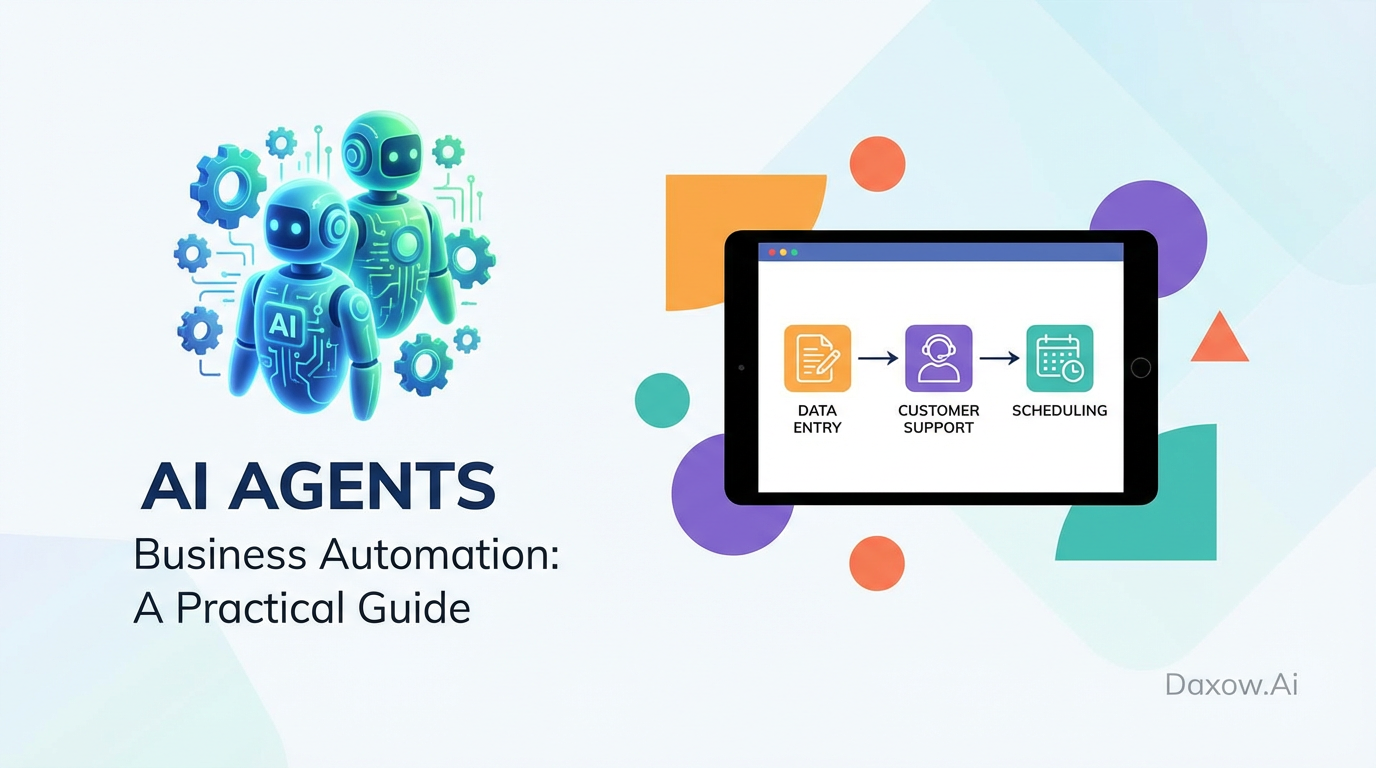
Practical guide to AI agents for business automation: how they work, industry use cases, ROI, implementation roadmap, and Daxow.ai deployment services.
AI Agents for Business Automation: Transforming Operations and Driving Growth — A Practical Guide for Decision-Makers
Estimated reading time: 12 minutes
Key Takeaways
- AI agents automate complex workflows by combining natural language understanding, planning, and tool integrations to drive efficiency and scalability.
- Core components such as LLM cores, memory, planning, and orchestration engines enable adaptable and reliable business automation.
- Strategic use cases span industries including e-commerce, healthcare, finance, real estate, HR, manufacturing, and supply chain management.
- Clear implementation roadmaps and governance are essential for minimizing risk and maximizing measurable ROI from AI automation.
- Daxow.ai offers end-to-end custom AI agent solutions focused on business-first automation, integration, security, and continuous improvement.
Table of Contents
- AI Agents for Business Automation: Transforming Operations and Driving Growth
- Strategic Use Cases and Industry Examples
- How AI Agents Deliver Measurable Value to Your Business
- Implementation Roadmap — A Low-Risk, High-Impact Approach
- Best Practices and Governance
- How Daxow.ai Helps You Implement AI Agents and Full Workflow Automation
- Practical Checklist for Leaders Ready to Act
- Frequently Asked Questions
AI Agents for Business Automation: Transforming Operations and Driving Growth
What is an AI agent and why it matters for business automation
AI agents are autonomous software systems that interpret natural language tasks, reason over data, and execute sequences of actions across applications. Unlike traditional rule-based RPA, AI agents are adaptive: they learn from context, handle exceptions, and collaborate in multi-agent setups. This flexibility enables them to tackle decision-heavy, multi-step workflows that were previously impractical to automate.
Immediate business impacts:
- Reduce manual tasks by automating repetitive decision points and data entry.
- Increase productivity by up to 40% and reduce processing times by nearly 50% in targeted workflows.
- Improve accuracy and compliance through audit trails and validation steps.
- Scale operations without linear increases in headcount.
Core components of AI agents (and their business value)
Understanding the building blocks helps decision-makers prioritize capabilities for pilot projects:
- LLM Core: Interprets natural-language requests and formulates plans. Business value: intuitive interfaces and flexible task definitions.
- Memory Module: Retains context across interactions. Business value: continuity across multi-step processes and reduced rework.
- Planning Module: Sequences actions and manages branches/exceptions. Business value: reliable automation of dynamic workflows.
- Tool Integration Layer: Connects to CRM, ERP, ticketing, and databases via APIs. Business value: executes actions across siloed systems.
- Orchestration Engine: Coordinates multiple agents and tasks. Business value: enterprise-grade reliability and scalability.
- Decision Engine: Applies rules, scoring, or reinforcement learning to choose actions. Business value: improved decision quality and risk mitigation.
Strategic Use Cases and Industry Examples
E-commerce — inventory, fulfillment, and personalized CX
- Use case: An AI agent monitors stock levels, forecasts demand, triggers automated reorders, and coordinates fulfillment across warehouses and carriers.
- Outcome: Fewer stockouts, reduced excess inventory, and faster order-to-cash cycles.
- Sales automation: Agents handle lead qualification from incoming inquiries, create CRM records, and schedule follow-ups, improving conversion rates.
Healthcare — patient intake, scheduling, and incident response
- Use case: An intake agent collects patient data, verifies documents, populates EHR fields, and manages appointment scheduling across providers.
- Outcome: Faster onboarding, fewer scheduling conflicts, and better compliance with audit trails.
- Incident response: Agents detect anomalies in patient data, assemble relevant records, and alert clinicians for triage, improving response times.
Finance — fraud, compliance, and reporting
- Use case: Decision-support agents analyze transactions to detect fraud patterns, flag exceptions, and assemble audit-ready reports.
- Outcome: Faster detection, reduced false positives, and streamlined compliance processes.
- Reporting automation: Agents query multiple data sources, reconcile figures, and deliver formatted reports to stakeholders.
Real estate — lead qualification, lease workflows, and market analysis
- Use case: Agents verify applicant documents, schedule viewings by coordinating calendars, generate lease agreements, and confirm payments.
- Outcome: Shorter rental cycles, reduced administrative overhead, and higher lead-to-lease conversion.
- Market synthesis: Agents aggregate property and market data to produce valuation insights for agents and investors.
HR — recruiting, onboarding, and compliance
- Use case: Recruitment agents screen resumes, score candidates against role profiles, coordinate interview schedules, and provision starter accounts when hired.
- Outcome: Faster time-to-hire and reduced manual admin work for HR teams.
- Compliance reporting: Agents gather HRIS data, validate against policies, and surface exceptions for human review.
Manufacturing and supply chain — maintenance and production orchestration
- Use case: Multi-agent systems predict equipment failures, schedule preventive maintenance, sequence production runs, and adjust procurement.
- Outcome: Higher uptime, optimized manufacturing schedules, and lower supply chain disruption risk.
How AI Agents Deliver Measurable Value to Your Business
Quantifying ROI and KPIs
AI agents deliver value across cost, revenue, and risk dimensions:
- Productivity gains: Organizations report productivity increases in targeted functions between 40% and 67%.
- Faster processing: Certain workflows see processing times reduced by nearly 50%.
- Time reclaimed: Teams can regain dozens of hours per month previously spent on manual tasks.
- KPIs to track: time-to-complete tasks, error rate reduction, employee time reallocation, lead-to-conversion times, SLA compliance, and cost-per-transaction.
Where ROI comes from
- Cost reduction: automated processing replaces repetitive human work.
- Revenue growth: faster sales cycles, personalized CX, and better lead qualification.
- Risk mitigation: automated compliance checks and audit trails reduce fines and rework.
- Scalability: once integrated, agents scale to new teams and geographies with marginal incremental cost.
Implementation Roadmap — A Low-Risk, High-Impact Approach
Phase 1 — Opportunity identification and prioritization
- Map core processes across functions.
- Score opportunities by frequency, complexity, error rate, and ROI potential.
- Prioritize processes where reasoning, context, or multi-step coordination is required.
Phase 2 — Define scope, metrics, and governance
- Set clear success metrics (time saved, error reduction, conversion lift).
- Define autonomy levels: what the agent can decide autonomously and when it escalates.
- Establish data access, security, and compliance boundaries.
Phase 3 — Pilot and incremental build
- Start with a bounded pilot (e.g., automated report generation or lead qualification).
- Connect to one or two systems (CRM, calendar, ticketing).
- Add memory and planning capabilities after validating core flows.
- Iterate quickly based on user feedback and measured KPIs.
Phase 4 — Scale and orchestrate
- Expand integrations to ERP, billing, and third-party services.
- Deploy multi-agent orchestration for end-to-end workflows.
- Implement monitoring, audit logs, and dashboards for business owners.
Phase 5 — Continuous improvement
- Use behavioral telemetry and outcomes to retrain decision models.
- Re-engineer processes to exploit AI strengths.
- Embed feedback loops for humans-in-the-loop when needed.
Best Practices and Governance
Process design and human-centered adoption
- Reframe processes for agent strengths: automate decision checkpoints, not entire business judgment.
- Position agents as collaborators: clear handoff points, explainability for users, and simple override mechanisms.
Security, compliance, and auditability
- Enforce role-based permissions and secure API credentials.
- Maintain immutable audit trails for each agent action.
- Validate data lineage for compliance-sensitive processes.
Monitoring and fail-safe mechanisms
- Track performance and exception rates.
- Implement escalation workflows before full autonomy.
- Provide clear dashboards for operations and support teams.
How Daxow.ai Helps You Implement AI Agents and Full Workflow Automation
Our end-to-end approach
Daxow.ai partners with your organization from discovery to long-term operation:
- Discovery & Process Analysis: We map workflows, identify automation candidates, and quantify expected gains.
- Solution Design: We design custom AI agents tailored to your business logic, data flows, and compliance needs.
- Integration & Development: We connect agents to your CRM, ERP, ticketing, and other systems with secure APIs and middleware.
- Pilot Delivery: We launch bounded pilots to validate business value and refine models.
- Scale & Orchestration: We implement multi-agent orchestration and rollbots across teams.
- Ops & Monitoring: We provide monitoring, retraining, and SLA-backed support to sustain improvements.
What makes Daxow.ai different
- Business-first automation: We focus on workflows that deliver measurable ROI, not technology for its own sake.
- Custom AI agents: Each agent is purpose-built — memory modules, planners, and decision engines tuned to your domain.
- System integrations: We build seamless connectors to CRM, ERP, HRIS, billing, and logistics systems to execute tasks end-to-end.
- Governance and security: We enforce enterprise-grade auditability and data governance from day one.
- Cross-industry experience: We apply proven patterns from e-commerce, finance, healthcare, real estate, and manufacturing to accelerate delivery.
Practical Checklist for Leaders Ready to Act
- Identify three high-frequency, multi-step processes that consume staff time.
- Confirm data accessibility: can your agents reach the required systems via APIs?
- Secure stakeholder buy-in: define SLA targets and KPIs.
- Plan a 3–6 month pilot timeline with measurable success criteria.
- Budget for integration, monitoring, and continuous improvement — not just initial development.
Conclusion and next steps
AI agents are a strategic lever to move from tactical business automation to transformative workflow automation. They reduce manual tasks, boost productivity, and create resilient, scalable operations when designed and governed correctly. Organizations that pilot agents in high-impact workflows can expect concrete ROI through cost reduction, revenue acceleration, and improved compliance.
Daxow.ai builds custom AI systems that design, deploy, and operate AI agents tailored to your processes and systems. We focus on measurable outcomes, end-to-end integrations, and governance so your teams can reclaim time for strategic work while our agents execute routine and decision-heavy tasks safely and reliably.
Book a free consultation with Daxow.ai or request a process analysis for your company to identify the top automation opportunities and start a pilot that delivers real business value. Contact us to build a custom AI system and begin transforming operations today.
Frequently Asked Questions
What distinguishes AI agents from traditional automation tools?
AI agents combine natural language understanding, adaptive learning, and decision-making capabilities, enabling automation of complex, multi-step workflows beyond rule-based systems.
Which industries benefit most from AI agent automation?
Industries such as e-commerce, healthcare, finance, real estate, HR, and manufacturing see substantial gains by automating decision-heavy and data-intense processes.
How does Daxow.ai ensure security and compliance in AI automation?
Daxow.ai enforces role-based access, secure API connectivity, immutable audit trails, and data lineage validation to ensure enterprise-grade security and compliance.
What is the recommended timeline for implementing AI agents?
A typical pilot runs 3–6 months, starting with opportunity identification through incremental deployment and scaling based on KPIs and feedback.