
AI Agents for Business Automation: Transform Operations & ROI
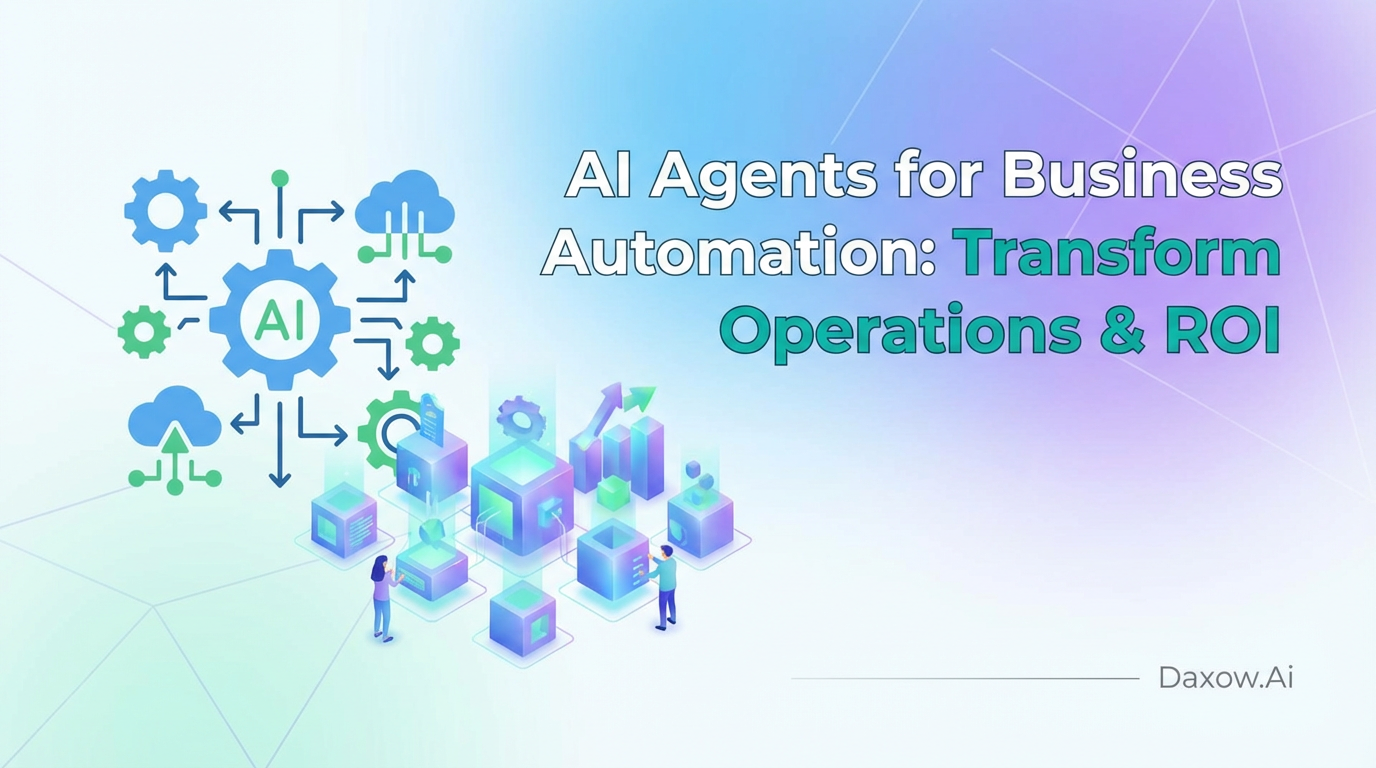
How AI agents enable goal-oriented business automation—integrating with CRM/ERP, cutting processing time and errors, and delivering measurable ROI with a practical roadmap.
AI Agents for Business Automation: Transforming Operations and Driving Growth
Estimated reading time: 15 minutes
Key Takeaways
- AI agents enable goal-oriented, context-aware business automation beyond traditional RPA, improving scalability and accuracy.
- Key capabilities include contextual reasoning, persistent memory, planning, tool integration, and continuous learning.
- Industry-specific use cases demonstrate significant productivity gains, error reductions, and faster processing times.
- A phased implementation roadmap reduces risks and ensures governance and compliance.
- Measuring ROI involves tracking time savings, error rates, throughput, and customer experience metrics.
- Daxow.ai provides custom AI agent design, secure integrations, governance, and ongoing optimization services.
- Risk mitigation and human-centered adoption strategies are essential for successful AI automation deployment.
Table of Contents
- AI Agents for Business Automation: Transforming Operations and Driving Growth
- What AI Agents Mean for Businesses
- Practical Use Cases Across Industries
- How AI Agents Work — Architecture and Integrations
- Implementation Roadmap and Best Practices
- Measuring ROI and Business Impact
- How Daxow.ai Designs and Delivers Custom AI Agent Solutions
- Risks, Governance and Human-Centered Design
AI Agents for Business Automation: Transforming Operations and Driving Growth
AI agents redefine workflow automation by moving from deterministic automation to goal-oriented, context-aware systems. Unlike traditional RPA that replicates clicks and keystrokes, AI agents combine large language models, memory, planning, and tool integration to make decisions and act across systems. The result is end-to-end business automation that delivers continuous, adaptive performance and significantly improves outcomes.
Key capabilities of AI agents:
- Contextual reasoning across documents, CRM records, emails, and databases.
- Persistent memory to maintain state across sessions and touchpoints.
- Planning and orchestration to manage multi-step processes and coordinate multiple agents.
- Tool integration via APIs and secure connectors to CRM, ERP, ticketing, and productivity systems.
- Learning and optimization to reduce exceptions and improve accuracy over time.
Business impacts typically observed:
- Up to 80% reduction in processing time for complex workflows.
- 40+ hours reclaimed per month per function through task automation.
- Error reductions exceeding 90% in reconciliations and data-heavy tasks.
- 6x productivity improvements in re-engineered processes.
What AI Agents Mean for Businesses
AI agents enable organizations to reimagine processes rather than simply automate existing work. They extend human capabilities while taking ownership of repetitive or cognition-heavy tasks.
From Automation to Autonomous Workflows
- Traditional automation executes steps; AI agents set and pursue goals, adapting when inputs change.
- Agents reduce handoffs by executing conditional logic and coordinating across systems.
- Multi-agent architectures allow specialized agents (e.g., intake agent, validation agent, escalation agent) to collaborate on complex workflows.
Operational Benefits Decision-Makers Should Expect
- Scalability: 24/7 handling of volume spikes without incremental headcount.
- Consistency: Standardized outputs and fewer process deviations.
- Faster decisions: Agents surface insights and recommendations from pooled data.
- Improved customer experience: Personalized, timely responses and fewer friction points.
- Employee focus: Teams can concentrate on strategy and exceptions rather than manual tasks.
Practical Use Cases Across Industries
AI agents are industry-agnostic but particularly transformative where high-volume, multi-step, and data-rich processes exist. Below are practical examples and concrete workflows that illustrate business automation and productivity gains.
E-commerce and Retail
Use case: Inventory optimization + omnichannel fulfillment
- Agent tasks: Monitor sales and returns data, predict demand, generate reorder recommendations, update purchase orders in ERP, and coordinate warehouse pick lists.
- Business outcomes: Reduced stockouts, lower carrying costs, and faster order fulfillment.
- Example benefit: Automated demand signals can reduce processing time by up to 80% and reallocate 40+ hours per month per planner to strategic sourcing.
Healthcare
Use case: Patient triage and administrative automation
- Agent tasks: Aggregate electronic health record data, pre-fill forms, verify insurance eligibility, and flag anomalies for clinician review.
- Business outcomes: Fewer administrative errors, faster intake, and improved compliance.
- Risk control: Human oversight for critical decisions and audit trails for regulatory compliance.
Finance
Use case: Reconciliations, fraud detection, and decision support
- Agent tasks: Analyze transaction patterns, match records across systems, flag suspicious items, and prepare exception reports for analysts.
- Business outcomes: Error reductions of 90%+, 40% faster processing, and stronger fraud detection.
- Example: “FinRobot” style agents can dramatically cut manual reconciliation hours, enabling staff to focus on investigations.
Real Estate
Use case: Lead qualification and contract automation
- Agent tasks: Ingest leads from ads and portals, qualify intent via conversational agents, schedule viewings, and auto-generate draft contracts for attorney review.
- Business outcomes: Higher lead-to-tour conversion, shorter sales cycles, and fewer contract revisions.
Human Resources
Use case: Recruitment triage and onboarding
- Agent tasks: Screen resumes against job criteria, schedule interviews, manage offer letters, and track onboarding tasks across systems.
- Business outcomes: Faster time-to-hire, consistent candidate experience, and audit-ready documentation.
How AI Agents Work — Architecture and Integrations
Understanding the technical anatomy helps decision-makers evaluate vendor solutions and integration risk.
Core Components
- LLM-based reasoning: Interprets unstructured inputs and composes human-like outputs and decisions.
- Memory store: Retains context across sessions to reduce repetitive prompts and improve personalization.
- Planner/orchestrator: Converts goals into sequences of actions and coordinates multi-step workflows.
- Connectors and tools: Secure APIs and prebuilt integrations with CRM, ERP, ticketing, and document stores.
- Monitoring and governance: Logging, explainability, and human-in-the-loop controls.
Execution Patterns
- API-first actions: Agents use authenticated APIs to create, update, or query enterprise systems.
- RPA augmentation: In legacy environments where APIs are limited, agents orchestrate RPA for front-end automation.
- Multi-agent orchestration: Specialized agents handle parallel tasks and hand off to human reviewers when necessary.
Implementation Roadmap and Best Practices
A phased, risk-managed approach maximizes return and minimizes disruption. Daxow.ai follows a structured methodology that aligns with these best practices.
Phase 1 — Discovery & Prioritization
- Map processes and score by frequency, error rate, cognitive complexity, and strategic impact.
- Prioritize high-frequency, multi-step processes where agents can replace repetitive decision-making.
Phase 2 — Pilot Design & Platform Selection
- Build a small, measurable pilot that includes integration to core systems.
- Choose platforms with robust connectors, memory, planning modules, and enterprise security controls.
Phase 3 — Pilot Deployment & Validation
- Deploy in a controlled environment with defined KPIs (processing time, error rate, cost per transaction).
- Iterate on prompts, tool workflows, and exception flows with stakeholders.
Phase 4 — Scale, Governance & Continuous Improvement
- Expand incrementally across teams and regions.
- Implement governance: access controls, audit trails, and ethical guidelines.
- Use reinforcement and supervised learning to reduce exceptions over time.
Best practices summary:
- Re-engineer processes — optimize the flow before automating.
- Start small, measure outcomes, then scale.
- Design human-AI handoffs for high-risk decisions.
- Ensure data security and auditability for compliance.
Measuring ROI and Business Impact
Quantifying value is essential for stakeholder buy-in. Use a mix of leading and lagging indicators.
Key Metrics to Track
- Time savings per task and per role (hours/month).
- Error and exception rates before and after deployment.
- Throughput changes (transactions processed per hour/day).
- Cost savings from reduced rework and headcount reallocation.
- Customer metrics: response times, NPS, resolution rates.
Typical ROI Scenarios
- Quick wins: High-volume reconciliations and intake processes can yield 40%–80% reductions in processing time within weeks.
- Mid-term gains: Cross-system orchestration and learning agents reduce exceptions and rework, delivering 6x productivity improvements over months.
- Long-term scale: Organization-wide agent platforms provide continuous optimization and compound value via reduced training costs and improved decision accuracy.
How Daxow.ai Designs and Delivers Custom AI Agent Solutions
Daxow.ai helps businesses convert ambition into production-ready automation. Our approach focuses on measurable results, reliable integrations, and long-term value.
End-to-End Services
- Process analysis and scoring: We identify high-value automation candidates and quantify impact.
- Custom agent design: We architect LLM-driven agents with memory, planning, and secure connectors tailored to your systems.
- Integration and execution: We build API and RPA connectors to your CRM, ERP, ticketing systems, and data stores for seamless execution.
- Governance and compliance: We implement audit trails, role-based access, and ethical guardrails.
- Continuous optimization: Agents are monitored and improved using real-world feedback and performance metrics.
Practical Delivery Examples
- Customer support automation: Daxow built multi-channel agents that triage tickets, propose resolutions, and escalate complex issues — reducing average handle time and improving resolution rates.
- Sales automation: We deployed lead-qualification agents that enrich CRM records, score leads, and automatically schedule meetings — improving salesrep productivity and conversion.
- Finance workflows: Daxow automated reconciliation and AP triage that cut processing time substantially and reduced exception volumes by over 90%.
Integration and Data Connectivity
- We prioritize secure, maintainable integrations with enterprise tools (document repositories, CRM, ERP).
- Our platforms support both API-first and RPA-augmented integrations to handle legacy systems.
- Data mapping, normalization, and lineage are built into every deployment to ensure transparency and auditability.
Risks, Governance and Human-Centered Design
Implementing AI agents requires attention to risk management and employee adoption.
Risk Mitigation
- Maintain human-in-the-loop for high-risk decisions.
- Implement rollback and approval controls for financial or legal actions.
- Regularly audit agent decisions and maintain explainability logs.
Adoption Strategy
- Engage end-users early, incorporate feedback, and provide training.
- Frame agents as productivity tools that reduce manual tasks and improve job satisfaction.
- Monitor usage and iterate on agent behavior to align with team needs.
Frequently Asked Questions
What differentiates AI agents from traditional automation?
AI agents use goal-oriented reasoning, context awareness, and continuous learning, enabling adaptive workflows rather than fixed rule-based steps common to traditional automation.
How secure are integrations with enterprise systems?
Integrations leverage secure APIs, role-based access, and audit trails to ensure compliance and protect sensitive data within enterprise environments.
Can AI agents be customized for industry-specific workflows?
Yes, Daxow.ai specializes in designing custom AI agents tailored with memory, planning, and proprietary connectors suitable for various industries such as finance, healthcare, retail, and more.
What is the typical ROI timeline for deploying AI agents?
Organizations often see quick wins within weeks on high-volume tasks, with continuous productivity gains and scale benefits accruing over months to years as the system evolves.